Wyoming’s governor on Monday let the state’s new $3.9 billion K-12 education plan become law without his signature in a sign of reluctant permission.
Gov. Mark Gordon could, alternatively, have signed the law as a gesture of approval, or vetoed it to reject it.
The chief executive’s biggest concern with the two-year spending package and plan is the “silo” preventing school districts from spending money meant for instructors on other things, like equipment, support staff or administration.
This erodes local governmental entities’ control over their own dealings, Gordon asserted in his letter to state Senate President Bo Biteman on the legislation, which had been labeled as Senate File 81 during the recent lawmaking session.
“For example, if a school loses a roof in the fall of the year, there may not be enough reserves to repair it under all the constraints the Legislature has placed on districts,” wrote Gordon. “I firmly believe the best government is the one closest to the people.”
The silo undermines local flexibility by “hamstringing” things its earmarked grant does not cover, the governor wrote.
He said he fears small schools and districts on the “bubble” of disadvantage will suffer under the new system.
Still, he lauded the work of the legislative Select Recalibration on School Finance, which met multiple times last year and this January to tailor the state’s K-12 spending plan to the educational needs of the current era.
That’s because the bill contemplates what Gordon calls a “well-deserved raise,” from a recommended average of $67,000 a year to $75,863.
Gordon also noted that the committee plans to meet during the interim months between now and the 2027 lawmaking session.
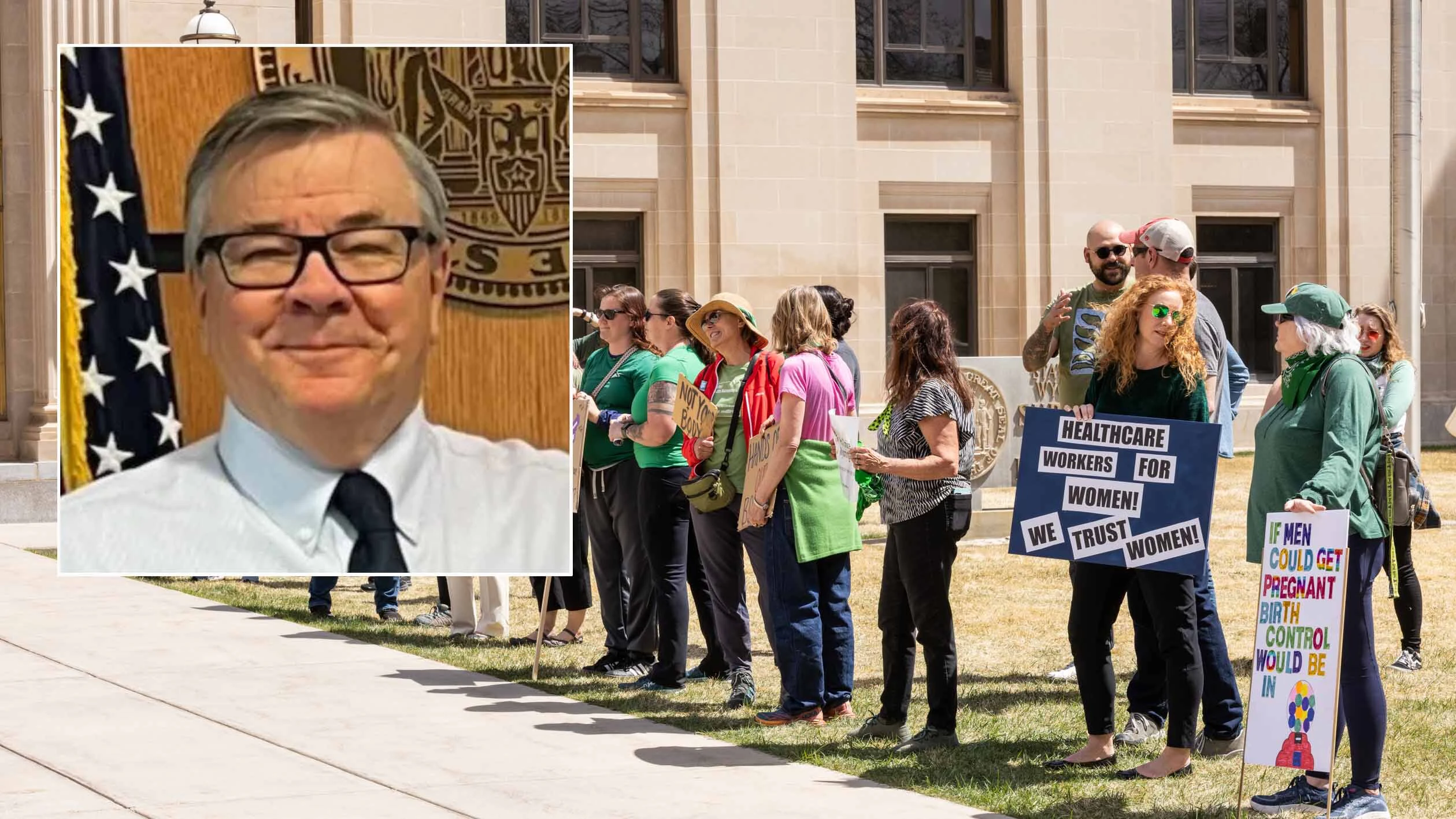
The committee is keeping itself intact so it can consider other education provisions a Cheyenne-based judge ordered it last February to furnish, like a computer for every child, money to fill gaps in student lunches or nutrition, and school resource officers.
That order is paused while the Wyoming Supreme Court weighs the issue.
But multiple lawmakers addressing the effort to “recalibrate” the education plan in recent weeks referenced the pressure the court system still exerts on the issue, with the appeal ongoing.
That’s after decades of Wyoming’s judicial branch dictating to the legislative branch the parameters of the latter’s education spending, due to a clause in the Wyoming Constitution guaranteeing a “complete and uniform” school system, among other educational boons.
The Numbers And Stuff
While rough estimates during the plan’s formation this session had it at $290 million over the prior $3.596 billion plan, the added cost is closer to $275 million, Cowboy State Daily has confirmed. That puts the plan at about $3.871 billion.
Sen. Chris Rothfuss, D-Laramie, was a key architect of the plan this session.
It is uncommon for a Democrat to have inordinate influence in the Wyoming Legislature, which is 91.4% Republican.
Rothfuss acknowledged the oddity with a chuckle during his Friday interview with Cowboy State Daily, and said his influence here was rooted in his experience in education.
“My colleagues have a lot of confidence in my knowledge and understanding of education policy,” he said. “I know they were all looking for a favorable outcome, so I was able to work with all of them to develop that.”
Rothfuss has served in the state Senate for 15 years, including 13 as chamber leadership. He’s been a member of the Senate Education Committee for his entire tenure and participated in two prior attempts at recalibrating the K-12 system.
When the bill passed last week, he called it a "great outcome for Wyoming education" on which he believed the court would look favorably.
Gordon's consternation Monday did not change that.
Rothfuss emphasized in his Monday interview that Wyoming has contingencies in place for school facilities fallout and emergencies. A roof faltering is a "non-issue," he said.
"You'd never take that out of salaries anyway. I don't know where that comes from," he said.
Rothfuss also noted that the instructional silo was the "lynchpin" of compromise between lawmakers, and said without it, the recalibration bill would not have become law. It was a way to ensure teachers received the raises the state recommended.
"I guess it's unfortunate that the governor doesn't see that that was critical to the outcome," he said. "But it's a very good outcome to the state."
In The Sausage
The state Senate on Thursday approved the House’s many changes to the bill.
The House removed from the bill a provision that would have capped superintendents’ compensation at 233% of the average teacher compensation.
It kept and clarified a provision Rothfuss had advanced, letting school districts choose their own insurance programs as they have in the past, but tightening insurance payouts to their actual, rather than recommended, number of employees.
The final version lets schools create an overflow account for teacher funding if they wish, but doesn’t require them to do that.
For the next three years, school districts can’t increase spending on teacher compensation by more than 10% per year. That’s an increase from the Senate’s earlier cap of 5% — and a provision meant to prevent a bidding war between districts as the new teacher raises spark a potential hiring frenzy.
Money to districts will now be rooted in an average daily attendance of the prior two years — or from the prior year, whichever is greater. That’s a metric likely to fluctuate more than the earlier measure, which drew from the greater of a three-year or prior-year average.
This bill recommends an average teacher salary of $75,863 per year, an increase from about $67,000.
The “teacher silo” remains.
Bemoaned by multiple local school district leaders and some lawmakers as rigid, the silo groups wages teachers, paraprofessionals, tutors, paraeducators and instructional aides into one part of the state grant.
Districts won’t be able to pull from that part to fund other things like equipment, administration or support staff.
Sen. Charlie Scott, R-Casper, praised the recalibration committee’s work throughout this session, but lamented the bill’s cost.
Unsuccessfully, Scott had urged the Senate to pare the bill’s spending.
“I lost that argument,” he said Thursday when the Senate voted to adopt the House’s changes. But overall, the bill “is one that is going to work very well. It’s something we needed to do to make our finance system work.”
Scott asked the Senate to adopt the concurrence and thank the recalibration committee members.
The Legislature has not passed a full recalibration bill since 2011.
While many lawmakers see this as a failure, Rothfuss argued from the floor this session that in 2015, the Legislature made a calculated decision not to recalibrate: the school districts didn’t want to see change at that point.
Unpacking The Argument ‘Lost’
The argument Scott “lost” started on Feb. 19, when he told the Senate that the historic investment returns Wyoming enjoyed this year likely won’t recur, and the Legislature should take a more sober look at “the spending in this education area” and whether it’s improving student success.
He said he doesn’t believe it will.
The Legislature this session advanced around $290 in biennium spending to the $3.6 billion K-12 package.
Some districts have prioritized connecting individually with students, which is a key to success, Scott continued. But, he said, other districts priorities are “creating a sports empire, or a bureaucratic empire.”
“I don’t see this (increase) doing anything about that,” he said. “It’s a big enough spending measure there’s some virtues in putting this on the record as to who will be responsible for the future tax increase that I think ultimately will occur if we pass this sort of thing.”
The Country Lawyer’s Concern
Sen. Barry Crago, R-Buffalo, tried without success to remedy what he saw as a defect in the bill that some small schools sitting a great distance from their school district centers may be short teachers under the new model.
Albany, Carbon, Johnson, Natrona and Platte County districts each have “co-located” schools, which are multiple schools grouped into one building.
The bill allows even small districts to enjoy a minimum of 17 teachers rather than a lesser, student-proportionate quantity that may winnow their topics scope.
But small, far-flung schools within larger districts don’t enjoy that same minimum, which Crago called a “hold harmless” feature of this bill’s predecessor.
“They’re going to lose funding for a handful of teachers,” Crago told Cowboy State Daily in a Thursday phone interview.
Ultimately he voted to accept the House’s changes to the recalibration bill, but not without voicing his concerns to the Senate.
Rothfuss told Cowboy State Daily on Friday that as just one member of the recalibration committee, he’s open to vetting Crago’s concern ahead of the 2027 lawmaking session. He said he suspects the whole committee may be too, he said.
Clair McFarland can be reached at clair@cowboystatedaily.com.