
Wyoming may have the geology to produce Olympic-grade curling stones, a Casper geologist told state lawmakers Wednesday. And a state senator with a proclivity for curling wants to take on "those guys in skirts" in Scotland and Wales and end their monopoly on the manufacturing of curling stones.
JoAnn True, who chairs the Wyoming Geological Survey, appeared before the Joint Minerals, Business and Economic Development Committee to present findings that the same mineralogy found in Wales and Scotland — the world's only commercial sources for curling stones — exists in at least three Wyoming granite formations.
The Wyoming Geological Survey posted a paper from Canadian researchers with some mineralogical data, "Indicating that the same mineralogy that exists in Wales and in Scotland, where they source them, also exists in three, at least three, granites in Wyoming," True told the committee.
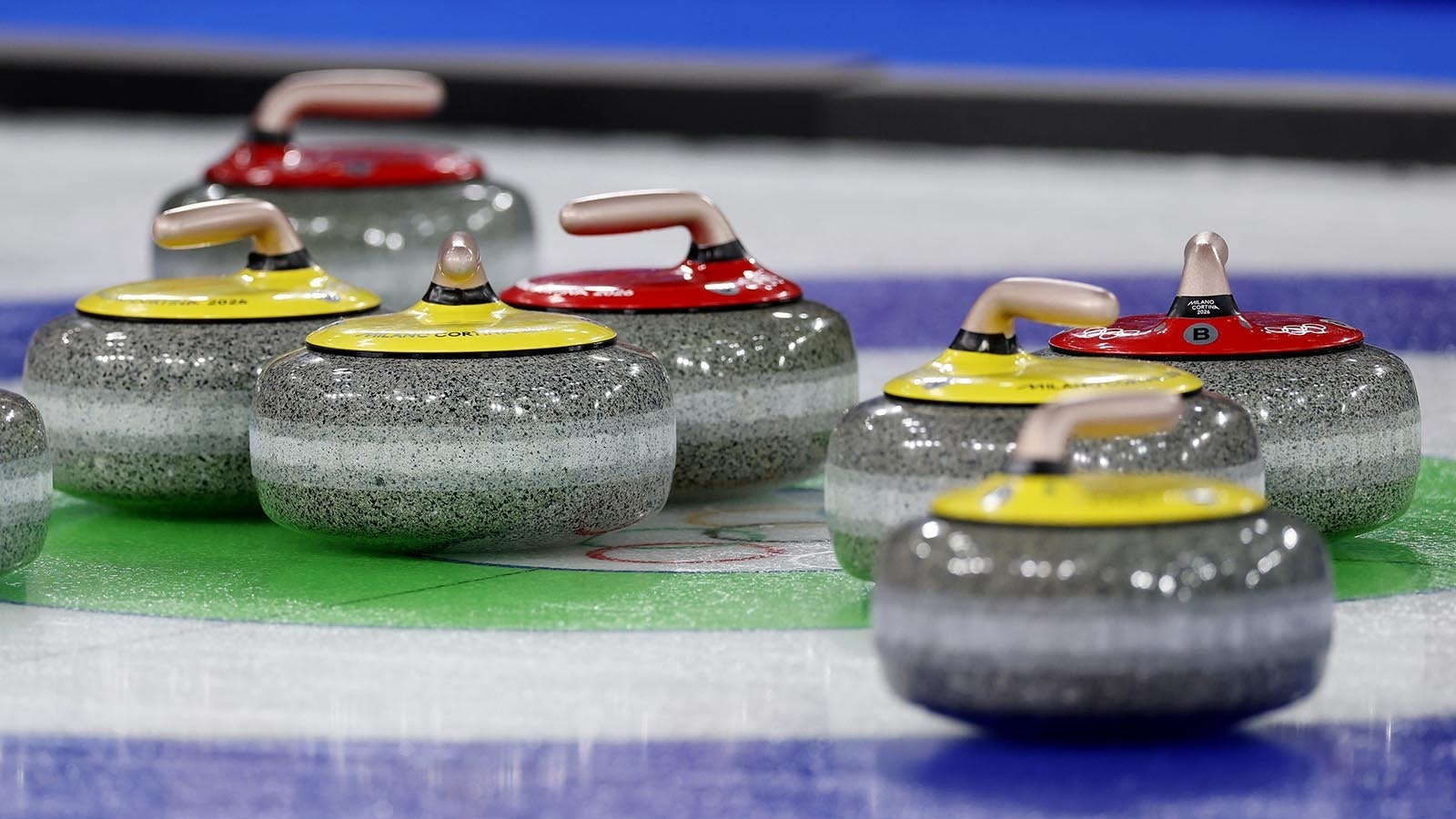
Curling stones require a specific type of dense, fine-grained granite with low water absorption. Those properties allow the stones to glide accurately on ice and withstand thousands of deliveries without cracking or chipping.
Currently, the Ailsa Craig island off the Scottish coast and the Trefor granite quarry in Wales supply nearly all of the world's competitive curling stones.
Olympic regulations mandate that each stone weigh between 17.24 kg (38 pounds) and 19.96 kg (44 pounds), including the handle and bolt. A typical stone is composed of at least two different types of granite sourced from those two remote U.K. locations.
True asked the committee to direct the Wyoming Geological Survey to formally identify where those three Wyoming granite formations reach the surface and could potentially be quarried.
"That would be my request — to work with the geologic survey to indicate potential source locations for this," True said. "I do have the three granites for anyone who wants any sort of technical information where those would outcrop and be potential sources."
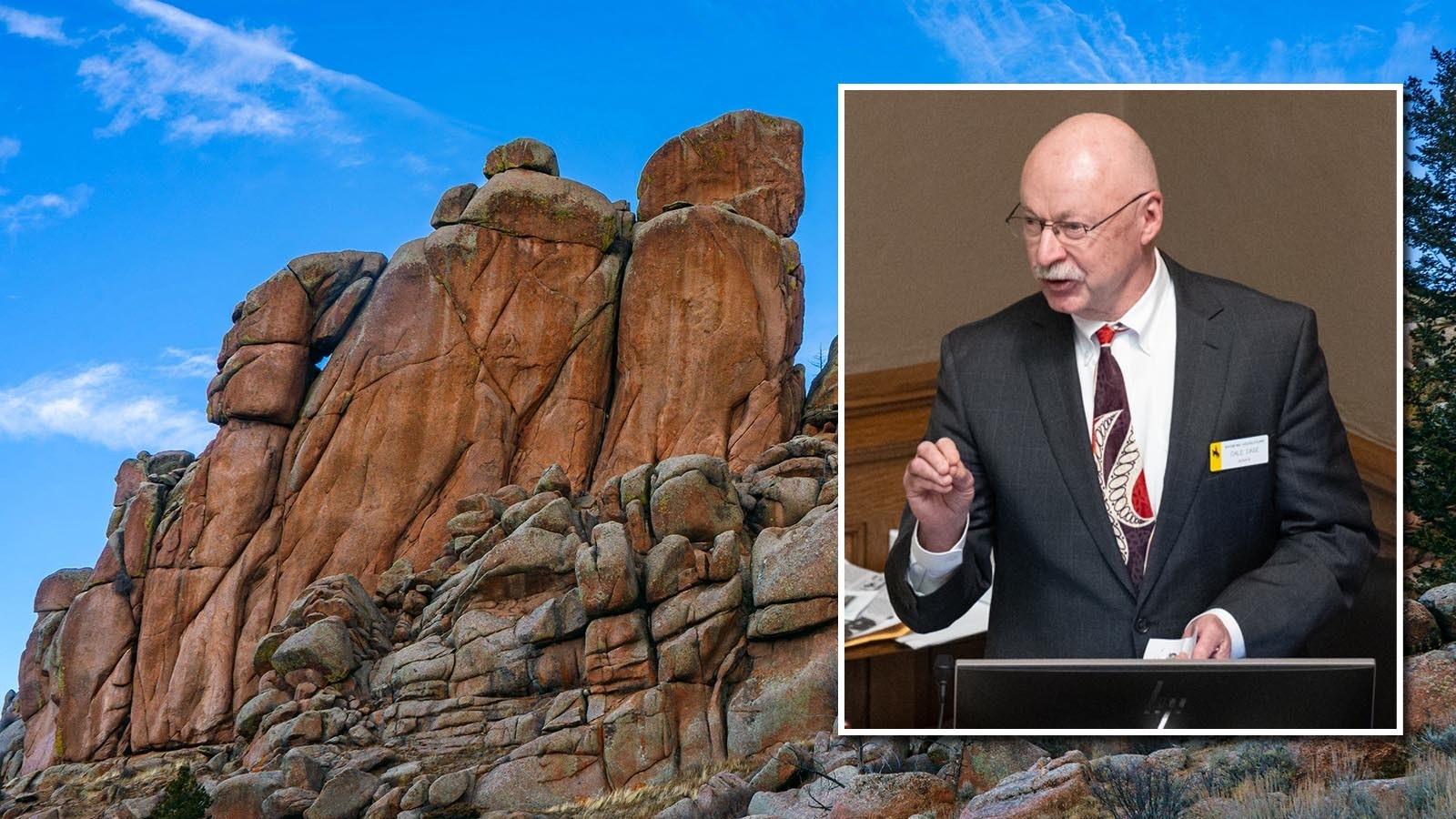
True appeared at the request of Sen. Cale Case, R-Lander, who said his interest in curling goes back to his work building and maintaining the public skating rink and organizing a local curling program.
"That was my job," Case said.
Case's Curling Background
In an email to Cowboy State Daily, Case elaborated on that chapter of his life, saying he built the skating rink on the little league ball field in Lander's City Park using a firehose while working for Lander Parks and Recreation through high school and college.
One year, he said, he dragged out a set of curling stones that hadn't been used since before he started working there, looked up the dimensions and markings, and laid out the first curling "sheet" in some time on a surface adjacent to the ball field.
"The newspaper came up and folks did use the facilities," Case wrote.
"We had a set of curling stones that somebody stole, by the way — but we set up a curling rink, and we had curling in Lander."
Case also reflected on one of the sport's cherished traditions: "broom stacking," the drinking session that takes place among players after matches.
Case said watching the recent Winter Olympics renewed his interest in the sport and prompted him to start asking questions about where curling stones come from and whether Wyoming could produce them. He pointed out to committee members that Wyoming stone was already present in the room — the tops of the legislative desks are made from it.
"Seriously, I suppose you guys didn't know that the tops on our desks came from Wyoming," Case said. "I'm positive that one of the two stones is from Wyoming, and I think both of them are. And it was quite a deal to find a source of stone for our desks and make them different in the two houses and kind of be emblematic of Wyoming."
Case proposed having the University of Wyoming help produce Wyoming's first set of stones, using that as a flagship moment to generate national publicity — and then challenge Scotland directly.
"Supposing we got — maybe go to the university and we ask, get some people involved there to produce the first set of Wyoming curling stones," Case said. "We make a big deal out of it. We have a competition with our Scottish competition. We bring attention to the fact that there's a lot of things in Wyoming that we could do in the dimension stone quarry world that we're not doing."
"But curling stones, people think they're pretty special. And it comes right off of the Olympics — we could get some publicity for maybe trying to push this along and that publicity would be good for Wyoming and we just produced a set and we went head to head with those guys in skirts, senator," Case said.
Sen. Ed Cooper, R-Ten Sleep, saw the potential extending well beyond the ice.
"I think there's a lot more potential for this material than just curling stones," Cooper said.
Case agreed.
"Absolutely. And what we're trying to do is identify it and maybe develop an industry around quarrying that rock," Case said.
Case framed the curling stone idea as the entry point to a broader conversation about Wyoming's dimensional stone quarrying potential — an industry he believes has been overlooked. He suggested involving the Wyoming Business Council and economic development organizations in assessing the opportunity, which he said extends to countertops, building stone and decorative applications.
Case acknowledged the proposal is as much about economic development as it is about the sport.
"This is just a camel's nose under the tent, but it's kind of a fun one," he said. "We might find some folks that would be willing to take the challenge without too much effort or money, and then we could think about really the entire industry downstream potential from quarried, beautiful Wyoming stone."
Mixed Reception
Committee Co-Chairman Sen. Jim Anderson, R-Casper, was skeptical — at least about the sport.
"I'm a little concerned that this senator finds curling to be entertaining," Anderson said.
Case pushed back, citing the sport's Olympic viewership numbers and his own experience watching the Games.
"I think we need to look at the ratings on the Olympics and see how popular it really is, because I think it was pretty popular," he said. "It's a pretty cool sport, really."
"It would bring a lot of publicity to Wyoming because nobody else makes curling stones," Case said. "It's just the beginning."
Committee members were asked to submit their top five interim study priorities by Thursday. Co-chairmen Anderson and Rep. Scott Heiner, R-Green River, will finalize the summer workplan and submit it to the Legislative Service Office. Whether the curling stone topic makes the cut will depend on how members rank it against a long list of competing proposals covering energy, water, economic development and regulatory reform.
Lunch Break Revelation
The chain of events that eventually landed a Casper geologist before a legislative committee began over lunch at the Wyoming State Geological Survey offices in Laramie.
Collin Jensen, a geologist with the Survey, was eating with coworkers one afternoon when curling appeared on the television during their break. The conversation turned to something that apparently had never occurred to any of them before: What exactly makes a curling stone a curling stone?
"We were like, 'Huh, I wonder if there's anything that's special.' You know, they always talk about these curling stones from Scotland and Wales. I wonder if there's anything actually special about it," Jensen told Cowboy State Daily.
So they Googled it.
What they found was a 2022 paper published in the Canadian Mineralogist, authored by Derek D.V. Leung and Andrew M. McDonald. The researchers had used light microscopes, scanning electron microscopes and X-ray diffraction analysis to study the actual mineralogical composition of curling stones used in international competition.
Their conclusion surprised Jensen. The stones weren't strictly granite at all — they were composed of several varieties of igneous rock, including quartz syenite, granodiorite and quartz monzonite. More importantly, the researchers found nothing geologically unique about the rocks from Scotland and Wales.
"It's like, wow, some geologists have actually done a very in-depth study about this already," Jensen said. Jensen turned the findings into a Feb. 9 social media post for the Wyoming State Geological Survey.
The post pointed to three Wyoming formations — the Sherman Granite, the Laramie Anorthosite and the Sage Hen granite — as candidates that could theoretically yield curling stone material comparable to what's currently being mined across the Atlantic.
Jensen said the Granite Mountains in Fremont and Natrona County would be "the obvious place" to look for good curling and described the range as "a possibility" — alongside the Laramie Mountains, the Medicine Bows and the Wind Rivers.
Jensen explained that the key variables identified in the Canadian research were mineral composition and texture — specifically the proportions of feldspar, quartz and other minerals, and the size and consistency of the mineral grains.
Grain size matters for durability. If mineral grains are too large, they can be more easily plucked out during competition, weakening the stone. The Canadian researchers also flagged the importance of unstrained quartz — quartz that hasn't been deformed by heat or pressure — as a marker of structural integrity.
"If the quartz is damaged by these forces, then it can make it weaker," Jensen said.
He cautioned that confirming any Wyoming site's suitability would require fieldwork — physically collecting samples and examining them under a microscope, since rock composition can vary even within a small area. But he said the geological case is legitimate.
A finished curling stone sells for between $600 and $1,500.
According to a February 2026 feature published by discoverbritain.com, Kays Scotland — the sole manufacturer of Olympic-grade curling stones, which has supplied stones for the last six Winter Olympic Games — produces 35 stones per week and currently has 1,500 stones on order.
The company exports 95% of its output to 60 countries worldwide, with growth forecast in the United States and China.
"The rock they have out there is not really special. It can be found in a lot of locations worldwide," Jensen said. "There's no reason why we couldn't find rock similar to this in some of those locations I mentioned in Wyoming for sure."
Jensen, for his part, said he has never curled.
David Madison can be reached at david@cowboystatedaily.com.


