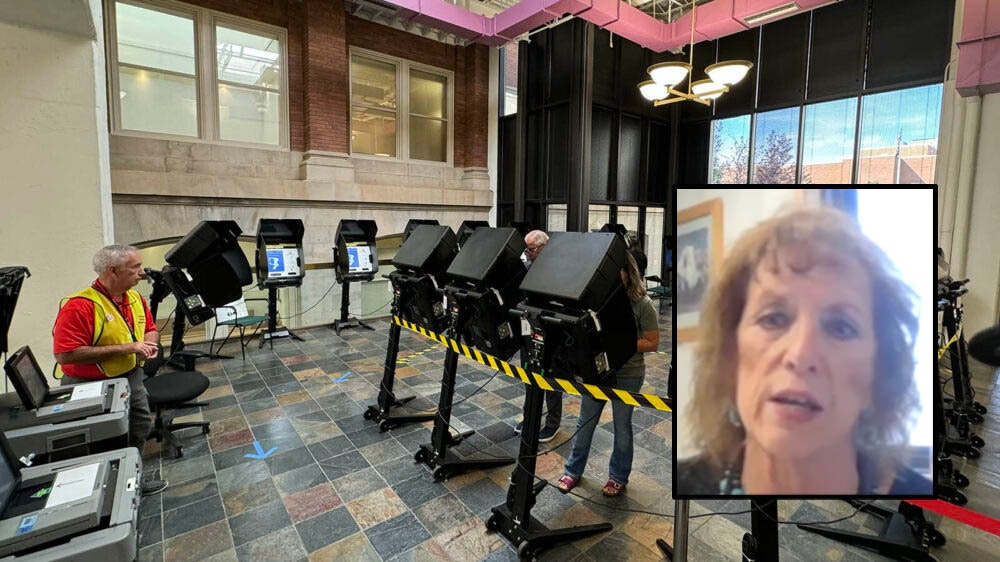
During a conference committee hearing Wednesday on Senate File 28, Fremont County Clerk Julie Freese told lawmakers about a previous public testing of voting equipment in the state where observers crossed a line.
“They had their hands on everything and had stuff with them,” Freese said, without identifying the county.
The account underscored her central argument: that county clerks must retain discretion to control who enters secure election spaces and how many people can be present during mandatory pre-election equipment tests.
In a follow-up interview after the hearing, Freese provided a fuller picture of the incident, which she said was relayed to her by another clerk. The testing had taken place in a room that also contained boxes of county records — a common reality in Wyoming’s smaller courthouses.
“They had boxes of vehicle titles and stuff in there and they noticed people were trying to go through other things in the area while they were trying to do a test,” Freese said.
The clerk in question had to establish new rules on the spot — telling observers what they were there for and what they were not permitted to touch — and found ways to better secure the non-election materials in the room.
Fremont County has a newly constructed election warehouse, which is full of supplies that will be dispatched to polling places.
The thought of unmonitored strangers moving through that space while Freese and her staff run hours-long machine tests is something she takes seriously.
“You’d hate to think that someone would put some device that would detonate later,” Freese told Cowboy State Daily. “I’m not thinking that’s really going to happen in Wyoming, but you have to think of those things of how you secure them (voting machines).”
As county clerk, she said, that building is her responsibility.
“I have a chain of custody on all my stuff,” she said. “And if I have to hire a law enforcement officer to stand there, then I guess that’s what I’ll have to try to do to make sure that nobody else touches my other stuff that I’m responsible for.”
The Bill
SF 28 clarifies the procedure for testing voting machines and electronic voting systems before any election. The bill requires county clerks to post public notice of tests, notify party chairs and independent candidates in writing, and it opens the testing process to public witnesses beyond just partisan representatives.
The bill also resolves a dispute that surfaced in 2024, when some counties refused to retest machines after errors were found — arguing the statute didn’t allow seals to be broken once a test was complete. SF 28 explicitly permits resealing after retesting.
Secretary of State Chuck Gray, whose office championed the legislation, pushed for a middle path between the House and Senate versions on notice periods and crowd size.
“I think we’ve got a nice healthy middle ground,” Gray said.
What The Public Will See
Freese went on to detail what the public would witness at an election machine test. All machines are set out and a “test deck” is run through them — a standardized set of ballots in which every candidate receives a different number of votes, including write-ins, undervotes and overvotes, as required by statute.
“You’re going to run all of these ballots through all of your machines to make sure they work and to make sure that they are counting as the test deck would require them,” Freese said.
For Fremont County’s general election, that meant running roughly 1,860 ballots — individually fed into machines. The DS200 tabulators took a full day. The central count machine used for absentee ballots took about two hours. The county has between 16 and 18 machines to test.
Freese said the Wyoming County Clerks Association is also developing a voluntary method that would let observers mark their own ballots during testing and then hand-count them to see if the results match the machine’s output.
“We have no idea what they’re going to mark,” she said. “Mark their own, put it through the machine, and then go ahead and print out the tape, but then have them hand count their five or six or 10 or however many people are there that want to do that and see if it matches the machine.”
The practice isn’t in statute, she said, but it’s being developed as an optional tool county by county.
Moving Forward
After brief discussion, the conference committee voted to recede to the Senate position on both the notice period and crowd language, restoring the two-day notification window and the clerk-discretion provisions. The motion passed with one dissenting vote.
Rep. Ann Lucas, R-Cheyenne, summed up her support, saying, “I like the language that says not less than three members because it doesn’t limit them to just three. I live in this county, and we’ve had testings where many people appear and there’s a large room and good security and everything is very well ordered and handled. And certainly, we’re not limited to three people. So I’m good.”
Freese said she left Wednesday’s hearing satisfied with where SF 28 landed — and with the session’s overall outcome on election legislation.
“I think the bill passed fine. I think it does clarify some stuff,” she said.
On the broader arc of this session’s election bills, Freese was measured but positive about the ones that made it through.
“I think the ones that did pass will be helpful,” she said, “and I think some of them we did support.”
Now, she said, the focus shifts to making sure every county clerk in Wyoming is implementing the new law — and all existing election law — the same way. The clerks association is meeting in April to finalize uniformity standards.
“The biggest thing is, it is open to the public,” Freese said. “Here’s how you’re going to do your notifications. Make sure you do this — and we’ll just follow the statute and make sure everybody’s doing it similar across the state. I think that’s what’s super important because I’ve heard, well, this county doesn’t allow the public to be in — and we want to make sure that all of us as county clerks are doing the same thing.”