
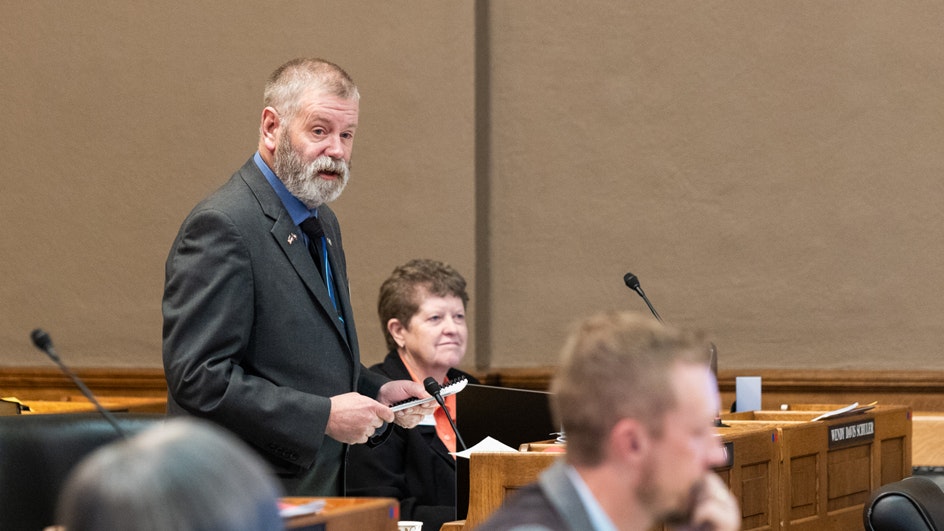
The Wyoming Senate killed a bill to purge sexually explicit books from children’s sections of public libraries Tuesday evening, by ending debate before it could be heard on the last day for first-reading debate.
To resurrect House Bill 10, the Senate would have needed to secure a two-thirds vote to suspend the rules.
Sen. Troy McKeown, R-Gillette, attempted that, asking the chamber on Wednesday afternoon to resurrect the bill.
The Senate rejected McKeown’s motion with 13 lawmakers voting in favor, and 18 against.
But First…
But first, Sen. Larry Hicks, R-Baggs, voiced agreement with McKeown.
“This was a joint committee bill,” noted Hicks. That means a full committee worked on that bill during the interim season between lawmaking sessions.
In the case of HB10, the concepts driving it have been before numerous Wyoming legislative committees each year since at least 2023. It follows years of controversy across Wyoming public and school libraries over sexually explicit content in children’s sections.
Wyoming has also seen multiple lawsuits over who should run certain libraries in the wake of content controversies in Fremont and Campbell counties.
“Let’s at least give the committee the opportunity to explain the work they did in the interim,” said Hicks, in favor of McKeown’s motion.
Sen. Charlie Scott, R-Casper, countered, saying this bill needs work, and he’d like adequate time to amend it rather than rushing it through the final stages of the session.
“It really needs to go back through the process for another year,” said Scott.
How It Happened Tuesday
Before HB 10 and the other bills died Tuesday evening, the Senate recessed for about one hour and 42 minutes during its “committee of the whole,” or full chamber debate on new bills from the House side.
It returned to continue debate, on a list of bills called “general file” which held HB10 and the other nine bills.
Senate Majority Floor Leader Tara Nethercott, R-Cheyenne, asked the Senate to end committee of the whole at around 8:30 p.m.
The Senate majority agreed.
Ending debate was decided on a voice vote: there’s no roll call available to show who favored it and who didn’t.
The move cut off 10 House bills, including HB10 — killing them for the session since Tuesday was the deadline for bills to make it through committee of the whole.
‘And Did Nothing’
Sen. Cheri Steinmetz, R-Torrington, voiced her disappointment with the bill deaths, including that of HB10.
“When the clock runs out, the remaining bills simply die,” said Steinmetz in a Wednesday text message to Cowboy State Daily. “That means several measures Wyoming citizens prioritized – including bills related to Second Amendment protections, protecting children from pornography in libraries, and strengthening parental rights with school boards – never even received a full debate before the deadline.”
Steinmetz called resurrecting one of those bills “unlikely” at this stage, given the broad support and leadership approval those moves require.
Steinmetz in a Tuesday-evening video post to her Facebook page called it a “disappointing night” as “the Majority Floor Leader adjourned us” at about 9 p.m.
She said the Senate “sat on the floor for three hours and did nothing” Tuesday evening. “We could’ve easily processed all of those bills. They could have had a fair debate on the floor.”
Pressure Builds
In response, Nethercott told Cowboy State Daily in a Wednesday-morning text message that toward the end of the session, “pressure builds, deadlines tighten, debates intensify and some legislators carry that strain more than others.”
“These accusations are an unproductive reflection of this time in session,” continued Nethercott.
She said she encourages her colleagues not to consider division “the best way through the stress,” but rather, “focusing on the continued work of the people and remembering why the job matters.”
To Let The House Catch Up
The Senate Majority Floor Leader determines the order of the Committee of the Whole and floor schedule, Senate President Bo Biteman, R-Ranchester, confirmed in his own Wednesday text message to Cowboy State Daily.
Biteman told Cowboy State Daily at the time that he expected the motion to resurrect the bill. When McKeown made his motion hours later, Biteman voted in favor of it.
Biteman on the floor Wednesday answered a question from Sen. Eric Barlow, R-Gillette, about whether the Senate would have had time to hear the bill. The Legislature would have had time, since it's stockpiled extra days, Biteman said.
The reason the Senate recessed Tuesday, Biteman said, was to let the House to catch up with the Senate on Committee of the Whole.
The House reached its Committee of the Whole debate phase later than the Senate did Tuesday. Once it reached that phase, the House worked late and heard every Senate bill on its list.
Mismatch
Sen. Cale Case, R-Lander, was chairing the Senate debate Tuesday.
“That’s her role,” said Case of Nethercott’s scheduling. “She picks the bills to go up — and we stand behind her. That’s why we elected her to do that.”
Case said determining the bill schedule is a tough job: “You have to decide between stuff that’s going to take a lot of time, stuff that’s not; stuff you have to have — a lot of things weigh into that decision.”
Case said as one legislator, he opposed HB 10. He also noted a mismatch between communications from the bill’s opponents and the bill’s proponents — saying the proponents often sent generic form emails from bulk email-generators; while the opponents gave more “thoughtful” comments and explained to him local library book-challenge processes.
He said this issue is best handled by local library boards and communities, and between parents and their own children.
Roll Call
Those voting to resurrect House Bill 10 were:
McKeown, Biteman, Hicks, and Republican Sens. Brian Boner (Douglas), Tim French (Powell), Lynn Hutchings (Cheyenne), Bob Ide (Casper), Stacy Jones (Rock Springs), John Kolb (Rock Springs), Dan Laursen (Powell), Laura Pearson (Kemmerer), Tim Salazar (Riverton), and Cheri Steinmetz (Torrington).
Those voting against its resurrection were Republican Sens. Jim Anderson (Casper), Eric Barlow (Gillette), Evie Brennan (Cheyenne), Ed Cooper (Ten Sleep), Cale Case (Lander), Gary Crum (Laramie), Barry Crago (Buffalo), Dan Dockstader (Afton), Ogden Driskill (Devils Tower), Bill Landen (Casper), Taft Love (Cheyenne), Nethercott, Jared Olsen (Cheyenne), Stephan Pappas (Cheyenne), Wendy Schuler (Evanston), and Scott; plus the chamber’s two Democrats: Sen. Chris Rothfuss of Laramie and Sen. Mike Gierau of Jackson.
The other nine bills that died in the cutoff were:
House Bill 84, an expansion of the law against falsifying election documents; House Bill 52, regarding hand counts for election recounts; House Bill 70, allowing Wyomingites to sue foreign governments for speech infringements; House Bill 95, regarding conceal carry at colleges and universities; House Bill 117, specifying informed consent before abortions; House Bill 127, specifying voter approval for recreation mill levies; House Bill 147, property tax exemptions; House Bill 157, specifying a cause of action for parental rights violation; and House Bill 159, letting people sue school districts in state court for infringements of free speech.
Reader Discretion Is Advised Below
Had it become law, HB10 would define “sexually explicit materials” in graphic and anatomical terms, as describing or depicting specific sex acts.
It would require county libraries to open a materials-challenge process to residents of the county. The challenge process would give the library a chance to send a children’s-section book deemed sexually explicit to the adult section and craft a written decision on the challenge within 60 days.
The bill would give electors of the relevant county a mechanism to sue a library violating that provision, and possibly win damages, costs, fees or other legal remedies.
It would require the libraries that fail to adopt the challenge process to pay $500 for every day they fail to craft it.
It would also have let county governments, but not school districts, opt out from being under the bill’s provisions for public libraries.
On the school-library side, the bill would impose a ban on sexually explicit materials in any area accessible to people under 18 and would provide the same lawsuit and penalty provisions for failure to follow the challenge process or implement it, respectively.
Only electors of the relevant school district could challenge books and sue. And the reviewers of the challenged books under this law would be the school board members — who are typically elected officials — rather than an appointed committee like the kind some districts currently use.
The bill’s definition of sexually explicit materials is as follows:
- Depictions or descriptions of penetration of the male genitalia into the female genitalia or anus;
- Contact between the mouth and genitalia or mouth and anus;
- Contact between the finger, hand or other body part of a person and the genitalia or anus of another person, except in the course of a medical examination;
- Ejaculation onto the person of another;
- The use of artificial sexual organs or substitutes to contact with the genitalia or anus;
- The touching of a person’s own genitals or anus with a finger, hand, artificial sexual organ or other similar device.
For Example
One of the books bill proponent Rep. Ann Lucas, R-Cheyenne, brought to a committee meeting on the bill last week was “Let’s Talk About It!” by Erika Moen and Matthew Nolan.
It generated controversy in 2023, when it was featured in a book display in the Lander Valley High School.
The Fremont County No. 1 school board adopted a tougher challenge policy in response.
The authors of “Let’s Talk About It!” dedicated it, “To whoever needs it, whatever your age.” The book’s topics range from how penises, vaginas and other sex organs function, to how to detect abusive habits in oneself or others.
It gives numerous instructions on sex and masturbation, with cartoon illustrations. Body positivity, respecting someone’s choice of pronouns and staying safe and legal while having sex or viewing pornography are a few other emphases.
The book also posits:
- That the anus is “a primo zone for touching and penetrating” because of its concentration of nerves.
- That erotic relationship types include monogamous, polyamorous, open, casual, and companionate.
- That gender binary is “an obsolete viewpoint.”
- That sexually transmitted infections are “super common,” but the majority are treatable and “if caught early, no biggie.”
- That it's fine to consume pornography of all types as long as it's legal, and as long as it doesn't interfere with one's daily life.
- Sending sexually explicit images through one’s phone is fine as long as the recipient and sender follow all laws, have rules in place, don’t share the photos with others, and edit out their faces and personally identifying characteristics.
The state’s online card catalogue lists eight available copies of “Let’s Talk About It!” not including one more in the Gillette College Library.
Of those eight, the catalogue lists seven of them in young adult or young adult graphic novel sections.
Another one is listed in the fiction area of the Campbell County Public Library.
Clair McFarland can be reached at clair@cowboystatedaily.com.


