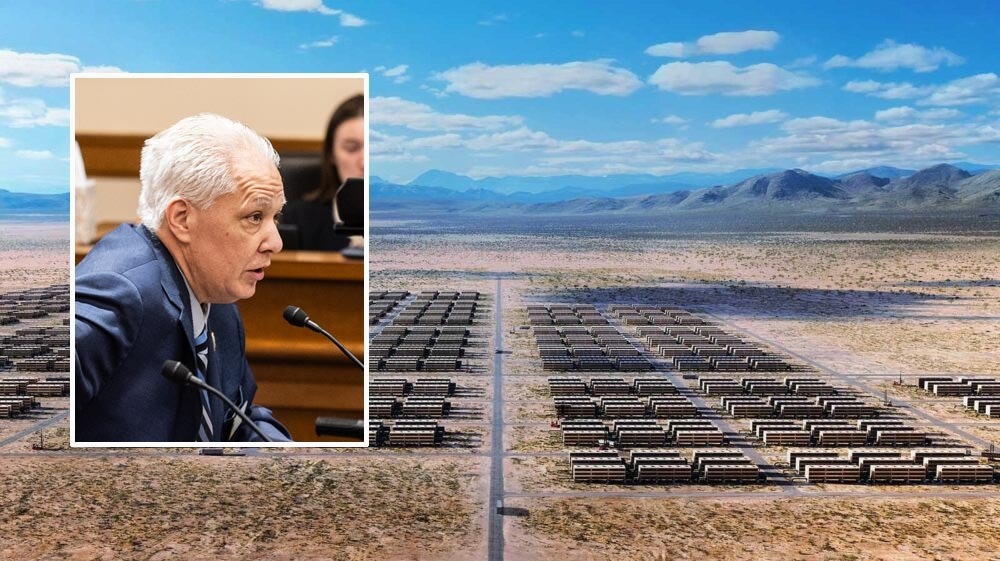
CHEYENNE — Rep. Chris Knapp, R-Gillette, opened Monday’s Senate Minerals, Business and Economic Development Committee hearing with an optimistic pitch to repeal Wyoming’s carbon capture mandate.
“Hopefully today is the day that it gets over the hump,” Knapp told the committee, calling the state’s low-carbon energy standard “the final yoke around our neck for Wyoming, that if we clear that, along with all the changes that have taken place, we can move forward to again be a leader for the country and for Wyoming.”
It didn’t get over the hump.
House Bill 56, which would have repealed the Reliable and Dispatchable Low-Carbon Energy Standards created by House Bill 200 in 2020, died after the hearing ran out of time on the final day for legislation to advance out of committee.
Randall Luthi, Gov. Mark Gordon’s policy director, once again made the case for keeping the carbon capture requirement on the books — a position he has now argued before lawmakers three times within a year.
“What HB 200 — it was not a mandate for low CO2. It was a requirement that utilities would look at carbon capture on coal-fired utilities,” Luthi told the committee Monday.
Luthi walked the committee through the history, pointing back to 2018 and 2019 when regulated utilities announced they were closing coal-fired power plants. House Bill 200 was passed in that context, requiring utilities to at least evaluate the possibility of carbon capture — much like Senate File 159 in 2019 required utilities to attempt to sell a coal plant before closing it.
“I would leave it on the books,” Luthi said of the carbon capture requirement.
Luthi acknowledged the political landscape has shifted, with the Trump administration moving to repeal the EPA’s 2009 “endangerment finding” that declared greenhouse gases dangerous under the Clean Air Act. But he warned that relief may be temporary.
“I would love to tell you we no longer have to worry about that,” said Luthi. “But the reality is we do. Within a week or so, California and other states immediately challenged that decision in court.”
He also noted that more than half of the states that buy Wyoming coal have renewable portfolio standards or similar requirements — state-level standards that won’t change regardless of what happens in Washington.
Summer Debate
The discussion extends back to the Joint Minerals, Business and Economic Development Committee’s July hearing, where lawmakers first rejected a draft bill that would have gutted carbon capture efforts.
At that meeting, Luthi made the case that the carbon capture requirement was producing results, telling the committee, “It is working! Without HB 200, utilities probably would not be analyzing the costs and benefits of carbon capture to extend the life of coal-fired plants.”
Knapp pushed back on the cost burden, arguing at the July hearing, “We continue to charge the end user for something that probably will not pan out in the market. Why not let the free market actually take care of that and get rid of the mandates? It does nothing but add costs to the end user.”
David Bush, state government affairs manager with Black Hills Energy, told the committee last summer that installing carbon capture equipment was not economically feasible.
A study conducted by Cheyenne Light, Fuel and Power found “the estimated capital cost to add amine-based carbon capture equipment to Wygen II was approximately $500 million, potentially increasing customer bills by up to 43%,” according to the PSC’s July report to the Legislature.
“It wasn’t economically feasible to bolt on a carbon capture unit,” Bush said, while also crediting HB 200 with inspiring new research. “Prior to House Bill 200, we are not looking at carbon capture,” Bush said. “Utilities are pretty conservative. R&D is not our business.”
House Vote
When HB 56 reached the Wyoming House floor on Feb. 10, Knapp framed his repeal effort within the broader national movement to roll back energy regulations.
“While the federal government releases the yoke from Wyoming, we have continued to enforce our own,” Knapp told the House. “This bill would get rid of that.”
Rep. Liz Storer, D-Jackson, offered a counterpoint, insisting the economics don’t favor coal regardless of carbon capture policy.
“I’d argue that the cost of burning coal for electricity with or without carbon capture is higher than it is for renewables at this point in time,” Storer said. “So I think Wyoming does have to shift, but it really does have to shift to a much… less carbon-intensive future.”
The House passed HB 56 by a vote of 52-10, sending it to committee.
Committee Path
In the House Minerals Committee on Feb. 11, the bill passed 9-0 with an amendment from Rep. Lloyd Larsen, R-Lander, that grandfathered in carbon capture projects already approved by the Public Service Commission.
Chris Petrie, deputy chairman of the Wyoming Public Service Commission, testified that his agency viewed the carbon capture requirements as “something of a hedge against those unpredictable pendulum swings in federal policy.”
The PSC’s July report to the Legislature recommended “continuing the efforts to establish and implement” the carbon capture standards based on “the anticipated need for reliable and dispatchable generation resources to serve growing demand, and the high probability of continued uncertainty surrounding state, regional, and federal energy policy developments.”
Petrie told the House committee that roughly $5 million has been collected from Wyoming ratepayers through surcharges to fund carbon capture studies and projects — a cost borne exclusively by Wyoming customers. He noted the surcharges have ranged from zero to about 1.4% of customer bills, and that not all of the collected money has been spent.
Market Forces
The debate over whether carbon capture can keep Wyoming coal competitive plays out against a national backdrop where coal continues to lose ground.
A February 2026 briefing from the Institute for Energy Economics and Financial Analysis (IEEFA) examined the decision to stop burning coal at the Springerville, Arizona, coal plant — home to one of the newest units in the country. Three different utility owners all reached the same conclusion: continuing to burn coal was no longer an economic option.
Tucson Electric Power, which owns two of the plant’s four units, noted that the current political environment does not erase coal’s supply and delivery risks, and that cleaner and cheaper alternatives are available.
“The high and uncompetitive cost of coal is not limited to Springerville,” said Dennis Wamsted, IEEFA energy analyst and co-author of the briefing note. “Six units at four plants across the Mountain West stopped burning coal in 2025.”
Lasting Divide
When HB 56 reached Monday’s Senate committee, Knapp argued the time had come to let Wyoming’s energy markets operate without the carbon capture requirement, pointing to what he described as a changed landscape — from the new federal administration’s posture on fossil fuels to utilities restructuring to separate customers in politically red states from those in blue states.
“Utility companies have started to realize it is better to peel off culturally different customers so that Washington state, Oregon, California can be one set of consumers. Utah, Wyoming, Idaho can be considered another set of consumers, each with different ideologies, each with advancements that they want to do in fossil fuels,” said Knapp.
Luthi countered that the requirement remains a strategic tool for an uncertain future, noting that coal-fired power plants extending their closure deadlines is “fantastic news” — and that carbon capture could open markets for captured CO2 in enhanced oil recovery.
“What a great opportunity I think it would be if coal-fired power plants could now become a part of that,” Luthi said.
But the clock, not the votes, decided the bill’s fate. With time expired on the final day for legislation to advance, the chairman tabled HB 56, ending the effort for this session and setting the stage for the debate to continue.
David Madison can be reached at david@cowboystatedaily.com.