If Wyomingites want to see the only total lunar eclipse of 2026, they’ll need to set their alarms in time to be awake by 4 a.m. Tuesday.
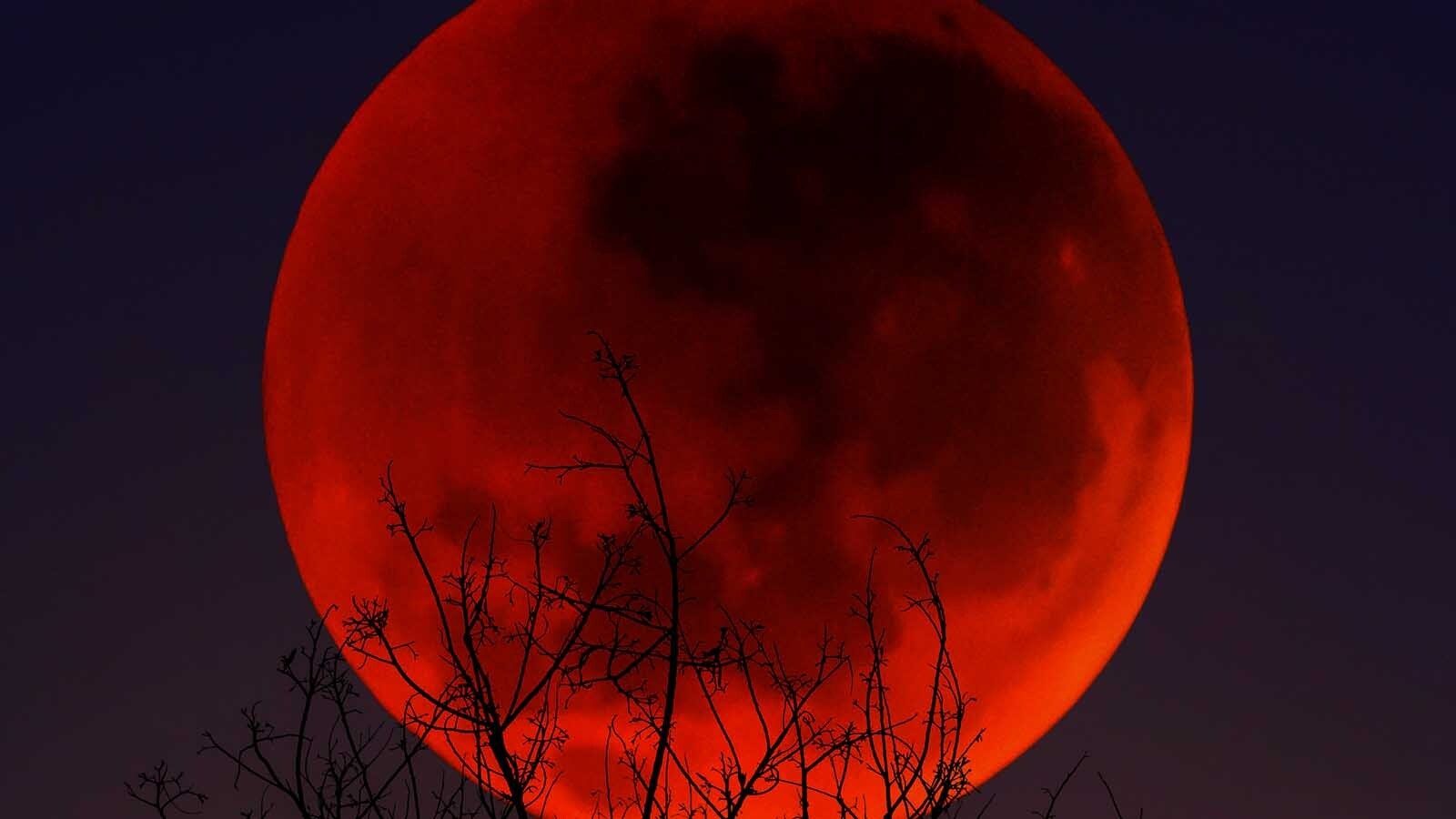
The Earth’s shadow will full cover the month, turning the March full moon — aka the worm moon — blood-red a few hours before sunrise on March 3.
It’s almost a year to the day since the last total lunar eclipse in Wyoming of March 5, 2025.
Anyone who sleeps in will miss it all. The moon will set shortly before sunrise and before the eclipse is over.
“If you’re in eastern Wyoming, sunrise is around 6:15 a.m.,” said Max Gilbraith, planetarium coordinator at the University of Wyoming. “The moon will set before then, which means it’ll set before the eclipse is even finished.”
Blood Moon Morning
A lunar eclipse happens when the moon’s orbit aligns with the Earth and the sun. When the Earth moves in front of the sun, it casts its shadow on the moon.
The blood-red color is the result of the sun’s light being filtered through Earth’s atmosphere. High-wavelength colors, like blue and green, are scattered before they reach the moon’s surface, leaving only a deep red behind.
Unlike solar eclipses, lunar eclipses can last for hours and are safe to look at with the naked eye. However, its duration won’t make this lunar eclipse any easier to see without an early-morning wake-up call.
“There are multiple stages to the shadow,” Gilbraith said. “The penumbral eclipse, which is the partial shadow, should start at just about 3 a.m., and we’ll get the full shadow around 4 a.m.”
According to NASA, the lunar eclipse will reach totality at 4:04 a.m. MST. That’s when the moon will be fully covered by the Earth’s umbra, the astronomical term for the darkest part of its shadow.
Totality will end by 5:03 a.m., giving astronomy enthusiasts nearly a full hour to see the “blood moon.” The last of Earth’s shadow will be gone by 8:23 a.m., long after the moon will have set over Wyoming.
“It’s not an ideal viewing opportunity,” Gilbraith said. “I’m sure many proud ranchers will catch the tail end of it, and folks in Hawaii will get to see the whole thing at a more convenient time.”
Worm Moon
The full moon of every month has a name.
April’s is the pink/Paschal moon, June’s is the strawberry moon, and August’s is the sturgeon moon.
March’s full moon is called the worm moon. It originates from indigenous traditions, as it was the last full moon of winter, a sign that worm trails would soon appear on the ground.
If that name sounds a little slimy, it’s actually one of the better options.
According to Royal Museums Greenwich, March’s full moon has also been called the chaste moon, the crust coon, and the death moon.
None of that will matter when it comes to Tuesday morning’s eclipse, even if early risers feel like death when they step outside to see it.
The moon will rise and set just as it always does, although Gilbraith said it will still be fairly high in the sky at totality.
“Spring is just around the corner, but the moon actually gets quite high at this time of year,” he said. “It’ll reach its highest point in the sky, 55 degrees, when it’s due south.”
When the eclipse reaches totality over Wyoming at 4:03 a.m., Gilbraith said the moon will be around 30 degrees off the horizon. That’s high enough for a good view, providing you’re willing to wake up for it.
And you might want to.
Total Eclipse Of The Snow (Moon)
The Earth experiences about two lunar eclipses per year, but total lunar eclipses only happen about once every 2.5 years. Gilbraith said Wyoming won’t see another total lunar eclipse until February 2027, when that month's snow moon will be fully covered by Earth’s umbra.
Many planets don’t experience any lunar eclipses. Astronomers have noted that Earth is the only planet in the solar system with an umbra large enough to completely cover its moon.
Planets like Jupiter and Saturn are much larger than Earth and have many smaller moons. Because they’re so far from the sun, their shadows aren’t large enough for total lunar eclipses.
Wyoming got one of the best views of a total solar eclipse in August 2017. That was also the second-busiest August in Yellowstone National Park’s history, with 915,000 visitors.
There’s not much point in planning for Wyoming’s next total solar eclipse. It’ll only be visible for a few minutes over Evanston on July 3, 2084.
Lunar eclipses are more frequent, but they don’t happen every day or night.
Gilbraith encourages people to get outside and experience Wyoming’s dark skies at every opportunity, but Tuesday morning’s lunar eclipse is worth the early morning wakeup, he said.
“If you don’t want to wait another 13 months for the next lunar eclipse, set your alarms for this one,” he said.
Andrew Rossi can be reached at arossi@cowboystatedaily.com.