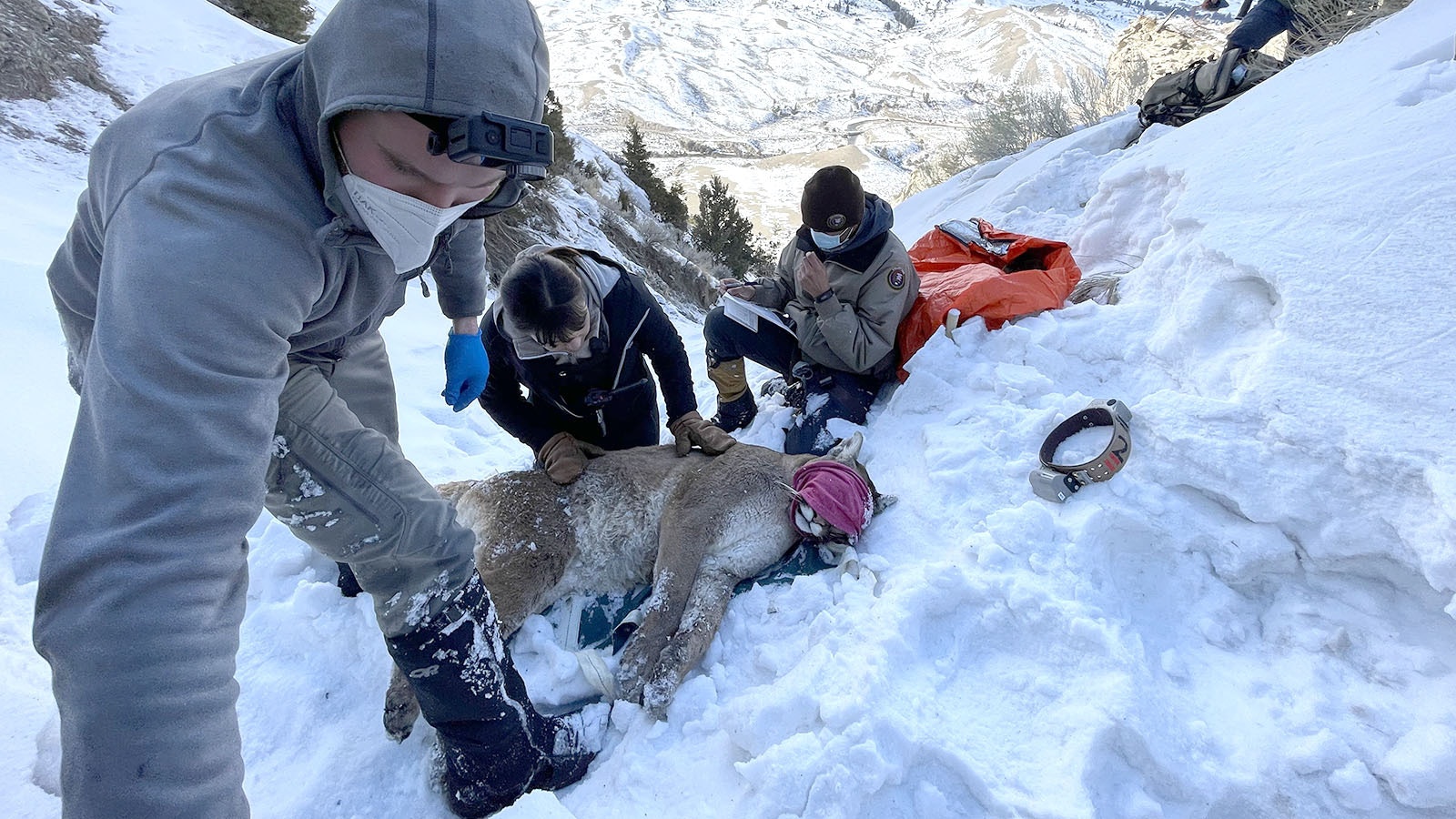
Faced with the quandary of how to get mountain lions out of trees for scientific analysis, researchers dosed them with ketamine, then climbed up to place harnesses on the still-conscious cats.
Wesley Binder, a doctoral student at Oregon State University, told Cowboy State Daily that he was a little nervous the first few times he did it.
“It’s definitely a little wild. And the first few times I did that, it was intimidating," said Binder, who studied interactions between wolves and mountain lions in the northern Yellowstone National Park.
“I’m up there thinking, ‘Oh, I hope this drug is working,’” he said.
After Binder got a mountain lion secured in a harness, it would be lowered gently to the ground another sedative was administered to knock it out for the hands-on study.
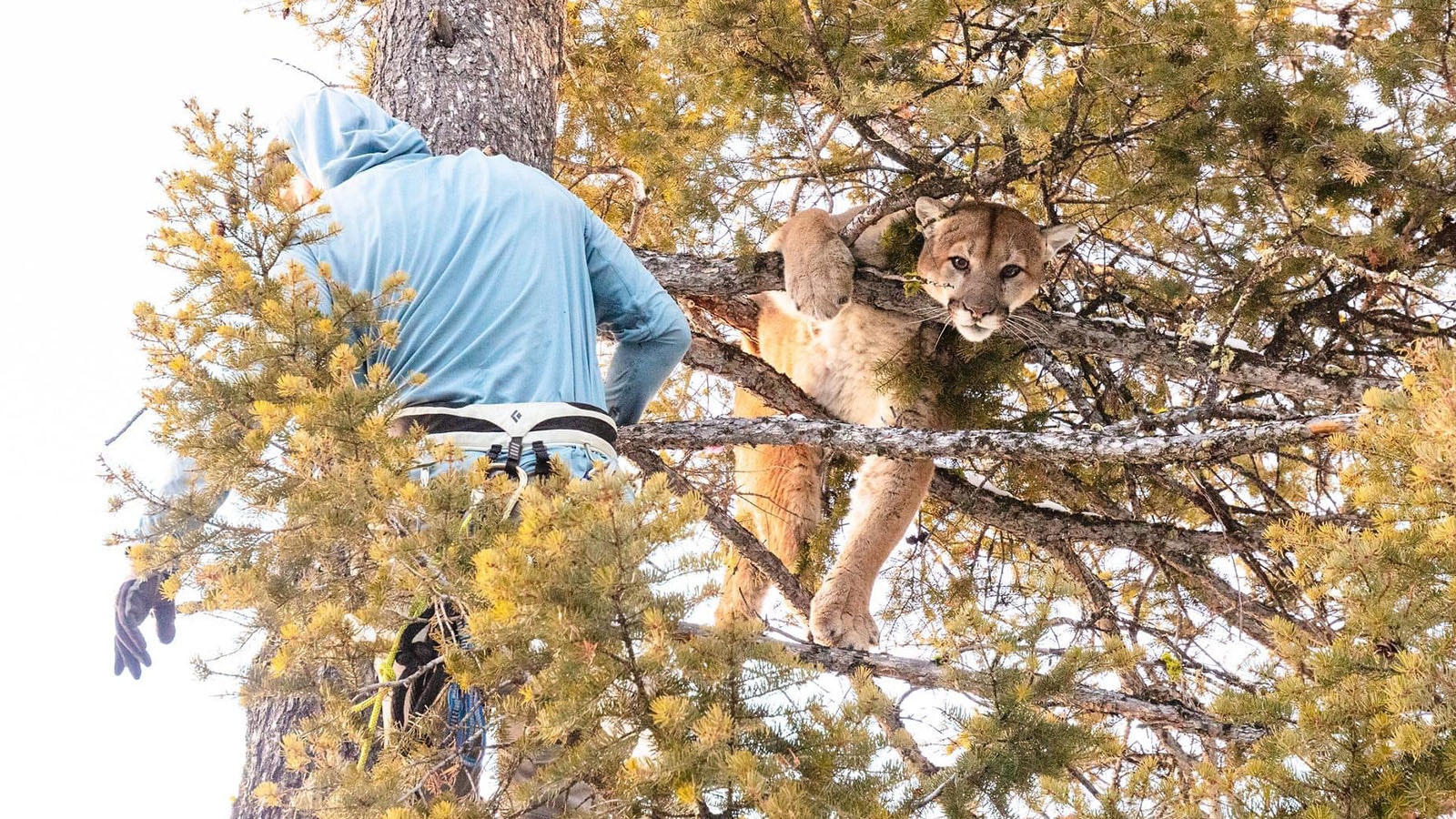
Mountain lion researcher Wesley Binder climbed into trees to put harnesses on mountain lions that were sedated with ketamine, but still wide awake. The harnessed mountain lions were lowered to the ground for examinations during research in Yellowstone National Park. (Courtesy Wesley Binder) 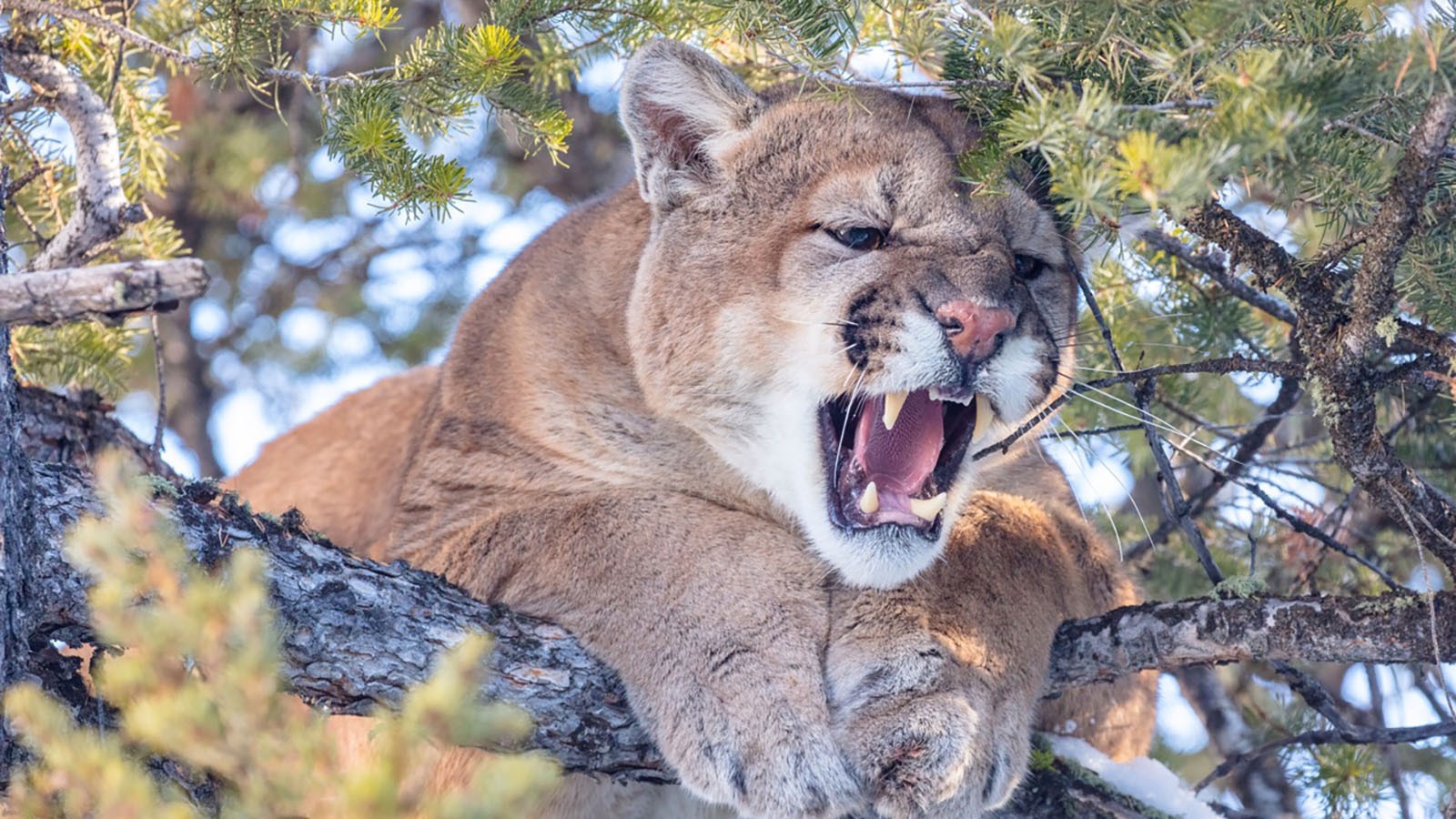
During a research project in Yellowstone National Park, mountain lions treed by hounds were given ketamine to sedate them but were still awake as they were put into harnesses and lowered to the ground. (Courtesy Wesley Binder) 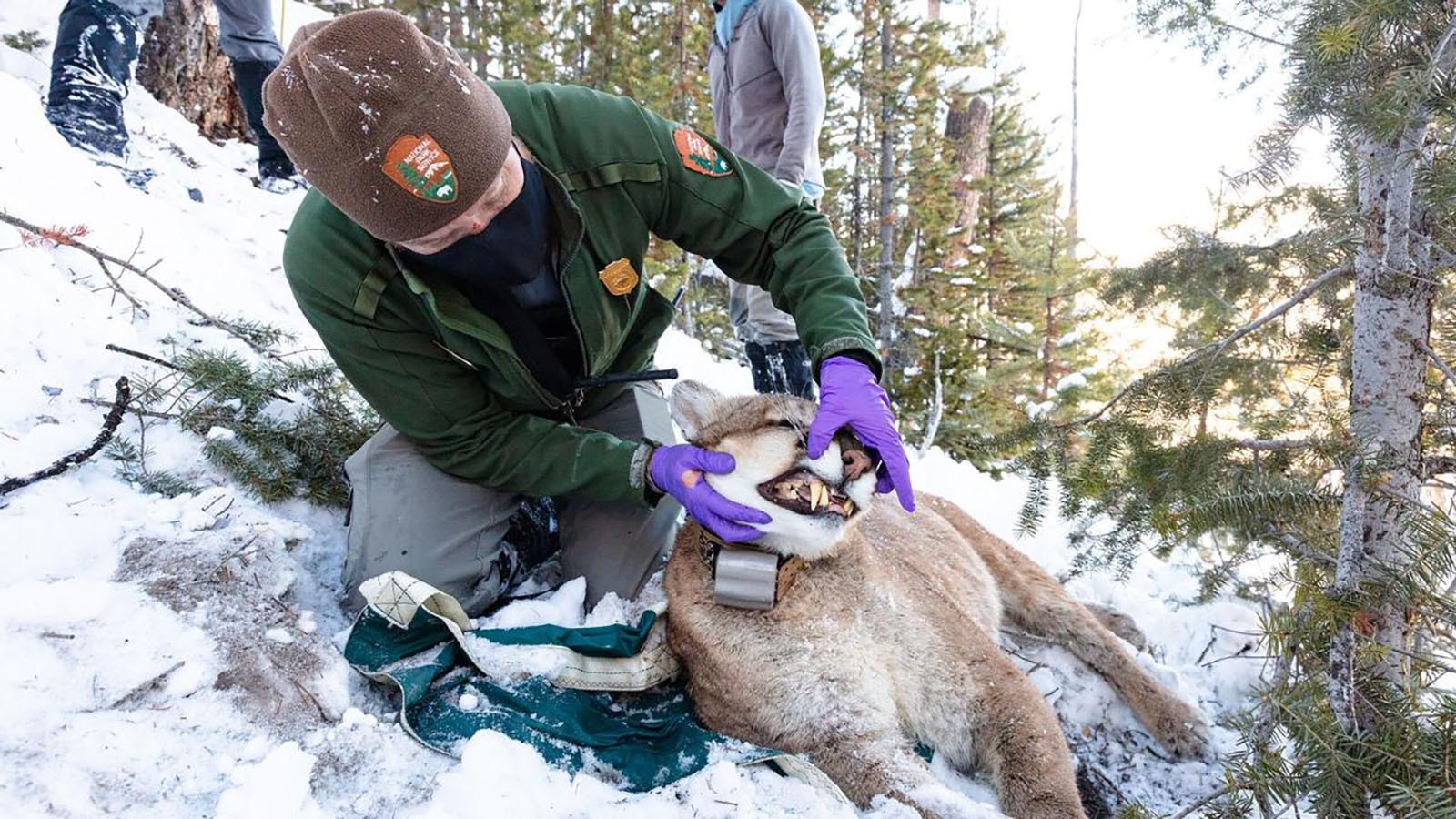
Dosing mountain lions with ketamine made it possible for researchers to capture them for deep-dive studies into how mountain lions and wolves interact in Yellowstone National Park. (Jacob W. Frank, National Park Service)
A Balancing Act
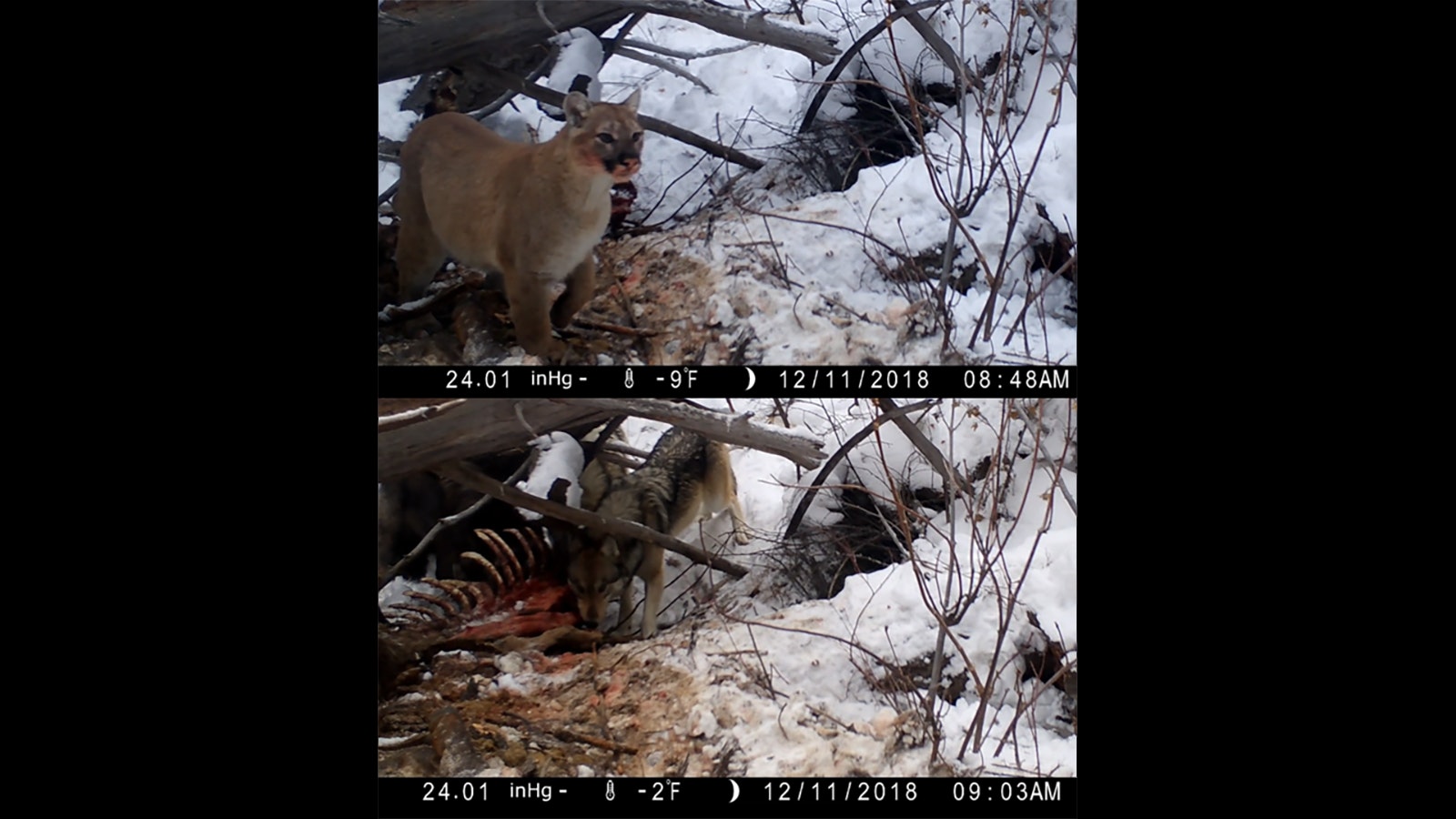
The study that Binder is involved in sheds light on how wolves and mountain lions might have reached a tenuous balance in Yellowstone.
They’re rival species. They compete for food and sometimes even fight and kill one another.
But they also have learned to adapt to one another. Evidence suggests that in the northern end of Yellowstone, mountain lions have started eating more mule deer, while wolves continue to dine on elk.
“Some people have suggested that if cougars respond to wolves by using more mountainous habitat, that a bit more rugged, that habitat might be better suited for mule deer, Binder said.
There are also fewer elk to go around than there were when the northern Yellowstone herd peaked in the 1990s, about the time that wolves were reintroduced to the park.
“I think the big thing that’s driving the change in diet in North Yellowstone is the changes in the elk herd,” he said.
An increase in the number of carnivores consuming elk might have been a factor. Along with mountain lions and wolves, black bears and grizzlies wanted their share of elk meat.
However, other factors have been at play, such as drought, and pressure from people hunting elk north of Yellowstone, Binder said.
The herd also seems to have stabilized, holding at about 8,000 elk for roughly a decade, he said.
And the wolves and mountain lions have carved out their respective places in the ecological order, Binder added.
“About the last 10 years have been stable for wolves, mountain lions and elk,” he said.
Different Hunting Styles
When it comes to killing prey, mountain lions are efficient, Binder said.
An adult mountain lion at the top of its game can kill about one big game animal per week, he said.
“Obviously, that seems like a lot of food for a mountain lion. But they lose so much of it to scavengers, including wolves,” he said.
Mountain lions and wolves use different hunting tactics. Mountain lions hunt alone and rely on stealth and ambush tactics.
“I think in general, these cougars getting about 10 yards away from the animal they’re hunting before they start running” in for the kill, Binder said.
They go for the neck, usually clamping down on a hapless deer or elk’s neck to deal death by suffocation.
Wolves on the other hand hunt as a pack and will start a group of prey animals running, “so that they can detect old, weak or sick” animals to target, Binder said.
Chasing Cats Up Trees
To capture mountain lions for the study, the research team brought in a houndsman, a hunter who runs packs of trained hounds after mountain lions.
The hounds live to do one thing: Chase mountain lions and run them up trees.
However, not every tree a big cat climbed was suitable for the dicey part; hitting it with a ketamine dart so Binder could climb up after it.
If the hounds ran a mountain lion up a tree that wasn’t suitable, “sometimes we’d throw snowballs or sticks at it,” to coax it into climbing back down and running from the hounds again, he said.
“On average, we ran each cat up three or four trees” before finding the right one, Binder added.
Why Ketamine?
He said ketamine is the drug of choice, because as a dissociative anesthetic,” it puts mountain lions out of it, but leaves some of their essential physical abilities intact.
“When you’re dealing with a cat up a tree, you want to be able to safely handle them, but you don’t want them to fall out,” Binder said.
On ketamine, “they don’t really know what’s going on, but they still can hang on. You can see them bobbing their heads, but they’re holding on,” he said.
Robert Crabtree, the founder, chief scientist and president of the Yellowstone Ecological Research Center, said ketamine has long been used as a wildlife sedative.
“I probably used it a couple thousand times, on several species,” he said.
Some of those include coyotes, skunks, foxes, lynx and bobcats.
Getting the dosage right is important, Crabtree said. And he always wondered what was going through the critter’s minds.
“They’re aware of what’s going on, and they might be having psychedelic , psychotic, paranoid experiences, from what he can tell from human experiences,” he said.
For humans, ketamine is used as a surgical anesthetic and is being researched for possible low-dose treatment of anxiety and depression.
It’s also sometimes illegally sold as a street drug.
It’s important to keep an eye on an animal that’s coming down off ketamine, because they can “cycle back” into a drug trip, Crabtree said.
“I once watched a coyote get the jitters” as it cycled back near some water, he said.
“It just about fell into the water and drowned,” he said.
Mark Heinz can be reached at mark@cowboystatedaily.com.