The license plate of a vehicle involved in a carjacking in Broomfield, Colorado, turned up in Cheyenne last weekend.
Police there had put the license plate of the vehicle in question into the National Crime Information Center (NCIC) database. A Flock camera in Cheyenne picked up the license plate number with its automated plate recognition software.
According to Cheyene Police Department spokesperson Alex Farkas, police officers responded to the location of the initial plate hit, but were unable to find the vehicle. They remained in the vicinity, anticipating another alert from the Flock camera system.
That alert came a few hours later when another Flock camera detected the stolen vehicle.
Officers located the vehicle and arrested a Cheyenne man on suspicion of felony motor vehicle theft and possession of methamphetamine.
Farkas said the Flock system provided timely plate detection alerts, allowing officers to quickly locate the vehicle and take the suspect into custody.
While they've proven helpful for law enforcement, a growing number of people are raising privacy concerns about whether the cameras go too far in monitoring law-abiding citizens.
A petition organized by the Laramie County Democrats wants the cameras removed, calling the surveillance system a "digital dragnet that monitors thousands of innocent Cheyenne residents every day to catch a handful of criminals.”
Ted Hanlon, chairman of the Laramie County Democrats, presented the petition to the Cheyenne City Council this week.
The petition had 779 signatures between Dec. 29, 2025, and Feb. 22, 2026.
The petition and dialogue surrounding the Flock cameras highlights rising public concern about the cameras’ technology and the potential for privacy overreach.
“I assume all of us are concerned about surveillance,” said Cheyenne City Council Member Pete Laybourne during the meeting after Hanlon read the petition into the record. “But when you don’t trust and when you don’t believe the facts of our police department, that is a big problem.”
Laybourne encouraged Hanlon and anyone who signed the petition to attend an upcoming meeting at the Public Safety Center Auditorium, where he said the Cheyenne Police Department will provide a complete explanation of what the cameras do and the history behind them.
Farkas told Cowboy State Daily that meeting is being planned, but no date has been set yet.
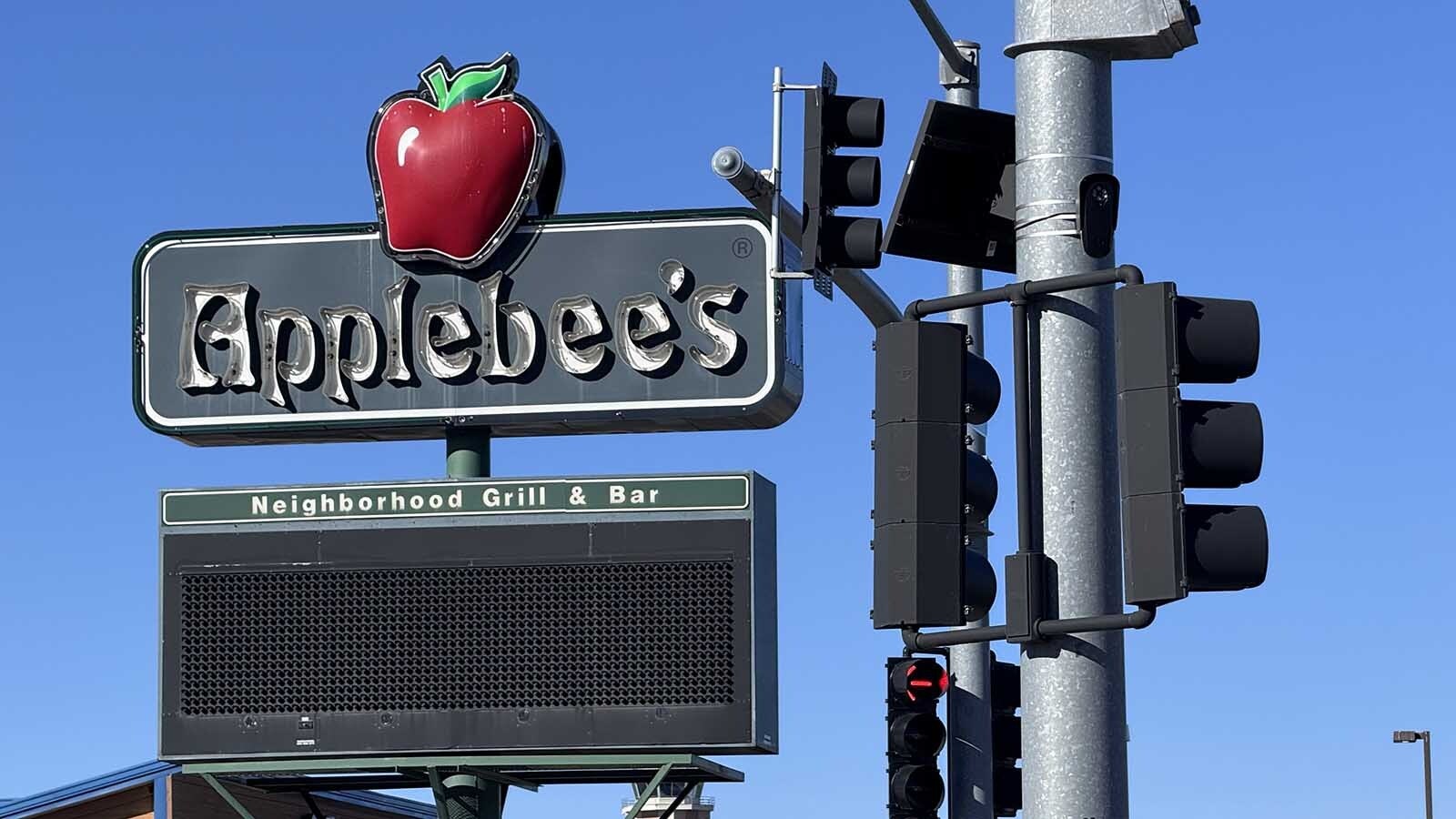
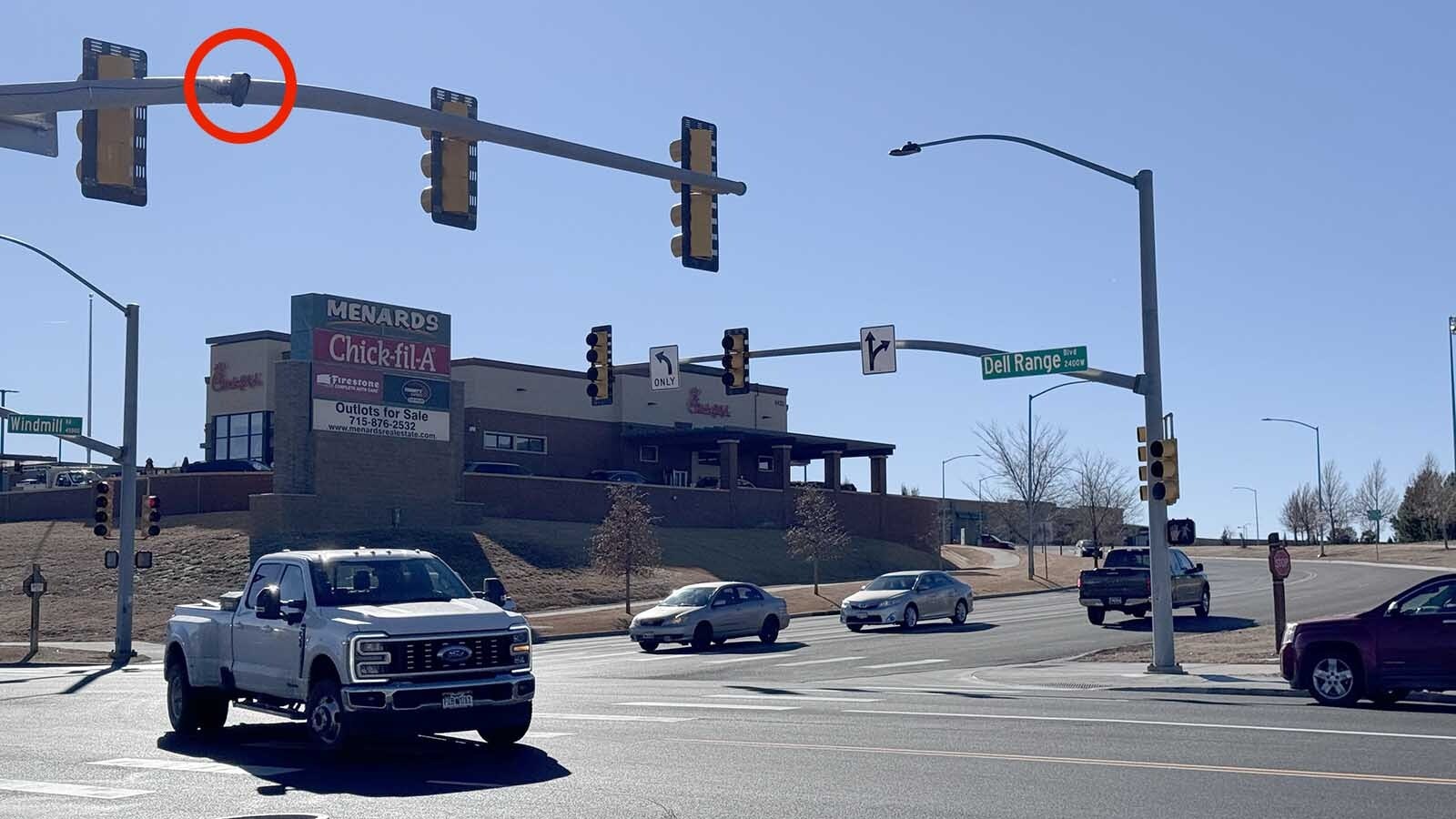
A petition has hundreds of signatures calling for Cheyenne to remove is Flock license plate cameras because they invade privacy. The city's police department says the 23 cameras are solving cases and catching criminals. The Flock camera at Del Range Boulevard and Stillwater Avenue across from Frontier Mall is strapped just above the traffic lights on this pole. (Greg Johnson, Cowboy State Daily) 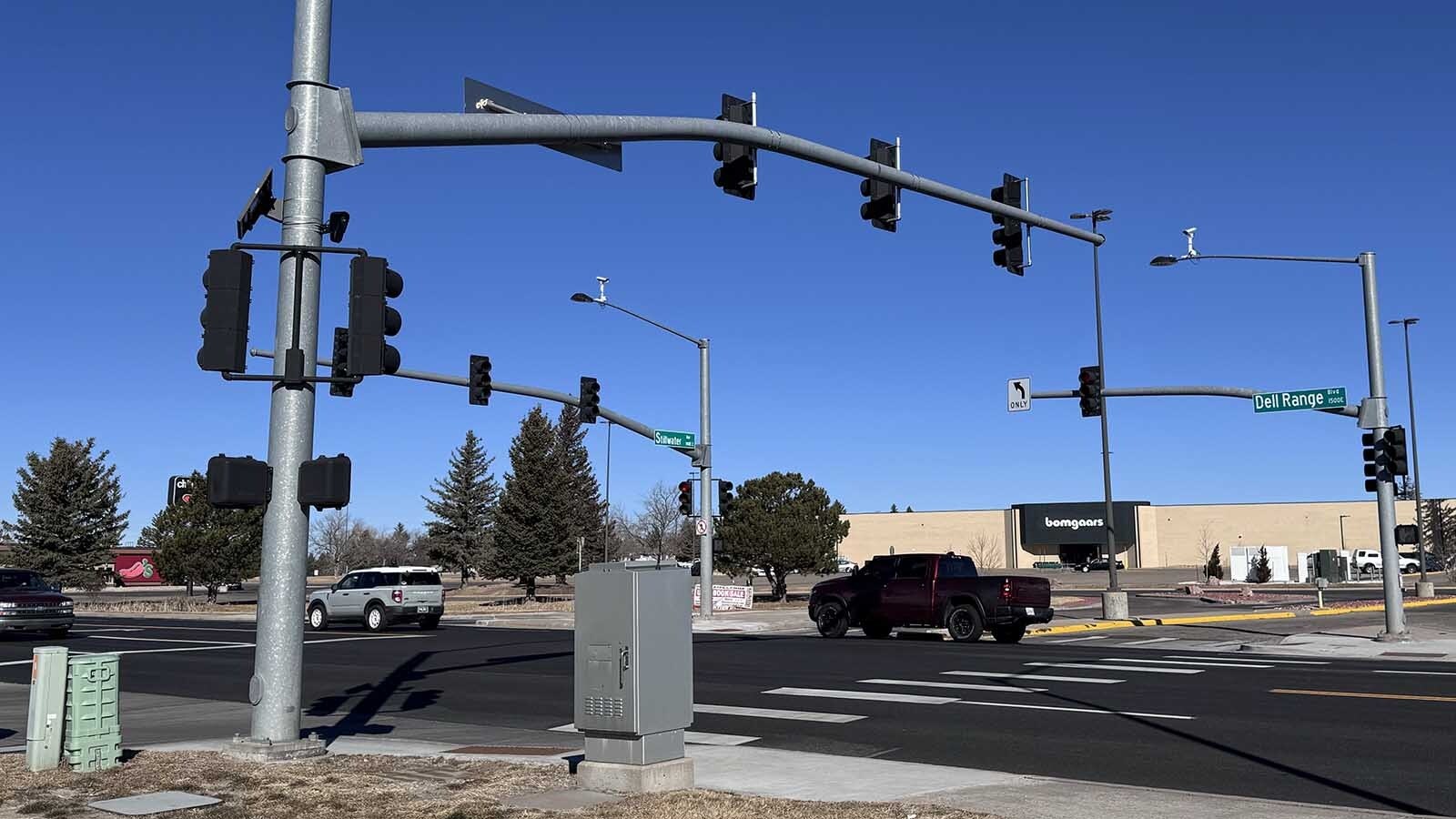
A petition has hundreds of signatures calling for Cheyenne to remove is Flock license plate cameras because they invade privacy. The city's police department says the 23 cameras are solving cases and catching criminals. This intersection at Del Range Boulevard and Stillwater Avenue has a Flock camera. (Greg Johnson, Cowboy State Daily) 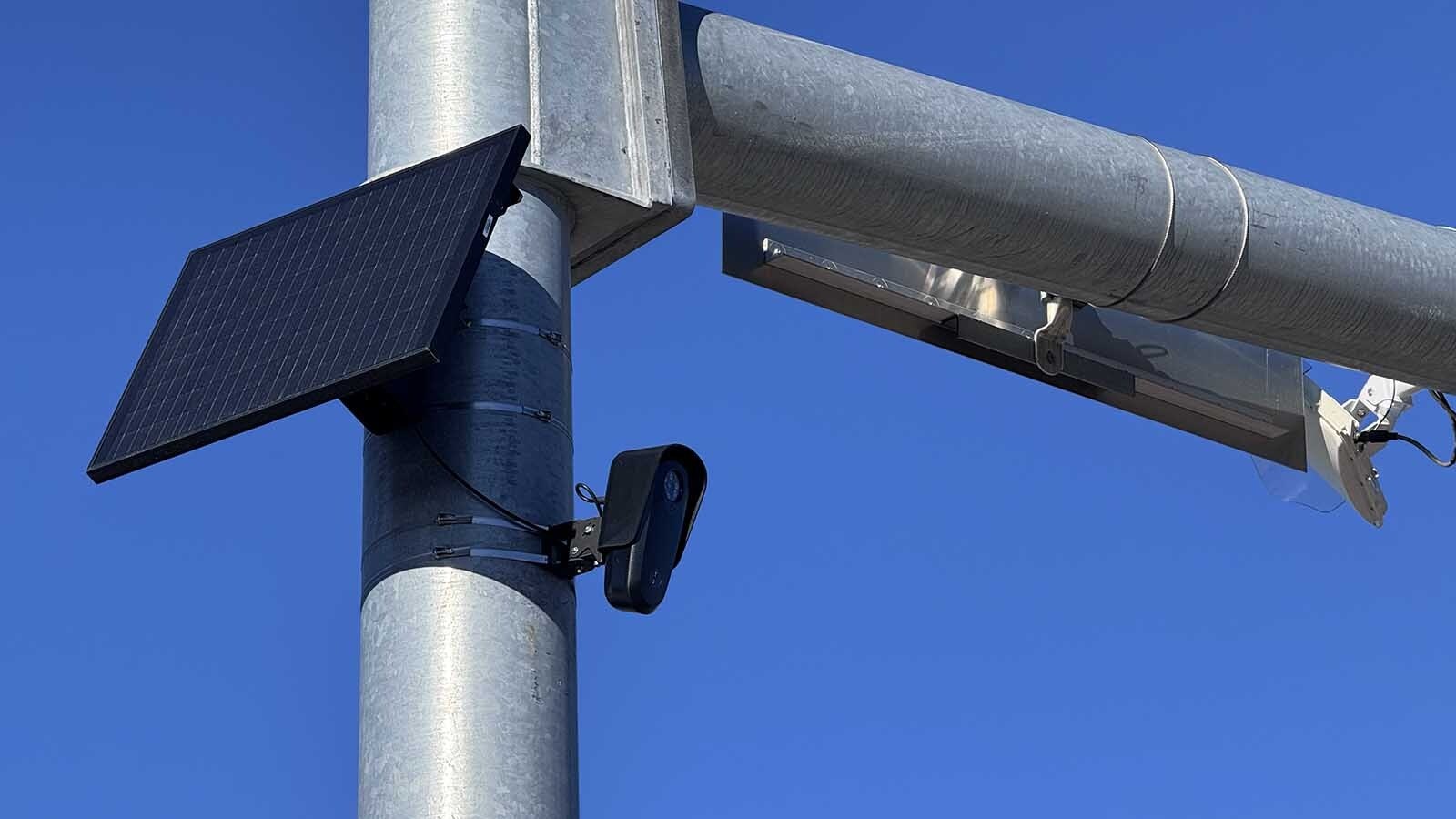
A petition has hundreds of signatures calling for Cheyenne to remove is Flock license plate cameras because they invade privacy. The city's police department says the 23 cameras are solving cases and catching criminals. Here is a camera pointing east along Lincolnway at its intersection with Evans Avenue. (Greg Johnson, Cowboy State Daily)
What Is A Flock Camera?
A Flock camera is a solar-powered automated license plate recognition (ALPR) system used by law enforcement, businesses and homeowners associations to capture vehicle data.
The system records details of passing vehicles — including time and location — rather than people or faces. If a license plate matches that of a wanted vehicle, police who use the system receive immediate notifications.
In late 2024, the Cheyenne City Council approved $146,300 for the purchase and installation of the cameras, using leftover COVID-19 relief money.
The first cameras were installed in April 2025. By October 2025, all 23 cameras were online.
Cameras were installed at major thoroughfares across the city, with particular focus on higher crime areas. Cheyenne Police Chief Mark Francisco said local crime statistics and traffic volume were big factors in determining where to put the cameras.
License plate readers have been in use for decades around the country, Francisco said. The Flock brand is relatively new in the game.
The Controversy
But whether the cameras go too far in violating privacy rights has been a contentious question.
The petition presented to the Cheyenne City Council calls the cameras an overreach, pointing to mass surveillance of law-abiding citizens, data that can be shared with agencies across the country without a warrant and lack of oversight. It calls for the Cheyenne mayor and city council to:
• Halt the expansion of the camera network.
• Remove existing cameras that “surveil residential neighborhoods.”
• “Pass a binding city ordinance that prohibits the collection of data on innocent drivers without a warrant and bans the sharing of local data with federal agencies.”
Cheyenne Realtor Kathy Scigliano, who co-hosted a public event called “Deflock Cheyenne” with Rep. Daniel Singh, R-Cheyenne, earlier this month, said the concern she most hears about is scope and oversight.
"How this technology is used, who controls the data, how long information is stored, and whether proper guardrails are in place before expanding surveillance infrastructure," are the concerns, she said.
It isn’t that people are anti-safety, she said.
Data is retained for 30 days, according to Francisco.
Francisco said the concern over the cameras he hears most is about privacy issues and questions about whether the cameras violate the Fourth Amendment, which protects individuals against unreasonable search and seizure by the government and ensures rights to privacy.
“I understand where they’re coming from,” Francisco said. “We do live in a society now that everything you do and say is tracked.”
But, he said, the cameras are not set up to do some of those things people fear that they do. The cameras are placed at public intersections and take still photos of vehicles and their license plates.
“None of these are in neighborhoods,” Francisco said. “The notion that these things could follow you from your home to your travel destination is just not accurate.”
He said that well over 30 court cases involving the use of public-view license plates have been brought to the courts and the legality of all those cases have been upheld, because the license plates being photographed are in public view.
“As we all know, you give up some of your privacy rights when you’re in public,” he said. “Every store you go in is videotaping you.”
Francisco called the cameras one of the greatest technology advances in his 36-year law enforcement career. The primary purpose of the cameras, he said, is to double down on crime in Cheyenne.
They are fantastic for situations like Amber Alerts, missing people and wanted people associated with vehicles, he said.
“Crime these days is so mobile and transitory,” Francisco said. “Every day these cameras are helping us solve crime.”
Hanlon argued that helping to solve crime does not justify the use of the cameras.
“The police department points out it’s a great way to catch criminals,” he told Cowboy State Daily. “That has been the excuse for government overreach since there were governments.”
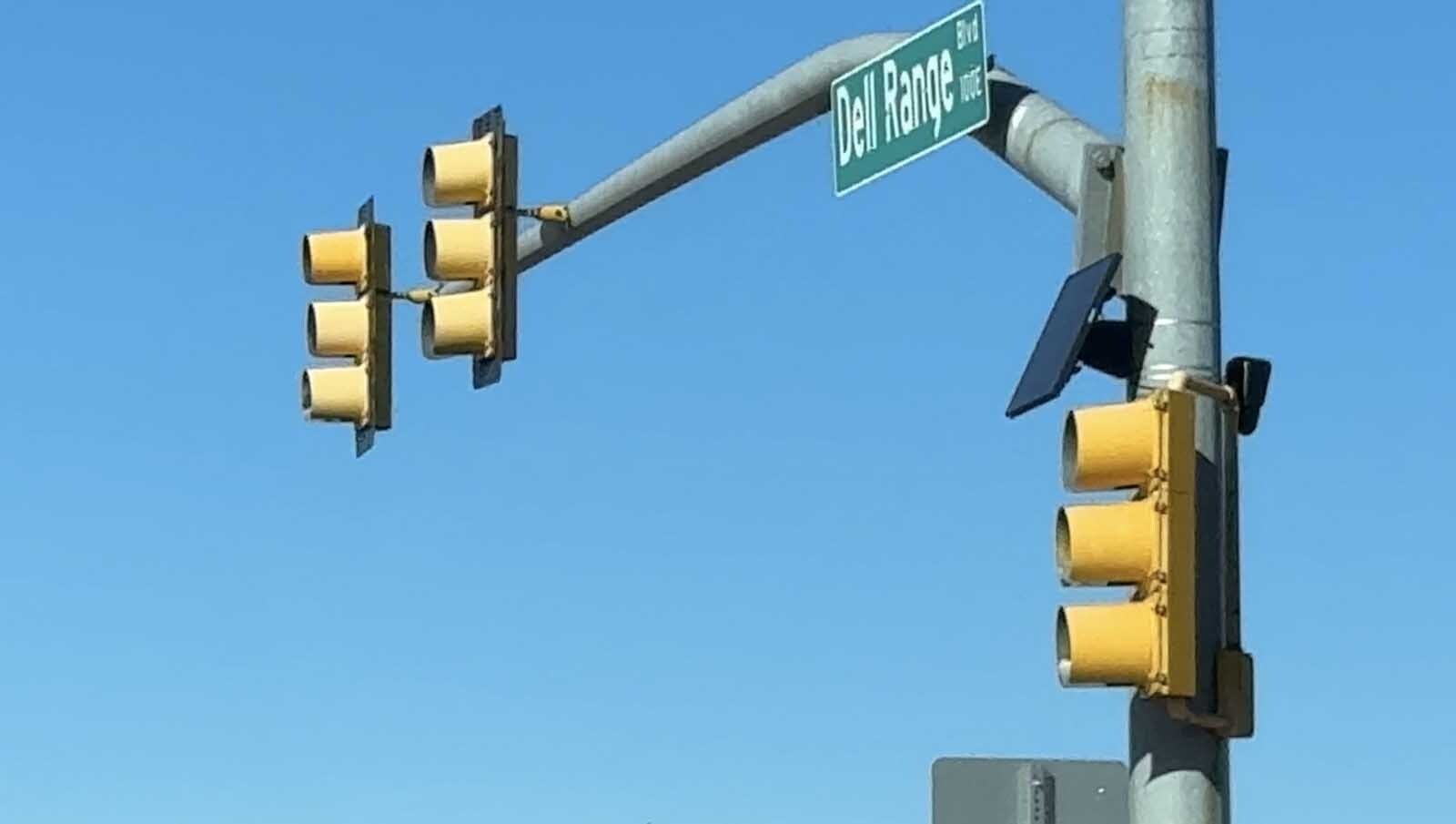
A petition has hundreds of signatures calling for Cheyenne to remove is Flock license plate cameras because they invade privacy. The city's police department says the 23 cameras are solving cases and catching criminals. Here's a Flock camera at Del Range Boulevard and Yellowstone Road. (Greg Johnson, Cowboy State Daily) 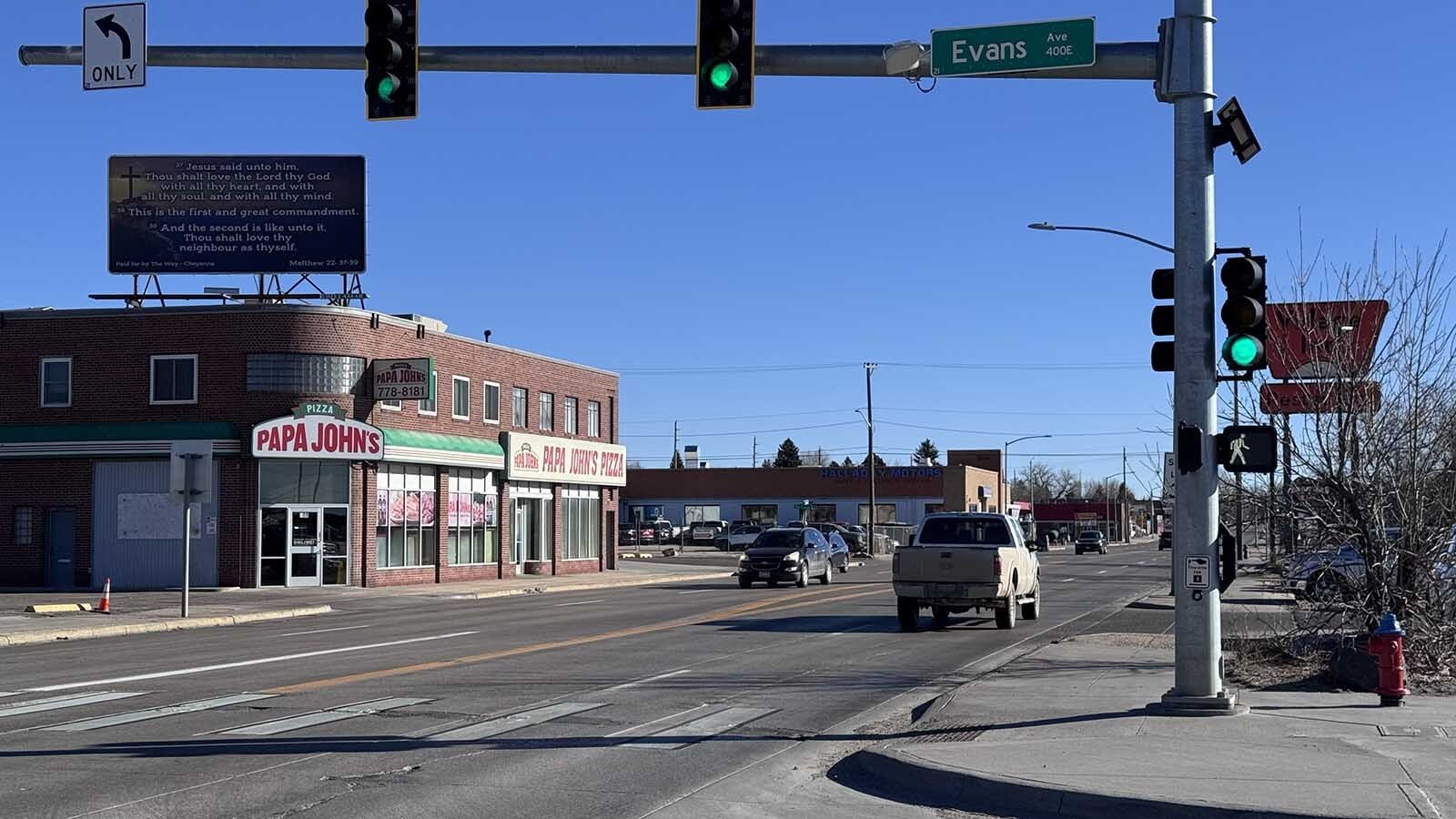
A petition has hundreds of signatures calling for Cheyenne to remove is Flock license plate cameras because they invade privacy. The city's police department says the 23 cameras are solving cases and catching criminals. Here is a camera pointing east along Lincolnway at its intersection with Evans Avenue. (Greg Johnson, Cowboy State Daily) A petition has hundreds of signatures calling for Cheyenne to remove is Flock license plate cameras because they invade privacy. The city's police department says the 23 cameras are solving cases and catching criminals. Here is a camera pointing east along Lincolnway at its intersection with Evans Avenue. (Greg Johnson, Cowboy State Daily)
Helping To Solve Crime
Francisco pointed to multiple cases where the city’s Flock cameras helped solve crime.
Recently, Flock cameras helped police apprehend a man who was wanted in northern Wyoming for the sexual assault of a 15-year-old girl.
Police were able to determine that the man had traveled south through Wyoming. A detective searching for a white truck with rust spots matched a license plate number to a truck that matched the description, Francisco said.
Later, that same license plate was captured on a Flock camera in the Fort Collins area. Police determined that the man had been hanging around schools there. In Wellington, Colo., he had been frequenting a food bank.
Police staked out the area around the food bank and arrested the man, after several months on the run. He was a repeat offender, Francisco said.
More recently, Flock cameras helped police arrest a suspect following a burglary at a local shopping area. The camera picked up grainy footage of the pickup the suspect was in. That suspect was also a repeat offender, Francisco said.
“Had it not been for Flock, neither of these two would have likely resulted in an arrest,” he said.
De-flock Cheyenne?
Earlier this month, Rep. Singh and Scigliano organized a public forum, “Deflock Cheyenne,” at the Laramie County Library. The forum allowed citizens to ask questions and express their concerns over the city’s Flock cameras.
“Partnering with Rep. Singh and hosting it at the library felt appropriate—neutral ground where people could come, listen and engage respectfully,” Scigliano told Cowboy State Daily.
A panel including broadband and fiber consultant John McKinney, retired Air Force Chief Master Sgt. Exie Brown, engineering manager and aerospace consultant Alan Sheldon and Rep. Singh spoke about the cameras and answered questions.
Members of the Cheyenne Police Department, including Francisco, were present. So was city councilman Tom Segrave. Segrave told Cowboy State Daily he invited the police chief and staff to attend.
Francisco said he was disappointed that no one from the police department was invited to be on the panel.
“We gladly would have accepted an invitation,” he said.
No one posed questions to the police department at the event.
“There were some misconceptions about the technology we use,” Francisco said, adding that the panel focused on the broad range of features Flock cameras offer while not clearly stating that the features the Cheyenne Police Department uses are narrowly focused on the license plate reader system.
“There were some far-reaching things, but it’s not what we’re using or doing here,” he told Cowboy State Daily.
Scigliano told Cowboy State Daily she and Singh organized the event because residents weren’t getting straightforward answers.
“When people have questions about surveillance technology being installed in their community, they serve transparency,” she said in an email. “The goal wasn’t to stir panic or play politics. It was to create a space where residents could hear information, ask questions, and speak openly without being talked down to.”
Scigliano told Cowboy State Daily that Councilman Segrave was condescending at the event and constantly interrupted the speakers. In an email to the city council after the event, she wrote: “Residents deserve to be treated with respect both inside council chambers and in public spaces where council members represent this city. Allowing dismissive or demeaning conduct to persist erodes public trust and damages the credibility of the entire council.”
Segrave told Cowboy State Daily he was not disrespectful, adding that Scigliano “did not set the ground rules.
“The event was advertised as a discussion on Flock cameras, but none of the speakers had any experience with the cameras,” he said. “The experts are our police chief and staff. They were not even invited to the event. I ended up asking them to attend.”
Some who attended the event were concerned about the use of the cameras, while others supported the cameras. It was exactly what a community discussion should look like, Scigliano said. Residents asked thoughtful questions about data storage, oversight and long-term use.
Francisco agreed that the event was beneficial.
“I think public meetings are great,” he said. “The more we can participate in, the better. It was a respectful meeting. I just wish we would have been invited to be on the panel.
Transparency Portal And Facts
Francisco encouraged people to visit the Cheyenne Police Department’s Flock Safety Transparency Portal. The portal lays out what the Flock cameras do and do not detect. It also shows how many unique vehicles the cameras have detected in the last 30 days and how many “hotlist hits” have been detected in the last 30 days. A “hotlist” is a real-time searchable database of license plates connected to stolen vehicles, wanted suspects or vehicles otherwise associated with criminal investigations.
“It’s a way for people to see what it is, what it does, what it doesn’t do,” Francisco said. “We understand people’s concern and we’re doing everything we can to safeguard the data we do collect.”
The Flock Safety company provides maps on its website, showing where its cameras are.
Francisco pointed out that not all Flock cameras are government-owned. Some are privately owned, he said. Businesses like Lowe’s also use them on their property.
Elsewhere In The State …
Flock Safety spokesperson Paris Lewbel told Cowboy State Daily in December that the company is expanding rapidly and making communities safer with each new camera.
The American Civil Liberties Union has called Wyoming a growing surveillance state.
The cameras have also been a contentious issue in Jackson Hole, Cowboy State Daily previously reported.
“At the end of the day, this isn’t about being dramatic or anti-technology,” Scigliano said. “It’s about making sure our community balances safety with privacy and keeps decision-making open and honest. That’s a pretty Wyoming-minded approach.”
In Cheyenne, Francisco is hopeful.
“I think it’s important that people know this system is making Cheyenne a safer place and it is helping us solve crimes,” he said.
Hanlon said he supports the Cheyenne Police Department. But the cameras, he said, “seem to be an un-Wyoming invasion of our privacy."
“I think it’s really unsavory in Wyoming,” he said. “It’s just not the way we do things.”
He suggested that ramping up community policing efforts would be a better way for the public to cooperate with the police.
“Certainly, we want the police to be able to do their job,” he said. “I know they see this as a force multiplier. I just think it’s the wrong choice.”
Kate Meadows can be reached at kate@cowboystatedaily.com.