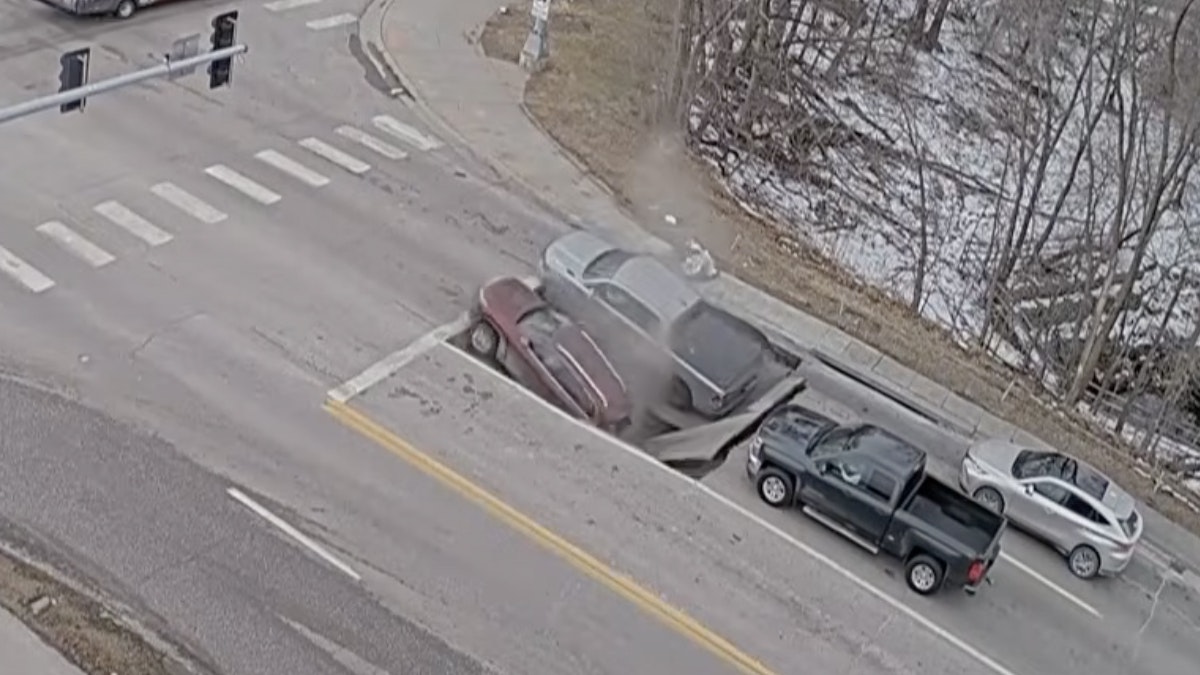
The sinkhole that generated international attention earlier this week for swallowing up two vehicles in Omaha may have been caused by a broken water main.
At a press conference Wednesday, Omaha officials said a water main about 4 to 6 feet underground was broken and actively running water at the time of the collapse.
"Based on the size and condition of the void, it's evident that a pressurized water source has been scouring soil from beneath the pavement and into the storm sewer for some time," city engineer Austin Rowser said.
The Metropolitan Utilities District, which operates the water main, disputed the assessment, saying it was too early to pinpoint a cause.
Whatever the cause, the sinkhole was massive measuring about 30 feet long, 50 feet wide and 10 to 15 feet deep beneath the pavement.
The incident occurred around 3:30 p.m. on Tuesday. The vehicles, a silver Dodge Ram pickup and a maroon Jeep SUV, were stopped at an intersection near the University of Nebraska-Omaha when the pavement buckled and collapsed.
Nobody was injured, and the drivers escaped their vehicles and the hole without incident. Omaha police credited bystanders and passerby for rescuing the motorists.
"Before first responders arrived, several bystanders jumped into action,” Omaha police said on social media "They helped get the drivers out of their vehicles and to safety. Other bystanders directed traffic and encouraged folks to back away from the area."
The vehicles were towed out later that afternoon.
Really A Sinkhole?
Although everyone’s calling it a “sinkhole,” not everyone’s agreeing with that assessment.
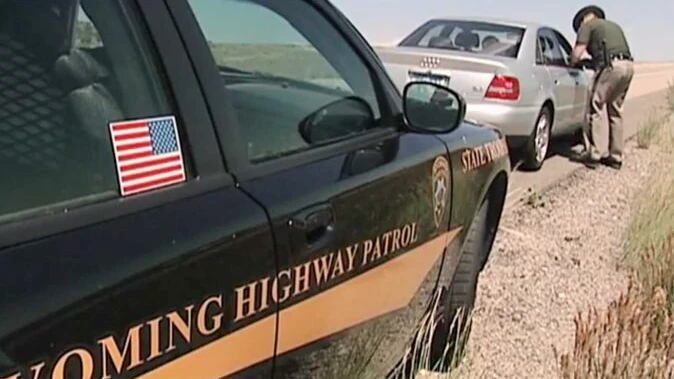
The Wyoming Department of Transportation has nearly 2,000 employees, most of whom could be called “road experts” in one way or the other.
Doug McGee, public affairs officer for the Wyoming Department of Transportation (WYDOT), thinks there’s a more likely explanation for what happened there. Based on the videos and images from the scene, he believes the explanation is a bit more mundane.
“They're calling it a sinkhole, which it could be,” he said. “It could also be failure of the infrastructure below the road, like a failing culvert, sewer line, drainage line, or other utilities.”
It’s the shape of the sinkhole that made McGee speculate on its cause.
“The hole opens very geometrically,” he said. “If I were going to speculate, I’d say that's very likely a structural failure that could have been due to age, combined with erosion, soil failure, or moisture.”
In urban areas, roads aren’t always built on perfectly solid ground. Cities often use the abundance of space under the pavement for subterranean utilities that would be difficult to place elsewhere.
“There can certainly be quite a lot under those roads,” McGee said. “Telecom, water, sewer, internet services, and gas, power, and electric lines. Since they already have the right of way for the road, it’s common for those utilities to run under the road.”
The vehicles sank several feet into the ground when the road collapsed. According to McGee, that wouldn’t be an unusual depth depending on the infrastructure.
“That's not a surprising depth for a culvert beneath the road,” he said.”
So That’s Why
WYDOT regularly upgrades and improves roads in Wyoming’s urban areas. The complexity of the terrain and the infrastructure under the road means large-scale projects in Cheyenne, Laramie, Casper or Cody can take a long time to complete.
“Before every project, inspect all the infrastructure and include any sort of upkeep needed in the overall project,” said WYDOT spokesperson Jordan Young. “If we're already getting in there, we holistically look at the roadway so that we can take care of everything at once.”
Young recalled the Third Street Project in Laramie as a good example of what goes into a “holistic” road project. It involved new asphalt surfacing and ADA upgrades along a 1.1-mile stretch of Third Street, including signal upgrades at several intersections and a box culvert replacement at the Spring Creek Bridge.
As WYDOT removed the old pavement, the City of Laramie did several utility upgrades along the expanse. Once they were finished, the new road was built over those utilities.
“We were able to partner with them so we could streamline the project,” Young said. “We didn’t have to dig up the pavement so they could make the improvements. Everything was upgraded at once.”
All the infrastructure, especially the new culvert, required a lot of digging and space under the road. WYDOT had to ensure the new road was solid while preserving the integrity of the underlying infrastructure.
So, if anyone’s ever wondered why WYDOT takes so long to work on a road in their community, there are a lot of reasons why it’s important to be thorough, organized, and slow-going.
“There’s a lot of important connections under those roads,” Young said. “We need to make sure the cities, counties, and companies can get in there to do maintenance.”
Wyoming Vs. Omaha
Neither McGee nor Young could confidently say what caused the incident in Omaha, but they didn’t think Wyomingites should worry about spontaneous sinkholes.
Young believed there were several factors that might make Omaha’s roads more prone to those occurrences.
“There are a lot of variables that go into the base of a road, what's under the road, and the pavement on top, but it depends on the area,” she said. “Groundwater is one of those variables, and I imagine that’s a bigger factor in Omaha than most places in Wyoming.”
Omaha is right next to the Missouri River, which serves as the state line between Nebraska and Iowa. With that much flowing water, groundwater could be a particularly troublesome factor in maintaining Omaha’s roads.
McGee believes aging infrastructure could be another contributing factor. Unfortunately, that problem isn’t unique to Omaha.
“There's been a long national discussion on our aging transportation system and the need for funding to address it,” he said. “I think almost every Department of Transportation is in that situation.”
It Can Happen Anywhere
Wyoming might not have a history of sinkholes in urban areas, but road failures can be particularly potent. One needn’t look any further than the catastrophic collapse of Teton Pass in June 2024.
“The ground under the highway suddenly gave way,” McGee said. “That’s very similar to a sinkhole. This incident highlights the importance of funding our infrastructure to keep our transportation system safe and effective.”
Nevertheless, sinkholes can happen anywhere. Nobody wants to collapse into the road they’re driving on, and it’s not something to worry about every day, but when it’s man versus nature, nature usually wins.
“We can't always win the battles against Mother Nature, but we sure do try,” Young said. “We have to meet the earth where it's at, so we often get situations where we have to get creative and fit the landscape. Instead of fighting Mother Nature, you pivot and work with her.”
City officials in Omaha hope to have the sinkhole fixed and the road reopened in a few days. They might be able to do it, even if catastrophic incidents like this can quickly become more complicated to fix.
Young was confident that the road crews in Omaha were already doing everything they could to repair the road and get traffic flowing again. That’s how any road crew, in any state, would respond.
“It took three weeks to install a temporary road in Teton Pass,” Young said. “A lot of factors went into that project, but the key factor was strong partners and dedicated employees. I don't doubt that that wouldn't be the case in Omaha.”
Andrew Rossi can be reached at arossi@cowboystatedaily.com.