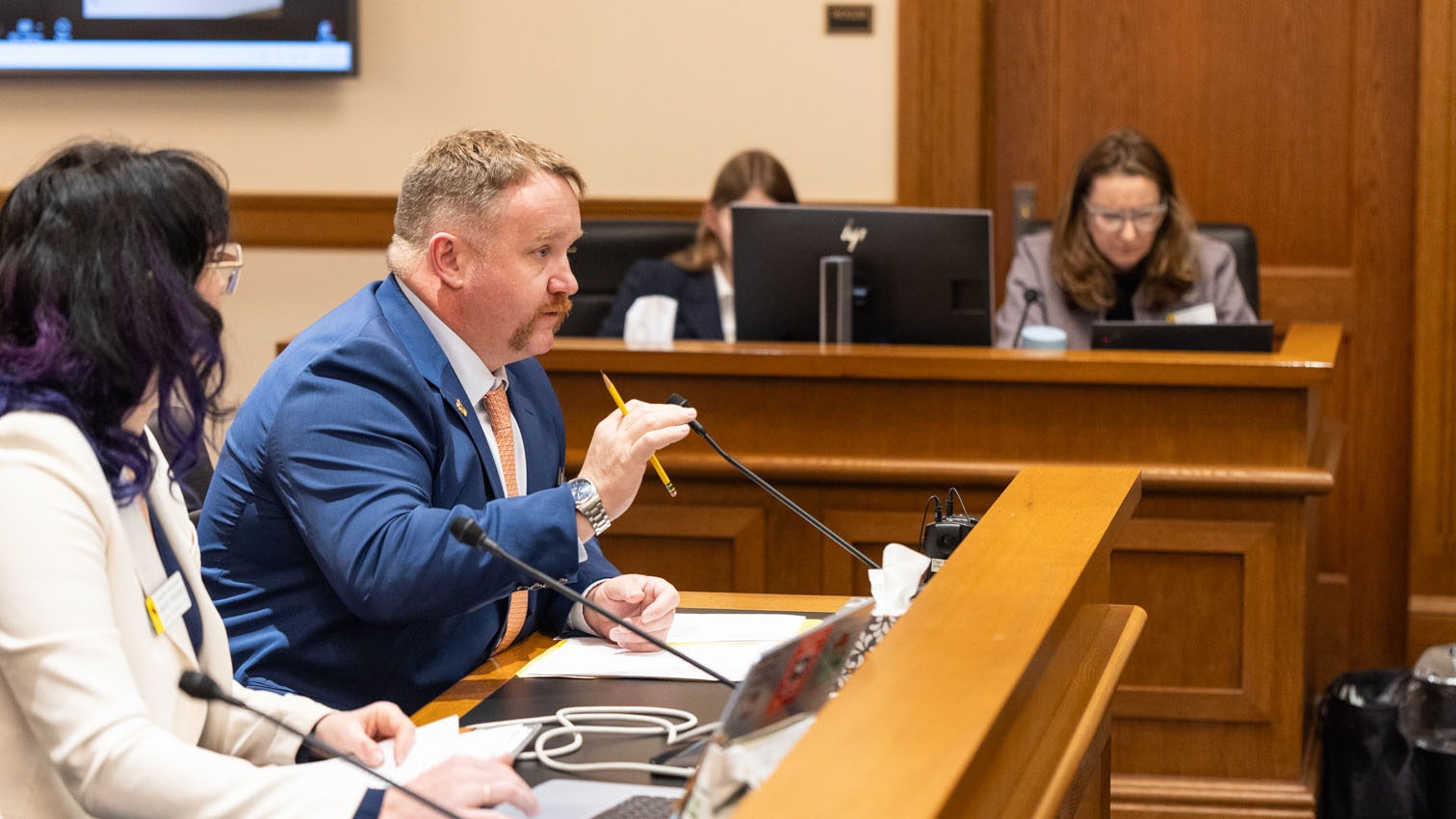
A corner-crossing bill received pushback from both hunters and ranchers before a Wyoming Senate committee on Thursday, but the committee still forwarded it to the Senate floor.
House Bill 19 aims to codify into Wyoming Statute what was essentially decided by a federal court decision — that corner crossing is legal.
Corner crossing is stepping from one parcel of public land to another at a shared corner without touching the private land that also meets at that point.
The practice has upset some property owners who believe the practice leads to trespassing and that frequent traffic from hunters across their property could damage property values.
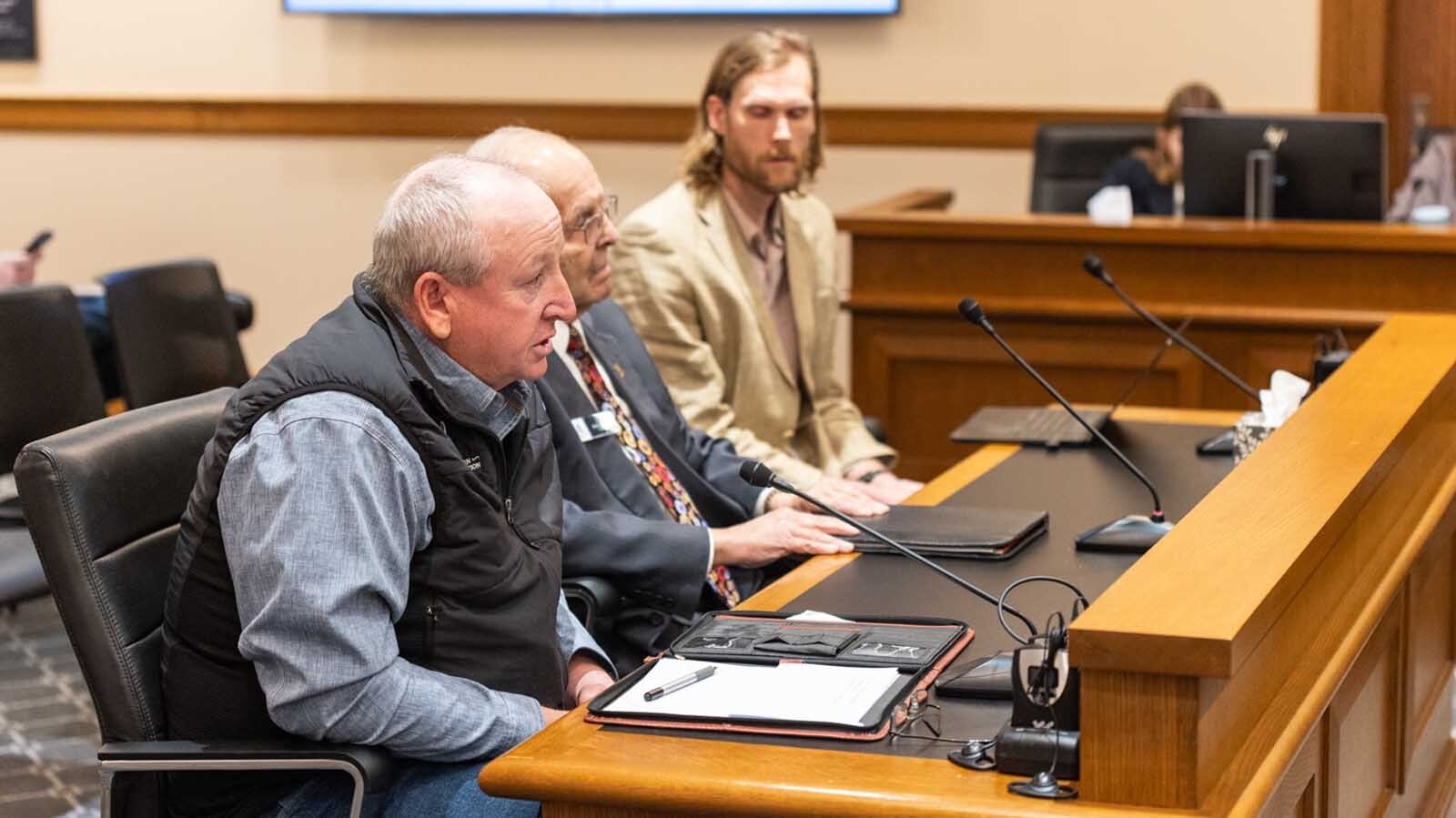
People testifying on the bill before the Senate Travel, Recreation, Wildlife and Cultural Resources said they like the general principle of the bill but have misgivings about its details.
‘Let’s Just Go Out And Corner-Cross’
Buzz Hettick, co-chair of the Wyoming chapter of Backcountry Hunters and Anglers, told the committee that he’d seen landowners and hunters work through similar thorny matters – such as stream access laws in Montana.
It might be best to go with the 10th Circuit Court of Appeals decision, seemingly in favor of corner crossing.
“I think what we should do is, just everybody take a breath and let’s just go out and corner-cross for a few years, let’s see what happens, and then come to our legislature and the legislators to solve those problems, in cooperation with the landowners,” he said.
Wyoming Farm Bureau Federation spokeswoman Kelly Carpenter and Jim Magagna, executive vice president of the Wyoming Stock Growers Association, also said the bill as written has sticking points for ranchers.
Ranchers won’t accept it, if it includes Wyoming State Trust lands, Magagna said.
In 1988, the Wyoming Board of Land Commissioners ruled that public access to state trust lands is a “privilege,” not a right, he said.
The bill should be amended to exclude state trust lands from corner-crossing access, he said.
That would not apply to other state property, such as parcels controlled by Wyoming State Parks and Cultural Resources, he said.
Carpenter said the bill doesn’t clearly define how to handle disputes in places where the adjoining corners of public and private land parcels aren’t clearly marked.
Numerous farms and ranches are in areas with “hundreds of corners, many of which aren’t marked,” she said.
Committee member Sen. Larry Hicks, R-Baggs, also said he had misgivings about the bill’s lack of clarity on how the “finite point” of a corner crossing should be defined, and who would be responsible for knowing that, either hunters or landowners.
“When none of that (boundary markings at corners) exists, then I think we’ve created a major trespass problem. Who is the duty on to be able to prove that they crossed at that corner?” Hicks said.
Not The Wyoming Way
Reps. Karlee Provenza, D-Laramie, and Andrew Byron, R-Jackson, are members of the House Travel, Recreation, Wildlife and Cultural Resources, which sponsored the bill.
Byron told the Senate Committee that hunters are already responsible for keeping track of where they are and not trespassing. So that should also apply to corner crossing.
“It is important to understand that it is on the sportsmen to know where that (corner crossing) point is,” he said.
Provenza said that in most cases, hunters and landowners can work things out among themselves. But HB 19 could clarify things, particularly in light of more Wyoming land being bought by people from out of state.
“I think we’re on the same page, that 99% of the time, Wyomingites are going to work this out. We’re good neighbors. But at the center of this case, of the 10th Circuit Court, was Iron Bar Holdings (an out-of-state company),” she said.
“And the reality is, we’ve got people that own land in this state, that come here and maybe don’t share the same values that we do. And they use ambiguity in the law to keep people from accessing their public land. And that’s at the center of why we’re here,” Provenza added.
Blatant Offenders
Sen. Ogden Driskill, R-Devils Tower, isn’t a member of the committee, but commented on the bill as a property owner.
He said that his family doesn’t have a problem with hunters who corner-cross to reach public land adjacent to their ranch. And it’s to be expected that people might stray a little way off the exact point of the corner.
The problem comes when dishonest hunters end up “a half-mile” away from the actual crossing and then try claim that it was by mistake, Driskill said.
Hunters who blatantly ignore property boundaries should have their hunting and fishing privileges suspended, he said.
“The only way to dissuade this activity” would be a suspension of privileges, he said.
The Case That Started It All
Across Wyoming and the West, there are places where square parcels of public and private land are interlocked in what many describe as “checkerboards.”
Corner crossing entails passing over the pinpoint where two corners of public land meet.
It’s long been controversial. Hunters and other advocates for the practice argue that it’s the only way to reach many sections of public land.
Opponents say there’s no way of doing it without setting foot on private property or at least passing through the airspace above private property.
And that can lead to abuses, such as damage to private property, and even drive down the value of private property in checkerboard areas, opponents argue.
The matter was put to the test in 2021, when four out-of-state elk hunters used a ladder-like device to clamber over a corner crossing between two parcels of federal land in Carbon County.
The parcels were adjacent to ranchland owned by Fred Eshelman and his Iron Bar Holdings LLC company.
Eshelman and Iron Bar first tried having the hunters charged with criminal trespass, but a jury acquitted them.
Iron Bar and Eshelman took their case into civil courts, all the way up to the federal 10th Circuit Court, just one level below the U.S. Supreme Court (SCOTUS).
When the 10th Circuit Court ruled in the hunters’ favor, the landowners petitioned for a hearing before SCOTUS. However, the high court declined to hear the case, effectively upholding the 10th Circuit Court’s decision.
Many considered that to be a de facto declaration that corner crossing is legal.
Mark Heinz can be reached at mark@cowboystatedaily.com.