
CHEYENNE — Bill Winney has knocked on a lot of doors in Sublette County. Too many times while out shoe-leathering for votes as a legislative candidate, nobody’s home.
“You knock on the door, you want to talk to people, and all of a sudden nobody comes, and then you look in the window and the house is empty,” Winney told the House Revenue Committee on Thursday. “There’s no furniture, no nothing.”
Winney, a retired Navy captain, said he’s heard the same story too many times — homeowners couldn’t make their mortgage payments after rising property assessments drove up their tax bills.
“‘I couldn’t make the mortgage. Left the keys on the kitchen counter,’” Winney said, recounting what residents told him.
It was that kind of testimony that framed Thursday’s debate over Senate File 110, a bill that would reshape how Wyoming taxes the homes people live in full-time.
Winney urged lawmakers not to lose sight of who the bill is meant to help.
“I just want to make sure they don’t get sucked off into the minutiae,” Winney told Cowboy State Daily. “Keep your eye on the ball. The original intent of this was to give a tax break to lower-income people.”
“I look at it as a tax reform,” said Rep. Jayme Lien, R-Casper. “Its local impact to the funding will be minimal. It'll be less than it was the last year. So I hope that our municipalities and counties recognize that we're trying to work on a solution to give our taxpayers relief without impacting their funding.”
Two Levers
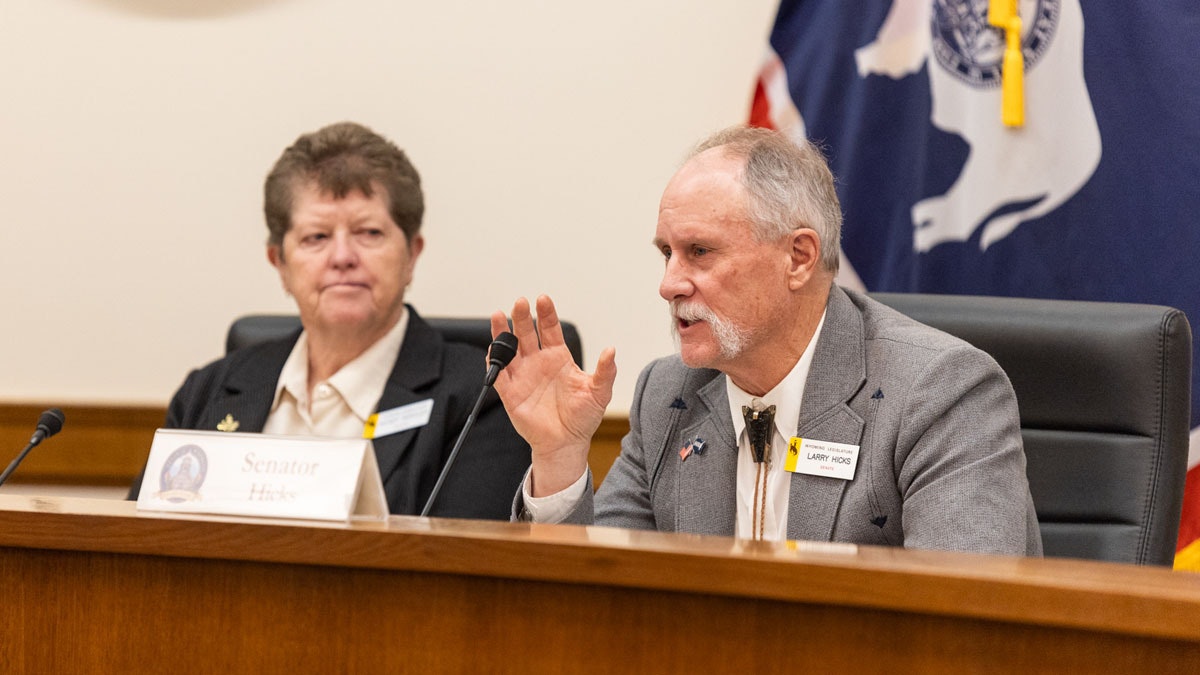
Sen. Larry Hicks, R-Baggs, presented the bill and walked the committee through a new approach to property tax relief.
“It’s been a journey, ladies and gentlemen,” Hicks said. “And I think we’ve refined what we’re trying to do.”
SF 110 pulls two levers simultaneously.
First, the bill implements Amendment A, the constitutional provision voters approved in November 2024, which allows the Legislature to create a separate property subclass for owner-occupied homes. That drops the assessment rate on those homes from 9.5% to 8.3% — roughly a 12.6% reduction in the assessment rate.
Second, to reach the equivalent of the 25% property tax cut lawmakers approved last year, the bill zeros out the 25 school mills the state collects from owner-occupied homes. Those mills simply would not be assessed.
“We’re just not going to collect them. It’s cleaner,” Hicks said.
The approach shifts the burden from counties and special districts to the state. About 70% of all mill levies collected in Wyoming fund education. Under SF 110, local entities would see their revenue hit limited to that 12.6% from the lower assessment rate — not the full 25%. The state absorbs the rest.
“It’s about $18 million a year that would go back to the counties and the special districts,” Hicks said.
Numbers Crunched
Ken Guille, administrator of the Wyoming Department of Revenue’s Property Tax Division, told Cowboy State Daily the bill is fundamentally different from exemptions lawmakers have passed in recent sessions. Previous measures reduced the assessed value of a home before taxes were calculated.
SF 110 instead changes both the assessment rate and the mill levy.
Guille broke it down: Wyoming calculates property taxes by multiplying a home’s fair market value by the assessment rate, then by the mill levy.
“So if you had a $100,000 home currently, you multiply that times 9.5% — your taxable value is $9,500,” Guille said. “In this case, 8.3% — $100,000 home, your taxable value will be $8,300.”
On top of that, the bill removes the 25 school mills entirely for owner-occupied homes.
The big takeaway, Guille said, is that education funding would lean more heavily on the state rather than on local property taxpayers. In an effort to not have property tax cuts cripple local municipalities, the bill would put the state on the hook to fill that gap.
Moving Parts
Converse County Assessor Dixie Huxtable told the committee the change is massive for the officials who actually administer property taxes.
“This is a big change — a lot of moving parts, both internally and externally for the taxpayer to understand,” Huxtable said. “They’re thoroughly confused currently.”
Huxtable flagged a key question: the bill requires homeowners to attest they live in the home at least eight months per year, but the language was vague about which year.
“Is the expectation that they’re going to live in that home for eight months in 2028? Or is the expectation that they did live in that home for eight months in 2027?” Huxtable said.
The committee adopted an amendment from Lien, clarifying that homeowners must have lived in the residence eight months of the prior year. Lien also successfully amended the bill to extend the lower rate and mill levy reduction to outbuildings like sheds and pole barns on the same property.
Premature Move?
Rep. J.R. Riggins, R-Casper, and Rep. Liz Storer, D-Jackson, both voted no, arguing the Legislature was getting ahead of itself.
Riggins said he supports implementing the 8.3% rate but wanted more time on the rest.
“I would have liked to have seen this bill come out with what Amendment A was, stand alone,” Riggins said. “The rest of this is very intriguing, and I would love to look at it, but I would like to look at it for weeks to find out where I’m at.”
Storer told Cowboy State Daily her concern is simpler: why layer on more tax cuts when a citizen-led ballot initiative heading to voters in November could slash property taxes by 50%?
“We should focus on the fact that we’ve got a ballot initiative on the November ballot that would cut property tax in half and have a huge impact on our communities,” Storer said. She said the bill amounts to a transfer of the tax burden from homeowners to the mineral industry and state investments.
“At the end of the day, this is really a transfer of taxation from homeowners, especially ones that have expensive properties — they’re getting more of a tax break,” Storer told the committee. “We’re putting a big hole in our pocket.”
Ballot Looming
The initiative, certified by Secretary of State Chuck Gray in January 2025, is the first citizen-led ballot measure in Wyoming in 30 years.
“The people’s right to propose and enact laws by initiative to address fundamental issues, such as property tax limits, is pivotal to our state,” Gray said at the time.
If approved, it would allow full-time homeowners to have their property taxed at 50% of its assessed value — an estimated $143 million annual hit to statewide revenue.
Guille told Cowboy State Daily that nothing in current law would prevent homeowners from receiving the benefits of both SF 110 and the ballot initiative if both pass. But Hicks noted SF 110 wouldn’t take effect until the 2028 tax year — after voters decide on the initiative — giving the Legislature time to adjust.
“The legislature could just come back and repeal this,” Hicks said.
Lien spoke in favor, framing the bill as genuine reform.
“It implements Amendment A, which I think is important that we get done because the taxpayers said they wanted that done,” Lien said. “And there’s no additional burden on our industries in this.”
One More
Also on Thursday, the Senate passed House Bill 45, which expands the long-term homeowners property tax exemption.
The bill clarifies that the 50% exemption for homeowners 65 and older who have paid property taxes in Wyoming for at least 25 years applies to fair market value rather than assessed value, and caps the benefit at the first $3 million of a home’s value.
The Roll Call Vote on SF 110
Aye: G. Brown, K. Campbell, Lien, Lucas, Styvar, Wharff, Locke Nay: Storer, Riggins
David Madison can be reached at david@cowboystatedaily.com.


