Editor's Note: This story features sexually graphic language. Reader discretion is advised.
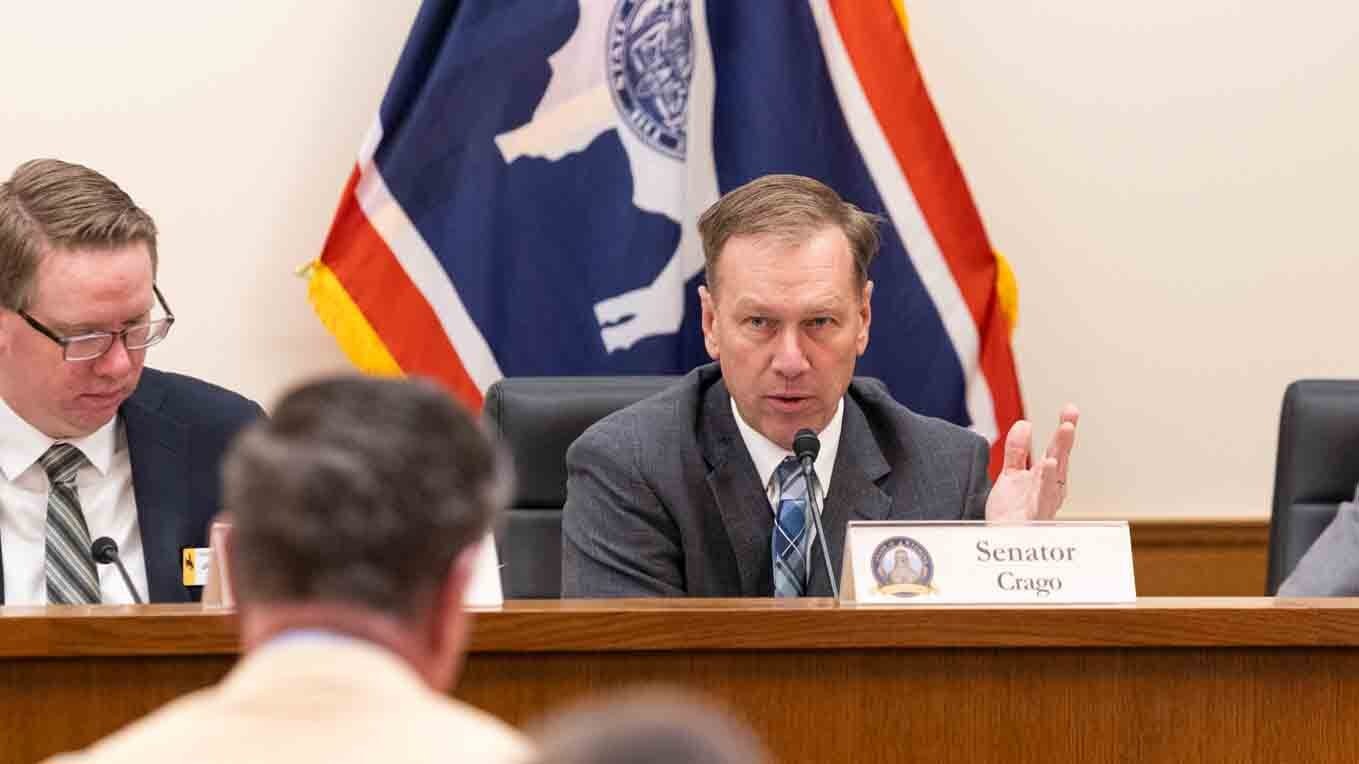
As two hours of passionate debate unfolded Wednesday in a room so packed, people craned their necks in the doorways, the concern on Sen. Barry Crago’s face deepened.
The hearing in a below-ground meeting room of the Wyoming Capitol was the final small-committee debate on House Bill 10, which seeks to create a lawsuit mechanism against public or school libraries that refuse to move sexually explicit books out of children’s sections.
The Legislature provided an overflow room with virtual streaming to accommodate the crowd.
In the end, the bill advanced to the Senate floor on a 3-2 vote. It must clear a Senate floor debate, two more Senate readings, House approval on any changes, and the governor’s desk to become law.
The Wyoming Library Association, Wyoming Equality and numerous other stakeholders urged a nay vote on the bill.
They called it censorship, said it has constitutional problems, and said parents should manage their own children’s reading rather than rely on the government to restrict it. Some said sexually abused children need access to sex ed books to understand what they’re enduring.
On the other side of the ideological divide were the Wyoming Family Alliance, Moms for Liberty and others.
They urged state lawmakers to stop what they called government-driven sexualization of children in public spaces. They emphasized the extremely graphic nature of some of the books in Wyoming’s public libraries. And they said a statewide challenge process is a good idea.
Crago, a Republican from Buffalo, Wyoming, and a civil county attorney, said he appreciates the bill’s mission and understands why people would vote in favor of it.
But he said he worries that interpretational differences over which books are sexually explicit under the bill would fuel and unleash a lawsuit-happy society onto communities that have not brought problematic books into their libraries’ children’s section.
And that includes his own community, said Crago.
“This particular issue is not a problem in my county,” he said, adding that he’s talked with his library board and walked around the library. He noted that his library has a policy on this problem already. “If there’s a way for them to continue to do their job without fear of lawsuits, I want to try to give that to them."
On the other hand, said Crago, “I understand there are communities where this is important, and it is an issue."
So he successfully advanced a local-control amendment, giving counties the choice to opt out of the bill if they choose. If that amendment holds, communities can still hold their county commissioners to account if they disapprove of an opt-out vote.
“I think there are good reasons for the bill, and good reasons against the bill,” said Crago. “And it’s really a tough decision for a lot of us.”
He thanked the numerous members of the public who have helped refine the bill during its long vetting process last year and this year.
Crago also successfully advanced amendments tightening the bill’s legal definitions and allowing, rather than requiring, district court judges to award attorney fees to the prevailing party in a lawsuit against a library or school district.
His local control amendment did not give school districts the choice to opt out of the law’s enforcement provisions: just counties.
That’s a nod to school libraries being a different environment, he said.
Wyoming’s online card catalogue for public libraries lends credence to Crago’s argument that his local community is not part of this controversy.
Some of the most sexually graphic books that surface in this dispute — “Gender Queer,” “Let’s Talk About It!” “Tricks” and “This Book Is Gay”— are not listed as available in Johnson County public libraries.
Crago also represents parts of Sheridan County, which has a copy of “Gender Queer,” but only in the college library and not in the public library, the catalogue says.
Pretty Graphic…
If it becomes law, HB10 would define “sexually explicit materials” in graphic and anatomical terms, as describing or depicting specific sex acts.
It would require county libraries to open a materials-challenge process to residents of the county. The challenge process would give the library a chance to send a children’s-section book deemed sexually explicit to the adult section and craft a written decision on the challenge within 60 days.
The bill would give electors of the relevant county a mechanism to sue a library violating that provision, and possibly win damages, costs, fees or other legal remedies.
It would require the libraries that fail to adopt the challenge process to pay $500 for every day they fail to craft it.
On the school-library side, the bill would impose a ban on sexually explicit materials in any area accessible to people under 18 and would provide the same lawsuit and penalty provisions for failure to follow the challenge process or implement it, respectively.
Only electors of the relevant school district could challenge books and sue. And the reviewers of the challenged books under this law would be the school board members — who are typically elected officials — rather than an appointed committee like the kind some districts currently use.
The bill’s definition of sexually explicit materials is as follows:
- Depictions or descriptions of penetration of the male genitalia into the female genitalia or anus;
- Contact between the mouth and genitalia or mouth and anus;
- Contact between the finger, hand or other body part of a person and the genitalia or anus of another person, except in the course of a medical examination;
- Ejaculation onto the person of another;
- The use of artificial sexual organs or substitutes to contact with the genitalia or anus;
- The touching of a person’s own genitals or anus with a finger, hand, artificial sexual organ or other similar device.
The Bible
Critics of this bill and its predecessors have theorized that it will ban the Bible.
If the Bible were found sexually explicit under this bill, public librarians would have to move it from the children’s section to the adult section.
Dominic Syracuse, who introduced himself as a business owner in Cheyenne, a father and a youth pastor, quoted Ezekiel 23:20 as proof that the Bible would fall under the bill.
That chapter describes two sisters who become prostitutes. One of sisters, Oholibah, “lusted after her lovers, whose genitals were like those of donkeys and whose emission was like that of horses,” says the New International Version of the text. “So you longed for the lewdness of your youth, when in Egypt your bosom was caressed and your young breasts fondled.”
Nathan Winters, president of Wyoming Family Alliance, countered, theorizing that the Bible wouldn’t fall under the bill’s restrictions. Winters is also a pastor, he noted.
Winters complimented the bill’s many layers and the narrow definition of “sexually explicit.”
Crago grilled Winters on the issue, saying he did so because Winters is “one of the smartest people I know.”
“Are you concerned, regardless of your interpretation of the text that other people may interpret it differently and bring challenges based on this statute, in all of our libraries?” asked Crago. “Because that’s my concern.”
Winters said there was such a challenge in another state, but didn’t believe it “withstood scrutiny.” He again complimented the detail of HB10’s definitions.
“Remember, we have a lawsuit hanging over our head,” said Crago. “In the public library we can move the books.”
In the school library it’s a little trickier, said Crago. An earlier version of the bill considered an outright ban on sexually explicit materials in school libraries. But the House of Representatives added an amendment banning school libraries from letting minors access the books - which indicates schools can create different sections rather than remove books.
“They’re going to get sued. And that’s going to cost a lot of money,” said Crago. “And there’s nothing in this bill that provides money to our schools or our public libraries, to defend all these lawsuits that will be coming.”
Winters parried.
“I appreciate the fact that many many people use the threat of lawsuits to keep good legislation down,” he said. “And one of the things we’re faced with right now is the systematic sexualization of our children on the one hand, and the threat that we’re going to lose the opportunity to have the Bible — which I don’t believe fits (in the definitions).”
Winters encouraged officeholders to stand up and say, “no, not here” to the sexualization of children.
Crago asked again how Winters would propose to equip libraries to defend “all of the lawsuits that are likely to come.”
“Not everyone agrees with you and I on (the Bible),” added Crago.
After more back-and-forth, Winters said he’d support the idea of the state supporting local governments in fighting those lawsuits.
Why Not Just Remove It Though
Sen. Larry Hicks, R-Baggs, had his own verbal fray with retired Cheyenne-area attorney George Powers.
Powers had noted that the bill makes no distinction between 6-year-olds and 17-year-olds. He said local librarians are making relevant decisions on books.
He also said he wished Crago’s amendment had given school boards the chance to opt out of the bill’s enforcement mechanism as well, saying the bill sets school districts up to be sued for not removing books altogether.
“My question would be,” countered Hicks, “if it’s identified as sexually inappropriate, why would they not remove it?”
Powers said the choice of book access should rest with parents. He also lamented that the bill’s definition of “sexually explicit” is not rooted in the state’s definition of “obscenity” which closely but imperfectly mirrors the U.S. Supreme Court’s definition of it.
“That’s not an answer to the question I asked,” said Hicks. “I appreciate the evasion, but that’s not the question I asked.”
Powers said the definition of “sexually explicit” is “so broad, and based simply on words, that it would sweep within it a number of works of literature.”
He referenced “The Bluest Eye” by Toni Morrison. Students shouldn’t lose out on the literature by some taking the sexualized language out of context, he argued.
Let’s Talk About… What’s In This Book
One of the books bill proponent Rep. Ann Lucas, R-Cheyenne, brought to the meeting Wednesday to tout the bill’s value was “Let’s Talk About It!” by Erika Moen and Matthew Nolan.
It generated controversy in 2023, when it was featured in a book display in the Lander Valley High School.
The Fremont County No. 1 school board adopted a tougher challenge policy in response.
The authors of “Let’s Talk About It!” dedicated it, “To whoever needs it, whatever your age.” The book’s topics range from how penises, vaginas and other sex organs function, to how to detect abusive habits in oneself or others.
It gives numerous instructions on sex and masturbation, with cartoon illustrations. Body positivity, respecting someone’s choice of pronouns and staying safe and legal while having sex or viewing pornography are a few other emphases.
The book also posits:
- That the anus is “a primo zone for touching and penetrating” because of its concentration of nerves.
- That erotic relationship types include monogamous, polyamorous, open, casual, and companionate.
- That gender binary is “an obsolete viewpoint.”
- That sexually transmitted infections are “super common,” but the majority are treatable and “if caught early, no biggie.”
- That it's fine to consume pornography of all types as long as it's legal, and as long as it doesn't interfere with one's daily life.
- Sending sexually explicit images through one’s phone is fine as long as the recipient and sender follow all laws, have rules in place, don’t share the photos with others, and edit out their faces and personally identifying characteristics.
The state’s online card catalogue lists eight available copies of “Let’s Talk About It!” not including one more in the Gillette College Library.
Of those eight, the catalogue lists seven of them in young adult or young adult graphic novel sections.
Another one is listed in the fiction area of the Campbell County Public Library.
Gender Queer
Another of the books Lucas brought, “Gender Queer” by Maia Kobabe garnered controversy in Wyoming starting in 2022, as a Casper community grappled over whether it should be in the school library at that time. It tells the story of a female who identifies as nonbinary and discusses her confusion, intense fear of vaginal penetration; and her sexual experimentation and relationships.
One of its most disputed and misinterpreted scenes features two adult females playing with a sex toy that is nearly indistinguishable from male genitalia. Lawmakers and community members over the years have interpreted the scene as an interaction between two boys, but it is not.
The Wyoming State Library’s online card catalogue lists 16 copies of that book in its branches, but five of those are college libraries that wouldn’t fall under the bill unless they have children’s sections. Of the remaining 11, one cannot be checked out except by visiting with library staff in the Thermopolis library.
Five of the remaining 10 are in young adult or teen sections. Five more have catalogue numbers showing under general sections.
Clair McFarland can be reached at clair@cowboystatedaily.com.