The University of Wyoming disagrees with a state House budget tweak that some lawmakers framed Saturday as an "Art-of-the-Deal” style negotiation, its spokesman told Cowboy State Daily on Monday.
The Wyoming legislative Joint Appropriations Committee’s majority in January advanced a proposed $40 million cut, or about 10%, to the state’s portion of UW’s two-year operating budget.
The state Senate undid that cut last week before it finalized its version of the draft budget.
The Wyoming House of Representatives, meanwhile, has its own draft version of the budget. The $40 million cut remained after extensive debate last week.
But then, two amendments surfaced in time for Saturday’s “third reading” on the budget bill.
One amendment, which Rep. Steve Harshman, R-Casper, brought, sought to restore all $40 million to UW’s state grant, but hinge that full amount on UW being able to find $5 million in savings by Dec. 1.
The House approved that.
House Appropriations Chair John Bear, R-Gillette, brought a second amendment - also approved - that deleted Harshman’s amendment and inserted a new bargain.
That is, $20 million of the cut would not be restored.
Another $20 million would be restored - but the university could only keep that if it could find $5 million in savings by Dec. 1.
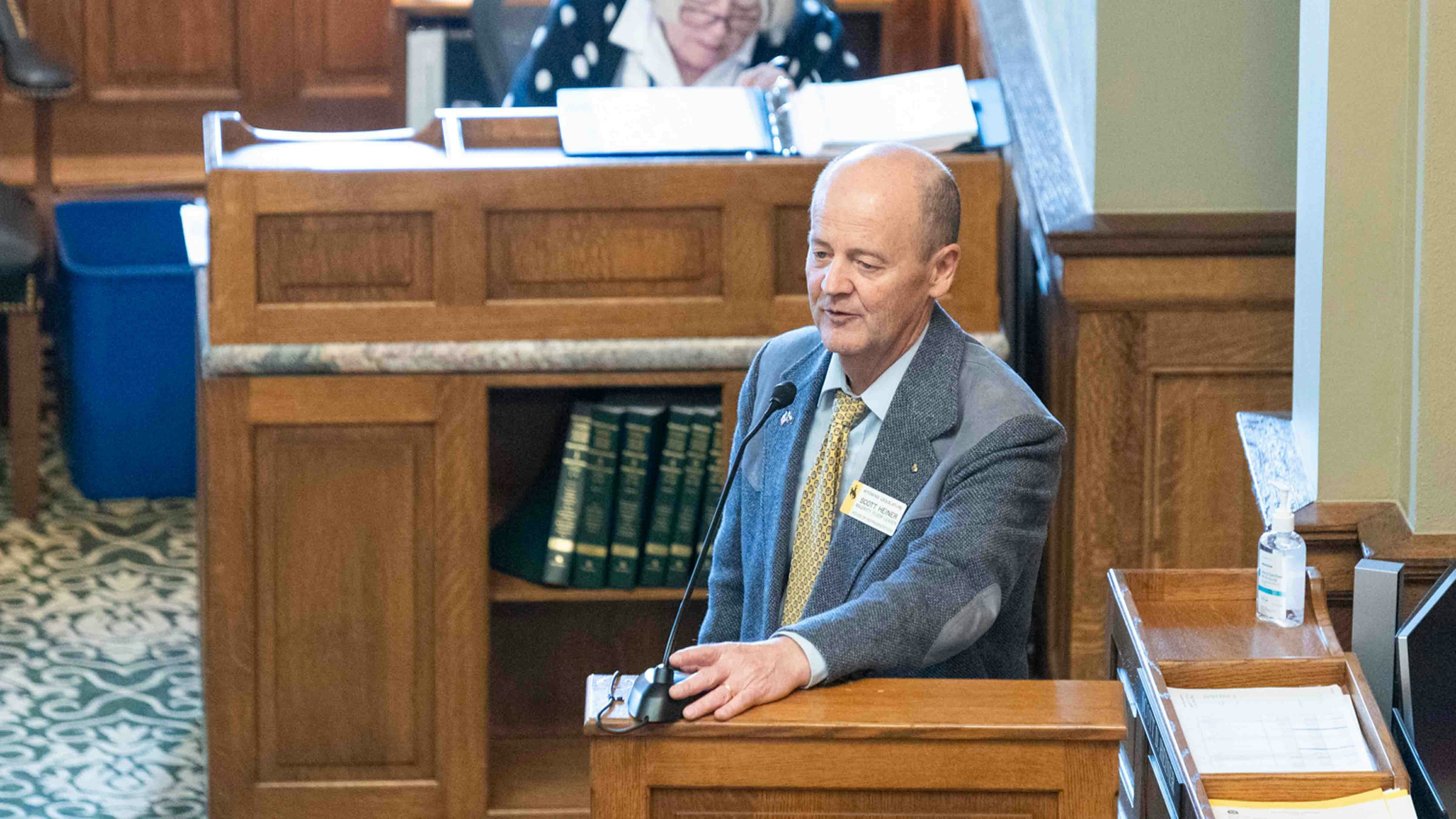
“Many of you have probably heard of the ‘Art of the Deal,’” House Majority Floor Leader Scott Heiner, R-Green River, began during the Saturday debate. “The only real leverage we have is the power of the purse.”
“Sometimes it takes a big lever… to negotiate,” said Heiner.
He said that one day prior, Friday, “we had a meeting with some key individuals from the university.”
That meeting brought university leaders to the table and was “very productive,” Heiner added.
Bear also referenced the meeting, and said his amendment, titled budget third-reading amendment no. 120, “came about based on discussions between leadership and the university.”
Other House representatives bristled.
“Let’s be absolutely clear,” began Rep. Bob Nicholas, R-Cheyenne. “There were no negotiations. This is another cram-down by our good leadership to get what they want.”
Rep. Martha Lawley, R-Worland, voiced similar consternation. That was on the backdrop of a point she raised earlier last week, that often during the Joint Appropriations Committee’s budget-planning marathon, the committee cut paused its livestream so members could confer privately.
“I’m seeing a troubling trend here of a lack of transparency, and discussions of private conversations,” said Lawley. “I’m not saying someone’s necessarily misrepresenting, but we just don’t have the ability to know what happened there unless it’s on the record.”
Lawley said she hasn’t heard concrete justification for the $40 million cut or its amount.
“That’s why we have public meetings,” she said. “That’s why we have public comment.”
UW Doesn’t Like This
UW’s spokesman Chad Baldwin told Cowboy State Daily in a Monday email that it disagrees with Bear’s amendment - and with any cut.
“The university continues to oppose any cut to its budget,” wrote Baldwin. “UW is adamant: No cuts are appropriate, period.”
He noted that UW has absorbed “major cuts” during a period of state financial distress in the past decade and said “unnecessary reductions” would hamper the mission the law dictates to it.
“We did not see Rep. Bear’s amendment before it was brought up on the floor of the House,” said Baldwin of the $20 million cut, $20 million contingency plan.
As for Harshman’s amendment, UW also doesn’t back that, wrote Baldwin.
“But we appreciated Rep. Harshman’s efforts to reduce the Joint Appropriations Committee’s proposed cut,” he added.
But These Meetings Happen
The meeting between UW and House leaders did happen, Baldwin wrote.
He called it a good discussion in which UW leaders opposed any cut and explained how UW “regularly looks at low-enrollment programs and staffing levels, and we will continue to do so.”
It is not unusual for trustees, the UW president and other campus administrators to meet with lawmakers and legislative leadership, said Baldwin.
It is also common, Cowboy State Daily has observed, for lawmakers to have private discussions with agency representatives around the Capitol.
“Normally we don’t publicly discuss such meetings,” wrote Baldwin. “But we feel an obligation to do so in this case because the meeting was referenced on the House floor.”
UW Board of Trustees member John McKinley and Mike Smith, vice president for governmental affairs and community engagement, were at that meeting, said Baldwin.
Culture Clash
Baldwin referenced a column by UW Board of Trustees Chair Kermit Brown, in which Brown addressed the culture clash between lawmakers and UW.
The Legislature in recent years has barred UW from keeping a diversity equity and inclusion (DEI) office and spending money on DEI programming.
Some members of the appropriations committee called that into question and voiced frustration last month, as UW’s webpages still listed programs like “ecofeminism” and gender studies.
“We hadn’t gotten their attention with some of the other things that we’ve done in the past,” Bear said during an earlier floor debate this month, regarding the cut. “So, trying to get their attention.”
Bear said the frustration was specific: legislative directives to eliminate diversity, equity and inclusion programs at the university “really didn’t happen” despite action taken in prior sessions.
By Saturday, Heiner indicated a different element could be driving that culture clash. He said UW uses a concept called “teach it out” and that they need to “teach out” some courses with waning enrollment until no more students remain in those programs.
UW Board of Trustees Chair Kermit Brown wrote in a column last month that UW is “excising DEI concepts and advocacy from instruction, a process that is ongoing.”
He wrote that UW leaders are willing to visit with lawmakers about what the university offers, “and follow established processes to make appropriate changes.”
“The Legislature and the state’s elected officials represent the people of Wyoming,” added Brown, “and appropriations from the Legislature and the governor are what make it possible to have a world-class land-grant and flagship university, as envisioned by the state’s founders.”
Comment
Bear, in a Monday text message to Cowboy State Daily, said, “I testified that (Harshman) had a good idea. I just made it better.”
Besides the different dollar amounts, Bear’s amendment has two more provisions than Harshman’s.
Harshman’s amendment directed UW to find savings by addressing duplicative positions andopportunities to consolidate. It also called for the university to evaluate its situation compared to similar institutions and identify cost savings and investment opportunities.
Bear’s two extra directives tell UW to find opportunities to eliminate programs “with consideration” of enrollment numbers; and limit any DEI programs or functions.
Regarding how the meeting with UW went from the vantage of House leadership, Bear referred Cowboy State Daily to Heiner.
Heiner did not respond by publication, to a text message request for comment.
Clair McFarland can be reached at clair@cowboystatedaily.com.