Milk does a body good, or so the popular 1980s industry publicity campaign proclaimed.
However, Why would this healthy beverage still do a body good for a week longer in Wyoming than it does in Montana?
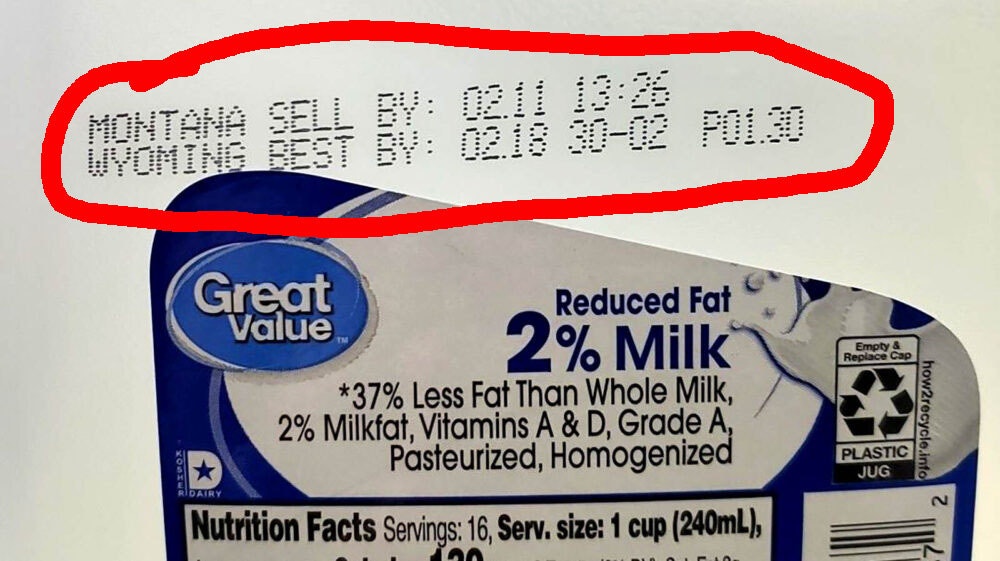
That's the head-scratcher occupying members of the Ask Billings Facebook page when Claudia Knepp posted a photo of a milk jug with two different dates on it, the one in Wyoming being a full seven days later than the one in Montana.
“Can anyone tell me why there’s one date for Montana and a different date for Wyoming on milk?” Knepp asked.
Her picture showed a Montana "sell by" date of Feb. 11 and a Wyoming "best by" date of Feb. 18.
Users piled on with lots of theories — 150 or so different takes in all.
Some of the tongue-in-cheek explanations included the idea that Wyomingites have stronger stomachs than Montanans. Because of that, health department officials are allowing milk to sell a full week longer in the Cowboy State.
“People from Wyoming are not as wimpy as those from Montana,” Connie Johnston surmised. “A little old milk don’t scare us.”
“It’s because Wyoming people already survived this damn place, and they figure it’s just a lot harder to hurt them,” Dan Williams agreed.
Kory Rigby of Lovell, meanwhile, echoed this theme with his own easy, Wyoming-style test for milk that’s gone bad.
“I just (do) the sniff test and taste test,” he said. “If it sniffs off, I taste it. If it burns my mouth, I dump it.”

Not Biology, Bureaucracy
Although funny, the tougher constitution of Wyomingites is not really why there is a seven-day discrepancy in the dates, Wyoming Department of Agriculture spokesman Derek Grant told Cowboy State Daily.
It’s all about the bureaucracy of milk.
That milk in the photo "was probably sold out of a place that distributes to both Montana and Wyoming,” Grant explained. “That said, Montana has a unique, stricter regulation for milk freshness compared to most other states.”
Montana’s law, sometimes called the 12-day rule, requires all Grade A pasteurized milk to be sold within 12 days of its pasteurization.
“This is notably shorter than the typical 14- to 21-day industry standard used within (Wyoming,)” Grant said.
Montana’s 1980s-era 12-day rule ensures its residents are drinking the freshest milk in the country, proponents of the rule say.
Critics, however, say the rule is needlessly confusing and causes more food waste, which can drive up prices.
Retailers have to remove any milk from their shelves once it’s hit the 12-day mark, even though the product is still safe to drink for at least another week, if not longer.
Protectionism?
Other critics have suggested the rule was really aimed at protecting Montana’s milk industry by making it more difficult for dairies outside the state to sell milk there.
Montana has been sued over that before. Core-Mark, a large Washington state dairy, filed a lawsuit over Montana’s sell-by law in 2008, hoping to overturn the law.
Montana Milk Producers Association and Dean Foods, which had the largest dairy in the state at the time, both intervened in the case to support Montana’s position, and prevailed.
A Montana state court in 2013 refused to hear the lawsuit again, though Core-Mark tried again in 2015.
Meanwhile, Montana’s restrictive law has been the subject of a documentary produced by the Harvard Food Law and Policy Clinic titled "EXPIRED? Food Waste in America: focused on how the rule causes needlessly wasted food and raises consumer prices.
What The Dates Really Mean
Best-by dates and sell-by dates are also not quite the same metric, nor do they indicate the milk has actually expired.
A best-by date means a food product will have its best quality if used prior to that date.
It doesn’t mean the product is unsafe if consumed after that point, especially if the food has been properly stored and handled.
In milk’s case, that would mean refrigerating the product at 40 degrees or lower. If that’s done, the milk should last at least another five to seven days, if not longer.
In the case of dry and shelf-stable goods, proper storage is a cool, dry, well-ventilated area between 50 to 70 degrees. Those types of goods will be safe to eat for months after a best-by date.
A sell-by date, on the other hand, tells stores how long to display a product for sale.
Aside from Montana’s mandatory pull-from-shelves date for milk, sell-by dates are more typically geared toward inventory management. It’s not, in either case, a safety date.
Another date sometimes seen on food products is a “use-by” date.
That's not a safety date, except in the case of infant formula. It’s the last date to use the product at peak quality.
The freeze-by date, meanwhile, indicates when a product may be frozen to maintain peak quality. It’s not a purchase or safety date, either.
So the next time you notice your Wyoming milk is outlasting Montana's by a week, realize it’s not tastebuds or toughness at all.
There’s no magic in the geographical dividing line. Montana and Wyoming milk are the same. It’s really just a tale of two state laws.
Renée Jean can be reached at renee@cowboystatedaily.com.