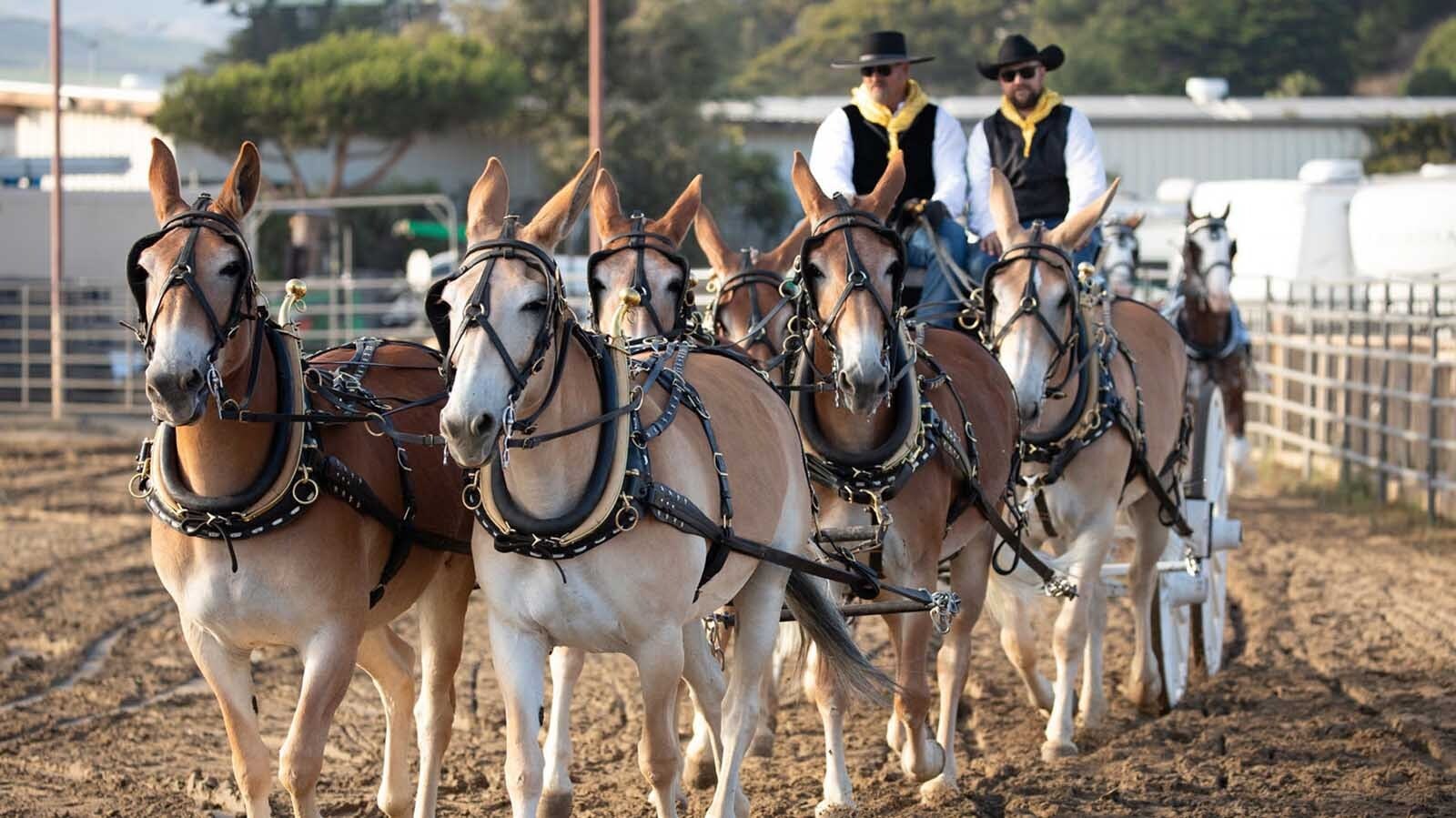
Teamster Rick Edney of Nevada talked himself into one of the biggest challenges a mule skinner can face. He is training 16 mules to pull his wagon down a two-lane street in Thermopolis, Wyoming, to reenact a scene from 1897.
To keep his team in order, Edney will use an old-fashioned jerk line and has been spending the last few months retraining his mules for this feat.
“With a jerk line, we’re not going to have a driving line to each mule,” Edney said. “They’re on their own a little bit and that means, the mules are on the honor system.”
Edney’s mules are used to driving four abreast but with the jerk-line and two-track road, they are learning how to pull in pairs.
“The way we steer those mules is with a rope that runs up alongside and connects to the bit on one of the lead mules,” Edney said. “One jerk to the left means turn left. Two jerks to the right means turn right.”
Edney said that it is taking extensive training for his mules to learn this new technique.
He said the idea of using so many mules came up when talking to Terry Geissinger, one of the event planners for the Trailblazer Days being held this coming June in Thermopolis.
“She called me last spring and said they were looking to put together some kind of event, maybe like a Founder’s Day,” Edney said. “One of their founders was a 16-Mule Johnson, and she wondered if I would have any good ideas.”
Edney soon called her back and told her that they needed to recreate the whole outfit. He found himself hired on the spot and soon set to work.
“We are recreating a traditional freight wagon, all tied together, with a wheel team in front of it,” Edney said. “And, of course, 16 mules.”
These freight wagons used to be common in the region and were once the only way to haul goods into the fledgling town of Thermopolis.
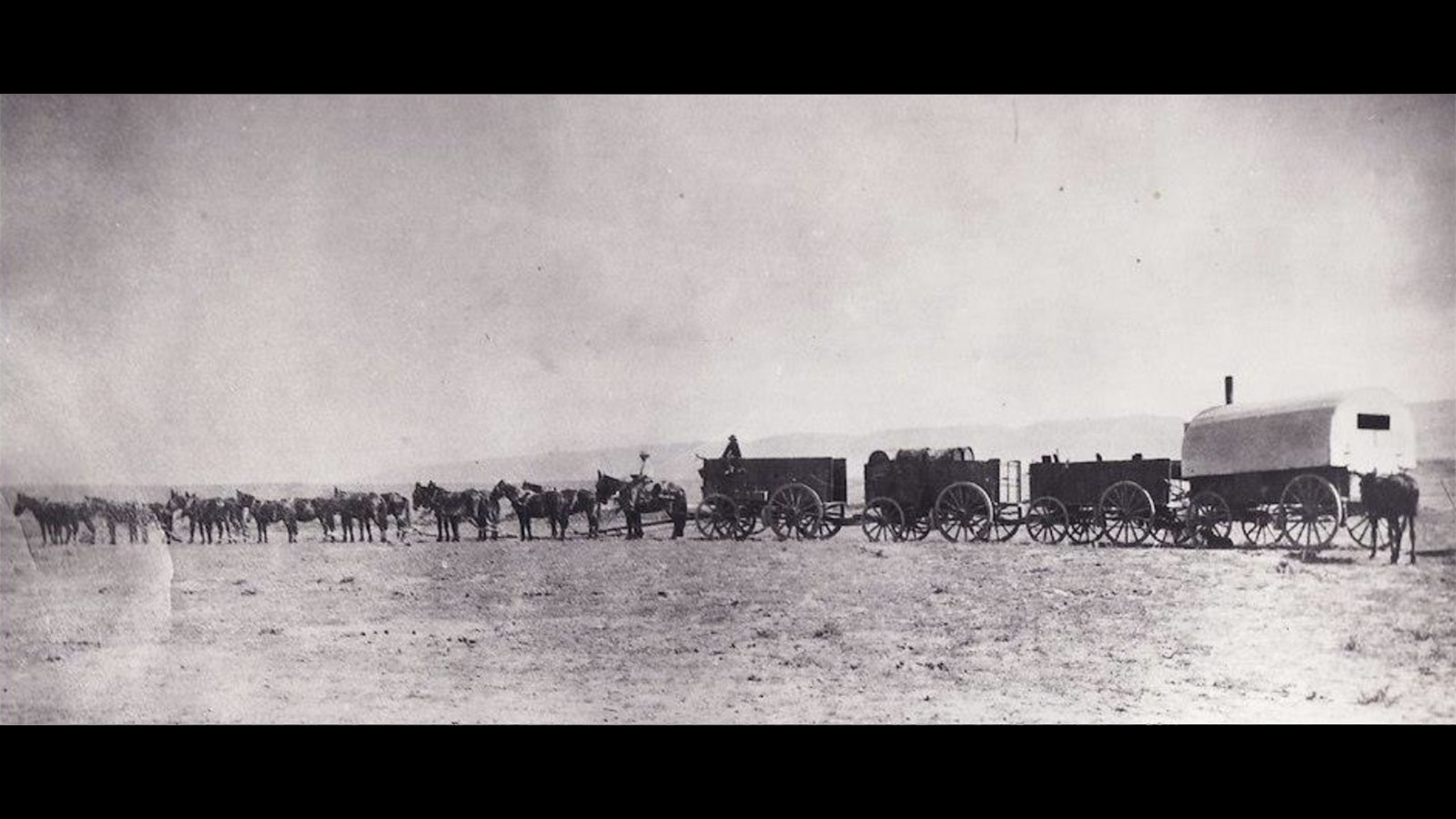
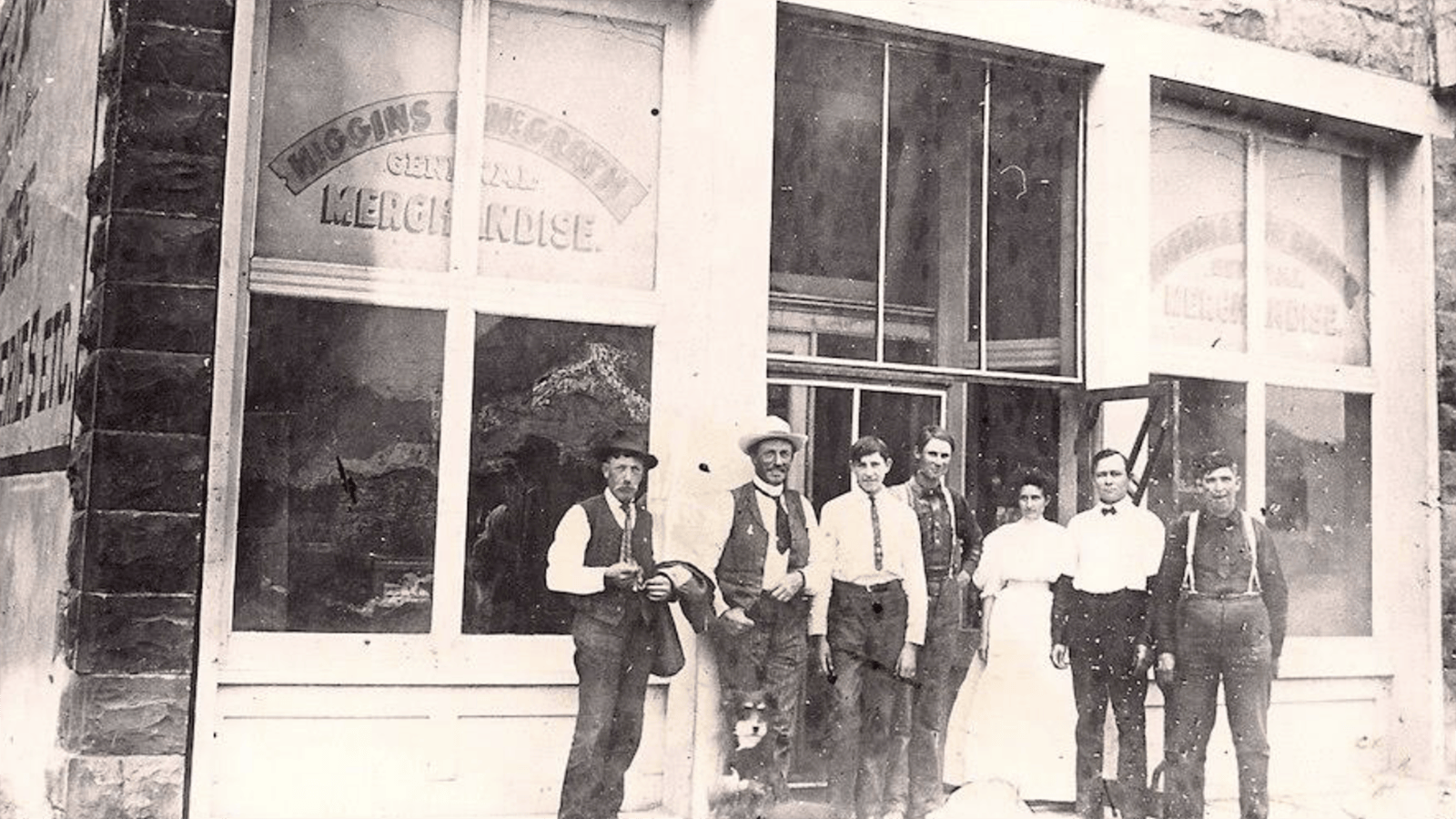
Henry “16-Mule Team” Johnson hauled loads of freight between Casper and Thermopolis in the late 1800s and early 1900s for the Higgins and McGrath store. When the new town of Thermopolis was being laid out, Johnson reportedly asked Martin McGrath to plot out wide streets so that he could easily turn his mules around more easily in the street. (Courtesy Hot Springs County Museum, Thermopolis) 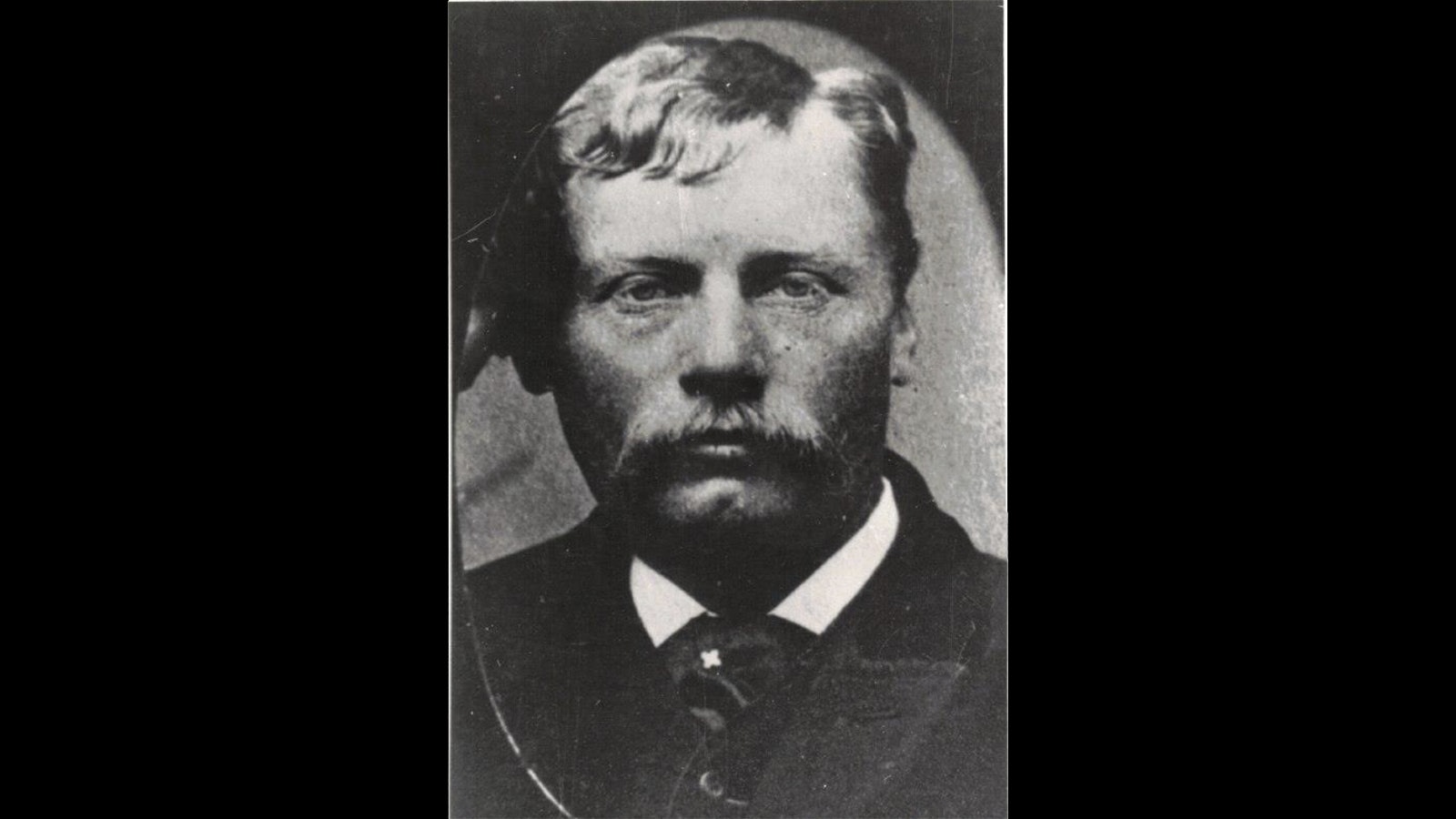
Henry “16-Mule Team” Johnson hauled loads of freight between Casper and Thermopolis in the late 1800s and early 1900s for the Higgins and McGrath store. When the new town of Thermopolis was being laid out, Johnson reportedly asked Martin McGrath to plot out wide streets so that he could easily turn his mules around more easily in the street. (Courtesy Hot Springs County Museum, Thermopolis) 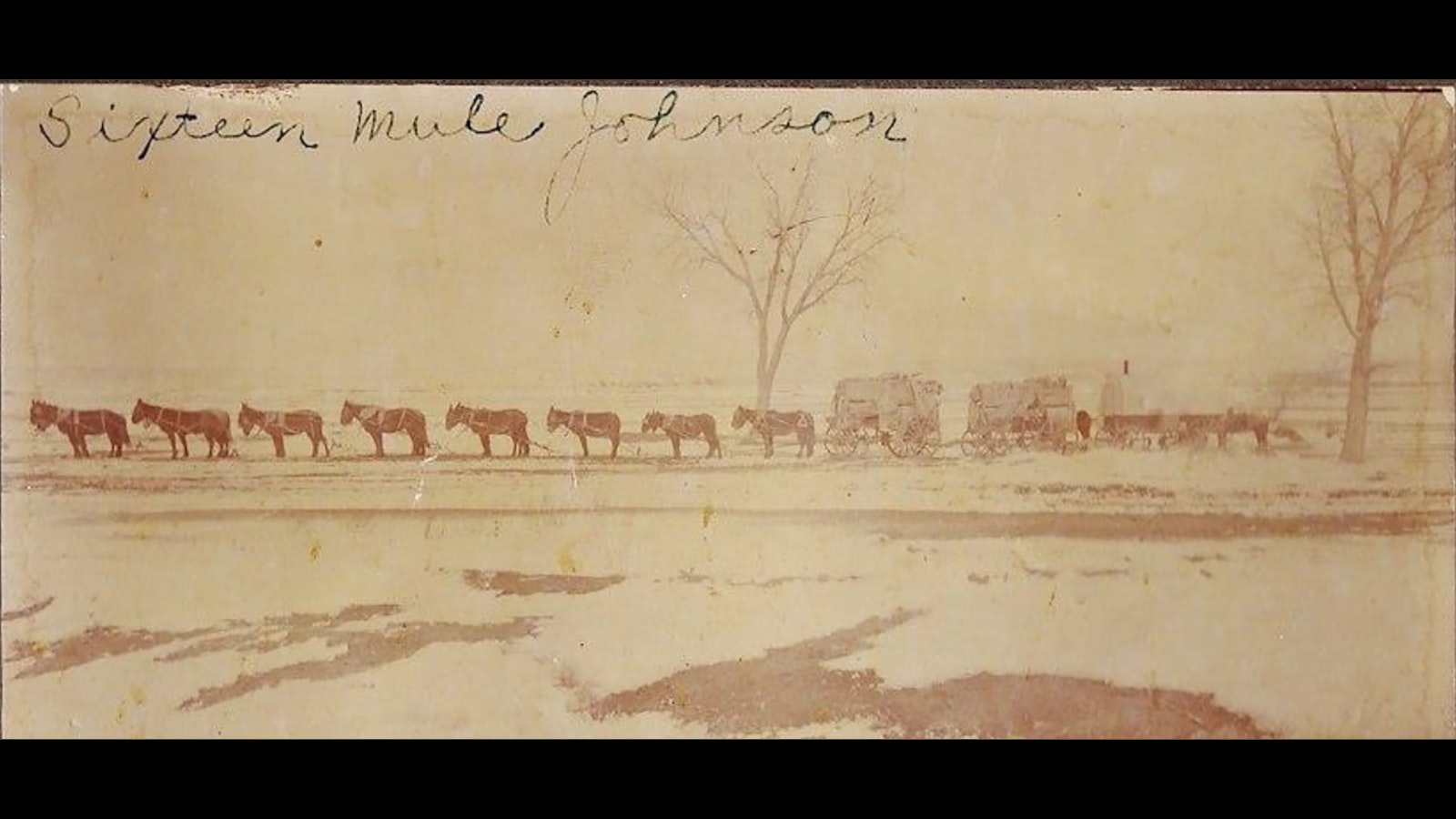
Henry “16-Mule Team” Johnson hauled loads of freight between Casper and Thermopolis in the late 1800s and early 1900s for the Higgins and McGrath store. When the new town of Thermopolis was being laid out, Johnson reportedly asked Martin McGrath to plot out wide streets so that he could easily turn his mules around more easily in the street. (Courtesy Hot Springs County Museum, Thermopolis) 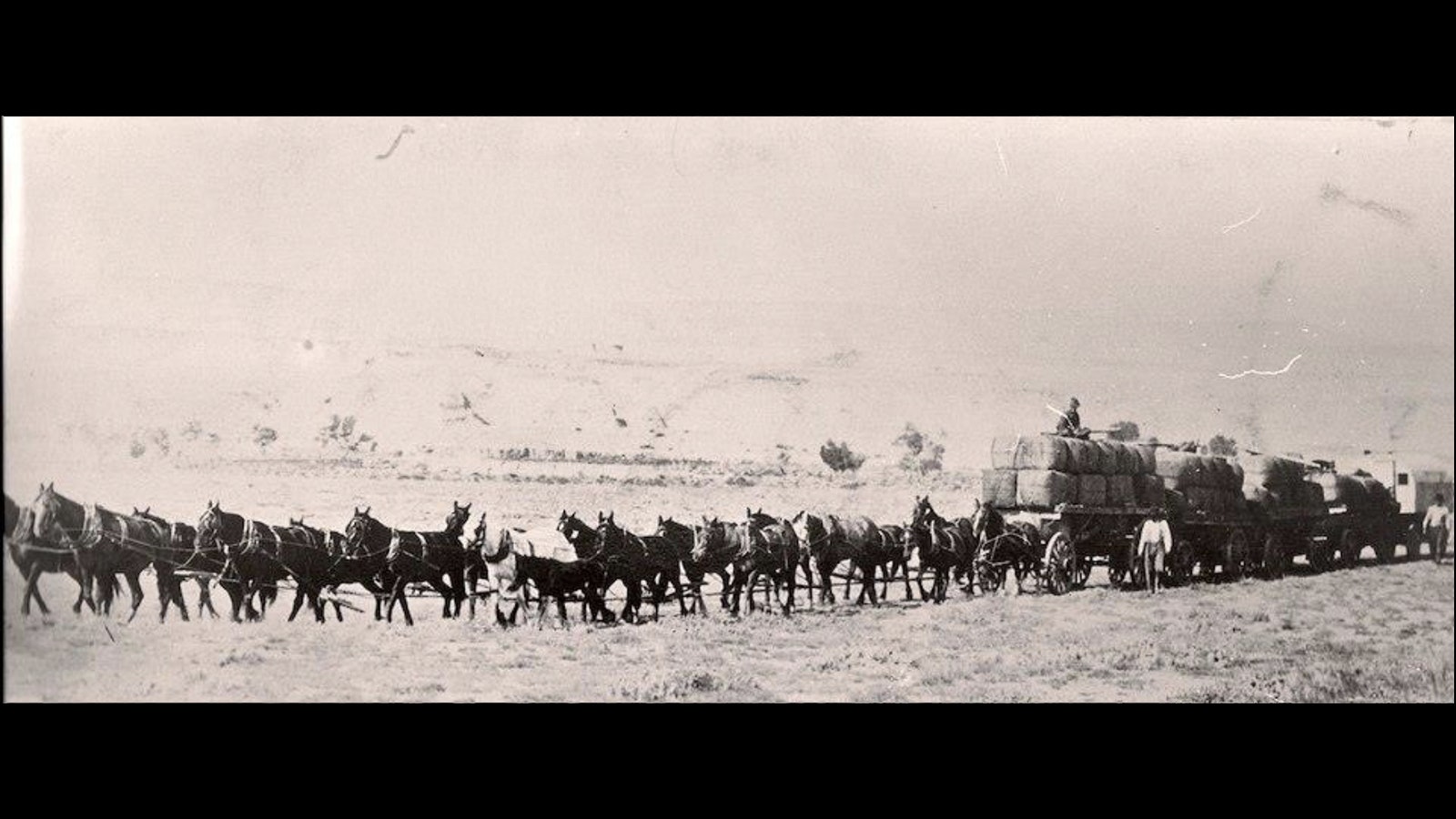
Henry “16-Mule Team” Johnson was not the only teamster to employ large teams of mule. This 20-mule team pulled wool to market for the L-U Ranch in the early 1900s. (Courtesy Hot Springs County Museum, Thermopolis)
Hauling Heavy Freight in 1897
The Big Horn Basin was the most remote area to access in the Wyoming Territory and to haul goods to the new remote town of Thermopolis was an ordeal. Business partners Martin McGrath and Jim Higgins had opened their new general store and needed tons of freight brought in. One load alone in 1897 weighed 24,000 pounds and another was valued at $40,000, the equivalent of $1.36 million in today’s dollars.
Everything from beer to flour to furniture were hauled to the isolated townsite by freighters. It was such an event that nearly every freight wagon train that came to town was noted in the local Big Horn River Pilot. Freight drivers would use up to 20 horses in a team to bring in their loads over the difficult roads and passes from Casper.
Hans Jensen of Denmark was an exception. According to Dorothy Buchanan Milek in her book, “Hot Springs: A Wyoming County History,” Jensen, who legally changed his name to Henry Johnson, was the only one who used mules exclusively. He had started hauling freight for McGrath and Higgins in the early years when the store was located in the Old Thermopolis and became well-known for his mule team.
“He soon acquired the moniker of 16-Mule Team Johnson,” Milek wrote. “Freight was hauled in three of the wagons and the fourth was a sheep wagon sort of affair, a ‘Cooster' which was home to the Johnson family.”
Johnson’s five children, two girls and three boys, lived in the wagon as their father hauled freight. Eventually, this wagon was parked on a homestead as Johnson continued to carry his heavy loads into Thermopolis from Casper.
“Between McGrath and Johnson, they decided the main street of the new town should be big enough to turn his eight-team outfit around in easily,” Milek said. “They never dreamt that nearly a century later the biggest arguments in the town would be over placing parking meters in the middle of their wide street.”
The Challenges
“Everything’s a challenge and you’ve got to have good help,” Edney said. “Two guys can’t do it alone.”
Edney has gathered a crew of 12 to do everything from handle the mules to modify their modern wagons. In 1897, “16 Mule Team” Johnson had done all this work himself although he was known to have enlisted the help of his children.
“We have a master wagon builder in our outfit, which is a big plus,” Edney said. “He’s going to modify our wagons to pull in a train instead of individually.
The mules Edney is retraining are more used to being driven with a field hitch which allows him to take tighter turns. Edney said that they usually drive four abreast and six abreast teams and put the eveners on that chain.
For the jerk line, he will have a lead team with bells on them.
“All the mules want to follow the leader,” Edney said. “The leaders set the rhythm.”
When the mules start to take off, the others hear the bells and take off together. Once they’re moving, the lead mules set the pace, which keeps all the mules working together.
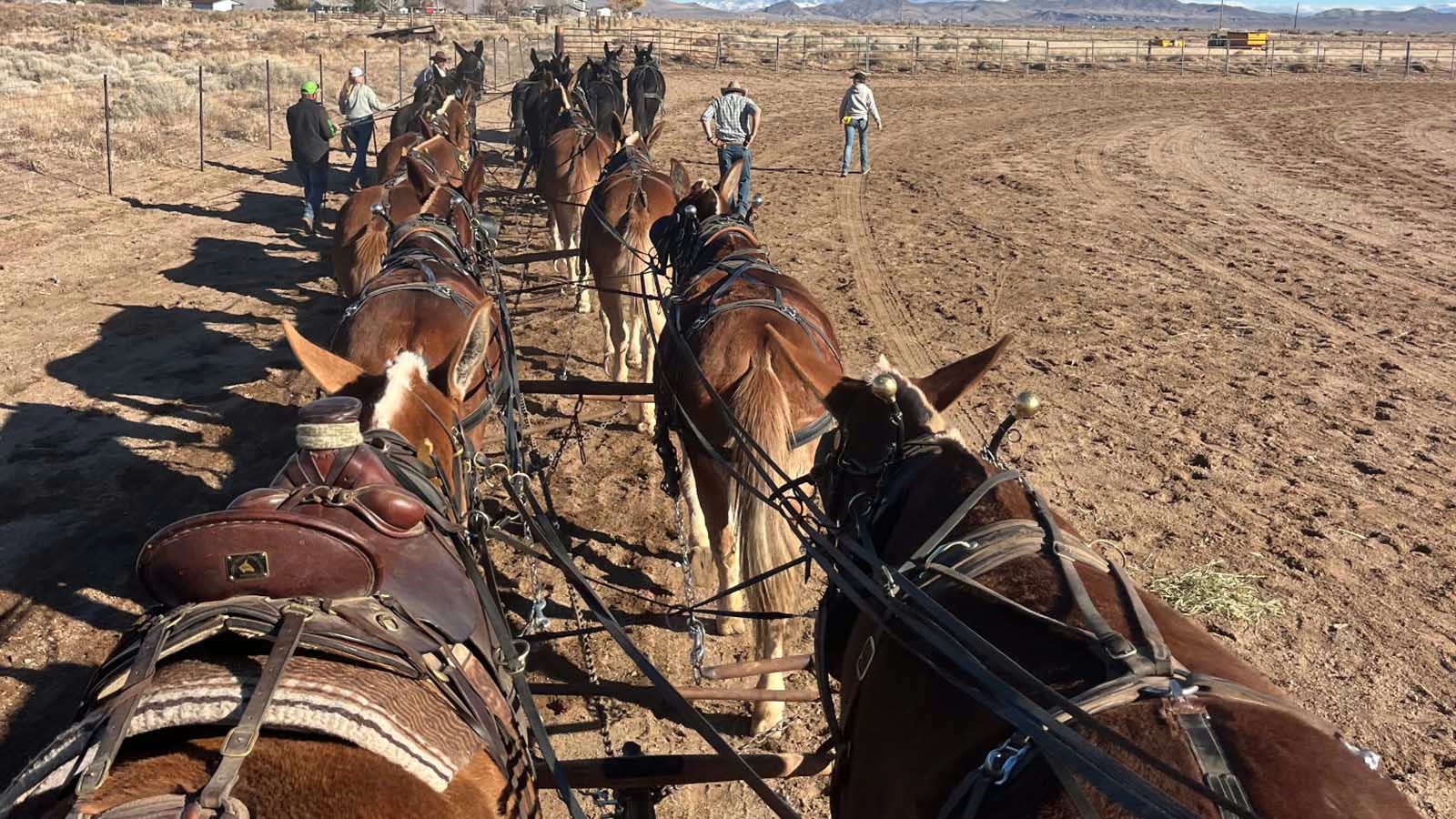
Teamster Rick Edney of Nevada is training 16 mules to pull several wagons to recreate the freight train that used to haul goods into the fledging town of Thermopolis, Wyoming in the late 1800s and early 1900s. He said that it is time consuming retraining his mules to a jerk line but is excited reenact the feats of Henry "16-Mule Team" Johnson. (Courtesy Rick Edney) 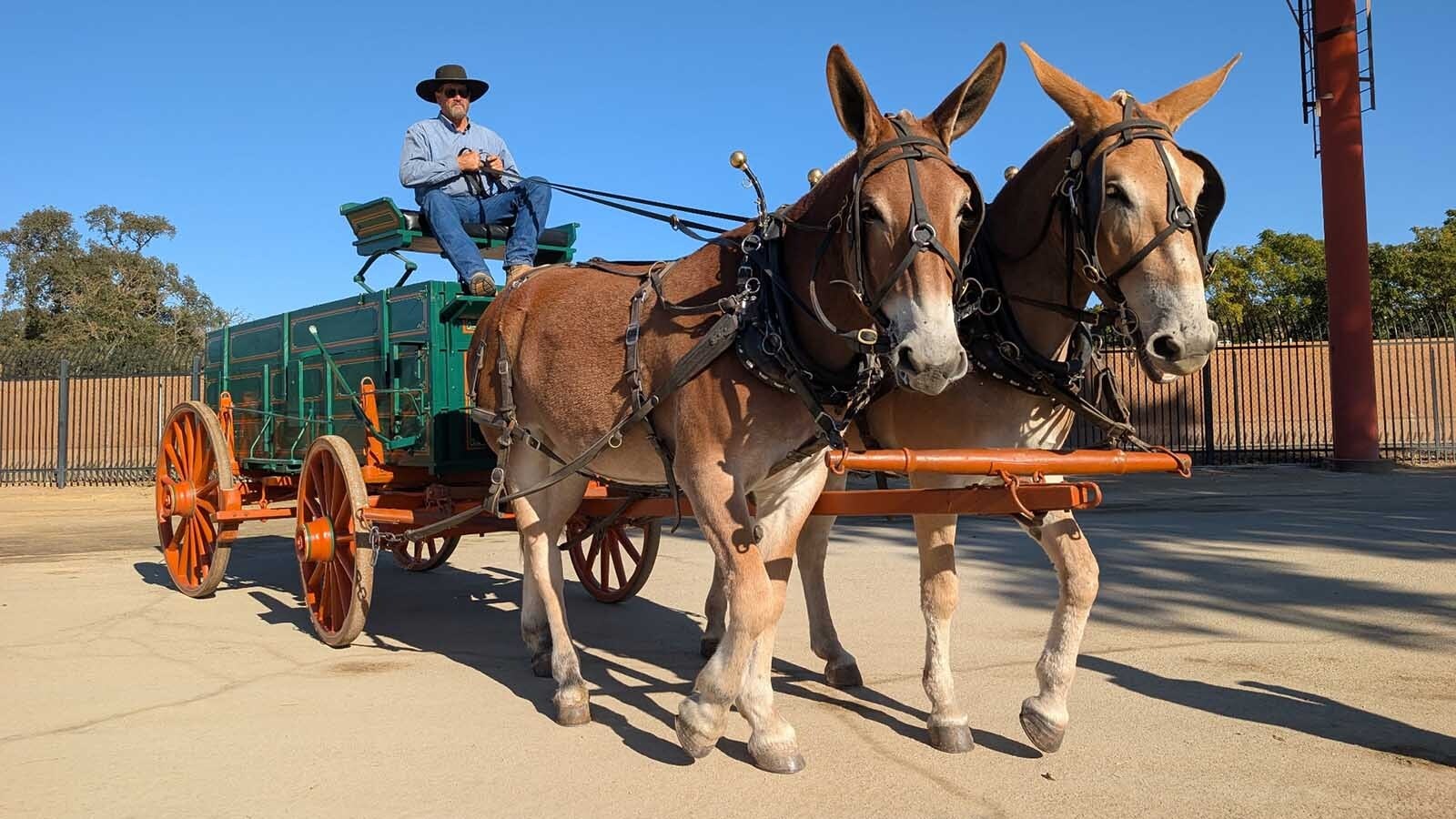
Teamster Rick Edney of Nevada claims that mules are stronger than horses, pound for pound, and smarter. He said that their reputation for stubbornness is actually self-preservation and caution. (Courtesy Rick Edney)
The Mules
Edney has eight mules that he is training and the rest he will be borrowing from the Sierras in Northern California.
“Getting together to practice is tough,” Edney said. “We have a storm that’s going to make traveling over the mountain rough, so we had to cancel our last practice.”
Edney is hopeful that the teams will have at least two more practices before the big day in Thermopolis. He is also still determining what role each mule will have.
“I use my two smallest mules, Abby and Rose, as my leaders,” Edney said. “I’m not sure if we’ll use them for the big hitch or not.”
Edney said the advantage of mules is that they are smart and much more practical than horses.
“Pound for pound, they’re stronger than horses,” Edney said.
He explained that their reputation for being stubborn is actually self-preservation.
“When you’ve worked around them long enough, you realize that they’re careful,” Edney said. “They stop and think things out.”
He used the example that if a mule gets his foot stuck in a fence, he won’t panic like horses, who’ve been known to rip off their hide.
“A mule will stand there all-night waiting for you to come rescue it,” Edney said. “I’ve seen that happen time and time again.”
Strong Personalities
Edney also said that most of the mules are fun characters that he is training for his 16-mule team.
“They’re like puppies a lot of times,” Edney said. “If you’re out there petting one, the other one will come push right in between you until they get the attention.”
The oldest mule will be 28 this year and she is what Edney described as an old creeper. However, he said that she holds her own and still wants to work all day. His two youngest mules are three years old and are his biggest mules. They will be the wheel team and closest to the wagon because of their large size.
“They’re not stubborn at all and are willing to do anything you ask,” Edney said. “Their biggest problem is they’re still adolescents and will chew anything they can get their teeth on.”
As Edney keeps a close eye on the pair to make sure they don’t get bored and chew up their harness or driving lines, he is looking forward to driving his team of 16 mules down Thermopolis’ Broadway Street to relive what the teamsters of old once did every day.
Jackie Dorothy can be reached at jackie@cowboystatedaily.com.