
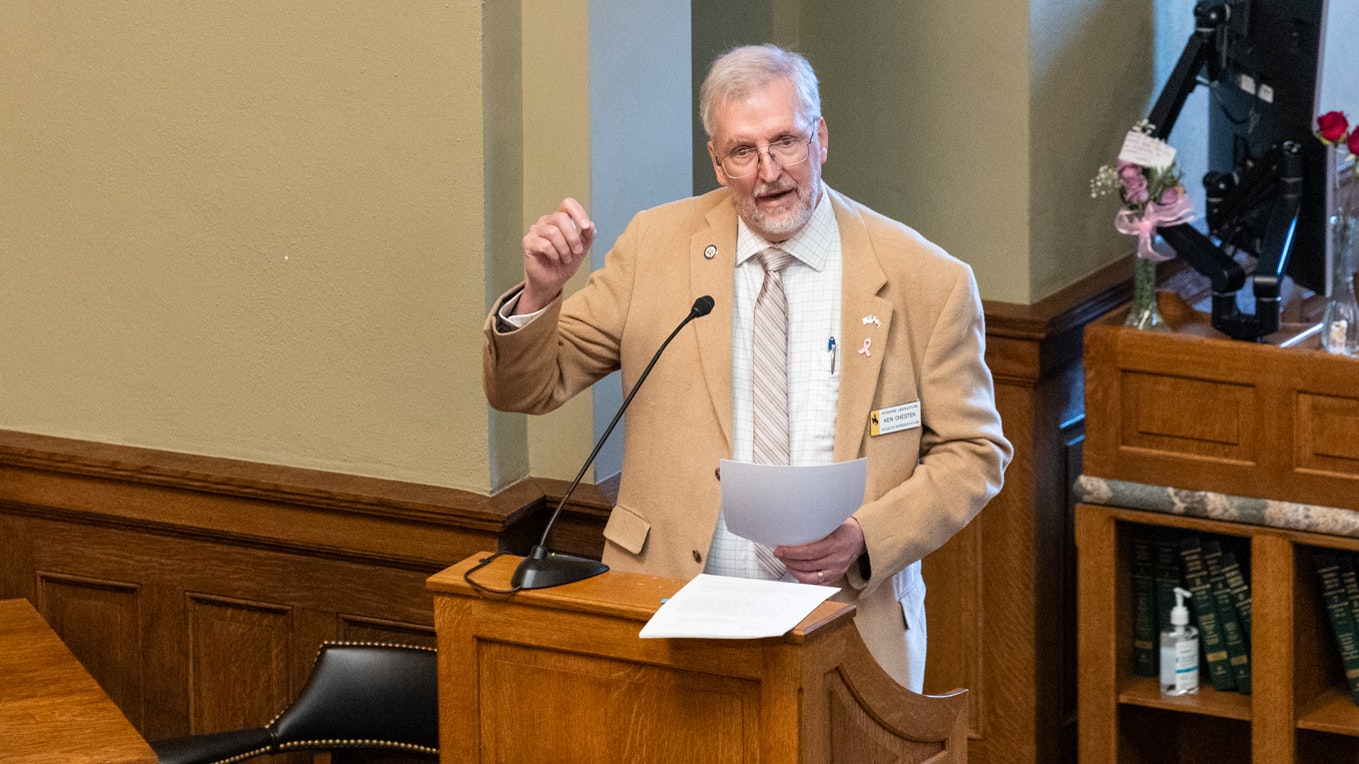
The House on Wednesday voted to keep a proposed $40 million cut to the University of Wyoming. The Senate did the opposite, reversing the cut - setting the two chambers up for a clash in a 10-person committee they'll both form.
The Wyoming House of Representatives by a 26-34 vote Wednesday rejected an effort to reverse its budget-planners’ proposed $40 million cut to the University of Wyoming.
That followed more than 90 minutes’ impassioned debate on the House floor, in which opponents of the cut called it ill-supportive and vindictive, and proponents of it noted that in the private sector, families and businesses have also had to tighten their expenditures due to inflation and other factors.
The Senate, conversely, voted Tuesday to reverse the cut and restore the $40 million.
If the contrast between the two chambers’ vision for UW’s budget remains after a final round of House budget amendments set to unfold Friday or Saturday, it will set the issue up for a showdown in a 10-person committee comprising five representatives and five senators.
The House speaker and Senate president get to appoint those negotiators once each chamber has vetted and changed the budget to its liking.
“This is the big one,” began Rep. Ken Chestek, D-Laramie, when touting the 66th of 120 amendments the House was slated to entertain on the budget’s second reading this week.
“The chairman of committee number two during the presentation of the bill… told this body (the cut) was made ‘because we needed to get the university’s attention,’” said Chestek, a reference to House Appropriations Chair John Bear.
Bear and others who support the cut have pointed to a cultural clash between the university and the socially conservative legislature.
“The inference,” continued Chestek, “was that somehow the university had ignored or skirted legal requirements.”
Chestek, who is a former UW law professor, said that inference is not true. He said UW honored a 2024 legislative budget footnote asking it to eliminate its diversity, equity and inclusion office, and a 2025 law prohibiting DEI-like instruction.
Chestek said the university eliminated “close to 30 courses.”
“I think these actions show the Legislature did indeed get the attention of the university,” he said.
House Speaker Chip Neiman countered, saying UW has more administrative bloat than schools in surrounding states. He also pointed to data showing 6,900 total employees, and 10,819 students – for about 1.5 students to every employee.
“I don’t know a business that can sustain that,” said Neiman, adding that detractors of the cut have postured themselves like,” don’t challenge that. Don’t question that. Don’t make anybody start looking at the bottom line – we just give you more money and it’ll be fine.”
Rep. Julie Jarvis, R-Casper, asked why the legislature wouldn’t just write laws limiting administrative bloat, if that’s the problem.
Rep. Trey Sherwood, D-Laramie, said that of those 6,900 employees, only 765 are faculty – posing a 14-to-one student-to-faculty ratio.
“Plumbers don’t teach,” said Sherwood, who also derided a budget footnote shielding the Colleges of Agriculture and Education, a minerals facility and program within it, and a tourism school. These make cuts to the other institutions deeper, Sherwood noted.
Ecofeminism
Rep. Ken Pendergraft, R-Sheridan, who was one of the Joint Appropriations Committee members who advanced the cut, noted that though the $40 million cut comprises roughly a 10% cut to the state’s grant to UW, it comprises about 4% of its total revenue.
With inflation, rising insurance costs and property taxes, Wyoming households have also sustained cuts, said Pendergraft.
He noted that UW’s website still, as of Wednesday midday, was showing gender and women’s studies, and a controversial course called “ecofeminism.”
Ecofeminism, Rep. Landon Brown, R-Cheyenne, parried, is a doctorate-level course – not an entry-level class used to indoctrinate freshmen.
“Again, not a course I’m going to take,” said Brown. “But if I want to go and… have a little bit better understanding what people who don’t agree with me think – it’s probably not a bad idea.”
Rep. Paul Hoeft, R-Cody, noted the declining birth rates, and how those could translate to lower attendance.
Rep. Steve Harshman, R-Casper, told the House that the way to reform UW is to pass targeted cuts. For example, he said, the university wanted to drop its trades education around seven years ago.
UW told JAC members last month that it teaches career and technical education, or “trades” teachers, while community colleges teach trades.
“I ran an amendment that said you’re going to lose $10 million of your block grant until you restore that,” recalled Harshman, adding that UW restored its trades programs and now draws students from areas without them.
The Rancher
Brown and Neiman clashed briefly when Brown said “not one of” the proponents of the cut attended UW.
“That says something to me,” Brown said.
Neiman, who runs a successful ranching operation in northern Wyoming, bristled.
“As a legislator who doesn’t have a college education and didn’t go to the University of Wyoming,” said Neiman, “I’m kind of curious, ladies and gentlemen, how that suddenly makes me less able to have something to say about how the spending of these dollars of the state of Wyoming – and the taxpayers – and have an ability to opine on this.”
Neiman said he has a 12th grade education and his dad had a 10th grade education – but still took the ranch over from a UW College of Agriculture graduate, who had “lost it.”
Chestek said the conversation kept shifting, from culture clashes, to efficiency, to dropping birth rates, and other justifications for the cut.
“It was news to me, sitting here today after I presented the bill – now we’re talking about administrative bloat?” he said. “That wasn’t the justification we got from committee no. 2.”
Sherwood had told the House that the Appropriations Committee – which lawmakers call “committee no. 2” to avoid proper nouns in what is supposed to be a merits-only debate uncharged by names and characters – did not discuss administrative bloat when making the cut.
Roll Call
Those voting to keep the cut were Republican Reps. Bill Allemand (Midwest), Abby Angelos (Gillette), Bear, Marlene Brady (Green River), Laurie Bratten (Sheridan), Gary Brown (Cheyenne), Kevin Campbell (Glenrock), Rob Geringer (Cheyenne), Joel Guggenmos (Riverton), Jeremy Haroldson (Wheatland), Scott Heiner (Green River), Hoeft, Steve Johnson (Cheyenne), Chris Knapp (Gillette), Jayme Lien (Casper), Tony Locke (Casper), Ann Lucas (Cheyenne), Darin McCann (Rock Springs), Pepper Ottman (Riverton), Pendergraft, JR Riggins (Casper), Rachel Rodriguez-Williams (Cody), Mike Schmid (La Barge), Daniel Singh (Cheyenne), Scott Smith (Lingle), Tomi Strock (Douglas), Clarence Styvar (Cheyenne), Reuben Tarver (Gillette), Jacob Wasserburger (Cheyenne), Joe Webb (Lyman) Nina Webber (Cody), Bob Wharff (Evanston), John Winter (Thermopolis), and Neiman.
Those voting against the cut were Republican Reps. Ocean Andrew (Laramie), Landon Brown, Andrew Byron (Jackson), Elissa Campbell (Casper), Ken Clousten (Gillette), Marilyn Connolly (Buffalo), Bob Davis (Baggs), McKay Erickson (Afton), Lee Filer (Cheyenne), Justin Fornstrom (Pine Bluffs), Harshman, Jarvis, Lloyd Larsen (Lander), JT Larson (Rock Springs), Martha Lawley (Worland), Bob Nicholas (Cheyenne), Pam Thayer (Rawlins), JD Williams (Lusk), and Cody Wylie (Rock Springs).
Plus all Democrats voted against keeping the cut: Chestek, Sherwood, and Reps. Ivan Posey (Fort Washakie), Karlee Provenza (Laramie), Liz Storer (Jackson) and Mike Yin (Jackson).
Clair McFarland can be reached at clair@cowboystatedaily.com.


