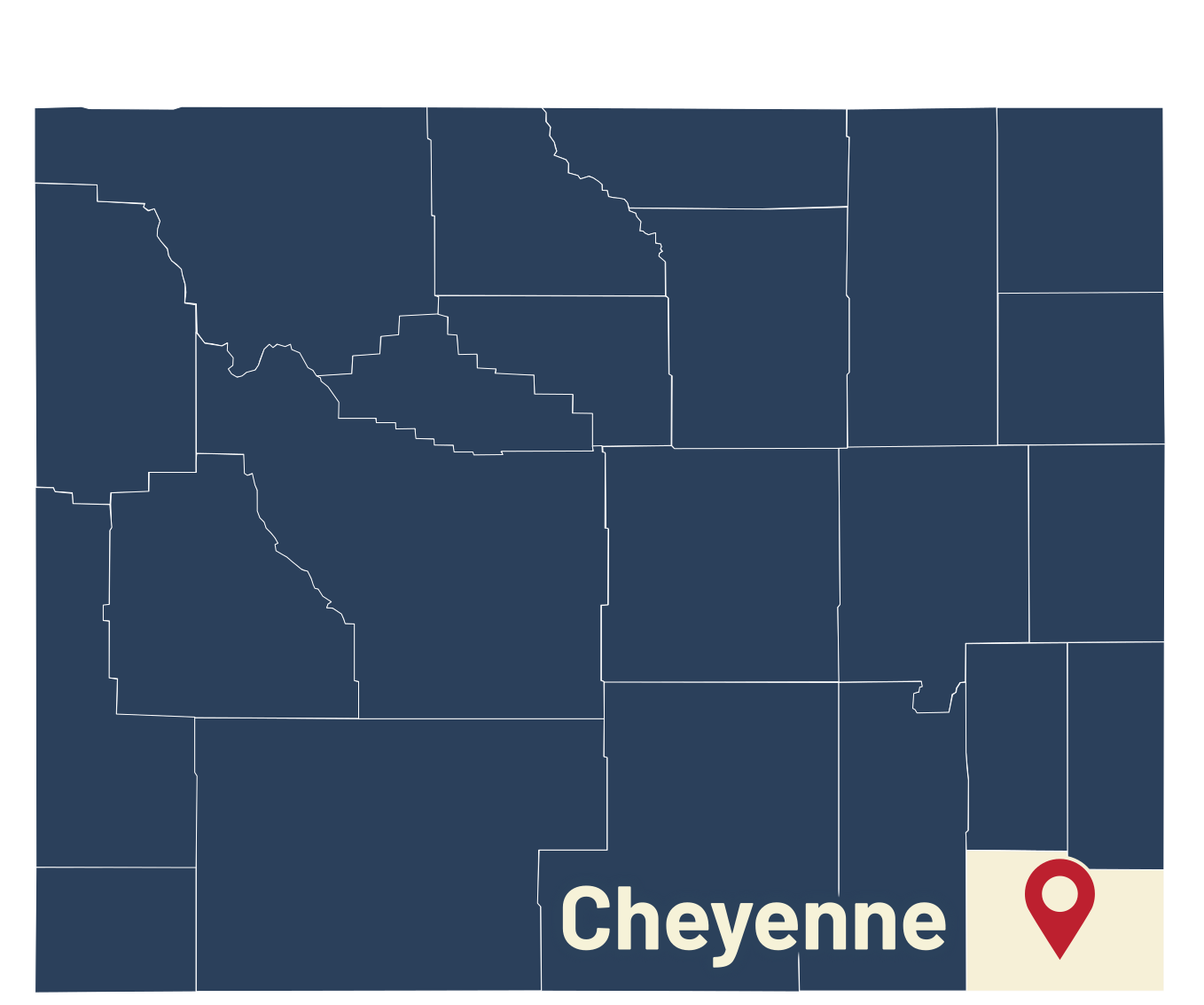
CHEYENNE — When a power company showed up to rework a high-voltage transmission line cutting through the middle of the Jackpot Ranch in northeast Wyoming, Tyler Lindholm was ready for the conversation.
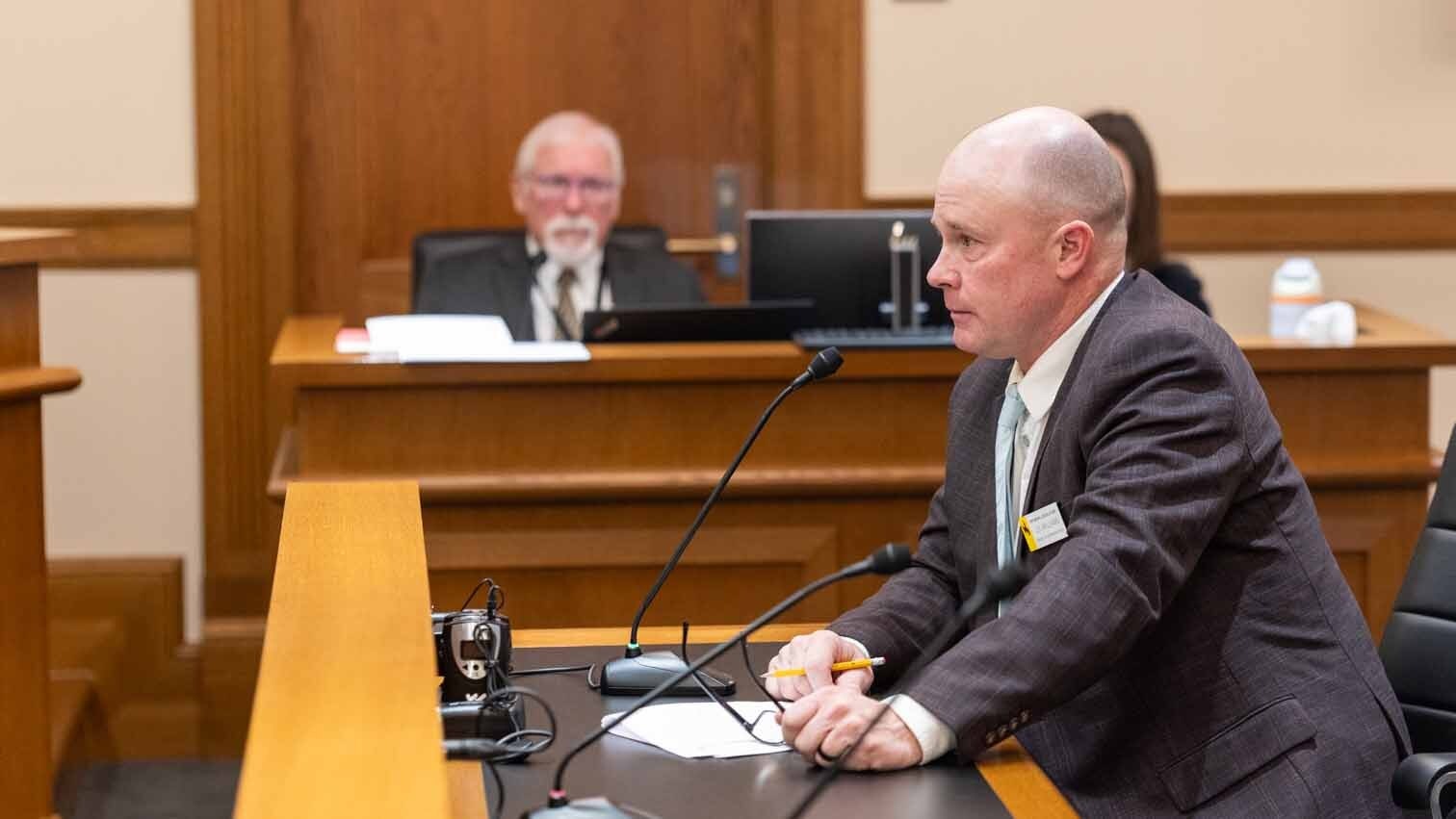
Most landowners know they have rights when an entity with eminent domain authority comes knocking. But knowing rights exist and being prepared to exercise them are two different things, Lindholm told a legislative committee Tuesday, and it’s that gap between awareness and readiness that often costs ranchers and property owners at the negotiating table.
The Jackpot Ranch predates the state of Wyoming. Lindholm is fifth generation. His children are sixth. Between Interstate 90, a county road and that transmission line, the family has dealt with eminent domain issues over the years.
Lindholm said he has an energy background and describes himself as “kind of geeky on statute,” so when Black Hills Energy came through about three and a half years ago to redo the line, he sat down with his father, Dallas Rolf, the fourth-generation ranch president, and mapped out their position.
“I said, ‘Listen, we have rights here and this is what they look like,’” Lindholm told Cowboy State Daily.
Because the family came to the table prepared, Rolf ended up with a bigger check for the right-of-way access and a deal to keep old transmission line poles for rebuilding corrals on the ranch.
“From their initial offer to where we ended up were vastly different things,” said Lindholm. He credited Black Hills Energy for working with the family once they made their position clear. “Being better informed about your rights will absolutely better your stance anytime you’re dealing with eminent domain.”
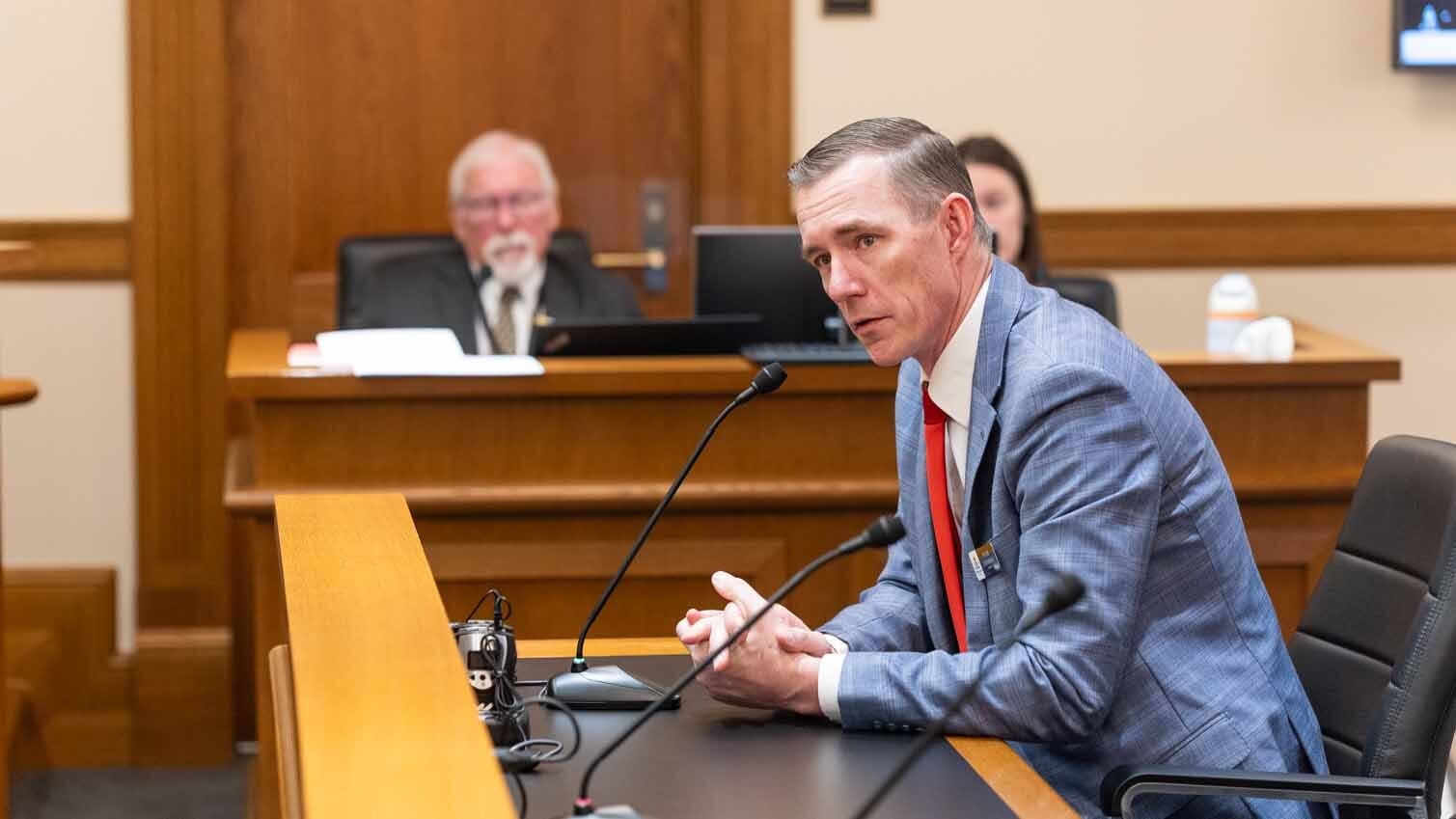
But Lindholm, a former legislator who serves as the Wyoming state director of Americans for Prosperity, told the House Agriculture, State and Public Lands and Water Resources Committee that not every rancher walks into those negotiations prepared the way his family was.
“I think that’s a misconception that a lot of ranchers believe, and landowners believe, is that when the transmission company shows up, or the pipeline company shows up, that they’re going to seize their land, and they’re just lucky to get anything at all,” Lindholm said. “That is not the truth.”
Putting a standardized bill of rights brochure in landowners’ hands before negotiations begin, he argued, would do exactly what his own preparation did for the Jackpot Ranch — level the playing field.
That’s the aim of House Bill 11, he said.

Bill Introduced
Rep. JD Williams, R-Lusk, introduced HB 11 on the House floor Feb. 10, drawing on personal experience.
“I’ve had that conversation several times in my career. When I first had that conversation, it was very intimidating to me. I interpreted the mention of eminent domain as a threat. Partly because I was not aware of my rights under eminent domain,” Williams told his colleagues.
The bill would create a standardized “Landowner’s Bill of Rights” document that must be delivered to any property owner before or at the same time an entity with eminent domain authority first indicates it may seek to condemn their property.
The brochure would outline rights including adequate compensation, the constitutional requirement that takings serve the public interest, the obligation of condemning parties to negotiate in good faith, 15 days’ advance written notice before anyone enters property for surveys, and the right to hire an appraiser or attorney.
In an email to Cowboy State Daily, Williams explained the motivation.
“When any entity mentions ‘eminent domain’ to a landowner, it is often perceived as a threat even when the entity is required by statute to breach the subject,” Williams wrote. “’The Landowner’s Bill of Rights’ will equip landowners with valuable knowledge that will lend clarity to a difficult conversation.”
Committee Debate
When the bill came before committee Tuesday, it drew supporters and no opponents — but the details sparked debate over a deceptively simple question: When, exactly, should landowners get the brochure?
Austin Rodemaker, representing Tri-State Generation and Transmission Association, told the committee Tri-State supported the bill and came with amendments worked out in advance with Williams. The most significant would replace the phrase “will or may attempt” to condemn property with the word “intends,” aligning the bill’s language with existing statute.
“In the last 10 years we’ve gone into condemnation through eminent domain once, and that was when we couldn’t contact a landowner,” Rodemaker said. “The people that we are working with here are our members. So we’re not trying to hurt our members.”
Pete Obermueller, president of the Petroleum Association of Wyoming, agreed with Tri-State’s amendments and added one assigning the Wyoming Attorney General’s office responsibility for creating the brochure, ensuring a single, neutral document used statewide.
Obermueller offered a counterpoint rooted in years of watching negotiations unfold.
“What landowners despise is if one of my members come into the room on the very first time and say, ‘Yeah, but we have eminent domain authority,’” Obermueller said. “If a bill mandates us that we walk in the door and immediately hand them an eminent domain brochure, then the state is basically forcing us to have that difficult conversation right away instead of all of us taking a step back and saying, ‘How can we come to an agreement that never gets to that point?’”
Rep. Steve Johnson, R-Cheyenne, was more blunt.
“Anybody that shows up at a rancher or landowner’s door, they have a huge club that they’re holding over the head of that landowner,” Johnson said.
Era Aranow of Rocky Mountain Farmers Union described the fear landowners face.
“Those companies deal with this all the time. Individual landowners don’t,” Aranow said. “And so there’s fear for our property, fear for our rights, fear for the money that this may cost us in the short term and the longer term.”
Claire Deuter of the Powder River Basin Resource Council also testified in support.
The bill passed 9-0 with amendments and heads to the full House.
Alkali Creek
The same day HB 11 sailed through committee, the Wyoming Senate held its own debate over eminent domain.
During second reading of Senate File 70, the annual omnibus water bill, an amendment was introduced to prohibit state-appropriated funds from being used to exercise eminent domain on the Alkali Creek Reservoir project.
“It is a heavy hand when you get several million dollars from the state and then exercise eminent domain over private property and use those funds to basically buy out your neighbor’s property,” said Sen. Cheri Steinmetz, R-Torrington, the amendment’s sponsor.
Sen. Tim French, R-Ralston, said he fully supported it: “What landowner out there wants to be browbeat with, ‘You either work with me, negotiate with me, or I’ll do eminent domain and take it anyway?’”
Also thinking about how local landowners opposed to the Alkali Creek project might feel, Sen. Bob Ide, R-Casper, said, “Anytime you can put a speed bump in front of eminent domain, it’s good. It’s really not fair to be using taxpayer money anyway. I mean, the neighbors that are against this, you’re effectively using their money to condemn their own property. So, I’m on and for this amendment.”
Sen. Dan Dockstader, R-Afton, framed it like this: “It simply comes down to property rights. Are we on the side of property rights or not?”
But opponents lined up against the amendment. Sen. Chris Rothfuss, D-Laramie, said that without even the possibility of eminent domain, “that changes the negotiation position to a large degree and obviates the project.”
Sen. Charlie Scott, R-Casper, noted that water projects are geographically constrained and that Wyoming’s constitution specifically authorizes eminent domain for both public and private water projects.
Senate President Bo Biteman, R-Ranchester, stepped out of the chair to question the amendment’s constitutionality, saying, “It’s clear in our state constitution that we have eminent domain for these types of projects and taking this out I think is unconstitutional.”
When a voice vote proved too close to call, a standing division settled it. The amendment failed 12-17.
Broader Bill
But the fight over eminent domain and water is far from over. Later on Tuesday, Sen. Jared Olsen, R-Cheyenne, re-referred Senate File 118, titled “Eminent Domain Water Projects,” to the Senate Agriculture Committee.
Where the failed Alkali Creek amendment targeted a single project, SF 118 would establish a sweeping new requirement across all state-funded water development: the Legislature itself would have to approve the use of eminent domain for any project receiving state water development funds.
The bill would amend more than a dozen sections of Wyoming statute to make the power of eminent domain contingent on legislative authorization.
Under SF 118, when the Legislature appropriates funds from the state’s water development accounts, it would be required to specify whether eminent domain may be used to complete the project. If the need for eminent domain arises after an appropriation is made, the project sponsor and the Wyoming Water Development Commission would have to notify the Legislature, and no funds could be spent on the project until lawmakers authorize eminent domain through legislation in a subsequent session.
The bill would apply to projects initiated on or after July 1, 2026.
David Madison can be reached at david@cowboystatedaily.com.