CHEYENNE — When Focus Clean Energy's Pronghorn project began taking shape in Converse County, promising hundreds of wind turbines and billions in investment, the pushback started with the turbines themselves. Ranchers and residents didn't want them on the landscape.
But the opposition intensified when locals learned what all that wind-generated electricity would actually do — power a process called electrolysis that would split their water into hydrogen and oxygen to produce "green" jet fuel.
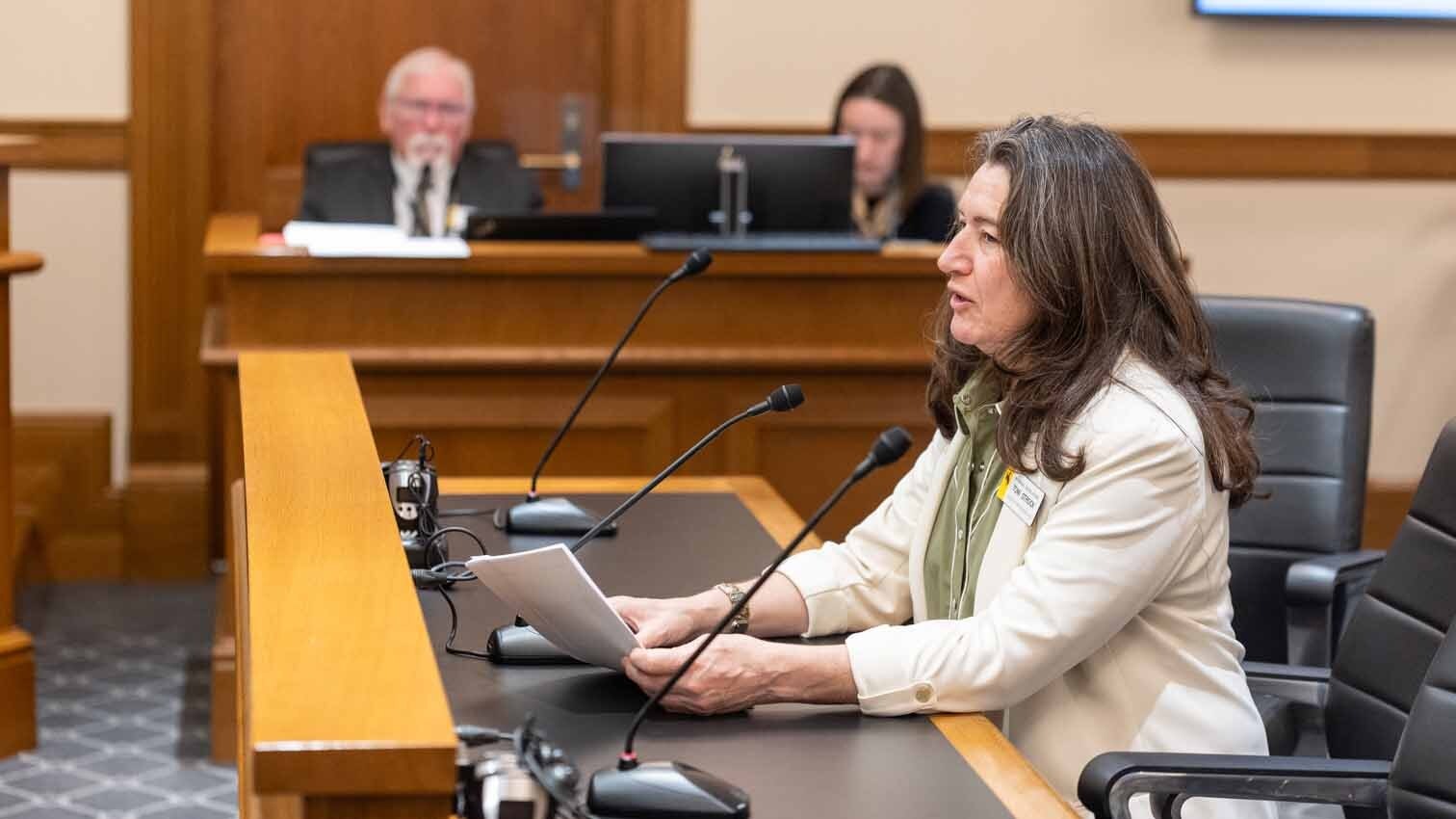
Rep. Tomi Strock, R-Douglas, watched the controversy unfold in her community. On Tuesday, she presented House Bill 116 to the House Agriculture, State and Public Lands & Water Resources Committee, calling it "a clear Wyoming first water protection bill."
"When the industrial process destroys the water molecule itself, it efficiently removes that water from the natural water cycle as water, changing its form and availability in a way that cannot be reclaimed for downstream uses in the same way," Strock told the committee. "And in our arid state, that is not a policy choice. It's a long-term resource decision."
The bill, sponsored by the Select Water Committee, declares that splitting water molecules to industrially produce hydrogen "shall not constitute a beneficial use of water" — the foundational legal standard governing every water right in Wyoming.
The committee passed it 8-1, with Rep. Karlee Provenza, D-Laramie, casting the lone no vote.
"I don't think we're ready for prime time on this," Provenza said. "I'm not entirely sure exactly what we're doing with this and what the implications might be."
Project Reworked
The Pronghorn project has since been challenged in court, and its lease of state land has become a political flash point, drawing criticism from Secretary of State Chuck Gray and support from Gov. Mark Gordon.
Focus Clean Energy announced Jan. 29 that it has reworked its plans entirely, dropping hydrogen production and reducing the project's footprint from roughly 57,000 acres to about 16,571 — a reduction of approximately 70%.
"Rapidly increasing energy demand means Wyoming needs additional electric generation, and the Pronghorn Project is repositioned to help meet that need," said Paul Martin, president of Focus Clean Energy, in a press release. "We anticipate these significant changes will resolve many of the concerns expressed by the community."
The company said removing the hydrogen component means water needs will be limited to basic office operations like sinks and restrooms.
Market Driven
In an interview with Cowboy State Daily, Martin said the decision to drop hydrogen was driven by market dynamics, not politics.
"At the heart of this effort from the start has been to build the wind and the solar projects, and we were trying to do an additional layer of economic activity within Wyoming," Martin said. "But when it comes down to it, we don't need to specify what the consumer is of our electrons, and the market has just changed for electricity over the years that we've been doing this project."
Martin said the hydrogen market isn't progressing as projected.
"As we look at one alternative being the hydrogen route, it is not advancing at the same way as other industries are," Martin said. "If we're to move forward in the near term, it probably is not going to be a hydrogen consumer."
Dropping hydrogen gives the company far more flexibility to sell power into Pacific Power's grid, Black Hills Energy, Tri-State Generation or to private industrial users, Martin said.
The company still holds a signed lease with the state for the project. Martin said the project — which got its start in 2021 — now sits primarily on two ranches belonging to a single private landowner, in addition to state land.
"We have a signed lease with the state of Wyoming that is a real contract," Martin said.
Sidewinder Question
While HB 116 may not directly impact the reworked Pronghorn project, which no longer includes hydrogen production, it could affect Focus Clean Energy's Sidewinder project in Niobrara County — where hydrogen has not been ruled out.
Asked whether hydrogen is off the table for Sidewinder, Martin was less definitive than he was about Pronghorn.
"It's really much more difficult to make a firm decision on that than for Pronghorn," Martin said. "This announcement really is about Pronghorn. Sidewinder has its own dynamics."
Martin said the biggest uncertainty around Sidewinder is a permitting question. He said the company has been waiting a year and a half to two years for local planning and zoning officials to revise their regulations before the project can advance.
Permitting Concerns
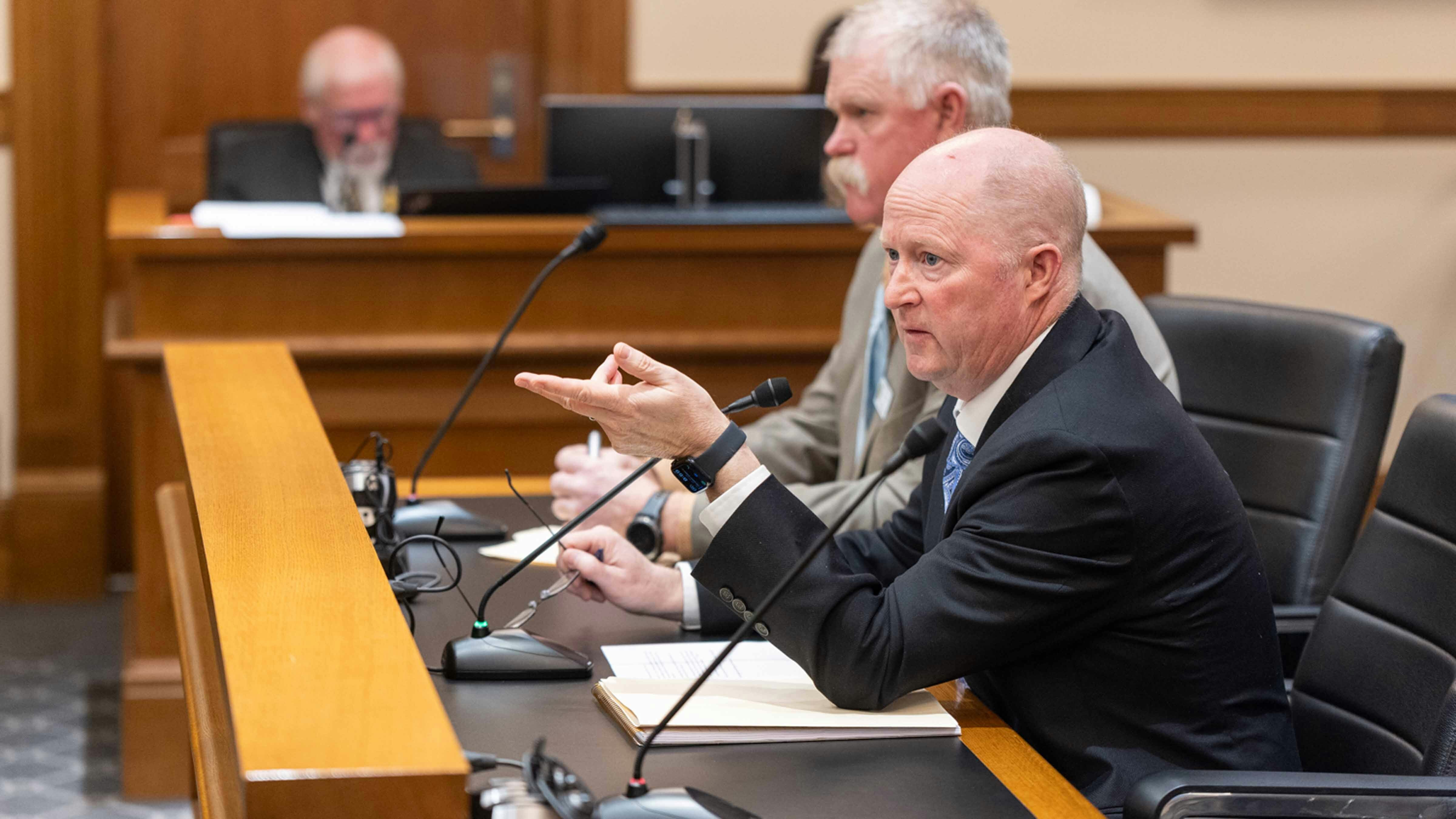
The bill's reach extends well beyond any single project, and the state's top water official told lawmakers Tuesday that HB 116 as written could create problems.
State Engineer Brandon Gebhart told the committee that if the bill's declaration that water-splitting is not a beneficial use remains in place, his office would have no ability to permit the process under any circumstance — including with wastewater or produced water from oil and gas operations.
"The splitting of water to create hydrogen with this language in there will not allow us to permit it at all," Gebhart said. "And if you want to regionalize it or allow byproduct water to be permitted through us, that would need to be addressed."
Gebhart said the State Engineer's office had worked with the Legislative Service Office to draft language that would allow hydrogen production in some parts of the state or using specific types of water, but the blanket declaration of non-beneficial use overrides those provisions.
"It's for you to decide whether you want hydrogen to be a beneficial use or not," Gebhart told lawmakers.
Wastewater Potential
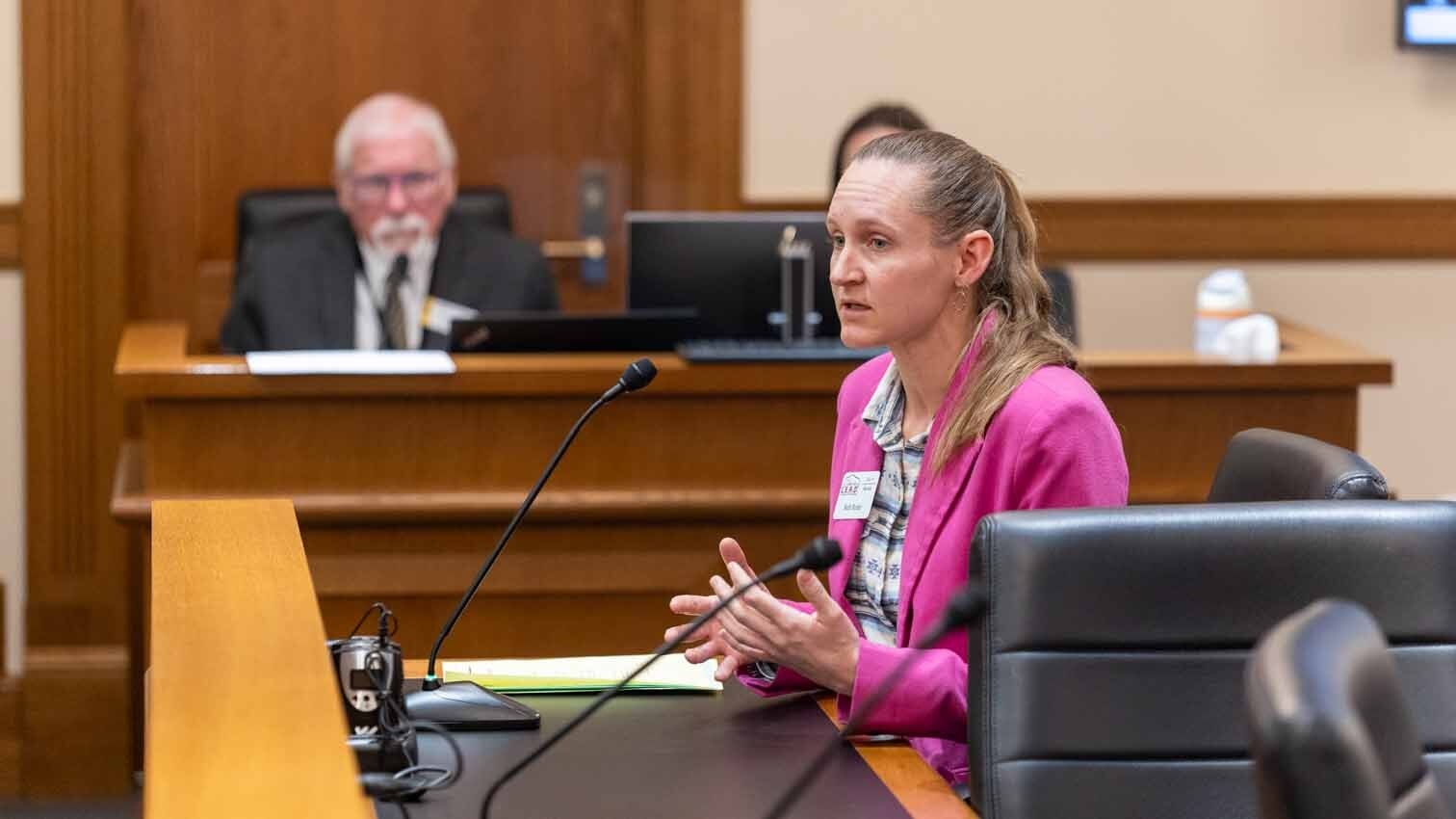
Beth Butler, a Converse County cattle rancher with a background in petroleum remediation, told the committee she supports the bill but wants to preserve the option of using wastewater for hydrogen production.
"I have a lot of concerns about using our fresh waters that could be used for other areas that I think are very important, like drinking and agriculture," Butler said. "But if that prohibits hydrogen being produced even through our wastewater or byproduct or our brackish waters that are currently not getting a lot of use, I think there is a lot of potential in this state."
Butler said she sees hydrogen's energy potential but doesn't want it developed at the expense of an arid state like Wyoming.
"I don't believe that Converse County is necessarily one of those places that can handle that," she said, adding that her understanding is the hydrogen fuel "wouldn't actually be used in the state of Wyoming as much as other places, which I also find maybe somewhat then concerning."
Hydrogen Markets
Pete Obermueller, president of the Petroleum Association of Wyoming, told the committee his organization doesn't have a position for or against the bill but shared concerns about wastewater restrictions and offered context on hydrogen markets.
"The largest market for hydrogen, of course, is in the production of ammonia used for fertilizers," Obermueller said, pointing to companies like Simplot that operate in western Wyoming. "It's also used in oil and gas refining to help create products in the refining process."
Future applications include fuel cell technology to create electricity, Obermueller said, noting the Minerals Committee is currently working to incentivize hydrogen production from natural gas and other sources rather than freshwater.
Asked by a committee member whether hydrogen production is a threat to Wyoming's legacy fossil fuel industries, Obermueller was direct: "Do we think that hydrogen production is a threat? No, we don't"
Amendment Coming
In a follow-up interview, Strock — who clarified she is a supporter of the bill, not its sponsor — said the legislation was born directly from the experience of watching the Pronghorn project develop in her community.
"Once we realized what they're wanting to do to our water, it's very important to protect it," Strock said.
She said she expects the State Engineer's office to return with an amendment for the House floor that would carve out an exception allowing hydrogen production from produced water and other waste streams that aren't suitable for drinking or agriculture.
"We do have other ways to make fuel. Wyoming is heavy in that. We all know that," Strock said. "Do not take something that is used to keep us alive. You can do without food a lot longer than you can water."
Strock noted that even with Focus Clean Energy's revised plans, the hydrogen fuel that had originally been proposed for Pronghorn "wouldn't actually be for Wyoming" — a point that added to her concern about using the state's scarce water for the project.
Deputy State Engineer Jack Morey told the committee his office would "make the time to prepare an amendment to be discussed on the House floor.”
Research Implications
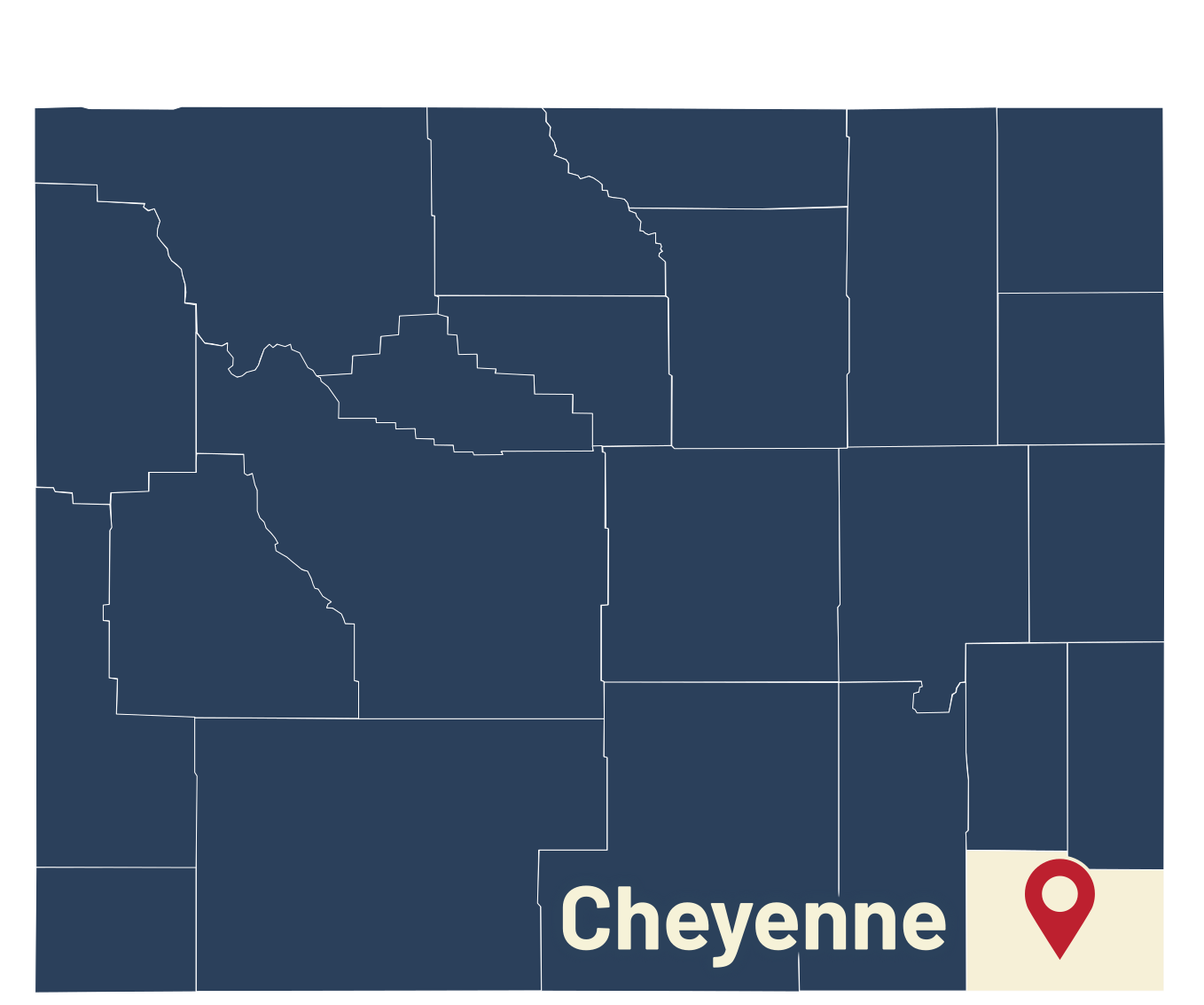
One project that could benefit from such an amendment is already taking shape just south of Cheyenne.
The University of Wyoming's Hydrogen Energy Research Center is developing a pilot plant designed to transform oil and gas waste streams into hydrogen fuel
"This thing could be run, theoretically, entirely on waste byproducts," UW research scientist Charles Nye told Cowboy State Daily earlier this month. "The device will eat the hydrocarbon, and it will eat the water, and then it spews out hydrogen."
The technology combines water desalination with hydrogen production using produced water and off-gas that would otherwise be flared or discarded — exactly the kind of non-freshwater application Strock and other supporters say they want to protect.
Since 2022, Gov. Gordon, Williams Companies and UW's School of Energy Resources have been partnering to develop the technology, which could eventually transform the small town of Wamsutter in Sweetwater County into a hydrogen fuel supplier to Pacific Northwest markets.
Brett Moline of the Wyoming Farm Bureau Federation told the committee his organization is firmly behind HB 116.
"When you use water to make hydrogen, it's no longer water. It's removed from the system," Moline said . "In a state like Wyoming, every area of the state at some point has a shortage of water."
Roll Call Vote on HB 116
Ayes: Winter, Banks, Davis, Fornstrom, Johnson, Ottman, Schmid, Strock
No: Provenza