In 1869 the first American football game was played by teams from Rutgers and Princeton. By 1883, the game had made its way west.
In the Territory of Wyoming the first football game was played between teams from Green River and Rock Springs on July 4, 1883.
UW’s first game was a double header on February 22, 1894, featuring a team from the University against Cheyenne High School.
The second game pitted a Laramie town team against soldiers stationed at Ft. D. A. Russell in Cheyenne.
Before a large crowd of around 800 (according to the Laramie Boomerang), the University recorded its first football victory, besting Cheyenne High by a score of 14-0. In a tradition that would later be repeated many times over, several hundred Cheyenne football fans accompanied the Cheyenne teams on a special Union Pacific train that chugged over Sherman Hill and back for the much-anticipated event.
For the rest of the 19th century and well into the 20th, football contests played by a team from the University of Wyoming featured high schools, town teams, make-up teams from various organizations (e.g.: “Wilson Beauties”, “Number 5 Hose Company”, etc.).
As the years went by, UW’s schedule featured an increasing number of regional college opponents. A team from UW played its first college football game against a team from Northern Colorado in 1894. The last game against a team from a high school was played in 1915 (Laramie High) and against a non- college opponent in 1920 (Ogden Athletic Club).
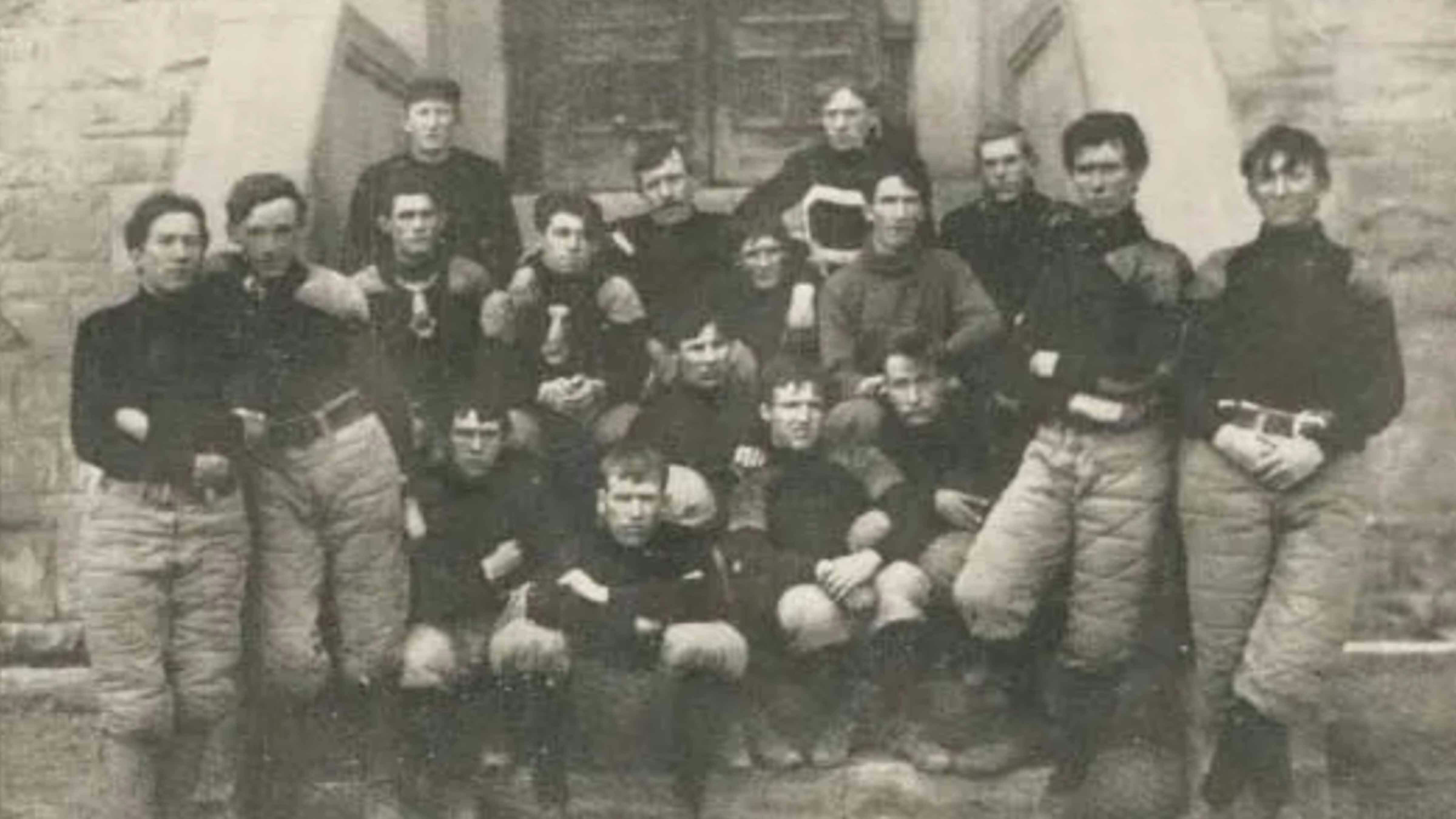
Wyoming joined its first “conference” in 1905 when it became a member of the Colorado Football Association. Not surprisingly UW played a lot of opponents from Colorado during those early years. Between 1894 and 1909 UW played Northern Colorado, Colorado State, Colorado College, Colorado Mines, Denver and the University of Colorado.
Between 1909 and 1937, Wyoming belonged to the Rocky Mountain Athletic Association and in addition to the Colorado schools, picked up these collegiate opponents: BYU, Utah State, Nevada, Arizona, Montana State, Nebraska, Western State (Colorado), Chadron State, St. Louis, Creighton, Santa Clara, New Mexico, Black Hills State, Chicago, Kearney State, Regis, Nebraska Wesleyan, Utah, Gonzaga, Idaho, and South Dakota Mines.
Seven of the Rocky Mountain conference schools, including Wyoming, broke off to form the Mountain States Conference in 1938. That conference, better known as the, “Skyline Conference” reached its final configuration after Colorado left in 1947 and Montana and New Mexico joined Wyoming, Brigham Young, Utah, Utah State, Denver and Colorado State, in 1951.
Although Wyoming started playing football in 1893 and won all 9 games over the first 5 years of competing, it fell on hard times in 1897 and lost all four of its games. It was 1949 before it would recover its winning ways. A record of 49 losing season over a 52-year period is enough to get the coach(s) fired! Heck, it’s enough to get the athletic director(s), university president(s) and the governor(s) fired!
That all changed in 1945. Boy howdy, did it change! The story of how it changed is a valuable lesson in leadership for today’s Wyoming leaders. It’s also a story worth the telling.
Lester C. Hunt (D) was governor and an ex officio member of the Board of Trustees, Milward Simpson (R), future governor/US senator, was President of the UW Board, and the Vice President was Tracy McCracken(D), described as a, “powerful newspaper publisher and leader of the Democratic party”. Among other distinguished members of the UW Board at the time, was Joseph R. Sullivan of Laramie, former president of the state bar, who was described as a “leading lawyer and politician” He was the grandfather of Governor Mike Sullivan. This cast was not known for its timidity or reticence.
When President Morrill resigned to take the presidency of the University of Minnesota, the Trustees took it upon themselves to find his replacement. They were looking for someone who could guide the University’s expansion to accommodate the expected influx of veterans taking advantage of the GI bill.
This would require infrastructure and infrastructure required money and money required legislative approval and legislative approval required a university president with a skill set that included getting along with people, especially politicians. It also required building an institution that was respected and admired by Wyoming citizens regardless of background, an institution that was recognized as an important and necessary part of Wyoming’s future.
This task was made easier by the fact that Wyoming had only one University. It wasn’t like the neighboring states where multiple colleges and universities competed for public and legislative support. What was needed was competence certainly, but also someone who could hob-nob with legislators of different backgrounds– in other words, a “good ole boy”.
The Trustees found their man in the avuncular George Duke Humphrey, then President of Mississippi State College (now University). His reputation at Mississippi State was as a builder; a builder of educational infrastructure and athletic programs.
A man of the rural South, Duke was a good fit for a state with vast rural areas and small towns. He developed informal relationships with powerful state figures, networking as any “good ole boy” would, to achieve his objectives. One of those objectives was establishing a high-profile athletic program in aid of making the people of Wyoming, including legislative appropriators, proud of their state university. If you’re a fan of the state university’s football team, chances are you’re also a fan of the university.
To achieve his strategy, Duke needed an athletic director who shared his vision. In 1946 he located and recruited a former Idaho coach and AD, Glen “Red” Jacoby, recently discharged from the Army.
Together, President Humphrey and AD Jacoby began the transformation of UW athletics. Seldom has an Athletic Director had the kind of support that Red enjoyed from Duke. But Duke enjoyed the unqualified support of the trustees, the governor and the legislature.
Red’s first hire, in 1947 was courtesy of Duke. Bowden Wyatt, a consensus All-American at Tennessee as a player, had been an assistant football coach at Mississippi State when Duke was president. Bowden became Wyoming’s head coach and soon turned the program around.
Under Wyatt, Wyoming earned a reputation for playing “hard-nosed” football and won Skyline Conference championships in 1949 and 1950. It went undefeated in the 1950 season and went to Wyoming’s first ever bowl game, the Gator Bowl. Wyoming defeating a nationally ranked team (Washington and Lee) 20-7. In the final national AP poll, the Cowboys finished 12th.
Humphrey, Jacoby and Wyatt, along with the University Board and the Wyoming Legislature, working together, ushered in what has been described as UW football’s “Golden Era” that lasted until 1969.
After coaching at Wyoming for six seasons, Wyatt went on to a Hall of Fame career, leading Arkansas and Tennessee to conference championships.
Wyatt was followed by highly successful Wofford head coach, Phil Dickens, a tailback at Tennessee as a player. Dickins coached Wyoming for four seasons, going undefeated in 1956 (10-0) and winning the Skyline conference title. Dickens’ tenure featured player development and discipline along with a continuation of hard-nosed football. Dickens took his 1955 team to the Sun Bowl in El Paso, Texas on January 2, 1956, where it defeated Texas Tech, 21-14. Dickens departed Wyoming in 1957 to become the head coach at Indiana.
Dickens was followed by Jacoby’s third hire, Bob Devaney. Devaney, a graduate of Alma College in Michigan and a successful Michigan high school coach, was an assistant at Michigan State under the legendary Duffy Daugherty when Jacoby reached out to him in 1957. Devaney coached at Wyoming for five winning seasons and won or shared in four Skyline conference titles. In 1958, Devaney took his team to the Sun Bowl, where it defeated Hardin-Simons, 14-6. In 1960 his defense was best in college football. In 1961 his team ranked 14th in the nation. Devaney left Wyoming to become a legend at Nebraska where he won two national championships.
Jacoby hired Devaney’s defensive coordinator, Lloyd Eaton, as Wyoming’s new head coach in 1962. Lloyd continued in Devaney’s footsteps, featuring hard-nosed, disciplined football with an emphasis on defense. Before the Black 14 episode decimated the Wyoming football program, Eaton’s record as a head coach at Wyoming was 56-20-2. He took the Wyoming team to the Sun Bowl in 1966 where it beat Florida State, 28-20 and to the Sugar Bowl where it lost to LSU, 20-13. That game ended when time expired with Wyoming on the 5-yard line of heavily favored LSU.
From 1947 until 1969, from Bowden Wyatt to Lloyd Eaton, was UW’s “golden era” of football. Football played at a high level and competitive with other nationally prominent collegiate football programs. It gave the state a focal point, something to talk about and something of which to be proud. It elevated not just the football program, but the entire University community.
The Golden Era ended with the Black 14 episode and didn’t recover until UW hired one of Lloyd Eaton’s assistant coaches, Paul Roach, in 1987. Over that period, from 1970 until 1987, the Cowboys managed only three winning seasons under eight head coaches.
Roach brought the Pokes back and enjoyed great success. Since that time, UW has recorded some good football years under some good coaches. Joe Tiller and Craig Bohl come to mind. Tiller loved Wyoming so much that after a successful stint at Purdue, he retired and he and his family moved to Buffalo (Wyoming, that is).
What does the future for Wyoming football look like? The jury is out. AD Tom Burman, Coach Jay Sawvel and their staffs are working hard to bring success back to the Wyoming football program. They have a tough row to hoe however, because the NCAA and the legal system have changed the rules, and not for the better.
NIL, the transfer portal and the “House Settlement” have had adverse consequences for a number of schools, Wyoming included. The new rules have extinguished amateur athletics in the United States, but they have also encouraged player disloyalty while placing money at the apex of important considerations in college football. The “House Settlement” resulted in a few lawyers and a judge dictating what can only be described as an “abomination”. My guess is that UW and similar schools had very little to say about the final House settlement.
A few years back I wrote a column about this subject and suggested that UW athletes be schooled in The Code of the West, which is enshrined in Wyoming statutes and is the law of this state.
So far as is known, the suggestion fell on deaf ears.
The Athletic Department ought to at least instruct what is meant by: Always Finish What You Start, When You Make a Promise Keep It, Ride for the Brand and Remember That Some Things Are Not For Sale.
These principles all have to do with loyalty and are relevant to football players committing to play football at UW.
Wyoming’s football success in the golden years just didn’t happen.
Its success was the product of a conscious decision by university and state leaders to excel in inter-collegiate athletics.
It required the collaboration, shared vision and unity of purpose of Duke, Red, Coaches Wyatt, Dickens, Devaney and Eaton, the university’s board of trustees, and the governors and legislators who served during the, “Golden Era."
The benefits to the university and the state were incalculable, but they were very real.
When Tracy McKracken’s Treagle Train, that famous chartered excursion train, departed Cheyenne bound for a University of Wyoming home game, its passengers were Republicans and Democrats, sheepmen and cattlemen, merchants and professionals, adversaries and allies, from towns and rural areas, but all were loyal University of Wyoming football fans, united in their admiration and support for their beloved Wyoming Cowboys.
Times have changed, but principles haven’t. Most fans want loyalty from athletes who choose to play for UW. Most Wyoming people also want the state’s only university to excel in all its endeavors, including intercollegiate athletics.
Given the mess that is the current state of Division I FBS football, can the University of Wyoming once again field football teams that are known, respected and admired for their “hard-nosed”, successful, but always ethical, play? Teams with the ability to compete with the best of the best? Absolutely it can!
What will it take to achieve these goals? The same thing it took in 1947 and for the 22 years thereafter that constituted Wyoming’s “golden football era”: Collaboration, shared vision and unity of purpose; skill by UW officials in advocating for excellence in athletics at the state’s only university; and “buy in” by the political leadership of Wyoming (pun intended).
With these things, the state can once again enjoy excellence in its football program. Without them, Wyoming’s once storied football program will wither, its reputation and success but a footnote in history.
The choice is at hand.
Ray Hunkins is a retired country lawyer and cowman. He is also a Distinguished Alumnus of the University of Wyoming and it’s College of Law.