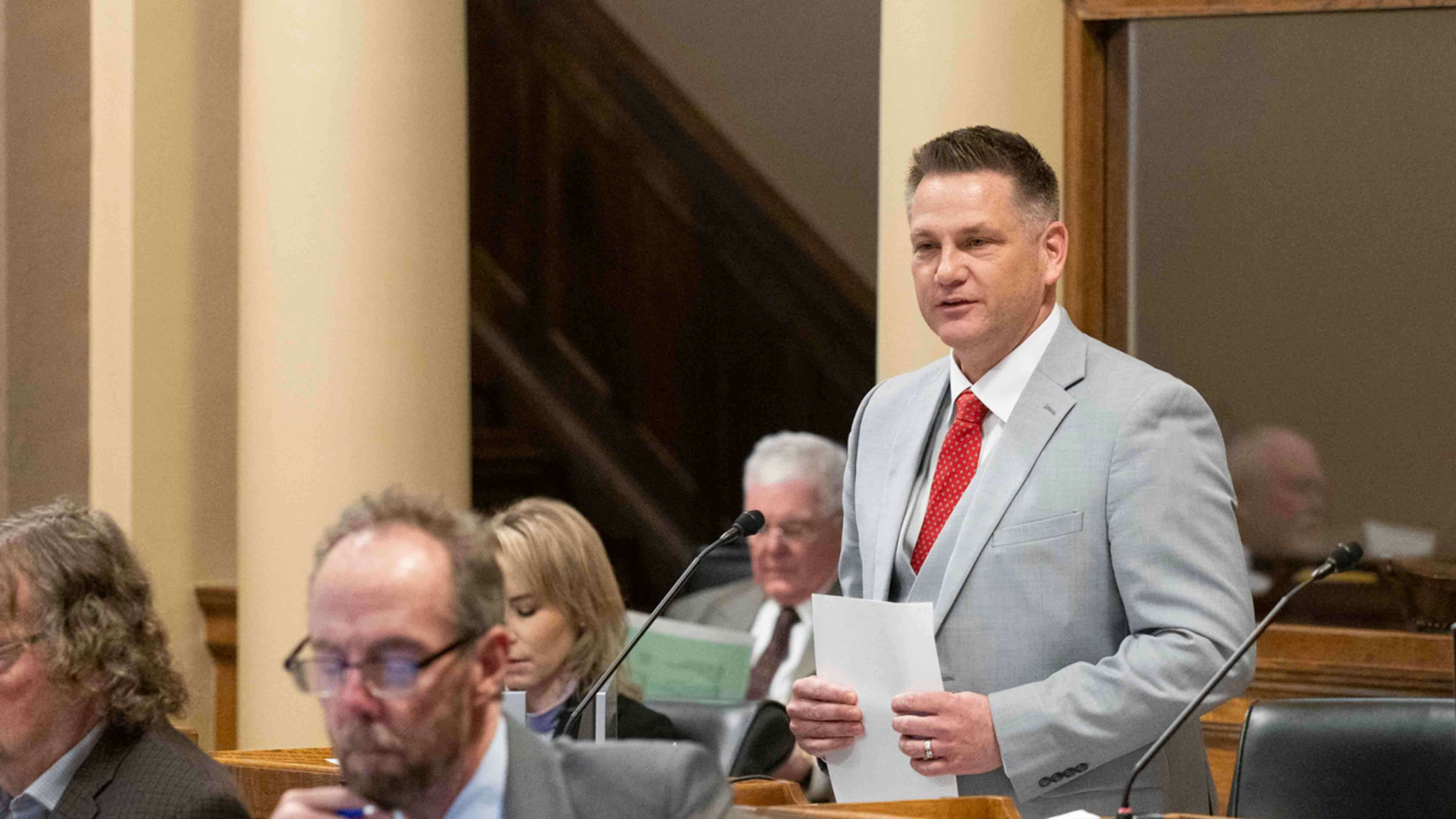
CHEYENNE — Senate President Bo Biteman stood on the chamber floor Thursday and told his colleagues that Wyoming needs to stop waiting and start leading as demand for electricity is expected to spike.
Introducing Senate File 123, the Wyoming Energy Dominance Fund, Biteman spelled out a vision for the state to position itself at the front of the Trump administration’s push for American energy supremacy — backed by roughly $105 million in redirected severance tax revenues.
“Ladies and gentlemen, Wyoming needs to be the tip of the spear, the energy dominance plan,” Biteman told the Senate. “Apparently, there are projects in the works that need a little bit of assistance to get these things going.”
Biteman rattled off project after project that could benefit from the fund, asserting each one was tied to national security and Wyoming’s economic future.
“Projects that come to mind could be possibly a uranium conversion plant,” offered Biteman. “There’s only going to be one built in the United States, probably in the next 20 to 30 years. We’re competing with other states with that.”
Biteman continued, “We need a pipeline to get CO2 up to the Big Horn Basin to unlock untold billions of barrels of oil that would directly benefit the state of Wyoming in severance tax revenue and revenue in our schools. You’ve got rare earth projects happening in Wyoming that need support.”
The Republican from Ranchester framed the legislation not as a government subsidy program, but as a strategic accelerator — one designed to clear bottlenecks that have slowed deployment of energy and mineral projects despite strong private-sector interest.
“These are vital to our national security,” Biteman said. “I’ve been working with the current administration to make this happen. I think the states can lead.”
The bill, co-sponsored by House Speaker Chip Neiman, R-Hulett, along with a dozen Senate and House co-sponsors, would channel severance tax revenues already paid by Wyoming’s energy industries into a fund administered by the Wyoming Energy Authority.
The money would flow as matching grants and loans for projects spanning coal innovation, natural gas, enhanced oil recovery, pipeline infrastructure, uranium conversion and enrichment, rare earth and critical mineral processing, and baseload energy development.
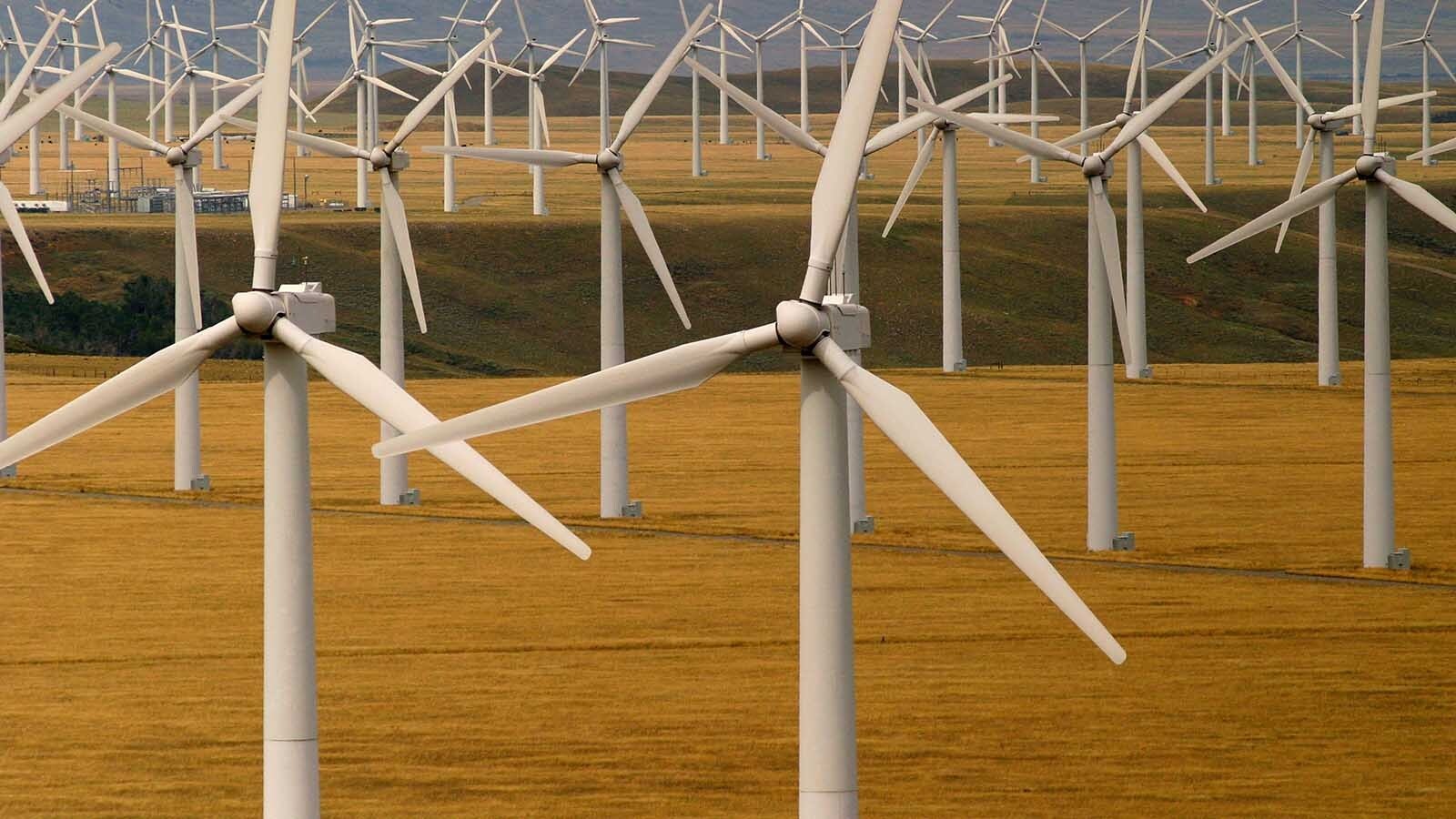
Wind and solar projects are explicitly excluded.
SF 123 received unanimous support, passing its introductory vote 31-0 and was referred to the Appropriations Committee.
Industry Support
Ahead of Thursday’s vote, the Petroleum Association of Wyoming threw its weight behind the bill, announcing its “full support” for the legislation.
“President Biteman and Speaker Neiman recognize the critical role oil and natural gas play in Wyoming’s economic development and the associated tax revenues that support our communities,” said PAW President Pete Obermueller. “By investing in Wyoming Energy Dominance Fund, the legislature has the opportunity to reinvest industry-paid taxes to the benefit of Wyoming families and the state’s long-term prosperity.”
PAW noted that under the current draft budget, the severance tax revenues earmarked for the fund are destined for the Legislative Stabilization Reserve Account — the state’s “rainy day fund” — which already contains about $1.5 billion.
The bill’s text underscores Wyoming’s outsized role in the nation’s energy economy, noting that energy contributes up to 25% of the state’s gross state product and has generated nearly $95 billion in total economic impact since 2015.
Wyoming leads the nation in coal production at roughly 40% of total U.S. output, ranks seventh in crude oil and tenth in natural gas.
Transmission Study
Rob Creager, executive director of the Wyoming Energy Authority, said SF 123 would give his agency another powerful tool to advance energy projects without drawing from the state’s general fund.
“It’s not coming out of the general fund or anything like that,” Creager told Cowboy State Daily. “It looks like a bill that we can rock and roll the day it goes into law if it does.”
He said the bill’s broad scope — covering everything from coal and natural gas to pipeline infrastructure, enhanced oil recovery and uranium — mirrors the authority’s existing mission.
Creager also said the energy dominance fund complements another major piece of legislation that advanced Thursday: Senate File 102, the Wyoming Energy Transmission Study, sponsored by Sen. Brian Boner, R-Douglas.
On the transmission study, Creager said SF 102 is about getting hard facts to policymakers as the state anticipates surging power demands on the horizon.
“Everyone’s talking about the power demands. And there’s the argument, right? Are these legitimate? Is it actually that much?” Creager said.
Wyoming’s position straddling the border of the eastern and western electrical interconnections gives it unique potential as an energy exporter, Creager said, but only if the state understands the landscape.
“If we want to look at sending more power west or if we want to send it east or however, what makes sense?” he said. “Is it a power plant in Campbell County? Is it a power plant down in the Rock Springs area? What is it? What makes sense? Where is the need?”
Grid Future
Boner introduced SF 102 as a two-phase study. The first phase would model three load growth scenarios — low, moderate and high demand — and identify gaps in Wyoming’s current transmission infrastructure.
“What this bill does is it directs the Wyoming Energy Authority how to conduct a study regarding the future for our state when it comes to our ability to generate electricity and transmit that electricity throughout our region,” Boner told the Senate.
The second phase would explore whether Wyoming should integrate into a regional transmission organization, or a day-ahead market where wholesale electricity is bought and sold one day before it’s actually delivered.
“These are organizations which are common throughout the country, and it’s going to be a topic of discussion for the American West in the years ahead,” Boner said. “So this is our opportunity to provide input as to how the Energy Authority gathers information as we begin to assess the policy decisions that we’re going to be faced with.”
Boner warned that states across the region are already expanding their reach, including California, and that Wyoming risks being caught flat-footed.
“We might have some very important decisions to make,” he said. “This is the first step in gathering information to help support that decision.”
In a follow-up interview, Boner said the issue crystallized for him as he became aware of shifting dynamics across the Western grid.
“California, for example, is talking about expanding their organization,” Boner said. “And so I think we have to be very intentional about if we do join one of those day-ahead markets or regional transmission organization, do we look to the west or do we look to the east?”
He explained that the current system relies on bilateral agreements between individual utilities rather than the kind of blanket regional framework used by organizations like the Southwest Power Pool, which already includes some Wyoming electric cooperatives with footprints in South Dakota and Nebraska.
“It provides stability for ratepayers. It provides relief to ratepayers oftentimes, because you have a much broader footprint that you can draw your electricity from in a stable, predictable manner,” Boner said.
The bill directs the Energy Authority to consider “advanced transmission technologies and electricity storage to meet the need for expanded transmission capacity in Wyoming from 2026 to 2046.”
Carbon Capture
On Wednesday, the House Minerals, Business and Economic Development Committee took up House Bill 56, another pro-energy development bill. This one seeks to repeal Wyoming’s carbon capture mandate.
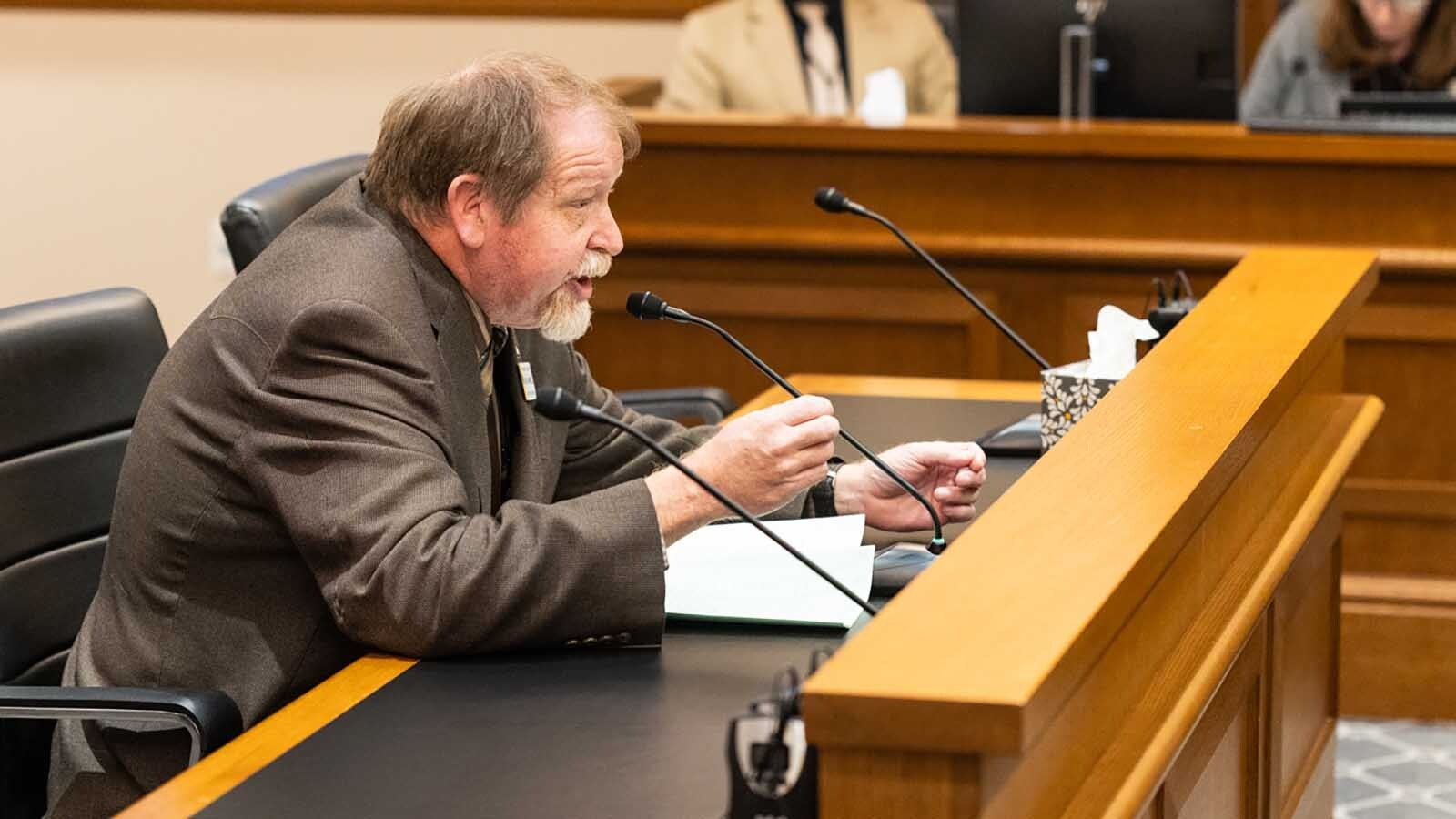
Rep. Chris Knapp, R-Gillette, the bill’s sponsor, told the committee the law was a product of a different era.
“I think it’s time that we reflect on what’s happening in today’s environment and repeal that low-carbon standard,” Knapp told the committee. “I do believe it’s time for us to release the yoke off of ourselves, self-imposed, and let the market decide what energy is best to use.”
The committee adopted an amendment to grandfather projects already approved by the Public Service Commission, then voted 9-0 to advance the bill as amended.
If passed by the full Legislature, this measure would reverse course on the state’s 2020 carbon capture mandate for coal plants. It requires utilities to study carbon capture retrofits for coal plants, and these studies are funded by a surcharge imposed on ratepayers.
Looking across the full sweep of energy legislation moving through the Capitol this week, the Wyoming Energy Authority’s Creager said Wyoming’s positioning aligns with the direction coming from the Trump administration.
“The president is supportive of that,” Creager said of efforts to expand Wyoming’s energy exports. “We partner with the White House, we partner with industry every day to try to advance projects in Wyoming.”
The Roll Call Vote for SF 102:
Ayes (29): Anderson, Barlow, Biteman, Boner, Brennan, Cooper, Crago, Crum, Dockstader, Driskill, Gierau, Hicks, Hutchings, Ide, Jones, Kolb, Landen, Laursen, Love, McKeown, Nethercott, Olsen, Pappas, Pearson, Rothfuss, Salazar, Schuler, Scott, Steinmetz Nays (2): Case, French
The Roll Call Vote for SF 123:
Ayes (31): Anderson, Barlow, Biteman, Boner, Brennan, Case, Cooper, Crago, Crum, Dockstader, Driskill, French, Gierau, Hicks, Hutchings, Ide, Jones, Kolb, Landen, Laursen, Love, McKeown, Nethercott, Olsen, Pappas, Pearson, Rothfuss, Salazar, Schuler, Scott, Steinmetz.
David Madison can be reached at david@cowboystatedaily.com.