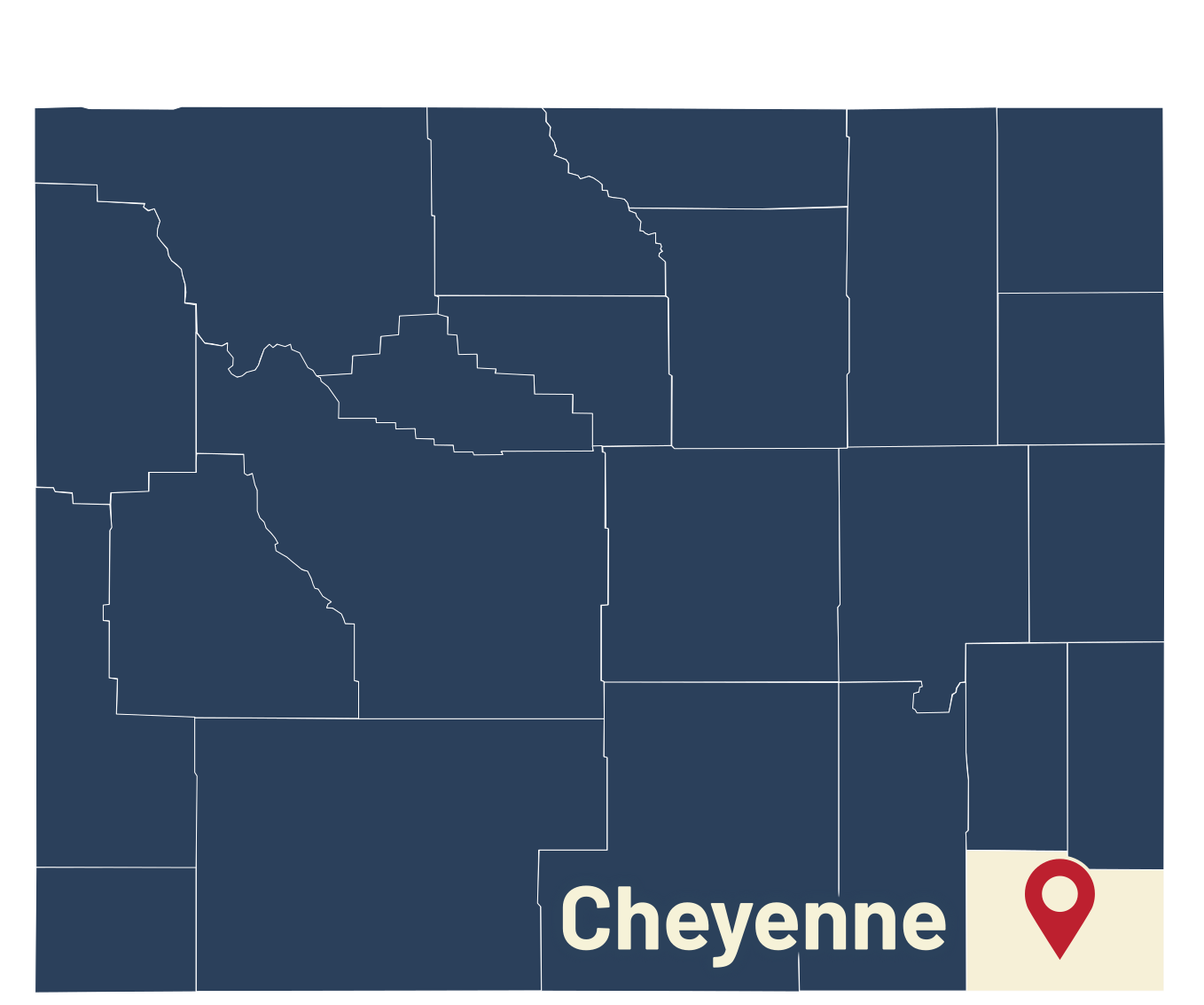
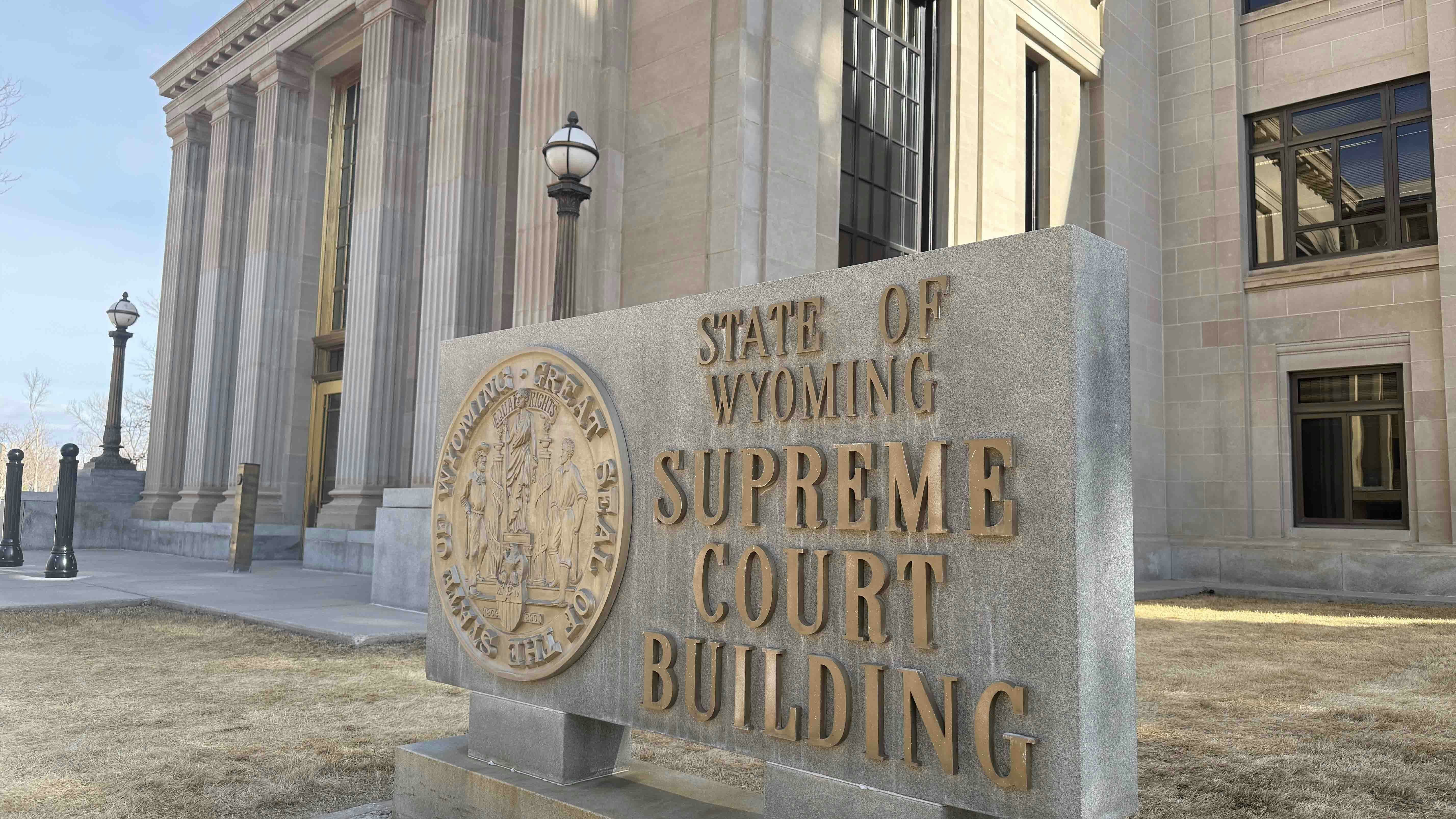
Three Wyoming Supreme Court justices grilled a public school advocacy group Tuesday in the state Capitol’s historic supreme court chambers, after the advocacy group called Wyoming’s school-choice scholarship program unconstitutional and harmful.
The oral argument on whether the Steamboat Legacy Scholarship Act - a $30 million school choice program that a Cheyenne-based judge blocked from going into effect last summer - pitted the Wyoming Education Association and some families of public-school children against the state of Wyoming, and families intervening to defend the program.
Chief Justice Lynne Boomgaarden lobbed numerous, lively questions at Wyoming Education Association (WEA) attorney Jeff Lupardo.
So did Justice Kari Gray.
Justice John Fenn asked repeatedly whether District Court Judge Peter Froelicher’s earlier decision to block the program from going into effect harms the private-school families, while WEA argued, rather, that letting the program go into effect could hurt public school families.
Froelicher’s preliminary injunction had blocked up to $7,000 in state-held scholarships each to families seeking private or homeschool alternatives. Around 4,000 families were approved to receive those payments when the order was filed.
Sweetwater County District Court Judge Suzannah Robinson asked two questions of WEA’s attorney. She heard the case alongside the justices, to stand in for Justice Bridget Hill.
Justice Robert Jarosh also heard the case. He did not ask counsel from either side questions during Tuesday’s two oral argument hearings.
The high court has taken the matter under advisement.
Nicolette Leck, the mother of one of the two families intervening in the case, told Cowboy State Daily after the hearing that she’s cautiously optimistic - “just (based on) the questions that the judges asked.”
She said her family moved from Casper to Cody and found the public school district there had fewer options, and was, in their view, inferior. So they opted for private school.
Leck’s attorney Thomas Fisher told Cowboy State Daily, “I think they had some tough questions - the justices did - and I don’t think the WEA had a lot of good answers.”
WEA did not immediately respond to an email request for comment. One of its attorneys in the historic chambers, Greg Hacker, told the outlet to watch for a press release.
Back It Up
The Wyoming Legislature in 2024 enacted the Steamboat Legacy Scholarship Act, and expanded it in 2025. It was set to take effect July 1, but Froelicher ordered a preliminary injunction, or a case-long block, on it before it went into effect.
He determined that those challenging it had shown they could suffer irreparable harm if it were allowed to function. And that the challengers had shown they are likely to win their constitutional challenge.
Wyoming Attorney General deputy Mackenzie Williams and the intervenors, through Fisher, challenged that decision in their arguments Tuesday.
Irreparable Harm
In the plaintiffs’ view, allowing the program to function would inherently violate their rights because the Wyoming Constitution places such a high value on keeping public education complete and uniform.
Lupardo referenced decades of state Supreme Court precedent casting the right to public education - and the Legislature’s obligation to fund it - as paramount.
“Explain to me how your clients don’t have access to the existing system in public education,” Boomgaarden countered.
The plaintiffs have not voiced a desire to use the school-choice alternatives under the scholarship, and have described themselves as public school families, employees and advocates in their complaint.
“That depends how you define system of publicly-funded education,” countered Lupardo. “The issue is when you have an entire system… a complete system of education, the entire system needs to meet the (constitution’s call for high quality).”
He cast the Steamboat-funded alternatives and the traditional K-12 system as parts of one whole system.
“We know that children across Wyoming including the parents we’re representing - their children - are going to be denied opportunities, marginalized, discriminated against,” said Lupardo, an echo of the plaintiffs’ complaint. It had argued that since private schools, for example, aren’t under those same legal guardrails as public schools, the scholarship program could create differing classes of students by funneling public funding into less regulated schools.
“How is that not speculative?” answered Boomgaarden. “What evidence can you give the court to show there’s a particularized discrimination or denial?”
Lupardo pointed to different admission criteria private schools can use, and public schools can’t.
“If the state wants to enact a publicly-funded voucher program, then it’s got to be open and accessible to all,” said Lupardo. “It can’t have such exclusivity. Can’t essentially permit discrimination.”
Here, Fenn questioned WEA.
“How deep does that go?” asked Fenn. He posed a hypothetical: whether the state would have to open up widespread access to a woman’s home just because she homeschools her children under the scholarship program.
Boomgaarden seized the point.
“Seems like the logic is falling apart when you’re willing to go so deeply,” she said, adding that by that logic, any aspect of the existing public school program would have to be available to everyone. But they’re not, she said, referencing tutoring and special education.
Money
Lupardo noted that to attend a school with Steamboat money, one would have to withdraw from the public K-12 system.
“You can’t view this as a supplement or an added bonus,” he said. “You have to withdraw and remove yourself from that.”
But, Gray countered, the state constitution provides that students can use other private education outside of the K-12 system.
The difference, Lupardo said, is that the constitution doesn’t say the public has to pay for that private education.
Gray noted that the Legislature funds the K-12 system with special accounts, whereas the Steamboat program was to pull from the state’s checking account, called the general fund.
Fisher later noted that pay for the K-12 system is based on attendance metrics. So students leaving that for private school could reduce the district’s block grant amount. But then, the funding would be calculated so that each school’s provisions are proportionate to its student count, Fisher emphasized.
Speaking to Lupardo, Gray said, “your whole argument really hinges on us granting that somehow this (program) is part of the uniform system of education.
“If we don’t agree with that,” Gray continued, “if we think the Legislature has plenary power to (create this) then you don’t have one.”
Lupardo parried: “The Legislature can’t do indirectly what it can’t do directly… This is indirectly privatizing education, through the public fund.”
Where We At In This Case?
Fenn indicated that, if WEA is going to argue the program is outright unconstitutional, then perhaps the justices should evaluate its constitutionality rather than confining themselves to evaluating Froelicher’s injunction.
Lupardo said he was arguing the constitutional point to show that his clients have a likelihood of succeeding on the merits of the case. That’s one of two necessary prongs to uphold a preliminary injunction.
Fisher argued the opposite direction, saying the high court should consider whether the plaintiffs have even cleared the threshold challenge, of showing they have standing, or grounds, to challenge this law.
He argued they haven’t done that and that they haven’t shown how the scholarship program poses articulable, particularized damages to them.
Recalibrating…
Williams and Lupardo both grappled with the high court’s Jan. 6 decision in Wyoming v. Johnson - in which it upheld abortion access as a fundamental right under the state Constitution’s promise of health care autonomy.
In that decision, the Wyoming Supreme Court majority changed the way it handles “facial” or outright constitutional challenges
It used to consider a facial challenge successful if the challenger proved there’s no set of circumstances under which the challenged law could be constitutional.
That’s too hypothetical, said the majority in Johnson.
They adopted instead a 10th Circuit Court of Appeals standard, calling facial challenges simple constitutional evaluations.
For this case, argued Williams, the plaintiffs should have brought evidence that the law was unconstitutional.
Because, Wyoming Business Council
One of WEA’s arguments is that the Steamboat program defies a section of the state Constitution barring the appropriation of money to entities not under the state’s control.
A different section of the constitution allows the state and its subdivisions to give out money for “necessary support of the poor.”
“So what about the Wyoming Business Council?” asked Gray.
That’s a state agency that gives grants and loans to businesses and communities.
Lupardo said he didn’t know the regulatory framework keeping the business council in check.
“The reason it’s relevant,” continued Gray, “it previously had a different title, name. And under a different name, that (agency) was challenged under this. And it was upheld.”
Lupardo said the court should evaluate whether government-funded causes are constitutional on a case-by-case basis.
Clair McFarland can be reached at clair@cowboystatedaily.com.