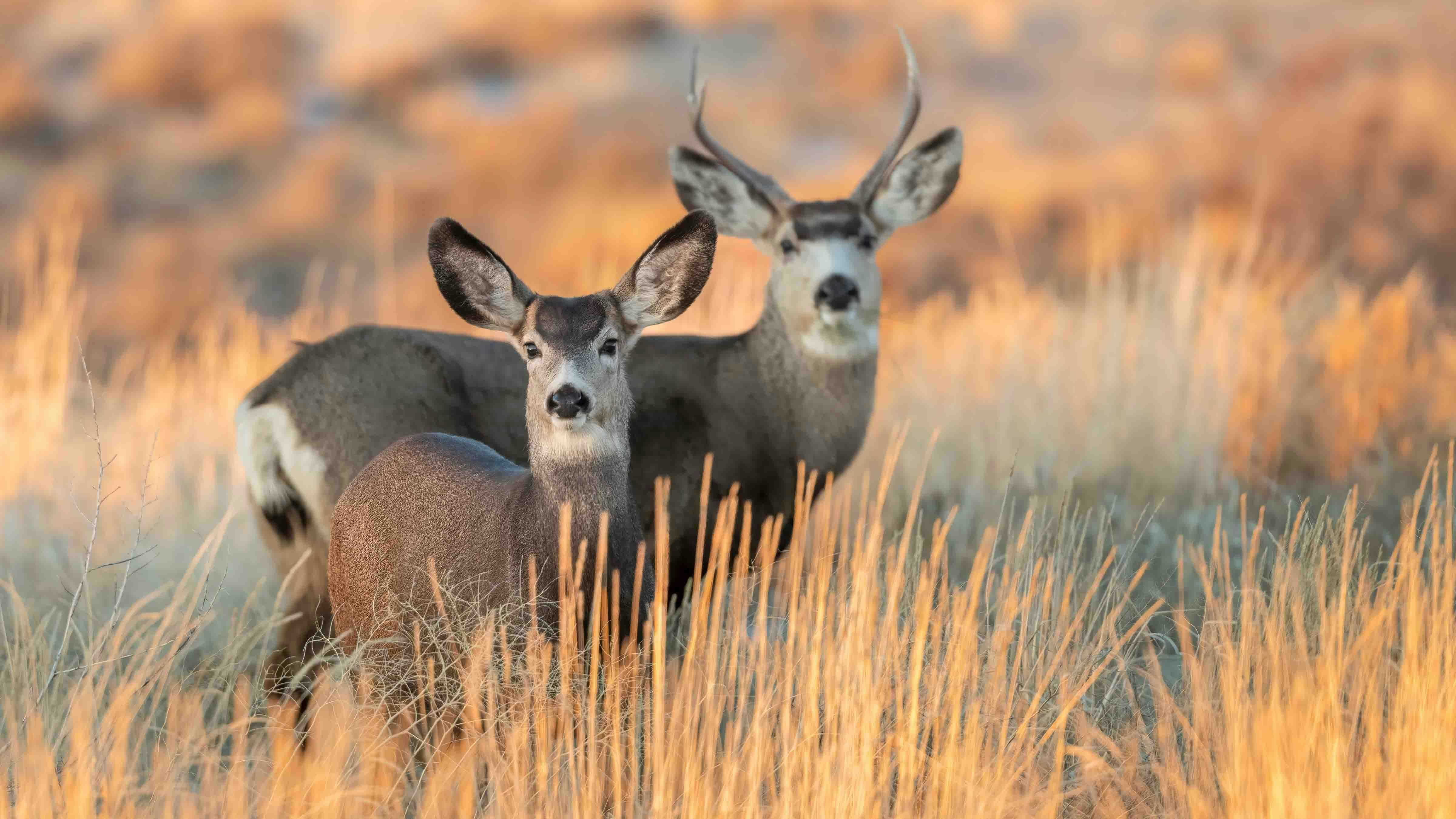
Mule deer are native to mainland California, but are considered an invasive species on Catalina Island about 22 miles off the southern coast.
So, plans are in place to send in squads of professional riflemen to shoot them all.
The Catalina Island Conservancy, which owns most of the 76-square-mile island, wants all the mule deer killed within the next five years.
The conservancy claims it’s necessary, because the deer have been gobbling up the island’s unique native plants.
That has greatly increased the risk of wildfire and upset the Island’s ecosystem, according to the conservancy.
Deer Introduced In 1930
Ten mule deer were set loose on the island in 1930, and their numbers have since swollen to roughly 2,000.
They are popular among wildlife watchers and photographers. There is also limited hunting for mule deer there.
Animal rights activists and hunting groups alike are balking at the idea of the deer being completely wiped out.
Greg Sheehan, president and CEO of the Mule Deer Foundation, told Cowboy State Daily that there’s room for compromise.
Hunting could be increased to cull the deer population, without eliminating it, he said, adding that the Mule Deer Foundation has come out against the Catalina Island deer eradication.
The California Fish and Wildlife Department on Jan. 30 approved a permit allowing all the deer on the island to be killed by professional sharpshooters within five years, the Los Angeles Times reported.
The plan is to take some of the deer carcasses off the island and feed the meat to endangered California condors. Other carcasses will be left where they’re shot to be scavenged by foxes, eagles and other wildlife.
Mule deer herds are meanwhile struggling across Wyoming, Utah and other Western states said Sheehan, who lives in Utah.
It seems like a needless shame to slaughter an entire population of them, he said.
Messages sent to the conservancy for comment weren’t answered by publication time.
California Mulies
There are mule deer in mainland California, including in coastal areas near the island, Sheehan said.
An argument can be made that the habitat and ecosystem on the island aren't fundamentally different than areas occupied by mule deer roughly 20 miles away on the mainland, he said.
Moreover, mule deer aren’t great at adapting to new habitats, he added. It’s one of the species' weaknesses compared to white-tailed deer, which can adapt to live just about anywhere.
That they’ve thrived on Catalina Island strengthens the case that they belong there, Sheehan said.
Hunting is allowed there, but is limited.
“It’s a privately-owned island, so hunting there is limited to guided hunts only, and hunts costs about $5,000 each,” he said.
The Mule Deer Foundation helps facilitate guided mule deer hunts for disabled veterans on Catalina Island.
If the island deer population has exploded to the point where it’s damaging the ecosystem, the answer might be to offer more opportunities to licensed hunters rather than sending in professional shooters to kill them all, he said.
The best way to control game herd populations is to take out breeding-age females, he said.
Issuing more mule deer doe hunting tags for a few hunting seasons could knock the island deer population back to more manageable levels, he said.
“Mule deer are browsers,” he said, meaning, they eat mostly leafy plants.
So, he said he understands concerns about “too many mouths on the landscape” devouring leafy plants on Catalina Island.
The Mule Deer Foundation would hate to see the entire Catalina Island population eliminated because the group wants to conserve mule deer wherever they are, Sheehan said.
Mule deer face numerous threats in the West, including disease, fragmentation of migration routes and habitat loss, he said.
Weather can also take a toll.
During the brutal winter of 2022-2023, the prized Wyoming Range mule deer herd was hammered. Many of the adult deer froze or starved to death, and it’s thought that year’s entire crop of fawns died.
Not And Existential Threat To Mule Deer
Kevin Monteith is a biologist and mule deer researcher with the Haub School of Environment and Natural Resources at the University of Wyoming.
He told Cowboy State Daily that wildlife management policies can sometimes affect even revered species such as mule deer.
“Restoration efforts in many places are aimed at restoring back to native species, from habitat to animals,” he said. "Therefore, removing some animals, whether highly revered animals or not, may be a management objective."
Taking out the Catalina mule deer wouldn’t threaten the entire species, he added.
“From the perspective of mule deer as a whole, even though they have declined across much of their range and a species of conservation concern, they are not a threatened species,” he said.
“If that (island) population was one of the last strongholds of mule deer, I suspect the conversation would be much different,” he added. "It is, however, not their last stronghold.”
Mark Heinz can be reached at mark@cowboystatedaily.com.