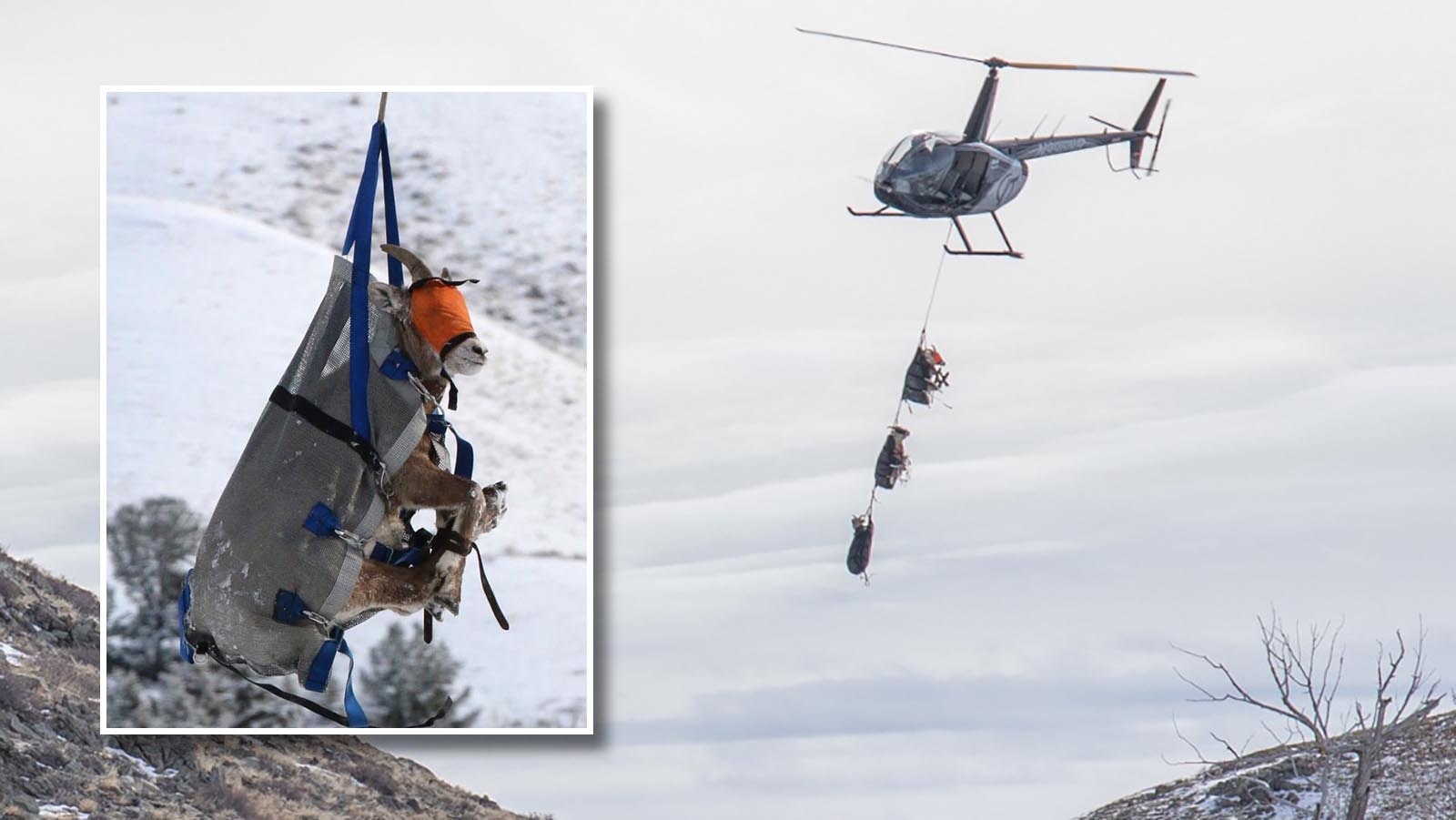
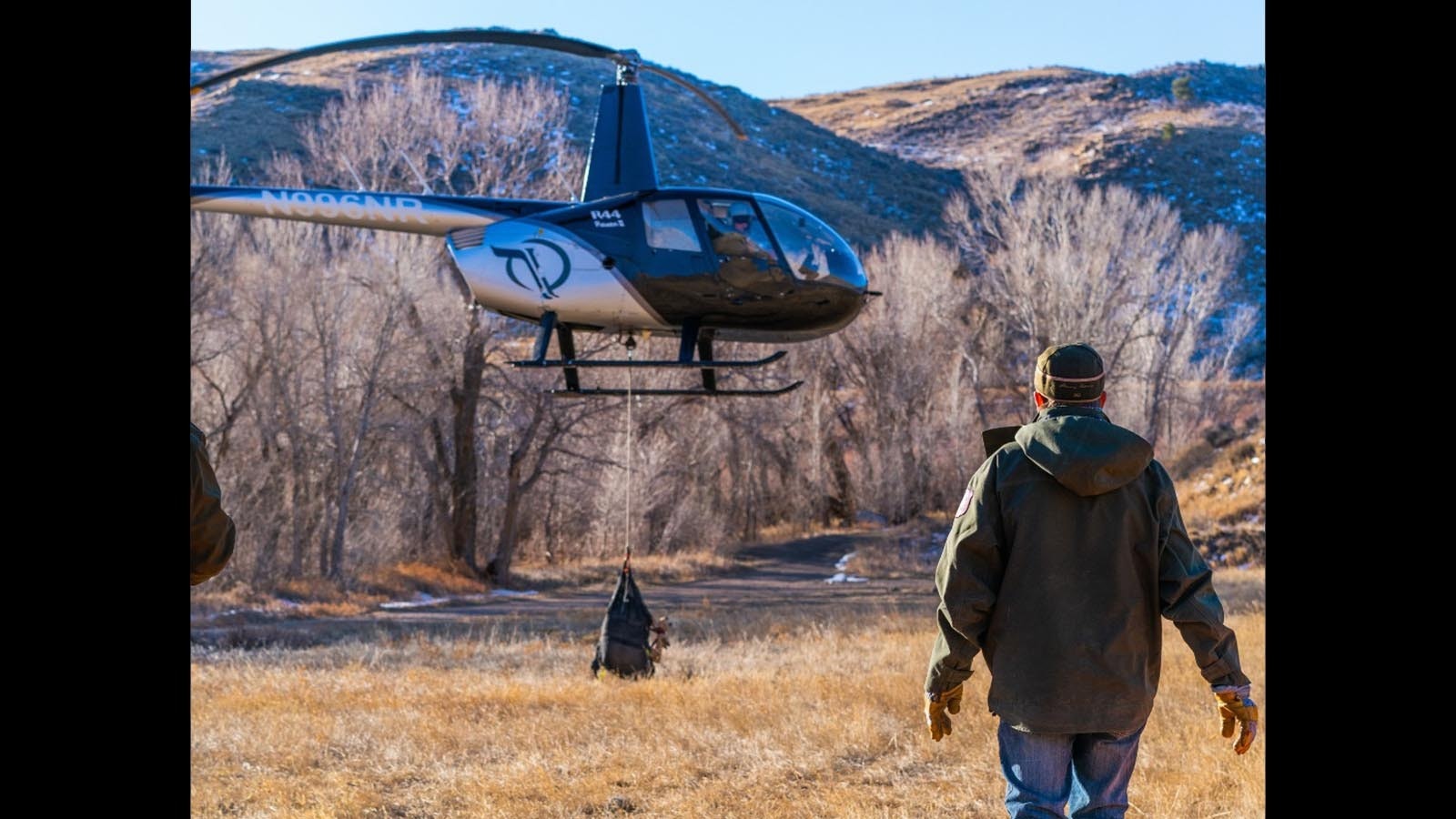
Until about March, folks might catch sight of blindfolded bighorn sheep or deer flying around, slung in harnesses under helicopters.
Don’t worry, the animals aren’t being nabbed by well-equipped poachers, they’re being transported for population studies, disease testing and other research by the Wyoming Game and Fish Department.
And as unnatural as the experience might seem for terrestrial species, wildlife biologists say the process doesn’t traumatize them.
Once researchers are done examining them, the critters are set free in the wild again, no worse for wear.
Why Now?
Why are the winter months the best time to capture animals from the air, and sometimes transport them via helicopter?
December to March it’s the best time window between wildlife being mostly in the rugged high country in the summer, and giving birth to their young in the spring, Tony Mong, Game and Fish Cody Region wildlifebiologist, told Cowboy State Daily.
The winter range occupied by big game animals is “lower, flatter topography” than the rugged high country they occupy during the summer and fall, he said.
Animals are easier to find in the open lowlands, and the topography also makes airborne capture and transport more efficient and safer.
Moreover, using helicopters allows researchers to get a broad sampling of animals from across wide areas of the herds’ winter ranges.
Game and Fish doesn’t have helicopters or flight crews for the task. Instead, the agency contracts with companies that specialize in wildlife flights.
“It’s fairly dangerous work. It’s very specific work. There are companies that specialize in doing this year-round,” he said.
Similarly, Game and Fish contracts with private helicopter companies to transport fish for stocking remote high-country lakes.
Helicopter wildlife research operations shut down around March because that’s when moose, elk, deer, bighorn sheep and antelope start giving birth to their young, and are best left undisturbed, Mong said.
Netting And Darting
To capture animals for study, they are either caught with nets dropped from helicopters or shot with tranquilizer darts from the air.
Darting is far less common, Mong said. It’s usually reserved for the largest animals, such as moose.
In many cases, helicopter crews can swoop in and net animals, then hop out, quickly get what they need, and set the animals free immediately.
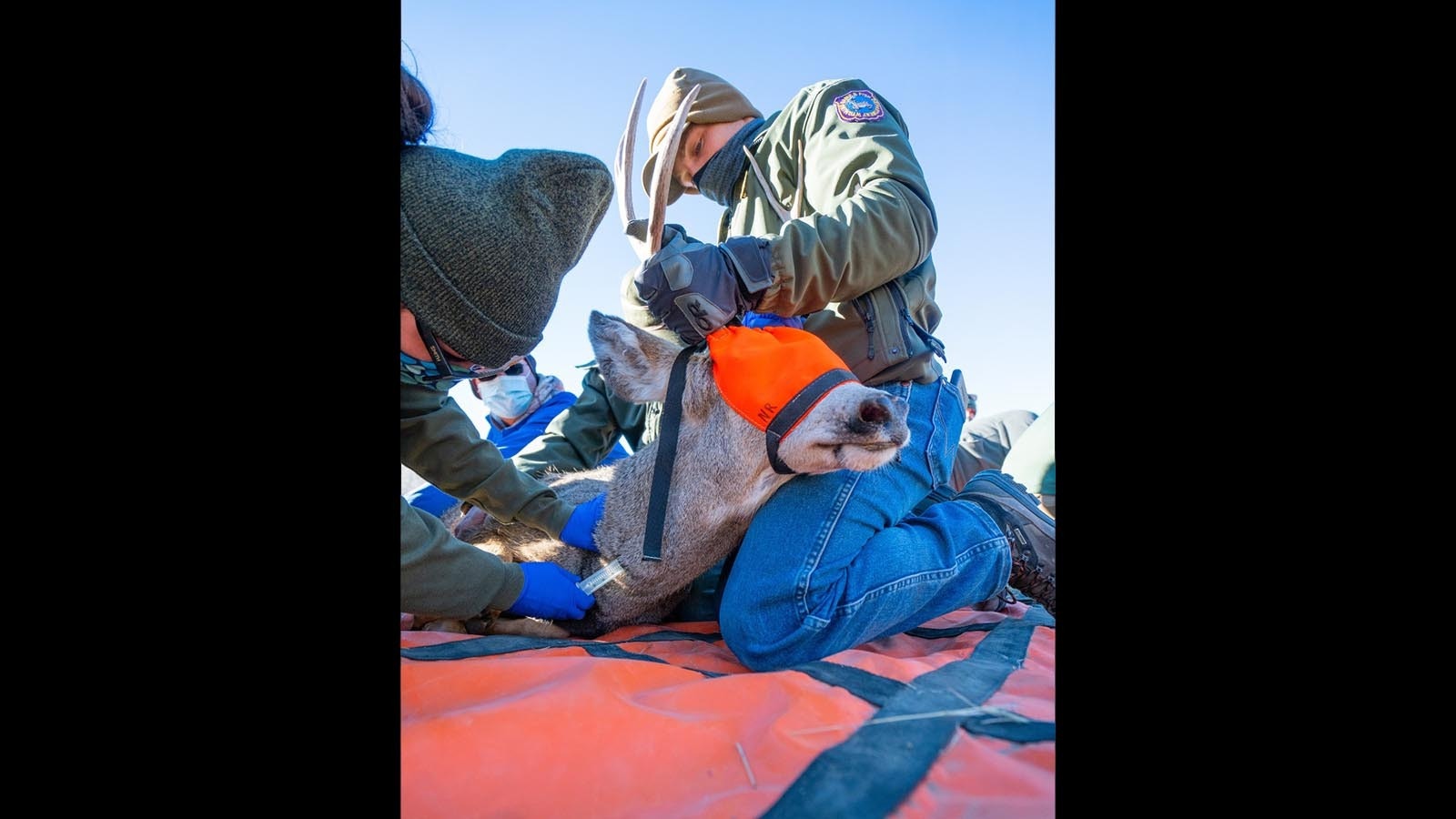
Once an animal is netted, tissue or blood samples can be taken or radio collars can be put on them right onsite, Mong said.
In other cases, the animals are blindfolded, put into slings and flown to a central location where biologists can conduct more thorough examinations.
Then they’re flown back and set free again, to rejoin the herd.
Bighorn sheep are the most-commonly transported species.
Places where people might see airborne bighorns this winter include the Jackson area, near Rawlins and also in the Dubois region.
There’s a “long-term research project” involving the Jackson bighorn herd, Mong said.
Among other things, the sheep are being tested for bacterial pneumonia infections, and body fat ratios.
Animals’ body fat is a good measure by which to determine their chances of surviving the winter.
The Whiskey Mountain herd, likewise, will continue to be tested for pneumonia, Mong said.
Pneumonia can be particularly deadly for bighorn sheep, and the Whiskey Mountain herd has suffered massive losses after battling decades of infection.
In the Rawlins area, bighorn sheep from the famed Ferris-Seminoe herd will be captured and examined.
That herd has historically tested negative for pneumonia infections, and thankfully, that’s still the case so far, Mong said.
There has been concern over how a proposed pumped water storage power project at Seminoe Reservoir might affect that herd.
Because of the herd’s disease-free status, Ferris-Seminoe bighorns have been captured and transported to other parts of Wyoming. They’ve been used to bolster struggling herds, or introduce bighorns into new areas.
No such transplants from the Ferris-Seminoe herd are currently planned, Mong said.
And when bighorns are transplanted, they aren’t flown over the vast distances, he said.
Instead, they are moved overland in a modified livestock trailer.
“We actually have a designated (bighorn sheep) trailer that was given to Game and Fish,” he said.
The trailer doesn’t have any open windows or slats. And its interior is configured in such a way that “makes it easy to disinfect” for possible infections, he added.
Movement Patterns
In the Cody area and elsewhere in the state, helicopter captures of mule deer will help biologists get a better picture of the herds’ movements, Mong said.
“We will be catching and collaring many deer to learn about their movement patterns and winter survival,” he said.
The pathways that deer herds take, the sort of winter range they occupy and other such factors play a big role in how well the mule deer population is doing, he said.
Mark Heinz can be reached at mark@cowboystatedaily.com.