
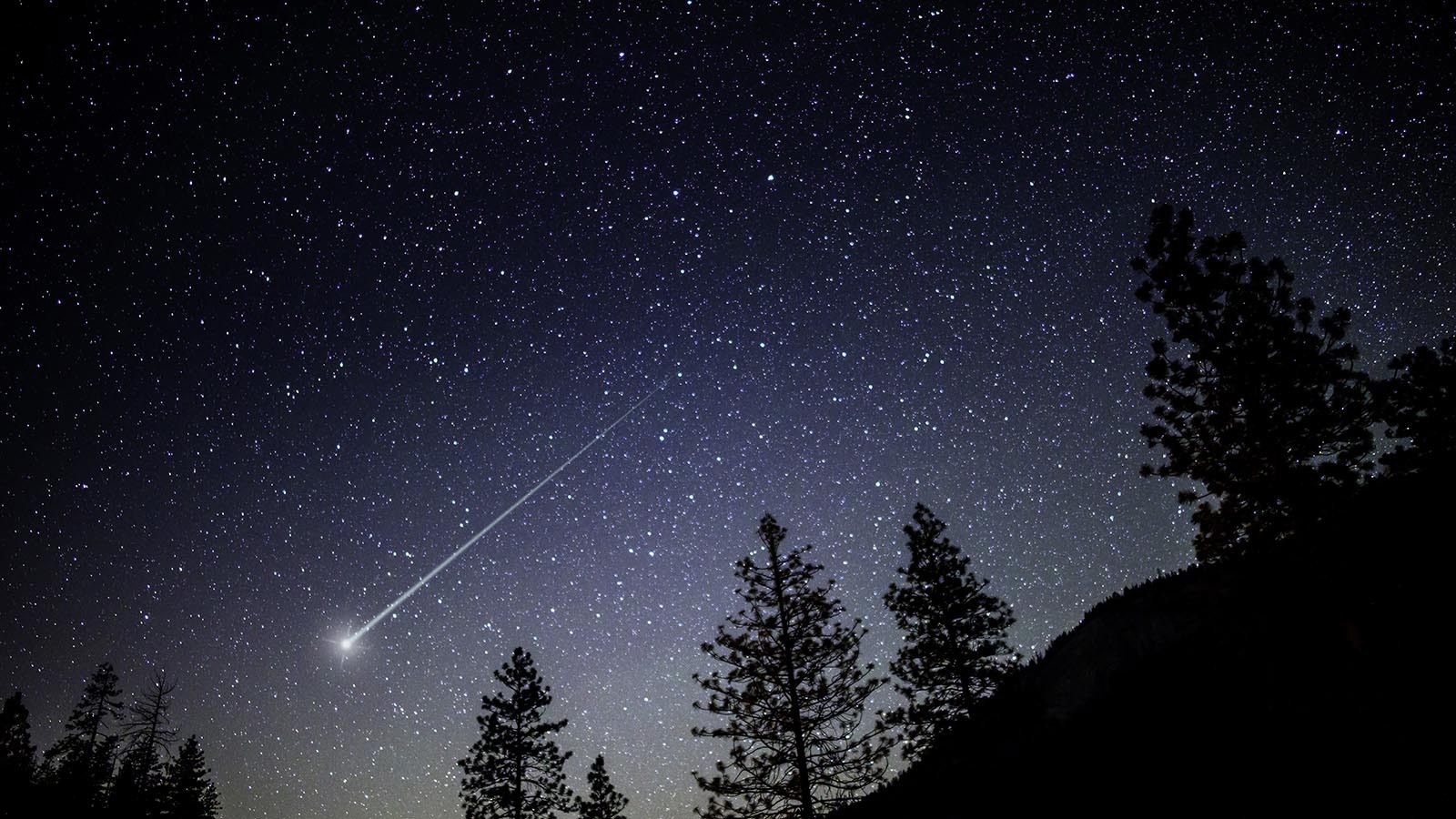
Dozens of people across Wyoming, Colorado and Utah spotted a fireball streaking through the sky on Thursday.
The American Meteor Society (AMS) received nearly 30 reports of a fireball between 9 p.m. and 9:45 p.m. Thursday. Orion T., who saw it over Casper at 9:41 p.m., said it had a “light blue and orange tail with a white body” that was visible for less than two seconds before quietly disappearing.
“Fireballs” are meteors, rapidly disintegrating as they descend through Earth’s atmosphere. Although they’re fairly common, if one looks hard enough, their short duration makes them difficult to spot.
Max Gilbraith, planetarium coordinator for the University of Wyoming, said the moving direction and descent angle of the fireball, along with the reports submitted to the AMS, indicate that it might have ended its journey somewhere in southwest Wyoming.
The fireball might have flamed out over Flaming Gorge.
“Almost no one's reporting sound from this one,” he said. “There might be a mineral-rich meteor in the ground in Flaming Gorge National Recreation Area.
Rainbow Bright
The AMS defines a fireball as “a very bright meteor, generally brighter than magnitude -4,” making it brighter than anything else in the night sky except for a full moon. Hundreds of fireballs fall to Earth every day, but most are too small to be seen or cannot be seen during daylight hours.
“They enter the atmosphere burning hotter than the surface of the sun,” Galbraith said. “It can hurt your eyes if you see it.”
Fireballs also come in many different colors. Those are determined by the elements in the meteor that are burned off by the extreme heat generated as it hurtles through the sky.
Green fireballs are fairly common, usually from the burning of iron and magnesium. Depending on the meteor’s elemental composition, observers might see an entire spectrum of colors, including green, blue, yellow, purple, pink, white, and red.
The eyewitness reports submitted to the AMS include people seeing orange, light blue, green, and white. Gilbraith described those as “firework colors,” as the colors of fireworks are created by adding specific elements to them.
“Red, orange, and white are expected from the black body radiation of a really hot object,” he said. “Green is usually iron, but other colors can come from magnesium, nickel, and stuff like that.”
The Tree-Forest Conundrum
If a tree falls in the forest, and nobody’s there to hear it, does it make a sound? Yes, obviously, but what about fireballs?
Once they reach a certain threshold, many fireballs violently explode before they hit the ground. The Chelyabinsk meteor, which exploded in the atmosphere over Russia in 2013, was 30 times more powerful than “Little Boy,” the atomic bomb dropped on Hiroshima at the end of World War II.
“When a large meteor burns up in the atmosphere, it can create a sonic pressure wave as it explodes that can shatter glass and cause injury,” he said. “It can have sufficient force to cause hearing loss and could seriously injure someone if they got hit by one of the fragments.”
There were no reports of sound that Gilbraith could see submitted to the AMS. It’s possible the fireball exploded and no one was there to hear it, but it might also have survived long enough to impact the ground.
“Based on these citizen science reports, it's unlikely that it had a powerful explosion and broke up,” he said. “If it didn't make a sound, it probably didn't explode and cause a huge shockwave.”
Unusual But Not Uncommon
When a magnificently colorful fireball exploded over Yellowstone in May 2025, several people had footage of it on their dashboard and home security cameras. It was even captured on the static webcam overlooking Jackson’s Town Square.
Galbraith called that a “once in a generation fireball.” Thursday night’s fireball wasn’t anywhere near that spectacular. Then again, fireballs aren’t all that uncommon, in his experience.
“Most people will only casually witness a fireball once in their lives,” he said. “The trick is that if you watch the sky a lot, you end up seeing them more often than you might think. I’ve seen several in just the last decade, just by observing the night sky.
Fireballs aren’t predictable events, like eclipses or Halley’s Comet. The best way to increase one’s chances of seeing one is to spend more time outside under dark skies and hope to get lucky.
The AMS has recorded 17 “major fireball events” from various parts of the world so far in 2026. The Thursday night fireball over the Rockies didn’t register as a major event, or at least it hadn’t by Feb. 6.
What makes this fireball somewhat unique is that there’s no evidence it exploded. That means there could be a meteor waiting to be unearthed in southwest Wyoming, assuming anyone could find the spot where it likely buried itself deep into the Earth.
“If they lost track of the trail north of Flaming Gorge, and it did make contact with the ground at some point, maybe it’s sitting down in the gorge or stuck in the hill over there,” he said. “Who knows?”
Andrew Rossi can be reached at arossi@cowboystatedaily.com.