
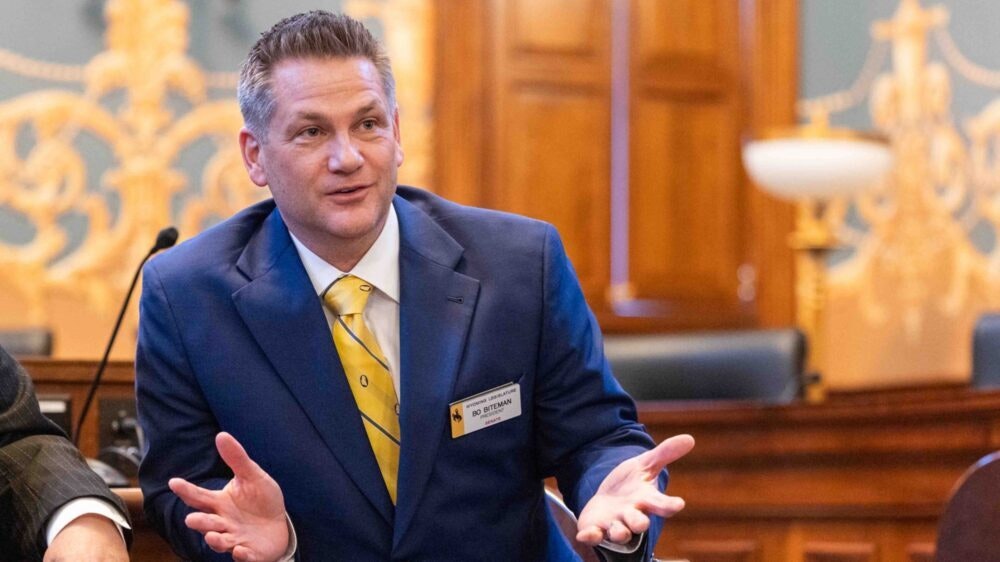
Wyoming Senate President Bo Biteman is “looking seriously” at running for the state’s lone U.S. House seat this year.
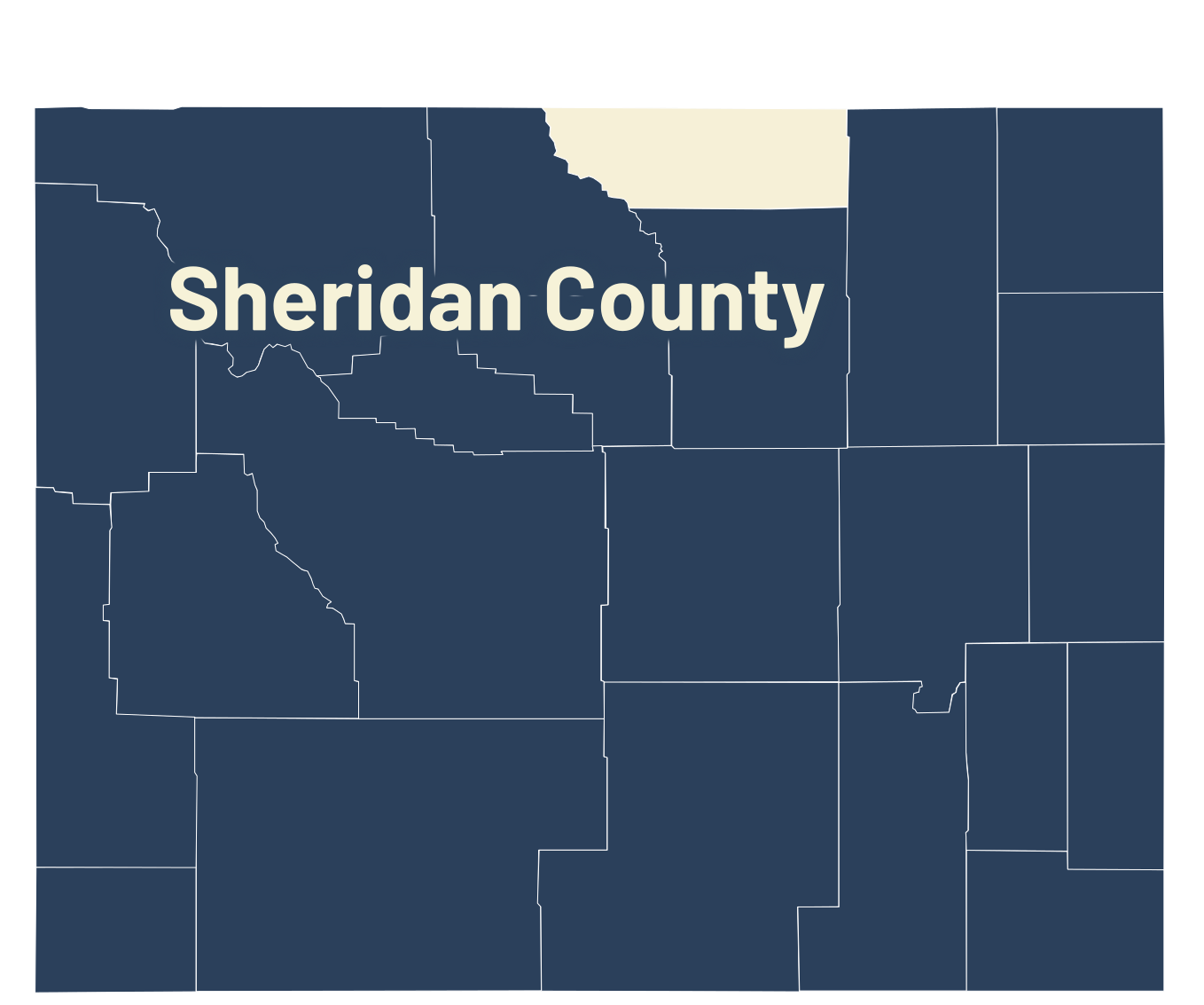
That’s what Biteman, a 47-year-old Republican from Ranchester, told Cowboy State Daily during a Tuesday video interview in which he previewed this year’s legislative budget-planning session, which begins next Monday.
“Well it’s no secret that I’ve been looking seriously at the open House seat,” said Biteman, a state legislator of nine years and a certified professional landman by trade.
He gave the interview from Washington D.C., which he said he’s visiting to discuss Wyoming’s prospects for energy dominance with the White House.
“I’ve been encouraged to run by a lot of friends and allies and fellow patriots across the state. So, we’re looking at it,” he added.
Biteman said he’s forming an exploratory committee and reaching out to potential allies and donors and building a team “to take a look at it.”
Two of Wyoming’s three seats in Congress face a shakeup this year, as incumbent U.S. Sen. Cynthia Lummis announced in December that she’s not running for reelection to the upper chamber.
U.S. Rep. Harriet Hageman followed that with her own bid for the Senate seat; and both Lummis and U.S. Sen. John Barrasso endorsed her.
That leaves the at-large House seat Hageman occupies without an incumbent candidate this election season.
Three, all-Republican candidates have emerged so far: Secretary of State Chuck Gray, Casper businessman Reid Rasner, and former state Superintendent of Public Instruction Jillian Balow.
Despite his interest in the seat, Biteman said he doesn’t want to campaign until after the budget-planning session ends in March.
“I’ve got a huge responsibility and a huge job to finish — the job I was elected to do, going into a budget session and taking care of the people’s work,” he said. “It’s taking up all my focus. And I will have a decision after session – one way or another.”
Let’s Preview This Thing
As state Senate President, Biteman has a gatekeeper role to determine which pieces of legislation can enter the Senate, especially during the shorter, 20-day budget session of even-numbered years.
The top issues going into this session are the budget, whether to change how Wyoming chooses judges, whether to eliminate the Wyoming Business Council, the potential passage of a constitutional amendment that would allow the Legislature to restrict abortion, the concept of spent nuclear fuel storage, the energy economy, public lands and property taxes.
The Budget
Gov. Mark Gordon in November recommended an $11.13 billion, two-year budget for Wyoming which includes state and pass-through federal funds.
The legislative Joint Appropriations Committee proposed increases to specific parts of that budget; like compensation for state troopers, snowplow drivers and prosecutors – and a Medicaid-funded Developmental Disability program that has been encumbered with a waiting list for years.
But the committee also advanced denials and cuts, including a $40 million proposed cut to the University of Wyoming, the dismantling and near-total defunding of the Wyoming Business Council, and multiple denials of Wyoming Department of Health requests – many of which were for spending authorization of federal money.
All those proposals are still in draft form.
Biteman said to anticipate the Senate’s consideration on the proposed UW cut.
“It’s not probably how I would do things,” he said. “I would do more of a targeted approach than just across-the-board cuts.”
But he continued, “I get where the Appropriations Committee is coming from.”
He also referenced what many call a culture clash between UW and the more socially conservative Legislature and said one of lawmakers’ few remaining powers toward making the university reflect Wyoming better is the power of the purse.
“And if we don’t use it, what are we doing?” he said.
Biteman said the Legislature has spent “a lot of money” on the University of Wyoming during his nine years in office.
“It’s always gotten everything (it) wanted. And then some,” Biteman added.
Wyoming Business Council
Biteman isn’t on the Joint Appropriations Committee, but he indicated some agreement with its push to defund the Wyoming Business Council.
That’s a state agency that gives loans and grants to communities and businesses, for economic development.
Biteman has run his own amendments to defund the council, along with fellow Republican Sen. Charlie Scott, he said.
“And we’ve had great debate over, kind of, what their core mission was, and kind of the mission creep over the years and where they’ve ended up… and whether or not that’s something the taxpayers are really seeing a benefit from,” Biteman said.
He said he’s looking forward to discussing that with the other senators. Though not a promise, the statement hints that the Senate president will allow the WBC-killing bill onto the Senate floor.
Abortion Amendment
The Wyoming Supreme Court ruled Jan. 6 that abortion is legal in Wyoming, thanks to a provision of the state Constitution voters passed in 2012, promising a right of health care autonomy to competent adults.
Biteman said the wording of the 2012 amendment left too much wiggle room to the judicial branch, enabling “legislating in the Constitution.”
Biteman and his counterpart, House Speaker Chip Neiman, promised on the day of the ruling to help advance a new constitutional amendment that would allow the legislature to ban abortion.
If the legislature succeeds, the voters could reject or adopt that amendment in November.
Its wording should be simple, said Biteman.
“If you give the court that much wiggle room, they’re going to hurt you when they want to,” he said. “In this case, they hurt us pretty bad.”
The new amendment should not read like legislation; it should clarify the legislature’s authority to restrict abortion, he said.
“I think it could be one or two sentences, honestly,” added Biteman.
He said he disagrees with adding rape and incest exemptions to a abortion bans, because “all life is precious and should be saved,” but would adopt those exemptions if passing a ban depended on it.
Judges, Now
Lawmakers have been discussing changing the way Wyoming chooses judges for months, floating ideas about state Senate confirmation for Wyoming Supreme Court justices, and possibly district court judges – and discussing whether the judicial nominating commission could be made more transparent.
That’s in light of an earlier version of the Jan. 6 abortion ruling; a series of specific court mandates regarding education funding, and a preliminary injunction on a school-choice program the legislature passed.
Biteman is open to discussing Senate confirmation for judges, he said.
As the law sits now, a panel of lawyers and non-lawyers nominates three judges from a pool of applicants whose names aren’t made public. The three nominees’ names do become public, and the governor appoints one judge from those.
“I think it's time (to consider changes), Biteman said. “There’s a lot of concern right now that we're… getting judges that are not strict constructionalists, that are more activist.”
He cited the school choice preliminary injunction and the abortion ruling.
“It seems like when conservatives finally get a win – if the governor doesn't veto it - it's almost like there's a second veto with the courts,” said Biteman. “And they can stop all the things that the people have wanted for years and finally got through their elected representatives.”
Energy Dominance
Biteman touted Wyoming’s “energy dominance,” promotion of traditional energy sources, grid reliability and economic-friendly policies as among his main goals.
“I’m talking to the White House tomorrow about some exciting things on the energy dominance front,” said Biteman.
He said he’s planning a bill to establish an energy dominance fund, geared toward traditional minerals like coal, oil and natural gas – “not so much wind and solar.”
The state-backed fund is needed, he said, because recent “ESG” or green-leaning compacts among banks and investors have bottlenecked the finance world for traditional energy companies.
That’s also the theory behind a lawsuit Wyoming is waging against Blackrock and other investors.
Biteman’s bill was not listed on the Wyoming Legislature’s website as of Wednesday.
“It’ll focus on grid reliability, stability and helping the Trump administration achieve energy dominance, and keeping Wyoming at the front and center of it,” said Biteman.
An obstacle to Wyoming’s success, in his view, is a not-in-my-backyard or “NIMBY” attitude among both the political right and left, toward business projects.
“If we’re going to be open for business, we can’t have that,” said Biteman. “Otherwise, (Wyoming) is just going to be a retirement home for old, wealthy people from out-of-state, and kiss everything else goodbye. That’s what’s at stake.”
Probably Won’t See That One…
State Rep. Jacob Wasserburger, R-Cheyenne, last month unveiled a bill that, if it passed, would implement a process seeking to sell between 30,000 and 200,000 acres of public, state-held, non-trust lands to solve a housing shortage.
“Well, I doubt we’ll see (that bill) in the Senate, I’ll just put it that way,” said Biteman. “I don’t want to criticize anybody’s ideas and I think – I think everybody that’s elected to the Legislature has the right to bring ideas to the table.”
Some ideas are better than others, he added.
“And the good ones will rise to the top – and the not-so-good ones will not,” Biteman said.
The Governor Sure Disagrees With This One
Biteman said Wyoming’s part-time Legislature already has a fulltime workload.
“I think we’re already there. We’re just not getting paid fulltime,” he said. “And it’s hard to attract (candidates) that aren’t independently wealthy or retired to do this job, so you don’t get the cross-section of Wyoming. Like, a guy like me that has a family and a real job outside of politics.”
Being part-time at least technically puts the legislature at a disadvantage to the maneuvers of the fulltime executive branch and the fulltime judiciary, Biteman added.
Gov. Mark Gordon in a Lander-based forum Tuesday voiced disagreement with going to a fulltime Legislature.
“I’m not a let’s-have-more-government kind of person,” said Gordon. “I actually love the way the Wyoming Constitution’s built. It limited the time of the legislature to be (in session). It made sure the big guy – the governor – had to deal with four other electeds in their own right, to make big decisions for the most part.”
Property Taxes, Education, And Nukes
In 2024 and 2025, property tax reform was a top issue for Wyoming voters and in the Legislature.
In 2026, many local governments are lamenting the 25% property tax cut and other exemptions, saying important services like fire departments are suffering.
Biteman said he’s going to let the people decide what happens next, then “come up with a way” to backfill dire shortfalls if necessary.
Wyomingites have placed a proposed 50% property tax cut on this year’s ballot, via petition.
The Select Committee on School Finance Recalibration, on which Biteman sits, took fire last month for a slew of proposed changes to the way K-12 funding works.
For example, lawmakers are considering increasing some class sizes, requiring all school districts to use the state’s insurance pool, changing the attendance metrics that drive school funding, and “siloing” teacher and paraprofessional pay.
As to the siloing, that’s from years of lawmakers wishing to pay teachers more and seeing some districts spend money from the educator compensation bracket in other areas, Biteman said.
Another hot topic this interim was whether Wyoming should adopt laws making it easier for nuclear storage facilities to populate the state.
If Wyoming does that, it should give local communities the option to reject those projects, Biteman said.
Clair McFarland can be reached at clair@cowboystatedaily.com.


