A new online portal for reporting foreign-owned agricultural land transactions is a step in the right direction for U.S. security and will further protect the future of Wyoming’s agricultural land, according to lawmakers.
But real estate brokers say there is little to worry about when it comes to foreign-owned agricultural land in the state.
The online portal, launched by the USDA in January, is meant to streamline reporting of transactions involving U.S. agricultural land by foreign entities and represents a broader trend of increased federal scrutiny of foreign investment in U.S. agricultural and forest lands.
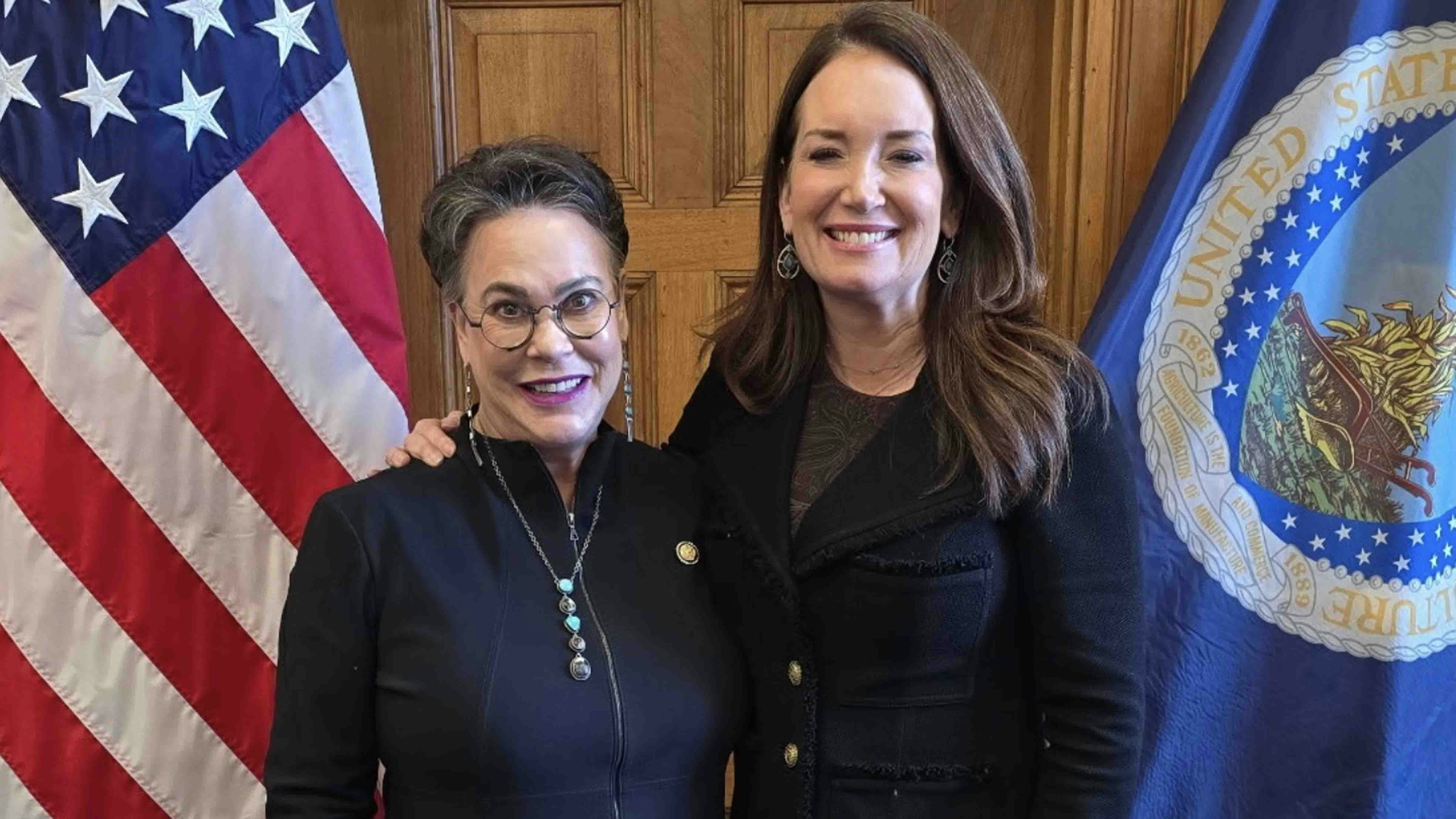
U.S. Agriculture Secretary Brooke Rollins said the online portal will collect information about foreign interests in the United States' agricultural land and help protect the security of America’s farmers.
Breaking Down The Numbers
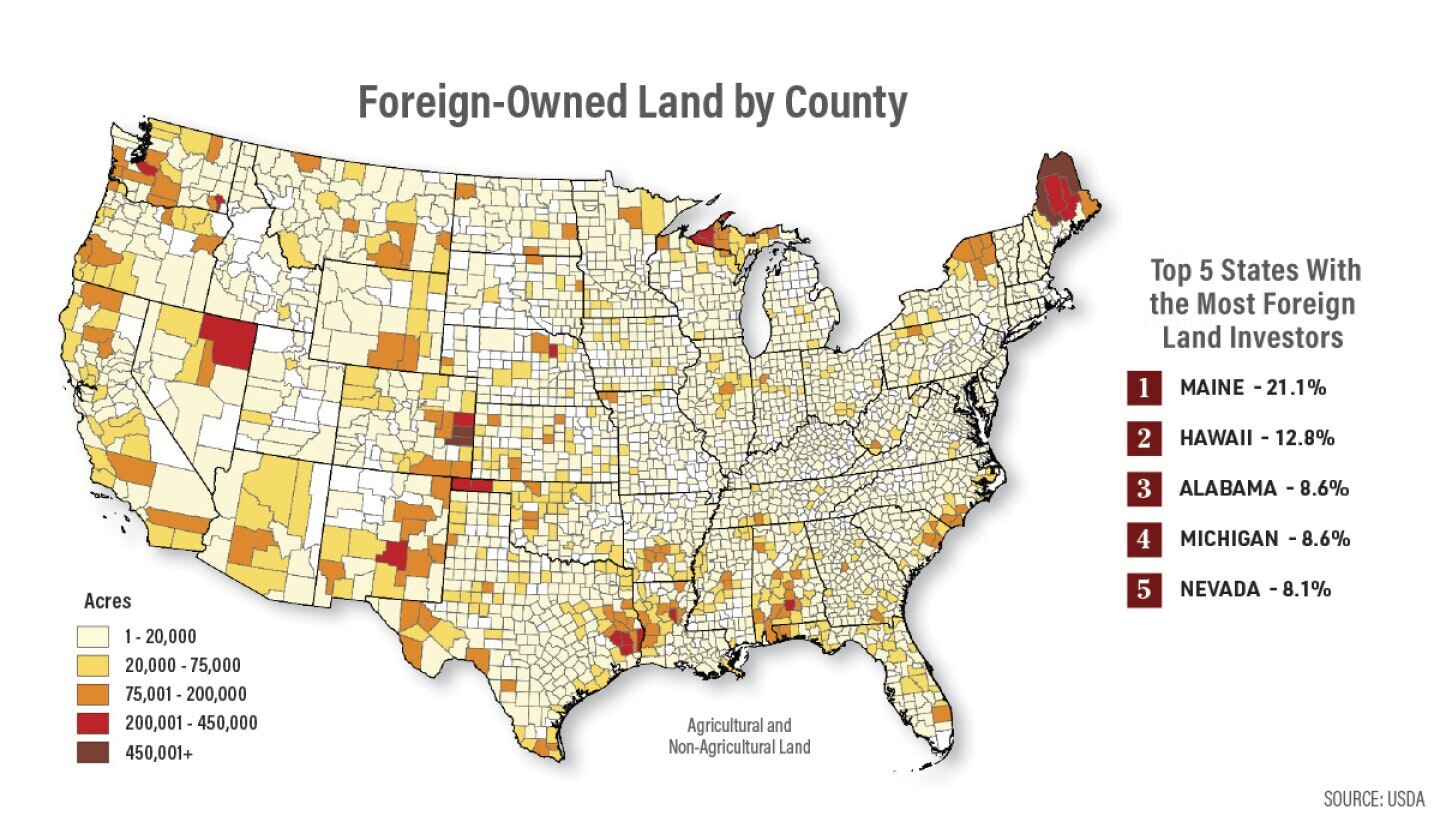
In 2024, about 1.6% — less than half a million acres — of Wyoming’s agricultural land was foreign-owned. Albany County had the most foreign-owned agricultural land, at 113,732 acres, or about one-fifth of the state’s total.
Albany County Assessor Chelsie Mathews did not return Cowboy State Daily’s call requesting further details about that land ownership as of publication. However, John Hewlett, a farm and ranch management specialist with the University of Wyoming, told Cowboy State Daily that the county's higher concentration of foreign-owned land is likely due to foreign-owned energy leases.
Wyoming constitutes a relatively small portion of the national total of foreign-owned land, Hewlett said. By comparison, Wyoming's foreign holdings are significantly lower than states like Texas (5.9 million acres), Maine (3.5 million acres) or Colorado (2.4 million acres).
State Sen. Cheri Steinmetz, R-Goshen, Niobrara and Weston counties, said in an email to Cowboy State Daily that even a small percentage of foreign-owned agricultural land can be a big problem in the state if it’s near water, food production, energy assets, military-related sites, or other critical infrastructure, or if it involves foreign adversaries using layered entities and leases.
Wyoming U.S. Rep. Harriet Hageman agreed, telling Cowboy State Daily in a statement that the Chinese Communist Party is trying to purchase land near sensitive national security sites.
“We need to take this threat seriously, as our adversaries would never let the U.S. purchase its land, let alone in strategic areas,” she said.
A Tough Sell
But limiting foreign ownership of agricultural land has proven to be a tough sell in Wyoming.
Cowboy State Daily previously reported that The Wyoming Legislature has considered but not passed laws restricting foreign ownership of land.
In 2023, two House bills died that would have banned foreign-owned property ownership in Wyoming. House Bill 116 would ban property ownership of more than 1 acre in the state by people or entities from Russia, China or other nations designated as a state sponsor of terrorism. Any current owners would have been forced to sell within two years.
House Bill 88 would similarly ban foreign-owned agricultural land, but with a broader application to any foreign ownership and contained a grandfather clause for current owners. Both bills ran into hurdles over questions about their constitutionality and the idea that foreign ownership is not unequivocally bad.
"Land use [in Wyoming] is primarily grazing," Hewlett said. "The type of land held by foreign investors in Wyoming suggests agricultural production (specifically livestock) rather than strategic asset control."
However, the Legislature did pass — and Gov. Mark Gordon signed — a bill requiring disclosures of ownership of land near critical infrastructure.
Steinmetz said broader restrictions did not pass because it is difficult to craft a bill that hits all the marks.
“Writing a ban that’s tight enough to stop adversaries, constitutional enough to survive and practical enough to enforce is harder than it sounds,” she said, “especially when ownership can be masked through complex entities and long-term leases.”
Brokers, Landowners Weigh In
Scott Williams, a real estate agent with Swan Land Company who recently sold the sprawling 916,000-acre Pathfinder Ranch, said foreign-owned agricultural land in the state is not much of a concern for him.
“It’s not really on our radar that much,” he told Cowboy State Daily. “From a practical standpoint, it’s not much of an issue.”
Williams said he meets with almost all prospective land buyers face-to-face.
“We get a very good pulse on who is the person or people [interested in a land transaction],” he said.
Williams doused rumors last fall that the Pathfinder Ranch was purchased by Ukrainian President Volodymyr Zelensky.
“Everybody was up in arms about it,” he said.
The buyer was, in fact, an American cattle rancher and neighbor of the ranch.
The University of Wyoming's Hewlett agreed that there is little to worry about when it comes to foreign-owned property in Wyoming.
"While the topic often generates significant attention, the actual footprint of foreign ownership in Wyoming is relatively small compared to national averages and neighboring states," he told Cowboy State Daily in an email. "Furthermore, data indicates that the primary foreign investors in Wyoming are from long-standing U.S. allies rather than geopolitical adversaries."
While Williams said he is not concerned about foreign-owned land in the state, he questioned oversight of managed limited liability companies (LLCs) and how easy it could be for a foreign entity to operate under an American-owned LLC.
It’s a concern echoed by Wyoming cattle rancher and former National Cattlemen’s Beef Association President Mark Eisele.
Foreign ownership is not very limited, he told Cowboy State Daily, because anyone can register for an American LLC.
While Eisele acknowledges there is reason to be concerned about foreign-owned agricultural land — especially land near military installations — he said American landowners sometimes appeal to foreign investors to get off the ground.
“The fear is justified,” Eisele said. “It’s going to take some real nuances to sort it out.”
Like Williams, Wyoming land broker Charlie Powers said he has rarely encountered land deals with any person or entity outside the U.S.
“I just wish we could keep ranches as (owned by) small businesses and families,” he told Cowboy State Daily.
The USDA AFIDA Report
The USDA in January shared its annual Agricultural Foreign Investment Disclosure Act (AFIDA) report with Congress, listing foreign holdings of U.S agricultural land. In recent years, there has been significant attention to foreign land ownership and its implications on national security, particularly concerning lands near military bases and training facilities.
As of the end of 2024, 46 million U.S. acres are owned by foreign entities, including land acquired by Russia, China, North Korea and Iran. According to Hewlett, five countries collectively hold 61% of all foreign-owned U.S. land: Canada, 16.1 million acres (34%); Netherlands, 10%; Germany, 6%; Italy: 6% and the United Kingdom, 6%. Hewlett said current data indicates Chinese investors hold slightly less than 1 percent of all foreign-held agricultural land.
Foreign-owned agricultural land in the U.S. increased by over 1.3 million acres from the previous year, according to the USDA report. Foreign holdings have increased an average of over 2.4 million acres annually since 2017.
Hewlett said AFIDA acts as a monitoring tool, leaving restriction decisions to individual states.
The USDA has been collecting information regarding foreign ownership of agricultural lands under AFIDA since the late 1970s.
Kate Meadows can be reached at kate@cowboystatedaily.com.