
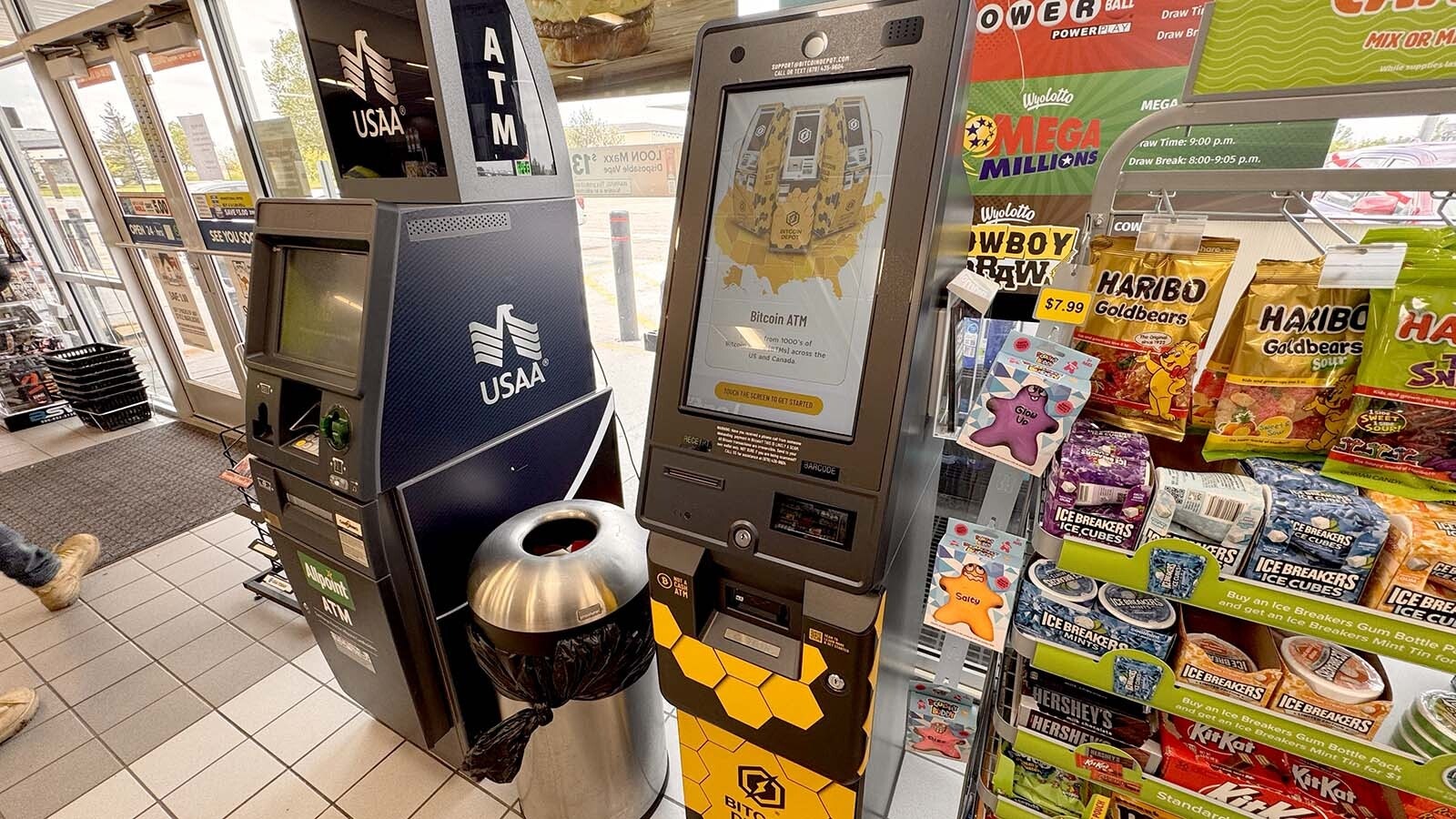
Millions of dollars are flowing out of Wyoming into the pockets of Nigerian princes and other foreign con artists through an unassuming portal that looks a bit like a bank ATM but isn’t.
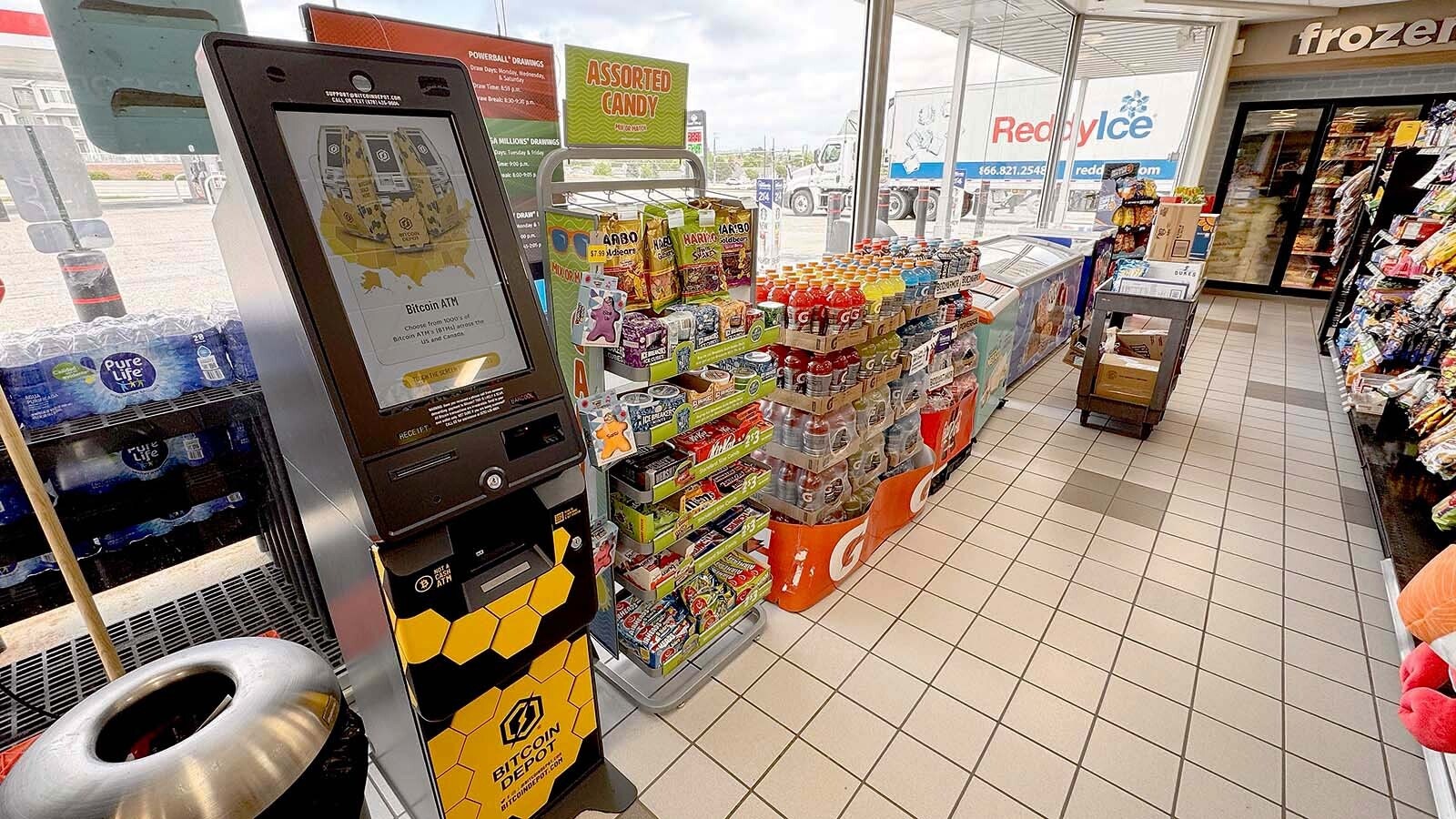
The portals are crypto ATMs, which have popped up in communities across Wyoming. AARP estimates that the Cowboy State has 45 Crypto ATMs in various locations of Wyoming and counting. Eleven of those are in Cheyenne.
The machines can be used to buy cryptocurrency, as well as transfer cryptocurrency to other users around the world.
The machines themselves are legal devices, but they have been co-opted by criminals, who have found in them the ideal, virtual getaway car.
Once they’ve convinced their victims to stash their cash in a designated cryptocurrency account owned by the scammer, they can instantly transfer that money through dozens of accounts, dividing and subdividing it, creating a virtual smokescreen that makes it nearly impossible to track without hours and hours of forensic accounting.
So far, the con artists have gotten away with more than $4.6 million from Wyoming’s three largest cities, $3 million of which was in Gillette alone.
That figure doesn’t include all the other communities that might have a Crypto ATM, nor does it include frauds that were never reported to law enforcement.
No Gatekeepers
The problem is not just confined to Gillette. It is statewide and is happening in communities from Sheridan in the north to Cheyenne in the south, and everywhere in between.
“This has become a newer method to get money from people in scams is to get them to direct the victim to a cryptocurrency ATM, ” Cheyenne Police Sgt. Kevin Malatesta told Cowboy State Daily. “So, in the past, maybe 10 years ago, when I first began working these kinds of cases, we would start to see victims being directed to use prepaid gift cards or do money orders. And I think the scams themselves are pretty similar to what we’ve seen over the last couple of years.
"It’s just the means of currency with which they’re perpetrating these scams has shifted from gift cards or cash or checks to these Bitcoin ATMs.”
A large part of the reason for that, Malatesta added, is that Bitcoin ATMs don’t require a cashier or teller, both of whom have been trained to notice behavior that might suggest someone has become the victim of a scam.
Oftentimes, the least little bit of questioning can help break people out of a panicked phase they’re in, thinking a loved one is in danger and needs bail money or that they’ve done something for which they themselves could be arrested, or any one of a dozen other scenarios that scam artists have crafted to convince people to send them money.
In Cheyenne, Malatesta estimated that Crypto ATMs were involved in at least $600,000 worth of scams in 2025.
“For a lot of the victims of these scams, it’s a long-term thing,” Malatesta said. “So, they’re giving money over the course of a couple of months, couple of weeks, or, in some cases, even a year or two.”
Grandma’s Savings Can’t Be Chased To Jamaica
Unfortunately, once a con artist has convinced someone to put their money into Bitcoin and send it to them, it becomes difficult to track, and even more difficult to claw back that money, Sheridan Police Officer Liz Shafer told Cowboy State Daily.
“Scammers use these methods because that money cannot be retrieved,” she said. “We’re having some success with cash that’s been mailed, because we can intercept that. But if you put it into a crypto ATM, that money is gone.”
Shafer has seen $1.5 million in losses over a two-year period through the fall of 2025. None of that money has been retrievable.
“Getting that money back, I have seen zero success stories on that front,” she said. “I mean because you put it into a wallet, which is a random string of letters and numbers, and the scammer is waiting for it, and they instantly move it to another one. They’ll split it up from there and move it to another one.”
The money can eventually be tracked down, Shafer said. But the problem is, Shafer has no jurisdiction in a foreign country like, say Jamaica.
“I can’t go there,” she said. “And the FBI is so overwhelmed with these cases that the only ones they’re really looking into have to total in the six figures. If someone lost $3,000, and it’s a lady who is living on social security and a pension who cannot afford a $3,000 loss, I have to look her in the face and say, ‘Look, I am so sorry that money is gone.’”
Shafer shares information on where these kinds of scams can be reported, including www.ic3.gov, reportfraud.ftc.gov, cftc.gov/complaint, sec.gov/tcr.
She’s also part of an ongoing campaign to educate her community about what these scams look like and how they operate, which she believes has helped raise awareness and prevent cases of this kind of fraud.
But it still feels hollow when she has to tell a victim that their less-than-six-figure — but still multi-thousand-dollar — loss is likely too small to generate any concrete action to attempt catching the thief, and that they will likely never see any of their money back.
“There’s nothing anybody’s really able to do about it,” she said. “Once (the money) is out of the country, I’m done. It doesn’t matter how far I track it. I could track it all the way to the house it got withdrawn at (in Jamaica). I have no jurisdiction there.”
Still, Shafer added, people should report the theft to law enforcement. That way, authorities can track what’s happening in a community, and there’s always the chance, however slim, that the case intersects with a larger one and some of the money can be seized and returned.
Legislation Could Help Curtail Damage
In Gillette, Police Detective Alan Stuber estimated the Gillette Police Department and the Campbell County Sheriff’s Department together handle between 75 to 100 cases of fraud annually that involve the use of Bitcoin ATMs, for a roughly $3 million take in all.
Stuber was not available for direct comment, but is among law enforcement officers who have been talking with lawmakers about some new rules for Crypto ATMs to try and curtail the harm these machines can do to any one person, and talked to lawmakers during a recent legislative preview session hosted by AARP.
Having a limit on daily transactions, for example, would help ensure people can’t lose thousands of dollars in a single day. Having clear messaging about what the fees for the transactions are could also help people understand that this might not be the best method for buying cryptocurrency anyway.
Campbell County Republican Ken Clouston, R-Gillette, plans to sponsor a bill that will require Crypto ATMs to adhere to rules set by the state banking division, including warnings on the machines themselves.
Stuber told lawmakers most of the scams he’s seen do follow tried-and-true scripts that con artists have been using for a long time now to convince people to give them their cash. But many of the con artists are smart about how they construct their plots, and it’s easier than people think to get caught up.
“They make threats, whether it’s a city bill, whether it’s a warrant out for their arrest,” Stuber said. “And they’re smart. They’ll figure out, I mean our names are in the newspaper, so they’ll use our names and say, ‘Hey, this is Detective Stuber with the police department. You have a warrant out for your arrest, so we need this money right away.'”
They structure their calls in a way that’s designed to induce panic and discourage questions.
They’ll often stay on the phone with their victim throughout the Crypto ATM transaction, as well, talking them through every step, keeping them upset emotionally, so that they don’t stop to think things through.
“And it is people 60 and older, and it used to be gift cards,” he said. “And we shot those down pretty hard in Gillette. Our stores are doing a lot better at not allowing people to buy thousands of dollars of gift cards.”
Showing Up On The Doorstep
The largest single scam Shafer has seen involving Bitcoin ATMs in the last two years was an overall $800,000 con that included several different approaches, including mailing some gold and silver bars for “safekeeping.”
“If it’s mailed, we can sometimes intercept it, if we catch it fast enough,” Shafer said. “But in a couple of instances, and this is where it gets really creepy, they’ll send someone to your house to come and pick it up.”
In one of the latter cases, the scammers even flew someone all the way to Wyoming for that purpose.
“To me, that’s terrifying,” Shafer said. “And we were able to intercept one person. I can’t talk anymore about that one (due to ongoing investigations), but somebody literally flew into Wyoming and came to the victim’s house to get the money.”
Shafer has also seen cases where con artists went to great lengths to resume conversations with someone they’d targeted, after relatives had discovered their activity and intervened.
“This was a romance scam,” Shafer said. “And she had already sent them some money. So we went to talk to her, and I said (to the daughter), ‘Look, you have to stop her. And the daughter was on top of it and was able to stop her mom from writing several checks.”
After the mom’s number was changed, she got two checks in the mail that, combined, totaled $900,000 as part of a scheme to recapture her attention.
“Then they contacted a local taxi company and said, ‘We need you to drive to this woman’s address, and we need you to hand her your phone so we can talk to her,” Shafer said. “Because the daughter had blocked their number and gotten her a new number, so they just sent a taxi driver to this woman’s house and said, ‘Hand her your phone so we can speak to her.’”
It’s just one example of many that Shafer has seen where con artists take bold action to hook and keep their victims engaged … as long as the money continues to flow.
Renée Jean can be reached at renee@cowboystatedaily.com.


