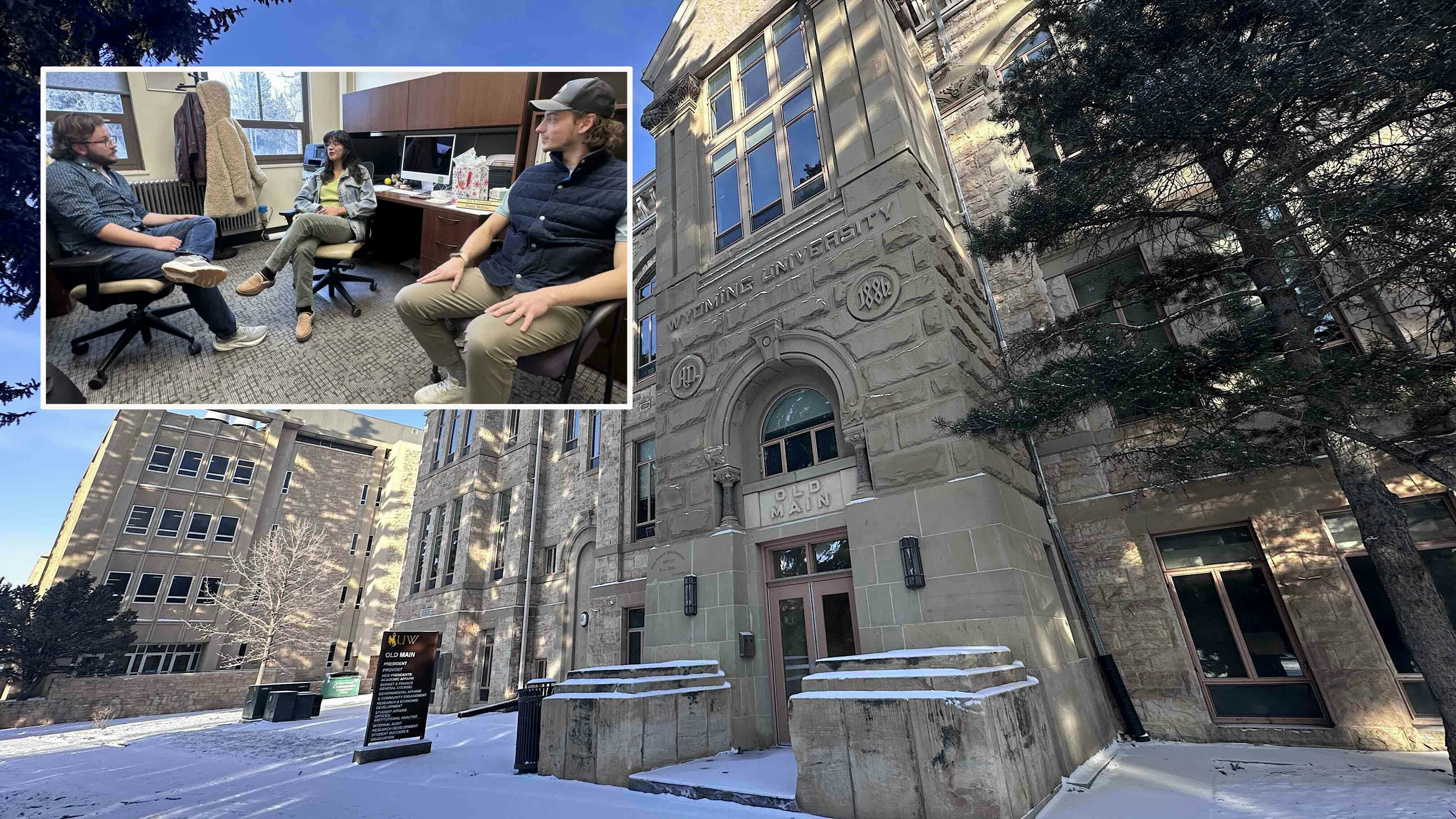
LARAMIE — Students at the University of Wyoming aren't waiting for the Legislature to finalize its budget before fighting back against proposed cuts they worry could slash funding by 15% for most academic colleges.
Paula Medina, president of the Associated Students of the University of Wyoming (ASUW), said students across campus are starting to organize ahead of the upcoming legislative session starting Feb. 9.
"A lot of students that I talk to are really considering what does my future look like in the state of Wyoming after this?" Medina told Cowboy State Daily Wednesday. “Their future hinges on the University of Wyoming.”
Legislators on the Joint Appropriations Committee voted Jan. 13 to cut $40 million from UW's block grant — roughly 11% of what the university receives from the state. Because the committee exempted the College of Agriculture, Life Sciences and Natural Resources and the College of Education from the cuts, remaining academic units face reductions closer to 15.4%, according to UW President Ed Seidel.
ASUW Vice President Aidan McGuire, a fourth-year philosophy and history student from Evanston, said the student government is preparing legislation opposing the proposed cuts.
"We've seen pretty much universally that people aren't on board with those decisions," McGuire said. "I wouldn't be surprised if that's something that goes through the (student) senate on Tuesday with little resistance."
The resolution has attracted sponsors from across campus, including student organizations like the Middle East and North Africa Culture Club, Microbiology Student Association, Model United Nations and Wyoming Competitive Speech Team.
The resolution argues that cutting the university's funding would harm Wyoming's economy and accelerate the state's brain drain. It cites data showing UW supports nearly 14,700 jobs and adds more than $720 million in value annually, while alumni living and working in Wyoming contribute $1.36 billion to the state economy.
The resolution also notes that 73.3% of Wyoming-born residents with a college degree have left the state, warning that "these proposed cuts may limit UW's ability to generate future revenue for the state because the lack of support and job opportunity turns UW students away from Wyoming.”
The student legislation points to recent cuts at the University of Utah as a cautionary tale. Reductions there totaling $19.6 million — less than half the amount proposed for UW — resulted in the elimination of 94 academic programs and 484 courses.
"Wyoming maintains only one four-year institution, making comparable outcomes likely and producing harmful statewide educational and workforce impacts if similar budget reductions are enacted," the resolution states.
The resolution also argues that the cuts will limit course offerings, hinder faculty research and threaten academic freedom, in addition to violating the Wyoming Constitution's requirement UW be "as nearly free as possible.”
Organizing Tool
Will the ASUW resolution help sway Wyoming legislators to back off the proposed budget cuts? Student leaders said they don’t know, but the resolution will provide formal opposition to the $40 million slash. McGuire said it will “justify our positions as representing the full university” and be used as an organizing tool and means to mobilize the student body.
ASUW President Medina, a senior double major in civil engineering and environment-natural resources from Cody, said, “ASUW has access to the all-student listserv. When we pass resolutions, we can disseminate information via those resolutions on that list.”
Student leaders are also warning about the ripple effects from budget cuts.
Dylan Fernholz-Hartman, ASUW's director of external public affairs and chair of the Graduate Student Council, said graduate students are particularly concerned.
"The conversations I've had with my peers and with the graduate student council, people can see the writing on the wall,” said Fernholz-Hartman. “There's got to be cuts to the work that we're doing, and there's a lot of concern that the work that people are so invested in is going be put on the chopping block when it's halfway done."
Fernholz-Hartman warned the cuts could trigger a damaging chain reaction.
"You have to imagine the faculty who bring in the most amount of grant dollars from outside the state are also the faculty who would be the most mobile to go to other universities, take their talents and their labs to those universities," he warned.
Fernholz-Hartman added, "So if we were to see these 15% cuts to departments, I would not be at all surprised to see some of our top award-winning, grant dollar bringing in faculty, also end up being kind of pushed out more than anything, and that's going to create this feedback loop where we're offering less competitive programs, we have less senior faculty and researchers here at the university. That's going to make more financial problems for the university."
Legislative Push
ASUW plans to send representatives to Cheyenne during the legislative session.
"ASUW has a really good history about going to the state legislature and advocating for a number of things," Medina said. "Usually, what our advocacy efforts look like is we get a team together. And we do some basic training about how do you approach a state legislature and what are talking points of what are the major things that we want to hit up, and most importantly, what are our objectives?"
Charles Vaughters, editor-in-chief of UW's student newspaper The Branding Iron, said student opposition to the cuts is widespread but hasn't yet reached a fever pitch.
"From a student perspective, I would say that most people are generally against any cuts," said Vaughters, a junior from Denver who served in the Marine Corps before attending UW on the GI Bill. "There is a little bit of variance in the degree to which the opposition is. I would say I'm more on the moderate end personally, and then there are some people on way more extreme ends saying like, ‘Well, this is fascism.’”
Vaughters said he’s heard some students state they believe the proposed cuts are, “About ‘reducing access to education so that the population is less informed so that an authoritarian state can take control.’ I personally don't think that it is that extensive. I think that this is a bad legislative decision."
Sizing up the student body, Vaughters said he doesn't yet sense enough momentum to mobilize en masse.
"I'm not exactly sure that students are as worked up about this yet," Vaughters said. "I think they may get more worked up as time goes on. And if this gets past the preliminary budget hearing, then yes, there's a possibility of that."
Past Victories
Medina said the student government has reason for optimism when it comes to lobbying the Legislature. She pointed to testimony before the Joint Appropriations Committee during the fall budget hearing.
"We got asked questions about free expression, and I think it was literally a breakthrough moment to kind of talk about what ASUW is working towards," Medina said. "I think we received a lot of positive input from the legislators to talk to me afterwards about ASUW's efforts and our exemplary efforts in trying to maintain this very important cause for the state."
McGuire said the Joint Education Committee hearing on Nov. 13 also went well when ASUW members testified in support of expanding Hathaway Scholarship eligibility and funding.
"We had a committee here within ASUW that recommended a Hathaway increase, student government legislation. And then we took that legislation and went to the joint education committee to advocate for that increase. And the joint education committee recommended a bill out of there for a 40% increase in the scholarship," McGuire said.
Faculty Alarm
Student leaders appear in lockstep with faculty representatives concerned about the proposed budget cuts.
Faculty Senate Chair Rob Godby told the UW Board of Trustees on Jan. 23 that the suggested cuts have created "a real sense of disappointment" among faculty.
"Faculty do feel under pressure. There's a lot of uncertainty, but more important, I think there's a real sense of disappointment — not only with respect to some of the changes that have occurred recently with respect to speech and values and some of those changes, but now at this point the real questioning of what the University of Wyoming is," Godby said.
He added recent moves by the Wyoming Legislature have raised troubling questions about the state's commitment to quality education.
"One of the members of the committee actually questioned whether we needed the quality of facilities and the cost that goes with them in our education," Godby told trustees. "And that really comes to the fact that in our constitution we are required to offer an education that's as nearly free as possible. But our tradition has been to make sure that is as close to the best world-class education as we can get. You're not getting a bargain basement education here that's based on a budget. You're getting delivered a world-class education."
Godby said the cuts, if enacted, would do lasting damage.
"What is represented in some of the suggested budgetary changes will be probably irreversible or they will amount to damage that will take decades to probably undo if we choose to undo them," he said. "When morale issues turn into retention issues, we undermine what we offer the state. And the state has made far too large an investment in its kids and its people to really let that investment depreciate."
David Madison can be reached at david@cowboystatedaily.com.