Tribal leaders in Wyoming were overjoyed Tuesday when state lawmakers who had voted to deny state permission to spend $58 million in federal Medicaid money destined for federal health clinics reversed course, promising to unblock the money.
That unfolded at Central Wyoming College in Riverton amid a protest, a legislative meeting of the Select Tribal Relations Committee and tense testimony in which one lawmaker accused another of being disingenuous.
Tribal government and health care leaders urged lawmakers to allow the Wyoming Department of Health to channel $58 million in federal Medicaid money to their clinics, calling it a dire health matter — and of the federal government’s obligation to honor its treaty promises to take care of tribal members.
House Appropriations Chair John Bear, R-Gillette, who had voted in favor of denying the money during a Jan. 13 meeting of the Joint Appropriations Committee appeared by virtual link to offer an explanation.
He told the committee and tribal leaders that the denial was not an outright block since the governor could still authorize the money to pass through the Wyoming Department of Health without legislative approval. That involves a legal process lawmakers call “B11," which this account has used in at least two recent years.
Bear also pointed to fluctuating reimbursement estimates from the federal government and the fact that the Medicaid reimbursement figure has changed from $58 million to about $41.3 million.
“So really, this is an accounting issue,” said Bear.
“I just want to make it really clear that the funding was never, ever in jeopardy,” he continued. “These are accounting issues that we’re trying to work through. And I think we’re getting our accounting cleaned up.”
The $41.3 million is the most current figure, legislative data show.
Rep. Lloyd Larsen, R-Lander, said Bear’s characterization Wednesday of the initial denial, however, was a disingenuous attempt to wallpaper his Jan. 13 vote.
“To suggest something that’s totally opposite of the testimony at the time (of the vote) is covering your butt,” Larsen told Cowboy State Daily during the meeting.
Larsen indicated the same notion, but in softer terms to the committee, telling them to harken back to the Jan. 13 appropriations meeting to hear a more budget-hawk line of reasoning behind the denial.
Go Back And Listen
Larsen’s recollection of the Jan. 13 meeting is correct.
Bear and Rep. Ken Pendergraft, R-Sheridan, had emphasized at the time that they were trying to save the taxpayer money.
Neither spoke of getting a more accurate accounting from the federal government or deferring the appropriation to the governor at that time.
Speaking to the tribal clinic funding specifically, Bear had voiced an understanding that his vote of denial amounted to a halting of the money.
“Yes,” said Bear at that meeting, “these benefits will not be expanded if we do not fund it.”
He added: “But also, somebody needs to look out for the taxpayer. And I think those people voting against expanding Medicaid further are looking out for the taxpayer.”
Sens. Mike Gierau, D-Jackson, and Ogden Driskill, R-Devils Tower, cast the motion as a careless move that would hurt tribal members.
“If that’s what you want to do, you own it,” said Driskill.
Blocking that federal money could cost the state more of its own money. If tribal clinics cut services due to waning reimbursements, the move could send Medicaid-covered tribal members to off-reservation clinics – where the state pays half instead of none of the bill.
Bear in a later interview Tuesday — after his testimony before tribal leaders — told Cowboy State Daily that even though he didn’t mention the “B11” process at the Jan. 13 meeting, it was in the back of his mind. He had mentioned the governor's money-moving law while on other topics at appropriations.
Bear also acknowledged that his statement about the benefits not being expanded without lawmakers’ approval “was inaccurate.”
“That was a mistake,” Bear noted.
Speaking For The Senate
Senate Appropriations Chair Tim Salazar, R-Riverton, who also sits on the Tribal Relations Committee, voted in favor of the denial at the Jan. 13 meeting, Gierau and Driskill confirmed Tuesday to Cowboy State Daily.
Salazar did not immediately respond to a text message request for further confirmation.
He promised tribal leaders Tuesday that the Senate would try to put the money back into the draft budget in the coming weeks.
“I can only speak for the Senate,” said Salazar. “I’m very confident that the state Senate will fully support whatever the Department of Health’s number is.”
Will Take It Though
Gierau shared Larsen’s sentiments about Bear’s narrative, he told Cowboy State Daily in a later interview.
But he was still happy to have assurances from both Bear and Salazar that the money would be restored.
“I am thrilled beyond measure at the good chairmen’s comments,” Gierau told the committee, as he too appeared via virtual link. “Just immensely gratified… Thank you good Chairman Bear and good Chairman Salazar, and looking forward to making sure that happens with you.”
Wind River Family and Community Healthcare CEO Rick Brannan told the committee he was on the brink of shedding joyful tears.
“I’m trying not to show my emotions because I’m about ready to cry – because Medicaid means everything to our patients,” Brannan said. “Without it, we couldn’t provide the health care at the levels we are.”
David Meyers, director at Shoshone Tribal Health, gave a technical overview of how his operation uses federal funding.
The Protest
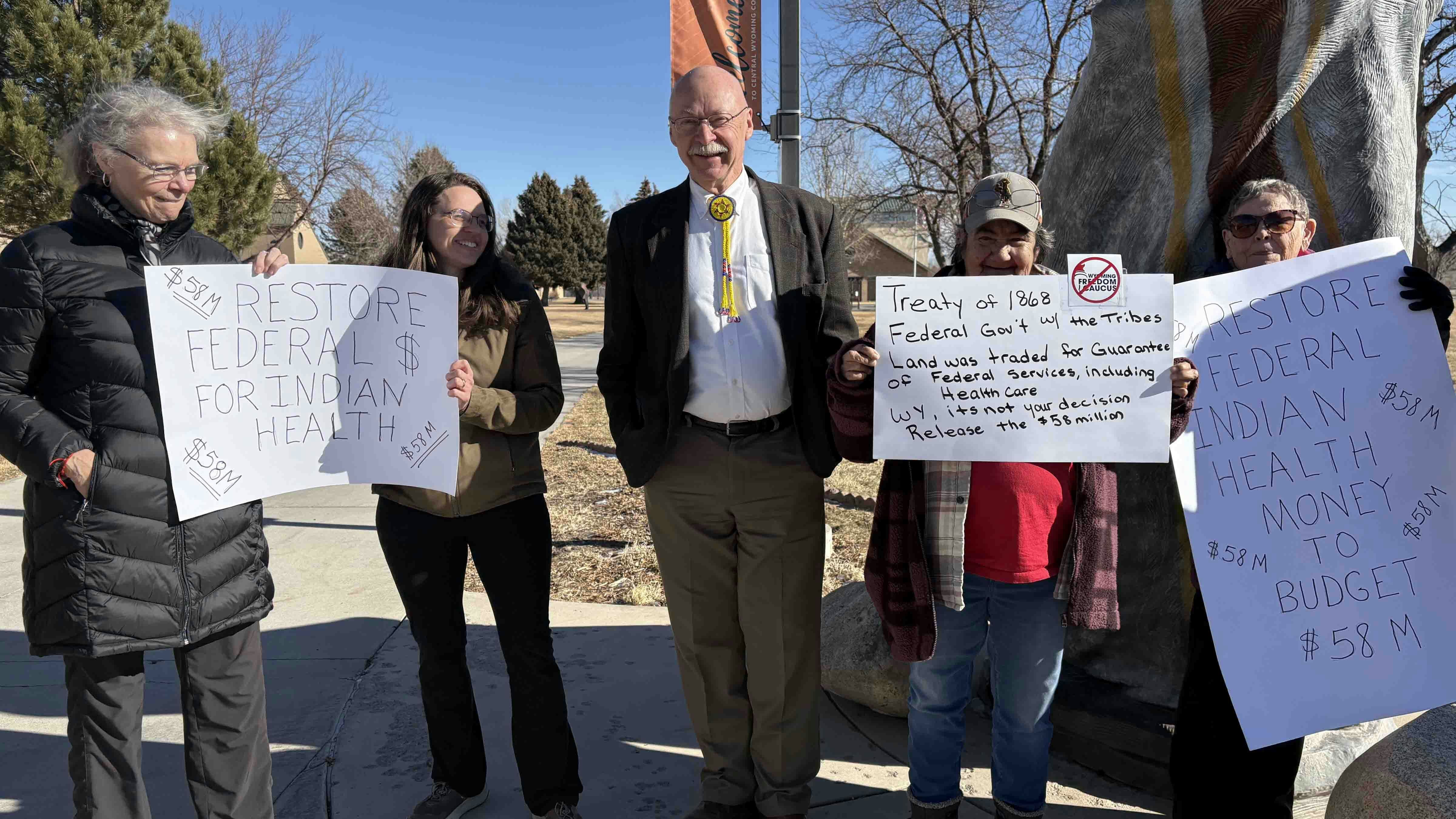
A protest preceded the Medicaid discussion, during the committee’s lunch break on the college campus.
A group of at least a dozen people held signs bearing slogans like “Don’t Steal Their Health Care,” and “Be Honorable.”
Tribal Relations Committee Co-Chair Sen. Cale Case, R-Lander, joined the protest.
Rep. Pepper Ottman, R-Riverton, approached one of the protesters and told her the original Medicaid figure had been changed.
It had, to the $41.3 million the federal government now anticipates reimbursing tribal clinics.
The protestors were a loose committee called the Action Committee, protest leader Lennie Poitras told Cowboy State Daily.
Clair McFarland can be reached at clair@cowboystatedaily.com.