Correction - an earlier version of this story said Neiman noted 40 jobs created by Wyoming Business Council to date. Neiman said 40 last year.
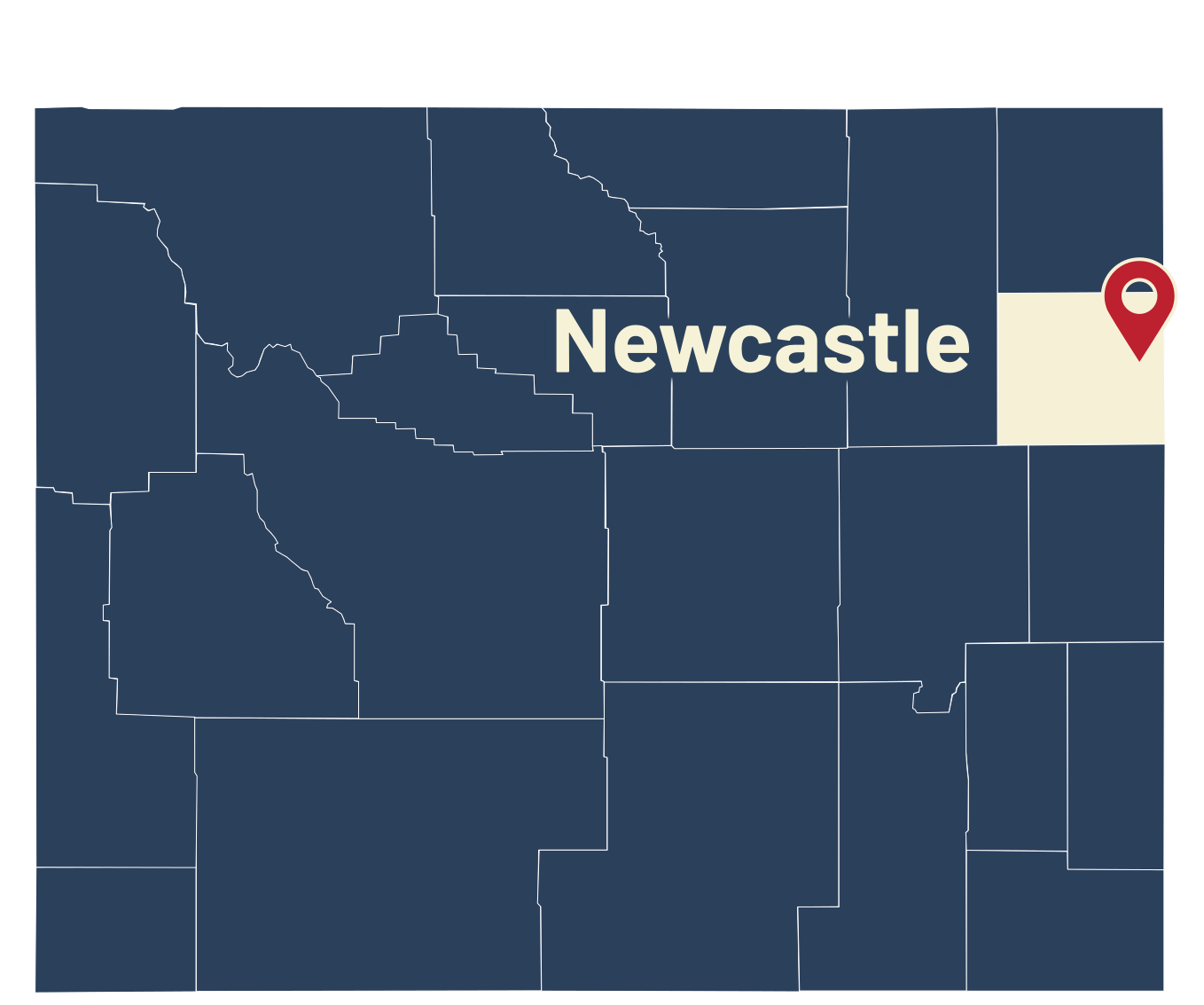
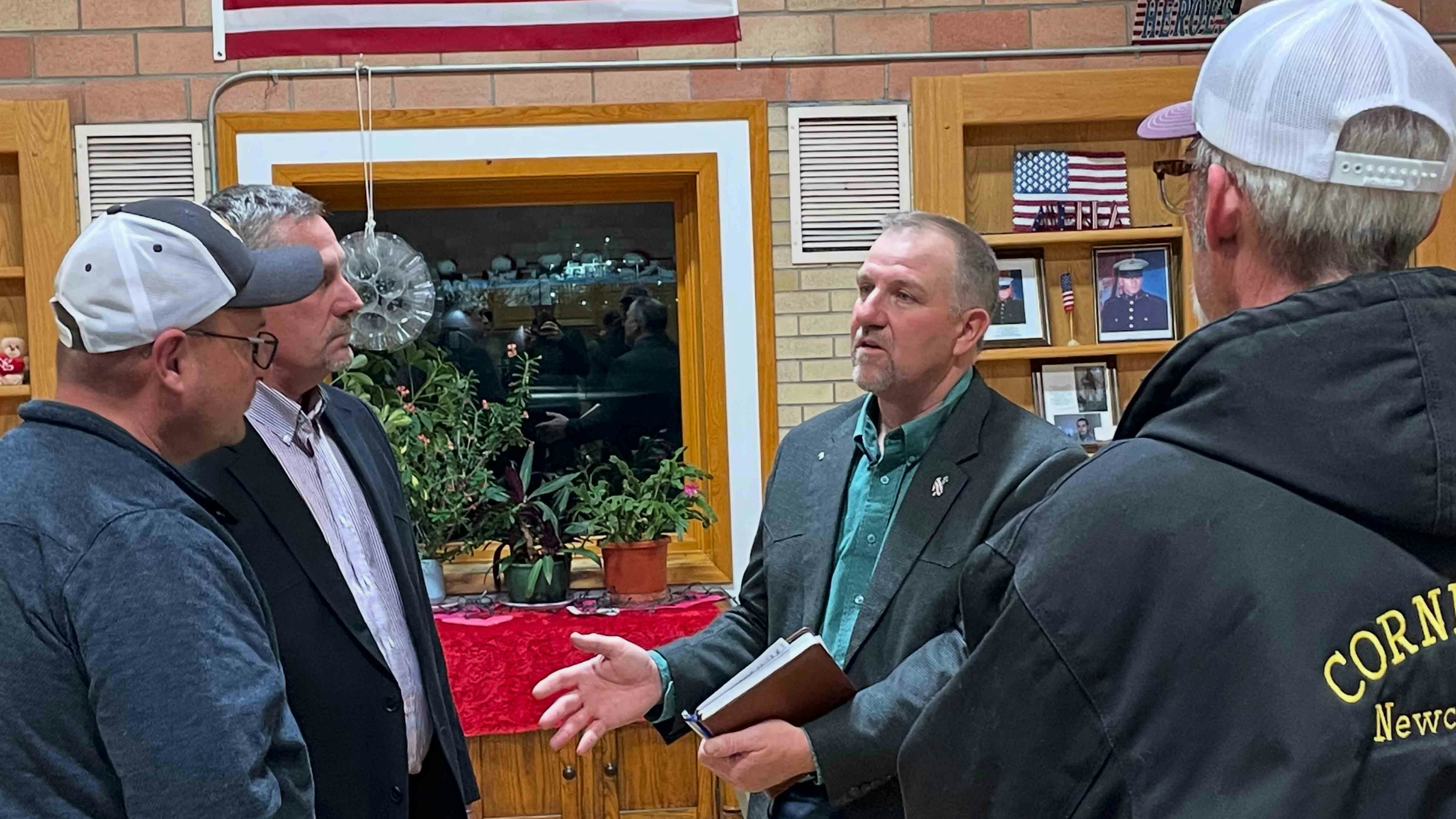
NEWCASTLE — Two of Wyoming’s top state legislators faced constituents Monday at a town hall, where they met with applause as well as pushback, including sharp questions over their roles in undermining local tax revenue – and the question of a health insurance mandate for state education employees.
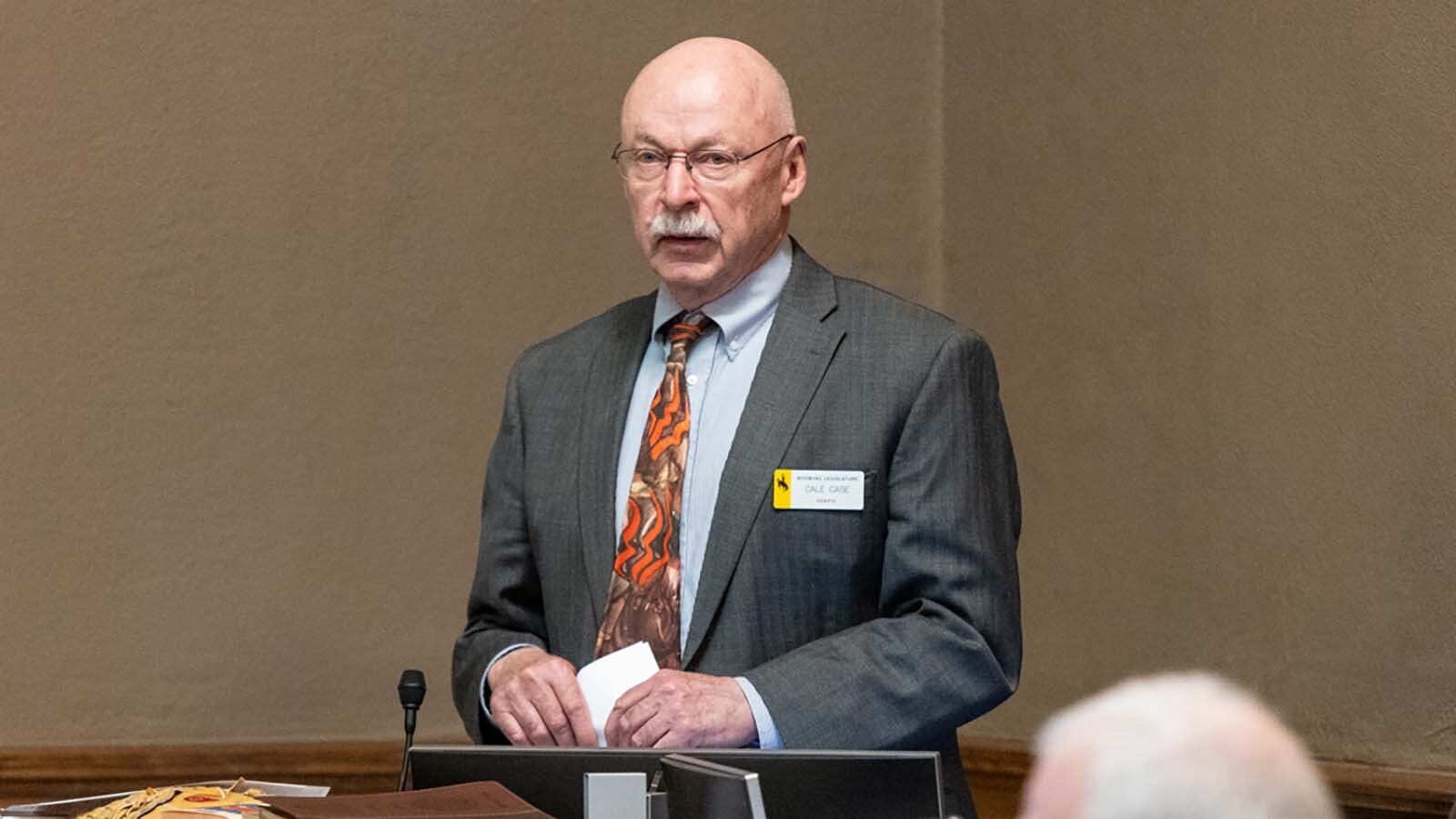
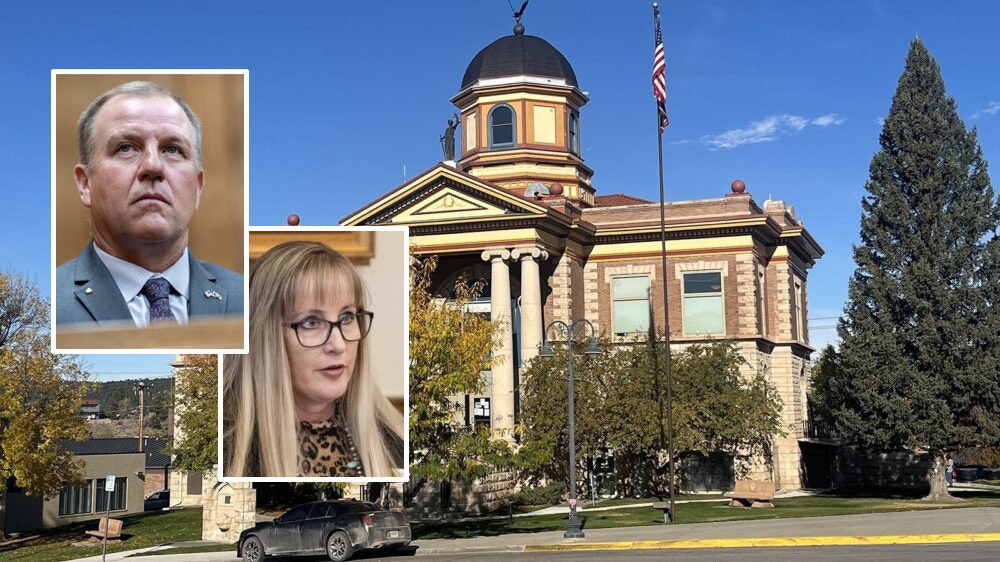
A crowd gathered in this far eastern Wyoming town for a two-hour-long public discussion with state House Speaker Chip Neiman, R-Hulett, and state Sen. Cheri Steinmetz, R-Torrington.
While constituents praised the pair for their efforts to restrict abortion as well as promote traditional fossil energy, Weston County residents also expressed disappointment with the lawmakers’ direction on issues related to taxes and economic development.
Tax Cuts
Taxes were top of mind for residents here, and one of the most tense topics of debate related to the looming impact of bills from sessions past.
“I would say 80 to 90% of the people that I talked to wonder why we passed the property tax bill and cut our local district budgets. Our fire district got cut…by 25% and other districts got cut worse,” said Rick Wehri, Weston County rancher and board member of the county’s fire protection district.
As a firefighter, he has gripes with his state delegates.
“We have no way to raise more money. It was the legislature, not the local people, that told us we were taking a budget cut. And I want to know why and how that is justified. We still have to fight fire, we still have to buy tires, and now we’ll have less money for everything.”
Neiman said the cut was necessary to bring quick economic relief to struggling families in Weston and Crook counties, which in the five-year period beginning in 2019 saw the cost of property increase by 44% and 76%, according to the lawmaker.
“I got completely tired of people…telling me, Did I just get 76% better roads? Did I get 76% better schools? Did I get 76% better anything?” Neiman said. “And where did all the money go? They said inflation did not increase 44%.”
Wehri shot back with anecdotes to the contrary.
“Tires in 2019 were $150, now they’re $300. We have less money now and everything’s twice as much. We are losing ground,” Wehri said.
Neiman and Steinmetz said they’d fought for “backfill” provisions that would have restored revenue to hardship counties like Weston.
The backfill provision did not survive the 2025 legislative session that led to a 25% property tax cut.
Wehri said it felt like an empty consolation, as the lawmakers made no mention of bringing backfill amendments to the budget session next month.
Insurance Mandate
The lawmakers took criticism for stripping away from local entities, and then they took criticism for imposing upon them.
The Select Committee on School Finance Recalibration last week advanced legislation that among other things would require all Wyoming’s school districts to participate in the state’s insurance plan instead of plans of their choice, which lawmakers cast as a way to reduce inefficiency and inequity.
Under the current block grant model, the state sends districts money for each employee’s salary, retirement, and insurance, regardless of whether they actually use the district’s insurance plan. About 30% of employees funded for insurance don’t use it, Neiman said, amounting to around $53 million of misallocated money.
“I don’t think we should have to be buying insurance for somebody that’s not going to take it. That’s something that the taxpayers have to come after us for,” he said.
The current proposal would require all school district employees to join the state health insurance pool.
The idea doesn’t resonate with school administrators in eastern Wyoming.
Joseph Samuelson, the principal of Upton High School, who’s made a name in education circles for a personalized learning approach that doesn’t push college, says the mandate is moving education policy in the wrong direction.
He said districts are already allowed to join the state plan, but virtually none choose to, because of the geographic realities of health coverage.
“Local school districts make decisions on their health care plans based on their location, what’s best for their people in that area, and all these local school districts have had the opportunity to go to that plan since 2010 but only one has actually done it,” Samuelson said, adding how the existing state plan network is anchored in Casper.
Samuelson is equally concerned that the state is inching in the direction of micromanagement.
Contrary to the notion that “ghost teacher” payments are inefficient or wasted, he argued the existing block grant structure gives districts a critical cushion and needed flexibility to meet unique needs.
“Each district’s different. Our district really emphasizes (trades education) and career classes… So you might have hired more teachers, or you might have hired less…to be more competitive. Local school boards need to be able to make a padded competitive package,” he said, adding that the latest proposal is “taking the control out of our local school boards, the people that we’ve elected and we vote on and hold them accountable to our communities.”
Neiman said he was open to exploring options to keep the certain aspects of grant structure in place. He also rebutted concerns over underfunding in education with a simple argument: money talks.
“According to the numbers I see right now, this coming year, if this gets passed, we’ll spend $1.85 billion on education in K-12. Write that figure down. That’s the most we’ve ever spent on education in Wyoming in our state’s history, and it has come from the conservatives,” he said, putting airquotes around the word “conservatives.”
He acknowledged districts could still negotiate the mandate and compromise on more tailored solutions.
But it’s unlikely the existing grant structure will stand, he said.
“I don’t think there’s an appetite in there right now to just send a blanket amount of money, and it’s not actually getting to individuals for the purpose of insurance.”
Business Council
Marty Hartman, a longtime Upton resident, chided the lawmakers for their fellow lawmaker’s actions toward defunding and dismantling the Wyoming Business Council, a publicly funded agency designed to boost business through state-backed loans and grants.
The Joint Appropriations Committee this month voted to dismantle the agency, depicting it as a budget boondoggle that’s failed to achieve its charter. But then there are people like Hartman, who see it as a vital lifeline in rural communities striving to maintain their taxbase.
“The first thing that came to my mind is the story of one of our cabinet secretaries that had a hunting dog that just was no good, so she took it out to the gravel pit and just shot it with no rehabilitation,” Hartman said, acknowledging that the agency could benefit from reform but not annihilation.
She then read a statement from the Mayor of Upton, Nick Trandahl, who said it was because of the WBC that Upton was able to secure a multi-million-dollar critical mineral processing plant from Rare Element Resources.
“RER would never have come to Upton without the Business Council’s support, and that critical rare‑earth development would not even be on the table had the council not helped position Weston County for economic self‑sufficiency,” the mayor wrote.
In this way, the WBC anticipated moves by the Trump Administration, who yesterday announced a $1.6 billion investment in the company USA RARE EARTH.
Mayor Tyrel Owens of Newcastle also endorsed the Business Council, which is helping the city with an economic development project.
Neiman wasn’t convinced.
The lawmaker derided the agency’s track record, explaining that after spending tens of millions, it created only 40 total jobs last year. He said its $50 million allocation would be better spent as direct grants to municipalities.
He also accused the agency of fraud, without providing specific examples. He cited his colleague, Rep. Scott Heiner, R-Green River.
“Heiner said, based on a 5% sample, they found a 1/3 fraud rate in the monies that were distributed for Covid,” said Neiman, who sees the agency as a poster child for bureaucratic bloat.
“All I hear is that there are too many chiefs and not enough Indians, too many little pieces all running around one talking to each other, but nobody’s actually getting anything done,” he said. “You’ve got to tear the thing down and start over.”
Ballot Initiative
Looming above the discussion in Newcastle was the prospect of a state-wide, 50% property tax reduction that will reach voters in a ballot initiative later this year.
For local district fire fighters like Wehri, the ballot poses an ominous consequence.
“People still want the fire truck to show up. People still want the roads bladed. People still want the county government. How are we going to survive if we have a 50% cut in our budget?” asked Wehri, who thinks lawmakers are responsible for “getting the ball rolling” on what he sees as an unsustainable tax-cutting movement.
That movement has steam heading into the budget session.
Senator Barry Crago, R-Sheridan, introduced a bill to extend a long-term homeowner's exemption, which cuts in half property tax for residents over the age of 65 who’ve paid property taxes for at least 25 years to date.
There is also a bill to reduce the taxable assessment rate for residential real property, Steinmetz noted.
In response to concerns raised by Wehri, Steinmetz offered a measured response.
She did not say whether she supported the ballot effort to halve property taxes, but acknowledged the implications are big and encouraged constituents to take the decision seriously.
“But it’s important that people before going to the voting box know exactly, that they’re clear about it and can make an informed choice,” she said. "And I would never tell anyone how they should vote or what to think, just the information so that they know exactly what they’re doing.”
Zakary Sonntag can be reached at zakary@cowboystatedaily.com.