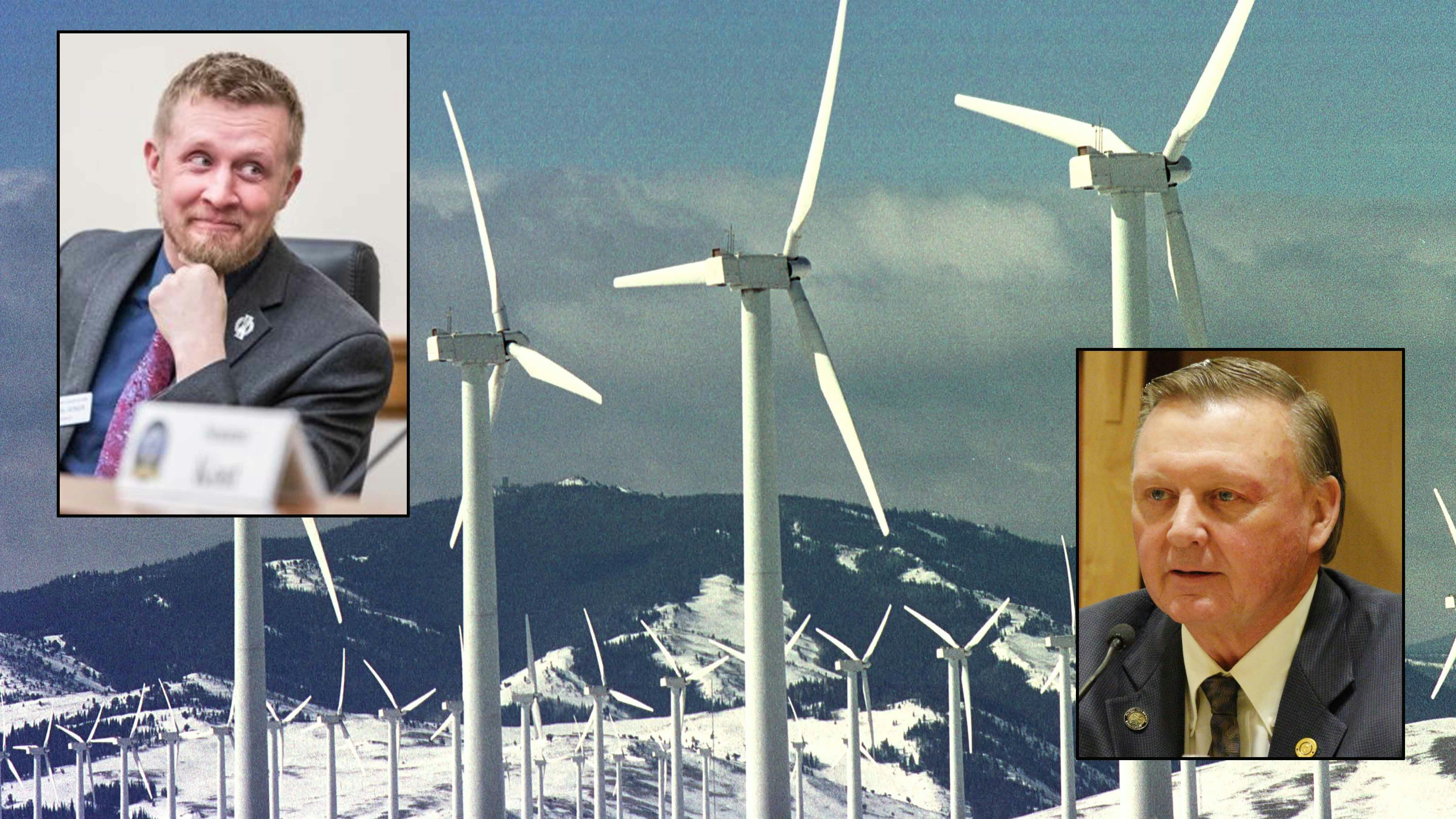
At this point, a Wyoming state senator from Douglas is just spit-balling legislation that would siphon part of the property taxes from wind and solar farms and other industrial projects back to the neighbors affected by them.
Sen. Brian Boner, R-Douglas, told Cowboy State Daily on Monday that he’s still investigating to see if he can craft a workable law to take one-sixth of major industrial projects’ property taxes and put them in a pot – overseen by each relevant county government – to give that money back to neighbors who have suffered negative impacts from the projects.
The bill was state Treasurer Curt Meier’s idea, Boner confirmed.
Meier told Cowboy State Daily about his vision during a phone interview Jan. 20, and said he sought Boner’s help with it.
“I’m not blind to the impacts that people have, even if they’re intangible property rights, and that we need to establish a compensatory mitigation fund,” Meier said, during a broader discussion about his aye-vote on state leases to wind companies for projects in Niobrara and Converse counties. He’s been outspoken about property rights and letting private landowners lease to wind companies in tandem with the state as they wish.
“But, to date, we don’t have any methodology or fund to actually offset some of those impacts (to their disapproving neighbors),” said Meier. “We should not impact a person’s ability to make a living. But on the other side of that – we need to be able to understand that there needs to be a mechanism to offset some of the impacts on the other side of the coin.”
Prompted by Meier’s idea, Boner is now asking county commissioners whether vetting and answering neighbors’ claims for mitigation money is something they can do, and how they’d do it, he said in his Monday interview.
“It’s a very initial concept that needs some work,” said Boner. “I think it’s intriguing but some of that is going to need quite a bit of effort before primetime.”
Primetime might not happen before the state Legislature’s four-week budget session starts Feb. 9. It may happen over the 10 “interim” months between the end of that session and the beginning of the 2027 lawmaking session, Boner added.
Boner gave an example of a potential impact.
“For example, when you’re developing a wind farm in the northern Laramie Range, folks feel like they’re impacted because they do buy the property (there) for the view,” he said. “Wind, solar – any industrial facility – there could be perceived negative impacts on property values if it’s in a scenic area.”
The Vision
Meier’s vision would send two of the 12 mills taxed from industrial projects’ property values into the mitigation pot.
A mill is a tax figure equal to one dollar of every $1,000 in assessed value on the property.
The mitigation could go to neighbors who have to drill a new well due to nearby underground projects, as well as people stuck with the sight of wind or solar farms, Meier noted.
Not everything has a dollar value, “but there’s a lot of things you can put a dollar value on in these circumstances,” he added.
Boner noted that property tax revenues increase significantly when a parcel switches from agricultural to industrial use.
Infra-Sound
To Kathryn Stevens, who is a Platte County homesteader mom and outspoken critic of putting wind turbines near homes, Meier and Boner’s effort is a welcome topic, though imperfect.
“I appreciate that people are thinking creatively about it and thinking outside the box, and I think that kind of thinking is necessary,” Stevens told Cowboy State Daily on Monday. “But there’d have to be a lot of money involved, (especially where) people are so tied to the land, there are going to be people for whom money is never enough.”
Distance is the only true cure to the ill effects of infrasound, said Stevens.
She was referencing the budding science of wind turbines’ infrasound and its effects on humans.
A research project unveiled at Washington University School of Medicine in 2013 indicated that the short wavelengths proceeding from wind turbines stimulate the human ear and brain, prompting potential nausea, vertigo, tinnitus and sleep disturbance.
Another report published in 2023 found no ill effects in test subjects exposed to infrasound in short-term bursts, but did not address the effect of “chronic exposures.”
An earlier 2023 report attributed mixed reviews on the topic to “strong partisans” in the field, but raised concern about potential health risks to people neighboring wind farms.
Stevens has spoken of the topic at Platte County Commission meetings and before the state’s Industrial Siting Council, in reference to a wind project seeking to establish near her home.
She acknowledged a mitigation fund could achieve many good things, including helping people drill new wells.
“When people are so tied to the land, I don’t know that (mitigation) is possible” for wind farm impacts, she said. “We have ancestry that connects us to this particular homestead, this place, and you can’t put a price tag on that.”
In some cases, said Stevens, the only way to mitigate the impacted wind-farm neighbor would be to move that person’s home onto a similarly-situated homestead.
“But we are talking massive amounts of money (for that),” she said.
Still, reiterated Stevens, she’s glad Boner and Meier have broached the topic, which she cast as a step in the right direction.