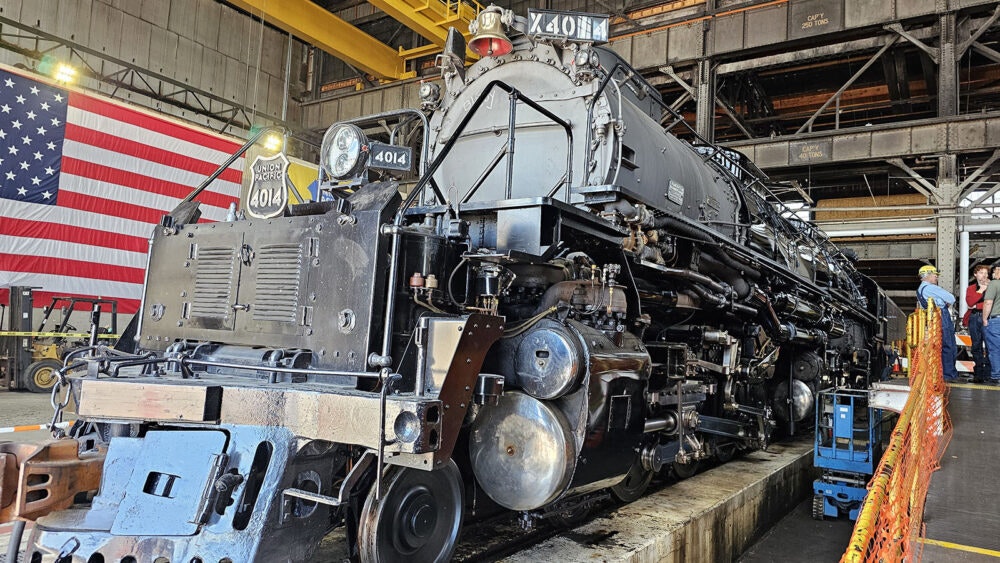
Union Pacific is making it official. The railroad company is no longer just talking about Big Boy 4014 going coast-to-coast for America’s 250th birthday. The world’s largest operating steam locomotive is going on tour, and the western half of its historic trip has been solidified.
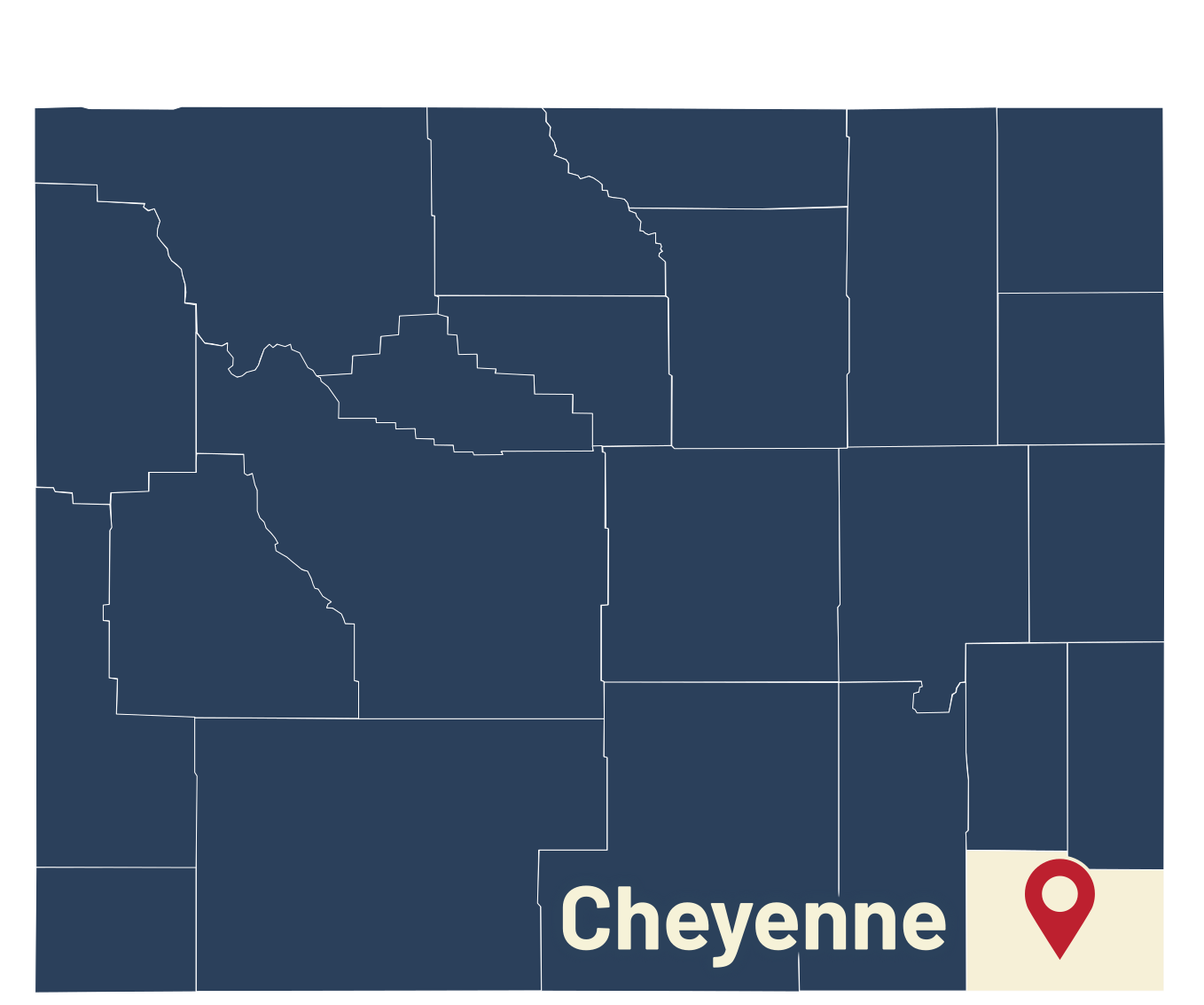
Union Pacific announced Monday that Big Boy will leave the Cheyenne steam shop on March 29 headed for California.
No passenger excursions for the western leg of the tour are planned, but two major public display dates have been set.
The first is April 10 and 11 at Roseville, California, and the second is April 18 and 19 in Ogden, Utah. The Western half of the tour concludes April 29 in Cheyenne.
A daily schedule, including additional stops along the way, with a map of the route, will be released closer to the tour’s launch.
Two commemorative locomotives will be tagging along with Big Boy, including Union Pacific’s newest locomotive, No. 1776-America250.
“No. 1776 is a new locomotive but we don’t have any images to share about it,” Union Pacific Senior Communications Manager Mike Jaixen said. “More information will be released as the tour approaches.”
The new locomotive pays tribute to the Declaration of Independence and the founding of America. The locomotive is to feature the emblem of the America250 Semiquincentennial Commission, a national, nonpartisan organization established by Congress to plan and orchestrate a national celebration for America's 250th anniversary.
The other locomotive that will accompany Big Boy hasn’t been decided yet. It will also be announced at a later time.
“We are proud to honor our nation’s great history and legacy of innovation with our heritage locomotives. For the first time, we will share the Big Boy with communities on the East Coast, operating it from ocean to ocean,” said CEO Jim Vena. “America has never been afraid to dream about what’s possible — and neither is Union Pacific as we carry the grain that feeds families, the steel that builds cities and the household goods that stock store shelves.”
Eastern Leg Still Being Planned
No dates have been set yet for the eastern leg of the tour, but Union Pacific said in its media release that it is anticipated to start in late spring.
The east coast leg of the tour is particularly significant because Big Boy has not returned to the East Coast since rolling off the line from its Schenectady, New York plant in 1941. That means a return to the east coast would be a first in Big Boy’s history.
Union Pacific declined to discuss behind the scenes preparations for Big Boy’s upcoming tour, but retired railroad man Stan Blake, who has ridden on Big Boy, had some insight.
“It takes a lot of money to make that happen,” Blake said. “You have to have support crews following, and it’s a big deal.”
Included among the support crew are people who specialize in working on steam locomotives.
“Not a lot of people know how to work on steam locomotives,” Blake said. “So, you have to take all of the mechanics with you, and all the oil, all the lube — everything that you have to do.”
Each night of the stop, there’s an entire checklist of things to do on Big Boy, to ensure that everything is in proper working order.
“There’s a whole crew of people who probably work on it all night, making sure everything’s working correctly,” Blake said. “It’s not like the new diesel electrics. You just fill those up with diesel and check your motor. (Big Boy) has tons of moving parts and, yeah, it’s just a major undertaking.”
Local Pilots Will Help Guide Train
One of the other things required for Big Boy’s tours are local pilots, who help with navigation. That’s a job Blake has helped with between Rock Springs and Green River.
“Every time that locomotive goes over a certain segment of track, the engineer who knows how to run that locomotive, he’s not familiar with the territory,” Blake said. “So, you have to have what they call a conductor pilot, with you, and probably another engineer, because they don’t know if there’s a 40-mile-per-hour curve coming around the corner. You need someone familiar with the territory to help you through that.”
Riding on Big Boy was a fantastic experience, Blake added.
“It’s very noisy, very noisy,” he said. “And a lot of heat. Of course, now it’s fired by diesel. They don’t shovel coal in there anymore.”
Big Boy usually also has other cars in tow, Blake added, which are carrying equipment the locomotive might need.
“I think they will have several cars behind it, what they call tool cars,” he said. “Because if something fails on that thing, you’re not going to call your local railroad parts store and say, ‘Hey, do you have a wheel for a steam locomotive?’”
Heavy Action
Big Boy weighs more than 1 million pounds when it’s fully loaded with fuel and water, and draws thousands of spectators for miles around wherever it goes.
One of 25 built during World War II to haul heavy equipment, it’s the world’s largest operating steam locomotive and the only Big Boy that still rides the rails.
Wherever it goes, everyone knows it for miles around, thanks to its classic steam whistle, a Hancock long-bell, 3-chime that produces a wall of haunting sound that drowns everything else out, even as its engines produce dramatic puffs of smoky, diesel-laden steam.
As the engine draws nearer and nearer, a rhythmic chuffing sound grows until it’s like thunder, alongside a hiss of endless steam.
With eyes closed, it’s a bit like standing inside a giant storm cloud, echoing thunder all around.
Heat pours off the 16-foot-tall train once it’s in station. It is 132 feet long and 11 feet wide. That’s as big as the train can possibly be for the bridges and tunnels it must pass through, and as long as the curves of the track allow.
It’s sheer size gave Big Boy the awesome raw power it needed to pull heavy equipment over the Wasatch Mountains during World War II.
Today, it draws fans by thousands to come and watch it roll into town during its many summer tours.
More than 200,000 people came out to see Big Boy in 2024 when it toured Utah, Nevada, California and Idaho.
The city of Roseville, California, meanwhile, reported a $3 million bump in economic impact just from tourists coming to see Big Boy while it was stationed there.
Big Boy’s last commercial run was in 1959, after which it went to live in a museum in California until 2019, when Union Pacific decided to bring the train back for the 150th Golden Spike Celebration commemorating the 1869 completion of the transcontinental railroad.