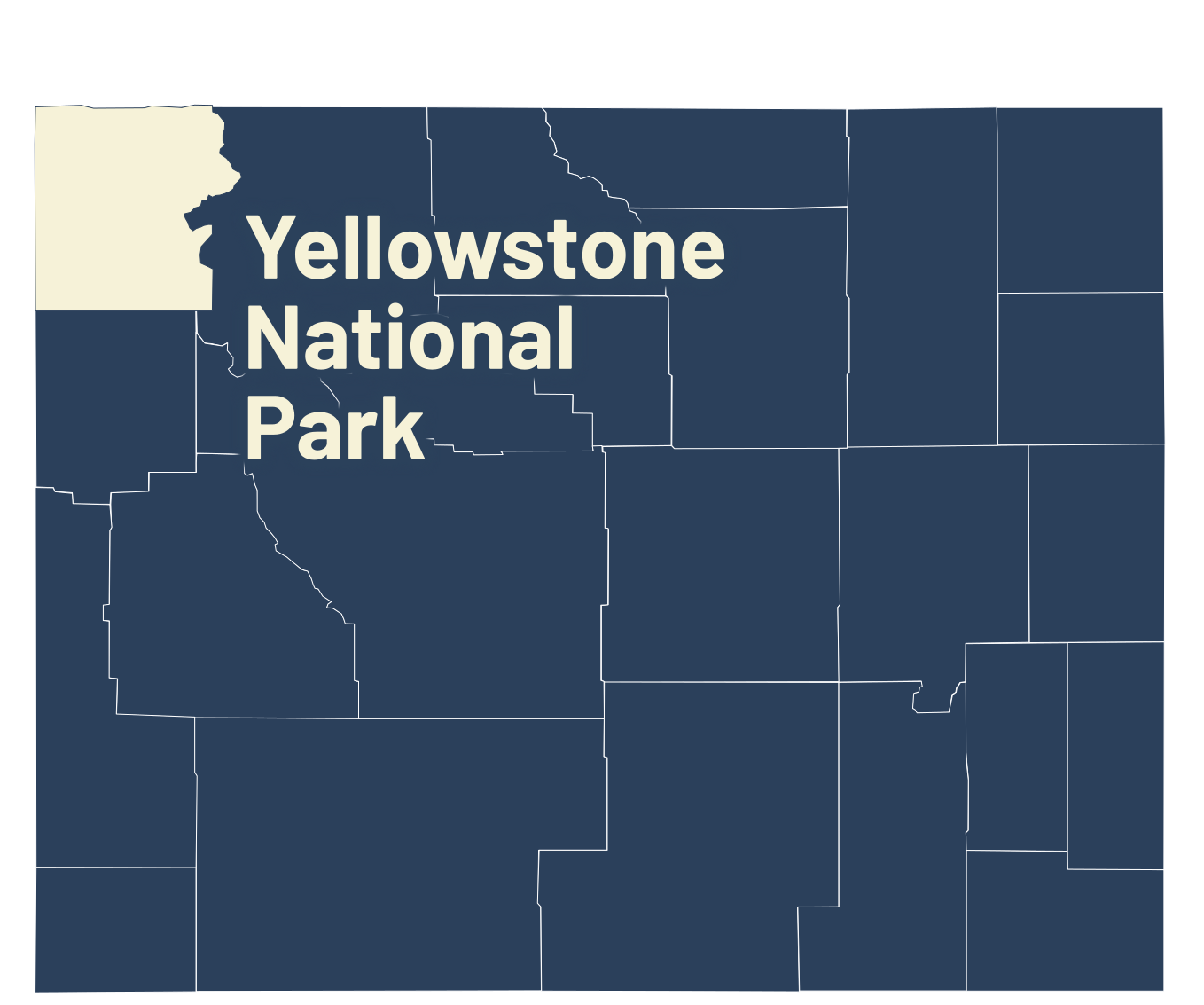
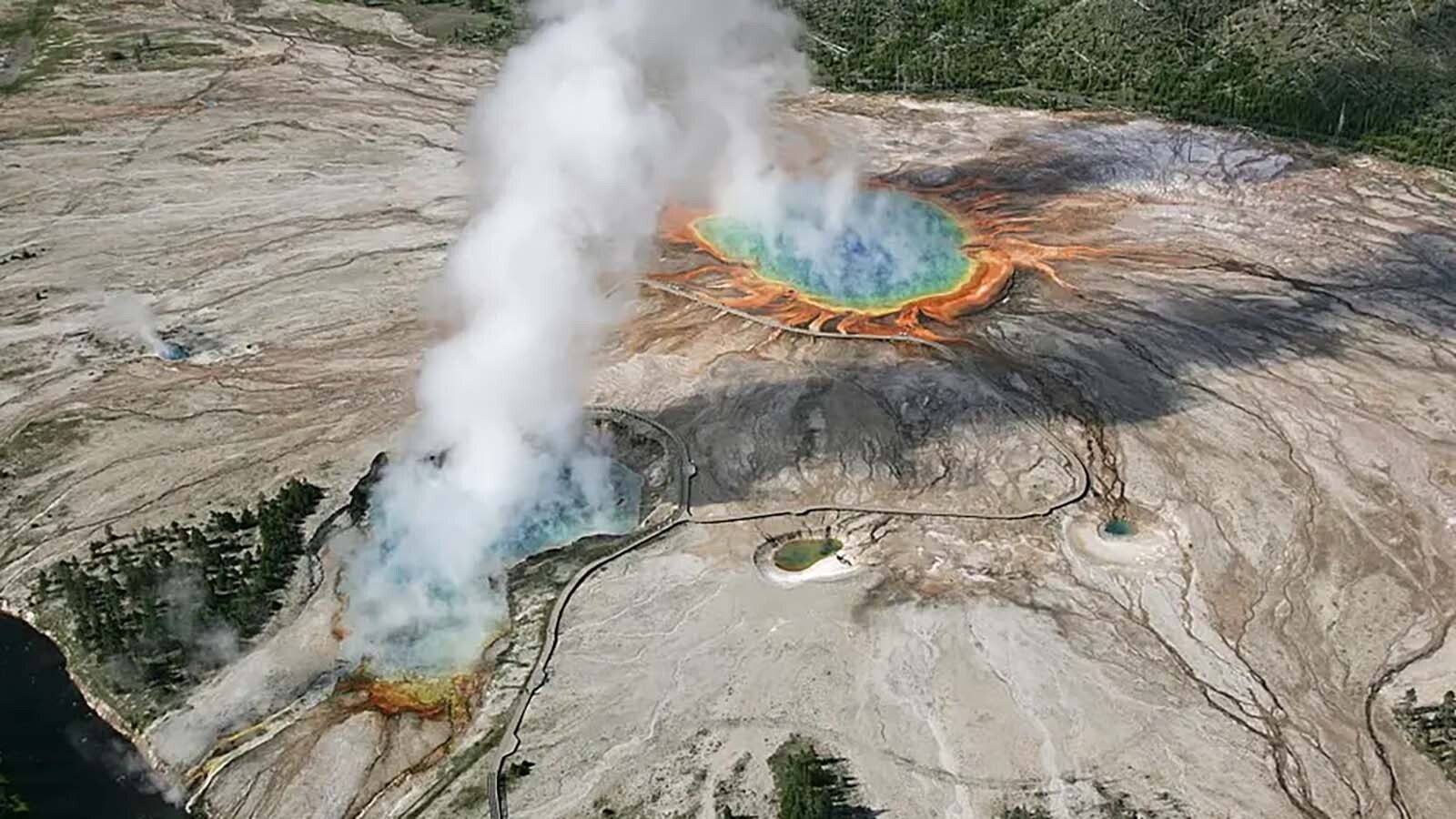
There’s a Chicago-sized bulge in Yellowstone National Park, and it’s still rising.
The Greater Yellowstone Ecosystem remains one of the most dynamic places on the planet. This is largely due to the ongoing volcanic, geothermal, and hydrothermal activity that keeps the park’s geysers erupting and hot springs bubbling.
Mike Poland, scientist-in-charge of the Yellowstone Volcano Observatory, and other scientists are monitoring an area of ongoing uplift on the northern rim of the Yellowstone Caldera, near Gibbon Falls.
The ground across a massive swath of the park has risen an inch since July.
“It’s an area over 19 miles across, give or take a few miles,” he said. “Saying the uplift is the size of Chicago makes it sound incredibly grandiose, but I think it’s pretty stunning even if it’s not particularly unusual.”
Is this underground bulge a sign that the supervolcano slumbering in northwest Wyoming is going to blow its top soon? Poland had a definitive answer.
“That doesn't mean that the volcano is about to erupt,” he said. “It’s Yellowstone being Yellowstone.”
North Side Chicago-Sized Uplift
Ground uplift isn’t unusual in Yellowstone. Similar episodes of surface movement, called deformation, occurred between 1996 and 2000, again in 2004 and 2020.
Poland and other scientists were aware of these uplifts as they occurred, but modern technology makes it much easier to obtain real-time information. Using that data, they’ve created a map showing the growing bulge in the middle of Yellowstone.
“It's a measure of how advanced our monitoring networks have gotten, and their sensitivity in detecting these small changes,” he said. “That’s the story of the year for me.”
According to Poland, the massive uplift is like inflating a subterranean balloon. It’s too small and slow to be noticed by the human eye, but a plethora of scientific equipment has been monitoring the ongoing changes.
“We can see things that are moving up and away from this area of uplift on radar maps and satellites we use to measure this sort of thing,” he said. “We've got 17 GPS stations in Yellowstone, and many more in the surrounding area, and they could pinpoint exactly when this uplift started.”
It’s Gonna Blow?
While the uplifting ground isn’t a sign of an imminent eruption, the most likely source of the ongoing episode is the volcano’s magma chamber. Poland said that’s the most likely explanation.
“The most likely explanation is that it's the accumulation and withdrawal of magma at a depth of nine miles,” he said. “That’s quite a bit deeper than we might expect the hydrothermal system to be acting, so magma is a likely source.”
A scientific paper published in 2025 concluded that there’s a low percentage of molten material in Yellowstone’s magma chamber, which greatly reduces the chances of an eruption. Nevertheless, the volcano remains active, and molten magma continues to churn beneath the park.
The movement of magma is what usually leads to volcanic eruptions. Poland acknowledged that as a possibility, but a remote possibility.
“If there was actually a chance that this was a magmatic system that was about to erupt, the deformation would be much, much shallower and accompanied by other huge changes,” he said. “We're not worried about much in the way of eruption just because those signs aren't there. We know there's a magma chamber, so it's not surprising that there's stuff moving around down there.”
Not Shaking Things Up
The ongoing uplift was “the story of the year” from Poland’s perspective. There wasn’t as much excitement in 2025, even by Yellowstone standards.
There were 1,119 earthquakes in Yellowstone in 2025. That’s on “the very low end of normal,” according to Poland.
“The average range is 1500 to 2500 earthquakes in Yellowstone every year,” he said. “This is the second straight year we've been at the very low end of the typical range.”
When talking about active faults, you typically want smaller, more frequent earthquakes rather than one or two major earthquakes. As the ground moves and contorts, it’s building energy that will eventually be released, which explains why large faults can be so potent and destructive.
Poland said there’s no reason to worry about the lower number of earthquakes in recent years. Most of the earthquakes detected occurred along smaller faults where there is always a lot of activity.
“We're not really seeing other indications of anything to be concerned about,” he said.” The difference here at Yellowstone is that a lot of the small earthquakes are driven by water interacting with minor tectonic faults. Water moving around causes those faults to move in small ways, giving you smaller magnitude earthquakes.”
Yellowstone always has the potential for a massive earthquake, like the 1959 7.5 magnitude Hebgen Lake Earthquake, but that’s the exception to the rule. Poland didn’t see any indications that the major tectonic faults in the area are building up to something, but that doesn’t mean they’re devoid of danger.
“There’s always the potential for a large earthquake in the Yellowstone region,” he said. “The overall level of earthquakes doesn't really have implications on the seismic hazard of the big tectonic faults, but the hazard is always high.”
Born, Blowing, Going To Bed
When it comes to Yellowstone’s thermal features, the biggest news of 2025 was the unexpected appearance of a baby-blue pool in the Norris Geyser Basin. It was the result of a small hydrothermal explosion that occurred sometime around Christmas 2024 but wasn’t spotted until April.
Black Diamond Pool, which experienced a much larger hydrothermal explosion in July 2024, had several unpredictable eruptions throughout 2025. A new camera was installed on the destroyed boardwalk to document and observe ongoing activity.
“Many of these eruptions threw material 30-40 feet in the air,” Poland said. “There have also been very small ones that have been like a bubble burst, and the splashing doesn’t get above 1-2 feet high.”
Poland said the activity at Black Diamond Pool has been “decidedly unpredictable.” That means the reopening of Biscuit Basin, which has been closed since the explosion, remains unlikely in 2026.
Meanwhile, the world’s tallest active geyser seems to be ending its latest period of frequent eruptions.
Steamboat Geyser erupted three times in 2025. Its last major eruption occurred at 10:02 p.m. on Dec. 31, 2025, over 261 days since its previous eruption.
Steamboat eruptions have decreased from a peak of 48 eruptions in 2019 and 2020 to only three in 2025. For Poland, it’s a clear indication that Steamboat is winding down after another one of its occasional active periods.
“It's not uncommon for Yellowstone geysers to go through periods where they're more active, and then they basically go to sleep,” he said. "Even when it's less active, Steamboat might erupt once every year or every few years, but I would say the sequence of frequent, predictable eruptions is probably over."
Yellowstone Being Yellowstone
One of the enjoyable aspects of the Yellowstone experience is its unpredictability. Many travel to the park expecting to see many incredible things, but the environment is unpredictable and ever-changing.
The uplift along the northern edge of the Yellowstone caldera is unrelated to the lower number of earthquakes, Steamboat’s slumber, and the new thermal pool in the Norris Geyser Basin. Poland is actively monitoring the changes, but their excitement could end at any time.
“The earlier, bigger episode of uplift lasted for several years, but it's entirely possible that this uplift will stop tomorrow and go back down again,” he said. “We don't know how long this one will last.”
When it stops, the area of uplift won’t pop like a pimple. If recent history is any guide, the ground will subside and lower down to where it was before the uplift started.
That could happen tomorrow or several years from now. Poland doesn’t have the answers, which adds to the excitement.
“This is how volcanoes behave,” he said. “It’s a representation of their dynamic nature and all the things happening beneath the surface. It’s part of what makes Yellowstone so interesting.”
Andrew Rossi can be reached at arossi@cowboystatedaily.com.