He was a drunk, a storyteller, and by some accounts a competent doctor when sober.
His real name was not Joseph Benson, and he may or may not have had a medical degree, been a Catholic priest, uncovered a lost gold mine on Casper Mountain, lost a wife or girlfriend to illness, or spent time in prison for killing a man.
The story of his escape from an East Coast prison in a bread wagon also could be just a fantasy that escaped his lips.
However, his unanswered drunken cries for help in a burning Natrona County jail in October 1891 were real, and so was the fire he apparently started that claimed his life.
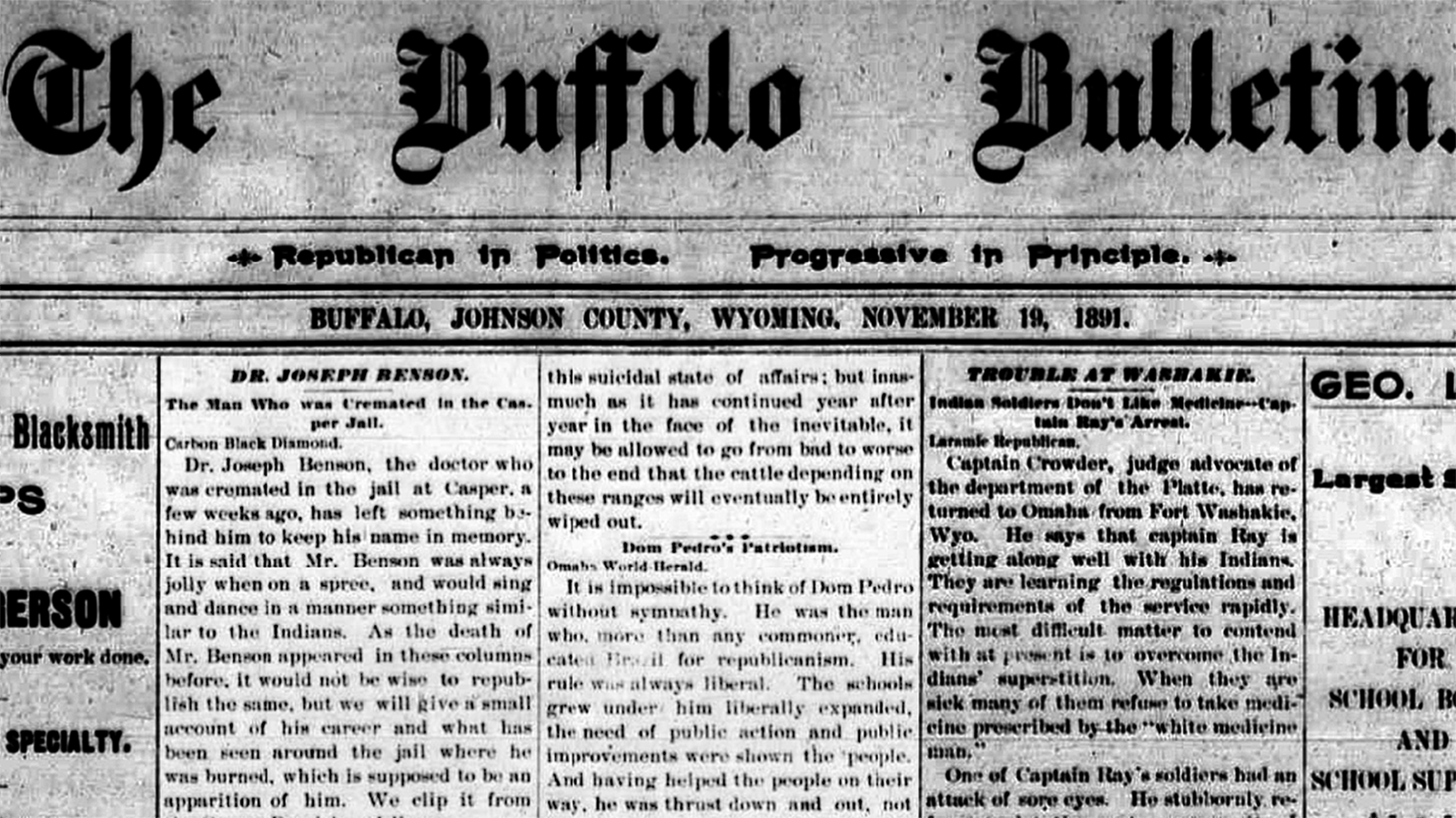
Wyoming newspapers and others across the country found his end compelling enough to give him some ink on their pages.
“A Wasted Life Ended,” the Boston Evening Transcript reported on Oct. 13, 1891.
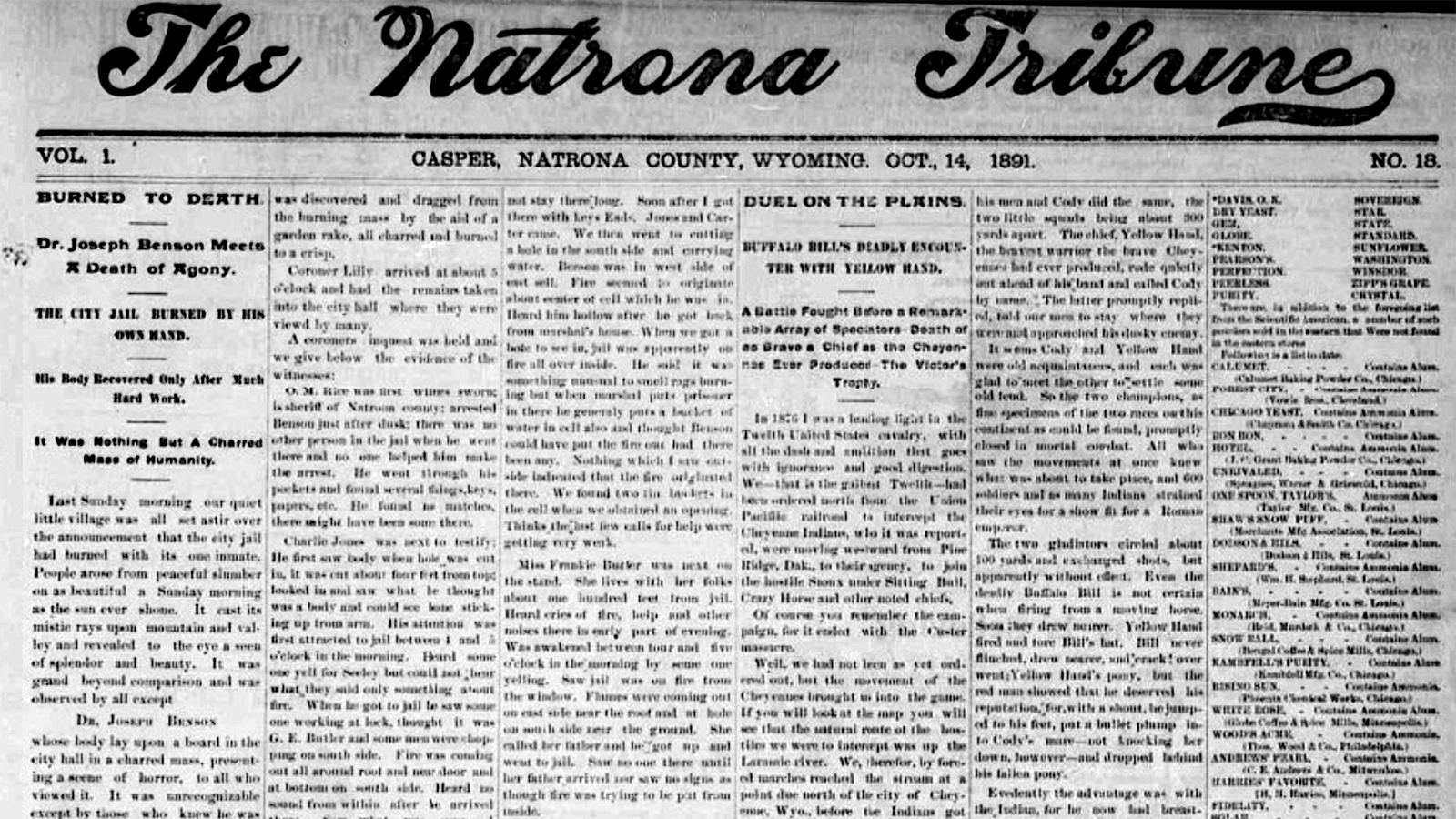
The hometown Natrona County Tribune on Oct. 14 got to the point: “Burned to Death, Dr. Joseph Benson Meets a Death of Agony.” That same story also reported that he was, "Nothing But A Charred Mass oof Humanity."
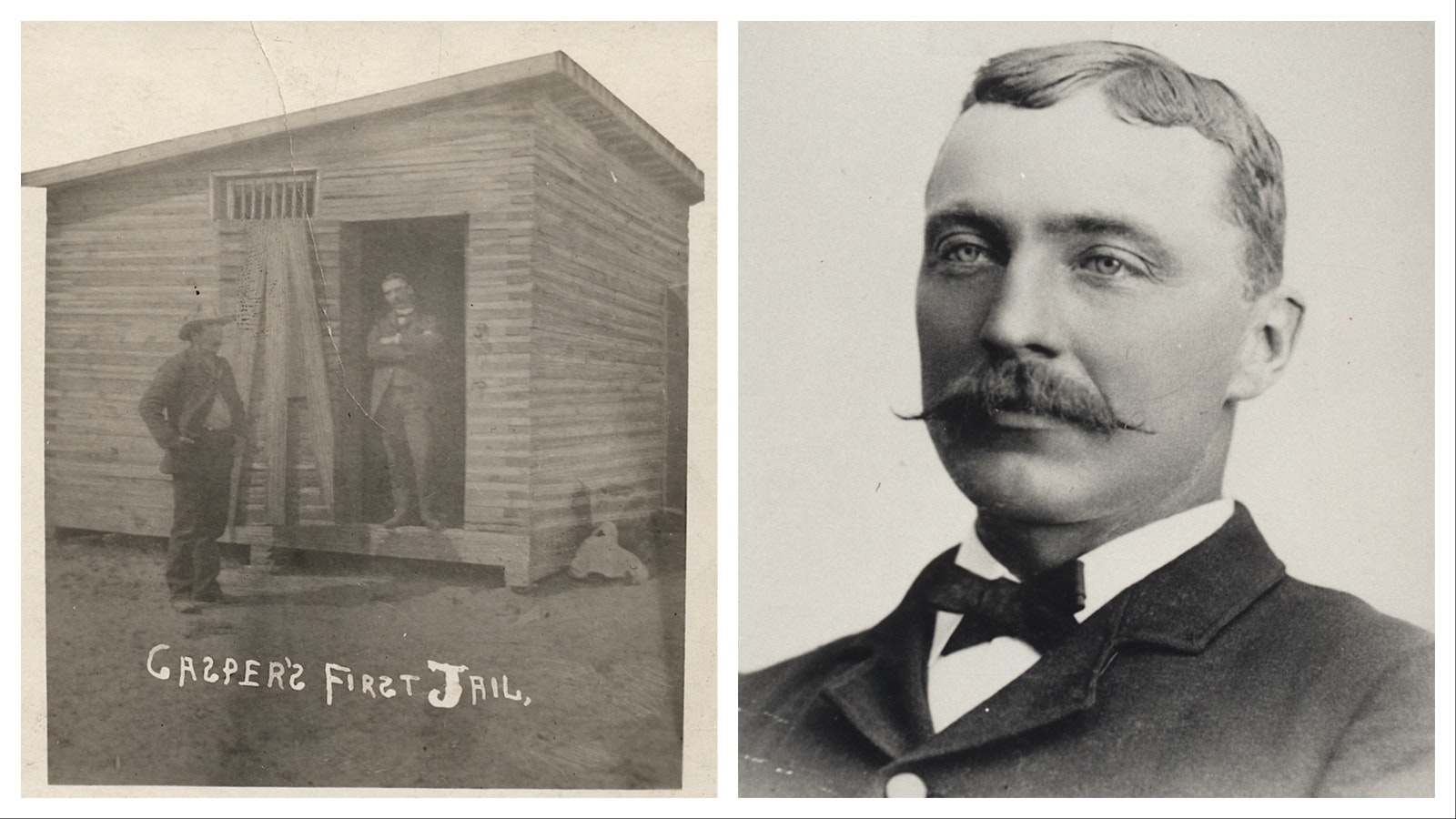
A photo of Benson from the Casper College Western Heritage Center shows a dashing man with droopy eyelids and a waxed mustache. The Center’s photo of the wooden Casper jail that was set on fire shows a blurry image of a man in the doorway that looks very similar to the doctor.
Newspaper accounts, as well as stories Benson told of his past, begin with a birth in Massachusetts in 1840 or 1841.
The Cheyenne Daily Sun on Jan. 16, 1892, printed a story about Benson with the headline “A Romantic Career.”
“He passed his early youth in South Framingham, Massachusetts, near Boston and then received a fine medical education at the Boston Medical School, which was supplemented by several special courses in the celebrated medical colleges of Vienna and Berlin,” the newspaper reported.
Love And Loss?
According to that newspaper account, he fell in love, married a European daughter of nobility, and lost her to “sudden death.”
The loss sent him into despair. He somehow became involved in a duel with a Prussian officer, killed him, and fled the country.
“He lost no time in falling as low as an educated man can when he sets about it intelligently and with a firm purpose to succeed,” the Sun stated.
Like many newspapers in that day, there was no attribution or source for the information.
Late Casper author and historian Charlotte Babcock in her book, “Shot Down, Capital Crimes in Casper,” devotes a chapter to Benson and quotes from the Natrona County Tribune’s very first edition on June 17, 1891, that apparently had a story about Benson.
Attempts to find that edition at the Natrona County Library and online were not successful.
In it, Babcock wrote the newspaper reported that Benson first arrived in Wyoming in 1866 from Saint Joseph, Missouri, with a freight company hauling supplies to military outposts in Casper, Lander and Salt Lake City. He later went to Montana and became a sergeant in the U.S. Army, serving at various forts including Fort Laramie.
Another account that Babcock includes in her book is that the doctor was arrested and put in prison for killing a man on the East Coast and made his escape in bread wagon. He fled to the West and changed his name. She also wrote that Benson told people that he had been ordained a Catholic priest and was kicked out of the church due to his drinking.
Different newspapers accounts say that he changed last name from either “Riley,” “Reilly,” or “O’Reilly” to Benson.
‘Noted Character’ The Cheyenne Daily Leader in a story on Oct. 14, 1891, reported that Benson was a “noted character in Montana and Wyoming for the past 15 years, though his history is mixed. It is shrouded in mystery.”
The Leader reported that Benson was “Joseph P. Riley” and that he had a brother who was a lawyer that lived near Boston. It also said he had been an “army surgeon” at Fort Robinson and spent a number of years in and around Miles, Montana.
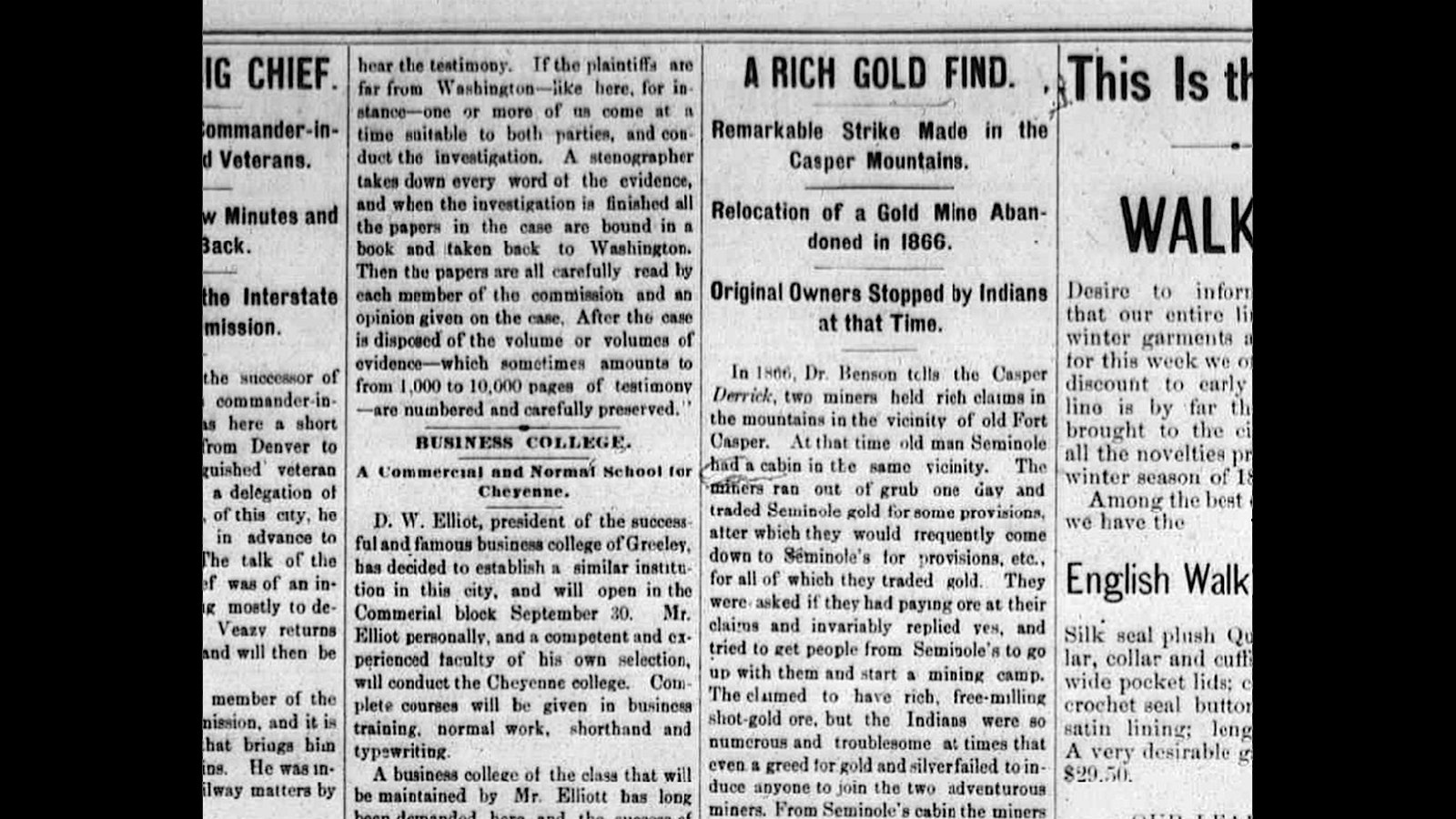
A year earlier, in its Sept. 21, 1890, paper, the Leader reprinted a story from the Wyoming Derrick newspaper that wrote that Benson and H. A. Lilley of Casper had located a gold mine on Casper Mountain that in 1866 Benson claimed was operated by two miners who paid for provisions at an old man’s cabin at the foot of Casper Mountain named Seminole with gold.
Benson’s story said that one day a single miner showed up at the cabin and told the old man that his partner had been attacked by Indians and killed. He said the miner had heard the natives yelling and four shots fired.
The next day, Benson claimed he was among those going to try and find the slain miner’s body, but the Indians were too many and the men abandoned the idea.
In 1890, the memory came back to him.
The newspaper said he and Lilly went to site of Seminole’s former cabin and entered the canyon that he remembered seeing the miners come from.
Benson then told the Derrick that they found the mining camp, a rotten piece of cloth that resembled a coat collar and a Colt cap-and-ball six shooter with four rounds gone and two still in the weapon.
“Benson and Lilly then broke off a few pieces from the remarkably rich gold and silver ore, and returned to town much excited,” the newspaper reported. “They are keeping the location of the ore a profound secret.”
Months before his death, Benson was mentioned in the Natrona County Tribune for responding to a “Luke Wentworth” who in a playful “scuffle” with another man severely hurt his ankle.
“Dr. Benson was called and found that the ankle had been thrown out of place,” the newspaper reported on July 22, 1891. “He replaced it and relieved the sufferer as much as possible.”
On Aug 26, 1891, the Tribune carried a line in its community section that mentioned “Dr. Benson and John Shanley carry their arms in slings now days.”
County Pays Him
The Natrona County Board of Commissioners at their Oct. 5, 1891, meeting days before the doctor’s death authorized payments of $6 to Benson for attending to a pauper and $40 for “expert testimony and postmortem examination” of the body of a William Warren.
Benson had billed $10 and $45, respectively.
Benson apparently kept his office at a Casper drug store.
The editions of the Natrona County Tribune starting with its sixth issue on July 22, 1891, through the end of the year after the doctor’s death carried an ad for H. A. Lilly’s Pharmacy promoting “pure drugs, medicines, etc.” with the note that “Dr. Benson in Attendance.”
His role in writing prescriptions, according to the Tribune’s Oct. 14, 1891, edition is what put him in hot water with another physician.
The newspaper reported that Benson had been drinking on Saturday, Oct 10, and got into an argument with Dr. A. F. Naulteus.
The disagreement became a physical confrontation where Benson was tossed over a hitching post.
Another account, chronicled by Babcock in her book, stated Benson was intending to perform a post-mortem on a living cowboy who was shot but still alive.
However, the Tribune states that Benson was arrested by the sheriff for “prescribing medicine while intoxicated” and was placed in jail to sober up.
“Mr. Benson has been confined to the jail several times of late and when in there it is his custom to keep up a continual racket all night long singing Indian war dances and making a noise imitating a wild animal,” the Tribune reported on Oct. 14, 1891. “But on this night, he would sing his war dance song and then holler: ‘Fire, help!’”
The small two-cell wooden jail was located on the west side of Center Street between First and Second Streets.
Neighbor Granville E. Butler, who lived just south of the jail location, heard the yells and went to the jail and walked around it, the Tribune reported. He could detect a faint smell of cloth burning, but decided it was nothing and told his family that the doctor was trying to get authorities to let him out by yelling that the jail was on fire.
Jail In Flames
At 4 a.m., Frankie Butler heard Benson yelling and looking out her window saw that the jail was on fire. She woke her father. He went to his shop and got a hammer and a piece of iron to try and break the lock on the jail.
That attempt failed. Butler went to find the town Marshal Lew Seeley who gave Butler his keys to run and try and unlock the jail, but the lock had been broken by Butler’s hammer and wouldn’t function.
The Tribune reported that others arrived and cut a hole in the side of the jail but by the time that was accomplished, the doctor’s body was just a “burning mass” that was pulled out with a garden rake.
“Coroner Lilly arrived around 5 o’clock and had the remains taken to the city hall where they were viewed by many,” the newspaper reported.
At the inquest, Sheriff Oliver Rice testified he had searched Benson’s pockets and had taken items from them but found no matches on him. Seeley, who after giving Butler his keys, testified that after dressing, he ran to the jail, but it was engulfed.
Seeley said that he had arrested Benson several times and after once finding a piece of paper inside the jail that Benson had burned, had always searched Benson closely for matches.
The coroner’s jury ruled that Benson died by a fire “started by his own hands.”
The Wyoming Derrick, a competitor to the Natrona County Tribune, on Nov. 5, 1891, published a story headlined “Benson’s Bogie, Weird Music and Uncanny Sights Near the Ruins of the Old Jail.”
Haunting Story
The editor wrote that it was known that the doctor was a “mysterious character” who during his drunken sprees “let fall hints of mysterious persons and invisible spirits that haunted his steps and followed him wherever he went.”
The paper then reported that strange sounds were being heard at night in the former jail location that started after midnight. The sounds began as “strange, sweet music” and then increased to something that “resembles the eerie wail of a lost soul in the agony of despair.”
After the noise, the paper reported a ghost-like figure rises from the ashes and does a “wild and fantastic dance much resembling the dance of the Sioux Indians.”
“Many persons have witnessed this strange sight, and that portion of town is now avoided,” the editor wrote.
Two weeks later, the Natrona County Tribune ridiculed the story on its editorial page and noted that other Wyoming papers had reprinted the article.
“Nothing of the kind has happened or ever will happen,” the editor wrote on Nov. 18. “If (editor) P. T. McNamara can’t find something more profitable to himself and (the) city to fill up the columns of his sheet, it would be good for him to remain in Denver.”
Benson’s ashes were buried in an unmarked grave in the Highland Cemetery.
Dale Killingbeck can be reached at dale@cowboystatedaily.com.