In modern times, beavers make dams by chewing through trees. In prehistoric times, they dug spiraling burrows up to 7 feet deep by chewing through the soil.
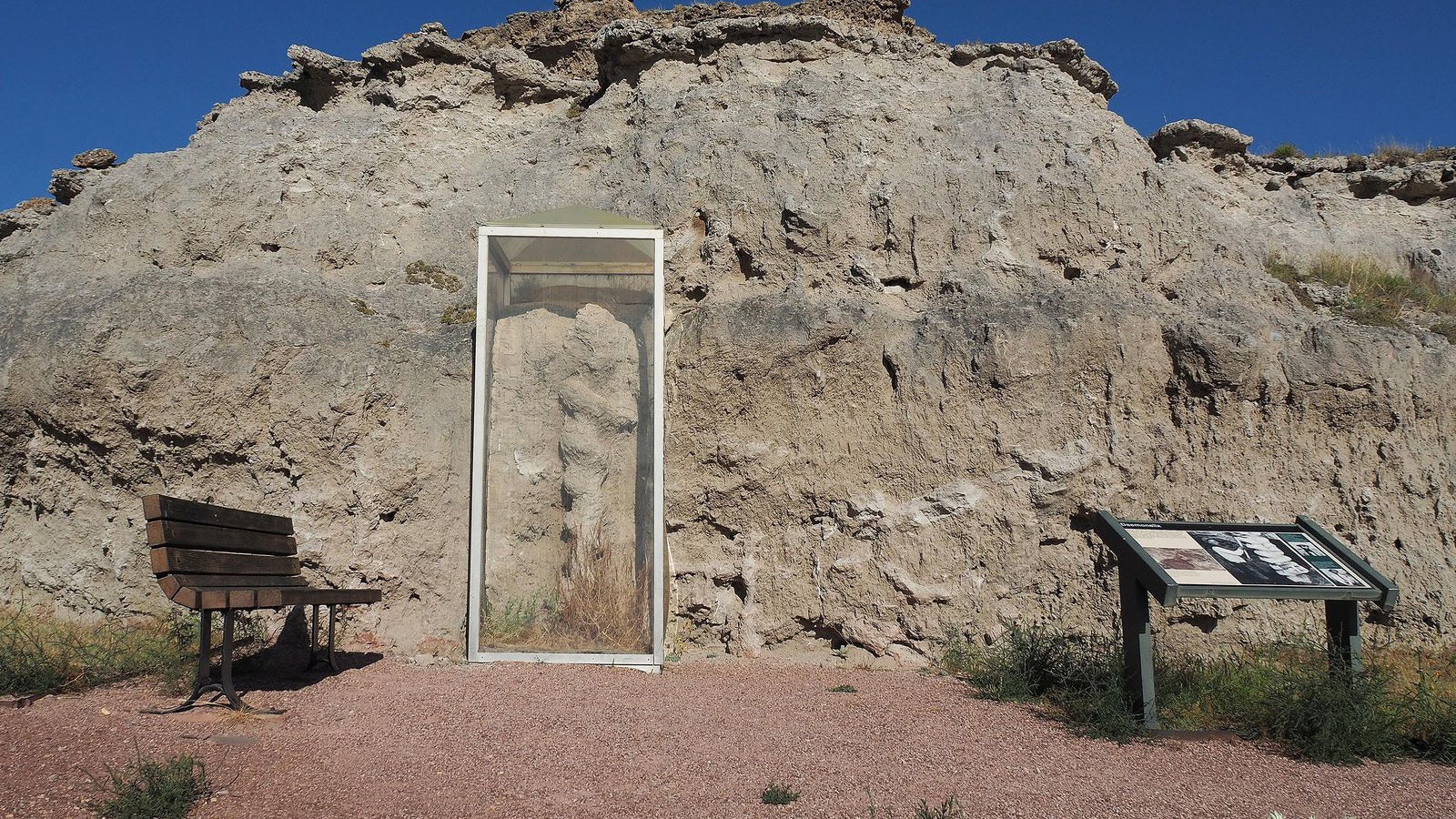
Daemonelix is the scientific name for a unique trace fossil found only in eastern Wyoming and western Nebraska. More people know these fossils by their common name, “Devil’s corkscrews.”
Even by the standards of bizarre prehistoric discoveries, Devil’s corkscrews seem inexplicable. Paleontologists know what they are and what made them, but more than 135 years after they were first discovered, there are a lot of intriguing unknowns.
"They’ve been well-studied for a century, but we don't know what new parts of the story could be derived from what’s waiting to be found in Wyoming,” said Brent Breithaupt, the regional paleontologist for the Bureau of Land Management in Cheyenne. “There’s more work to be done, and there’s plenty of them out there.”
Devil’s Corkscrews
In 1891, paleontologist Erwin Hinckley Barbour was scouring Sioux County, Nebraska, when he found something bizarre — a spiral-shaped rock descending straight into the Harrison Formation, a 20-million-year-old layer of rock from the Miocene Period.
The spirals went as deep as 9 feet, elegantly spiraling downward into a large chamber. Barbour found several intact spirals, but he and other paleontologists were at a loss to explain them for several decades.
“There were lots of misinterpretations, ranging from plant roots to the remains of freshwater sponges,” Breithaupt said. “They weren't readily identified as trace fossils, because there was nothing like them.”
The critical clue was found inside one of the spirals. Paleontologists found the partial skeleton of the spiral’s ancient occupant, an extinct type of beaver called Palaeocastor.
That was the answer to the spiraling riddle, confirmed by subsequent discoveries of the same animal in the same spirals. They were extensive, elaborate burrows dug into the ground by intrepid Palaeocastors during the Miocene.

Burrowing Beavers
Palaeocastor was a small species of terrestrial beaver, related to but distinct from its semi-aquatic relatives. They were diggers rather than builders, as evidenced by their impressive subterranean burrows.
“They were relatively small, about the size of a prairie dog,” Breithaupt said. “They lived like prairie dogs, but their burrows are much more impressive.”
Prairie dogs live in expansive burrows that can stretch 30 feet across and go as deep as nine feet. They accomplish this by feverishly digging with their tiny claws, creating impressive but artistically unimpressive burrows.
When Devil’s corkscrews were determined to be burrows, paleontologists assumed Palaeocastor lived and excavated the same way. A look inside the burrows revealed a very different behavior.
A 1977 study dug out the incisors from fossilized Palaeocastor skulls in wet sand. The resulting impression matched the indentations found inside the corkscrews.
“They basically used their teeth to carve out these burrows,” Breithaupt said. “The claw marks were actually tooth marks.”
That might explain some of the subtleties in the “design” of the burrows. Breithaupt said the tiny beavers would have been excavating downward at an angle, chomping into the soil until reaching a sufficient depth, and chewing a living room at the end of their spiral staircase.
It’s not an exclusive excavation technique. Naked mole rats in Kenya also use their teeth to dig burrows, though their burrows are simple tunnels rather than a deep-delving helix.
What makes Devil’s corkscrews unique is their shape. Many animals have burrowed their way through history, but none as distinctly as Palaeocastor.
What’s the intent behind the design?
Climate Controlled Housing
The Miocene Period was a period of climate change. The global climate was gradually getting cooler and drier, a trend that would culminate in “the Ice Age,” forcing flora and fauna to adapt and overcome.
Of all the burrowing animals known in modern and prehistoric times, only Palaeocastor is known for extensive spiral burrows. Most animals dig shallower, simpler burrows that suit their purposes, but aren’t as intricately excavated.
“This has been a topic of debate for many, many years,” Breithaupt said. “Why make a spiral burrow? It takes extra work. We don’t find a lot of other animals that do this kind of tunneling, but we find Palaeocastor burrows everywhere.”
The only modern-day analogue Breithaupt could recall is Australia’s yellow-spotted monitor lizard, which digs spiral-shaped burrows to lay their eggs.
These are exceptions to a universal rule that has held throughout Earth’s history. Most animals dig burrows simply and more efficiently, so what made Palaeocastor different?
One explanation that’s been ruled out is predator deterrence. Burrows can help small animals avoid predators, but Breithaupt said there’s direct scientific evidence that Palaeocastor burrows weren’t predator-proof.
“There have been reports of a weasel-like predator, Zodiolestes, found within one of these burrows,” he said. “It was probably looking for a Palaeocastor to eat and got trapped inside.”
A 1999 study found a possible answer. The spiral burrows were a direct response to the environmental changes in the climate of the Miocene.
Paleontologist Robert Meyer determined that the spiral burrows actually had higher subsurface air volumes and burrow wall surface areas, which limited air circulation.
That means the subsurface temperature and humidity of the burrow were fairly constant, regardless of what was happening topside. According to Meyer, as the Miocene grew cooler and drier, Palaeocastor put “unusual effort” into its burrows to comfortably survive.
If modern-day animals faced similar environmental conditions, they might dig similar burrows. Breithaupt said it offers a unique insight into the behavior of the long-extinct beavers, showing their tenacity in surviving in a hostile world.
“Apparently, it's a fairly ingenious system for temperature and moisture control,” he said. “That makes sense in a fairly hot, desert-like environment.”
Everything Old Is New
Several Palaeocastor fossils have been found, inside and outside of their burrows. However, Breithaupt said the burrows provide information on the animal’s behavior that couldn’t have been gleaned from skeletons.
“We find lots of burrows next to each other, like modern-day prairie dog towns,” he said. “The individual burrows would be occupied by one animal and its family, but they did seem to have some kind of colonial behavior.”
Wyoming’s prehistoric Palaeocastor was probably very similar to its modern-day prairie dogs and ground squirrels. They even had similar predators, as the extinct Zodiolestes shares many traits with the nearly extinct black-footed ferret.
While Palaeocastor thrived underground, the surface was dominated by large and bizarre mammals. There were several horse-like animals, the two-horned rhinoceros Diceratherium, the awkwardly proportioned herbivore Moropus, and the fearful omnivore Daeodon, which had a three-foot-long skull full of thick, powerful teeth.
Unfortunately, Palaeocastor didn’t have the best judgment when choosing land for their housing developments. Breithaupt said their burrows were preserved because they were filled and covered with sediment, probably during dramatic flash floods.
“Flooding events would have washed a lot of material into the burrow, trapping any animals inside,” he said. “That’s how we know Palaeocastor made the burrows, because we’ve found several of them trapped inside.”
Delving Deeper
The first and best Devil’s corkscrews have been found in Nebraska and are prominently featured in the galleries of some of the world’s best museums.
The best place to see the corkscrews is Agate Fossil Beds National Monument, right over the Wyoming state line near Harrison, Nebraska. There’s a Daemonelix Trail that leads visitors to Palaeocastor burrows preserved right where they were found.
Devil’s corkscrews have been found in the Harrison Formation exposures of eastern Wyoming, but those haven’t been as thoroughly excavated and researched as their Nebraska counterparts. Breithaupt believes Wyoming’s exposures should be explored more, because there’s always more to learn.
“I’d be interested to know where fossils are in Wyoming and how those compare to the much better and well-known exposures in Nebraska,” he said. “There's a lot of work that needs to be done on trace fossils, especially vertebrate trace fossils, in particular burrows, and probably more unique burrows out there that we don’t recognize as burrows. They’re very unique.”
“Devil’s corkscrews” aren’t relics of massive satanic construction projects. They’re a 20-million-year-old testament of a struggle for survival, tooth and claw, left behind by Wyoming’s long-extinct burrow beavers.
Andrew Rossi can be reached at arossi@cowboystatedaily.com.