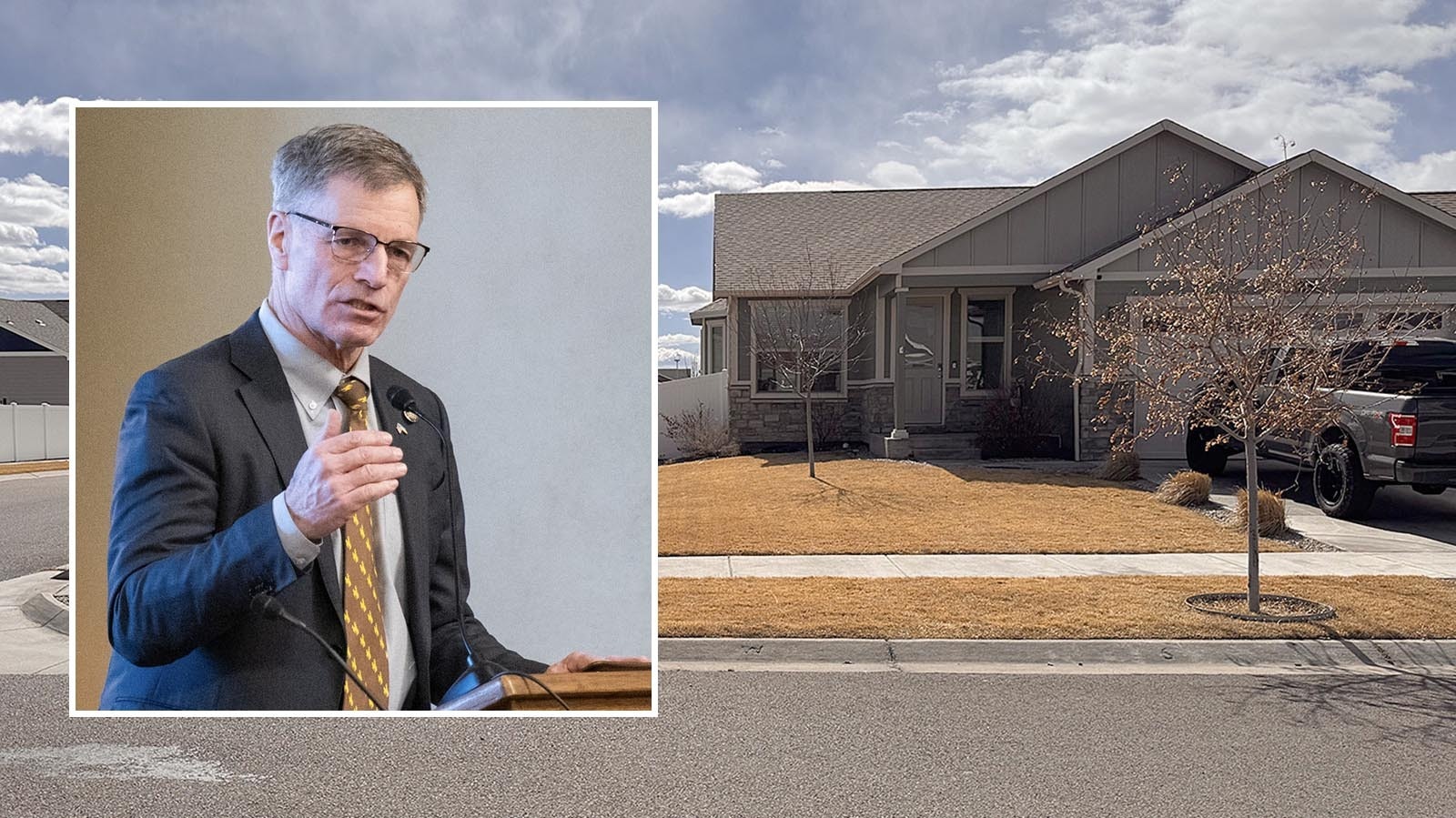
A board tasked with ensuring Wyoming’s property tax assessments are fair and lawful planned to challenge the state’s 4% growth cap on residential property taxes, but Gov. Mark Gordon put a halt to the lawsuit Thursday.
Wyoming State Board of Equalization Chair E. Jayne Mockler and Vice-Chair Martin Hardsocg prepared a legal complaint, of which Cowboy State Daily has obtained a draft copy, calling the growth cap unconstitutional.
The third member, Karl Anderson, did not participate in the lawsuit because he joined the board from the Attorney General’s Office in October and had a conflict, Mockler told Cowboy State Daily on Thursday.
As for whether the board will certify property taxes next spring, “We don’t know that,” added Mockler.
The legal complaint had sought to urge the Laramie County District Court to block the 4% growth cap as unconstitutional, or allegedly risk making the board members violate the oaths they took to defend the state Constitution.
The cap passed in 2024 along with a slate of other property tax bills. It limits the growth of property tax assessments to 4% each year.
Mockler and Hartzocg’s complaint draft says this unfairly punishes people whose home values are growing more slowly, contrary to Article 15, Section 11 of the Wyoming Constitution.
That section calls for uniform assessment of property taxes according to the property’s full value, within each class of tax. Residential is one of the four classes.
Why, Governor?
State Sen. Cale Case, R-Lander, told Cowboy State Daily on Thursday that he is frustrated that Gordon blocked the challenge.
Case emphasized that he had only secondhand reports and the voicemail of one former legislator informing the view, but said it was his understanding that “a lot of legislators were upset by this."
"They were thinking, falsely, that if this were to go to lawsuit it would push people into the constitutional amendment at the end of the November election,” he added.
That’s a reference to the people’s initiative, compiled via petition, to enact a 50% property tax cut at the general election in addition to the 25% cut and other reforms the Legislature has enacted to date.
Case said the looming ballot provision would not be a proper reason to oppose the lawsuit’s filing.
He believes the cap is unconstitutional and said of that argument, “two wrongs don’t make a right.”
“This lawsuit needs to go forward and get some certainty,” said Case. “I’m upset that the governor’s office pulled it.”
For This Former Lawmaker ...
Former state Rep. Pat Sweeney, a moderate Republican from Casper, confirmed Thursday to Cowboy State Daily that that is why he called Case to speak against the challenge.
“To me, this filing would have been more fodder to pass the 50% (cut),” said Sweeney. “If you take the cap away, it’s just one more reason to get that across the finish line.”
He noted that during his legislative service, after the COVID pandemic, he agreed with other lawmakers on the Revenue Committee to advance a bill to cap property taxes.
But since joining the Casper City Council, he said that he’s seen how local governments have taken a hit from the cuts.
“Obviously, I am not in favor of the 50% across-the-board,” he said, adding that he believes the cap is “working” and forestalling more drastic tax gouge efforts.
‘Confusing'
Gordon’s Thursday statement says he laid back the litigation to spare the taxpayers and county assessors “confusing” changes.
“I and many others remain confident that the 4% cap passed by the Legislature and signed by me in 2024 is constitutional,” said Gordon, adding that he still urges the Legislature to pass reforms “that would provide fair, equal, and meaningful property tax relief.”
Gordon’s spokeswoman Amy Edmonds said the governor wasn’t driven by the prospect of the ballot initiative passing.
She directed Cowboy State Daily to state Sen. Barry Crago, who is also the civil attorney for Johnson County, and to Fremont County Assessor Tara Berg, whom Gordon had consulted on the issue.
Berg confirmed to Cowboy State Daily that Gordon called Thursday morning to ask the Wyoming County Assessor's Association's position, as they were all together at a conference, Berg added.
Berg said the association wasn't informed of the litigation before it became public knowledge: It was a surprise.
As just one assessor, Berg said she believes the Legislature’s myriad property tax reforms of the past three years have been poorly vetted.
That leaves assessors struggling to reconcile every change into an already complex system, and explain those to the taxpayer, she said.
On the other hand, Berg said, pursuing litigation while assessors are working the cap into their calculations could have a whiplash effect.
“This is the result of what happens when you don’t do your due diligence on the front end,” said Berg of lawmakers. “If we implement (the cap) and the lawsuit comes out and says you can’t use the 4% cap — do we refund people? Or do we send a bill to all the people for an additional value?”
Berg added: “It’s been hard for the assessors to try and manage some of this stuff.”
Crago in a Thursday text message said he’s worried about the lawsuit’s timing, and effect on local assessors.
Non-Partisan
Mockler wasn’t as audibly agitated as Case. But she voiced disappointment.
“You can look at it on its face and see there’s a pretty obvious (issue),” she said.
Regarding whether Mockler’s board received pressure in light of the ballot initiative, Mockler said her board doesn’t behave politically.
“That’s way outside our responsibility and our role,” said Mockler. “In fact, we’re nonpartisan for a reason.”
Hardsocg did not respond immediately to a late-day voicemail request for comment.
Clair McFarland can be reached at clair@cowboystatedaily.com.