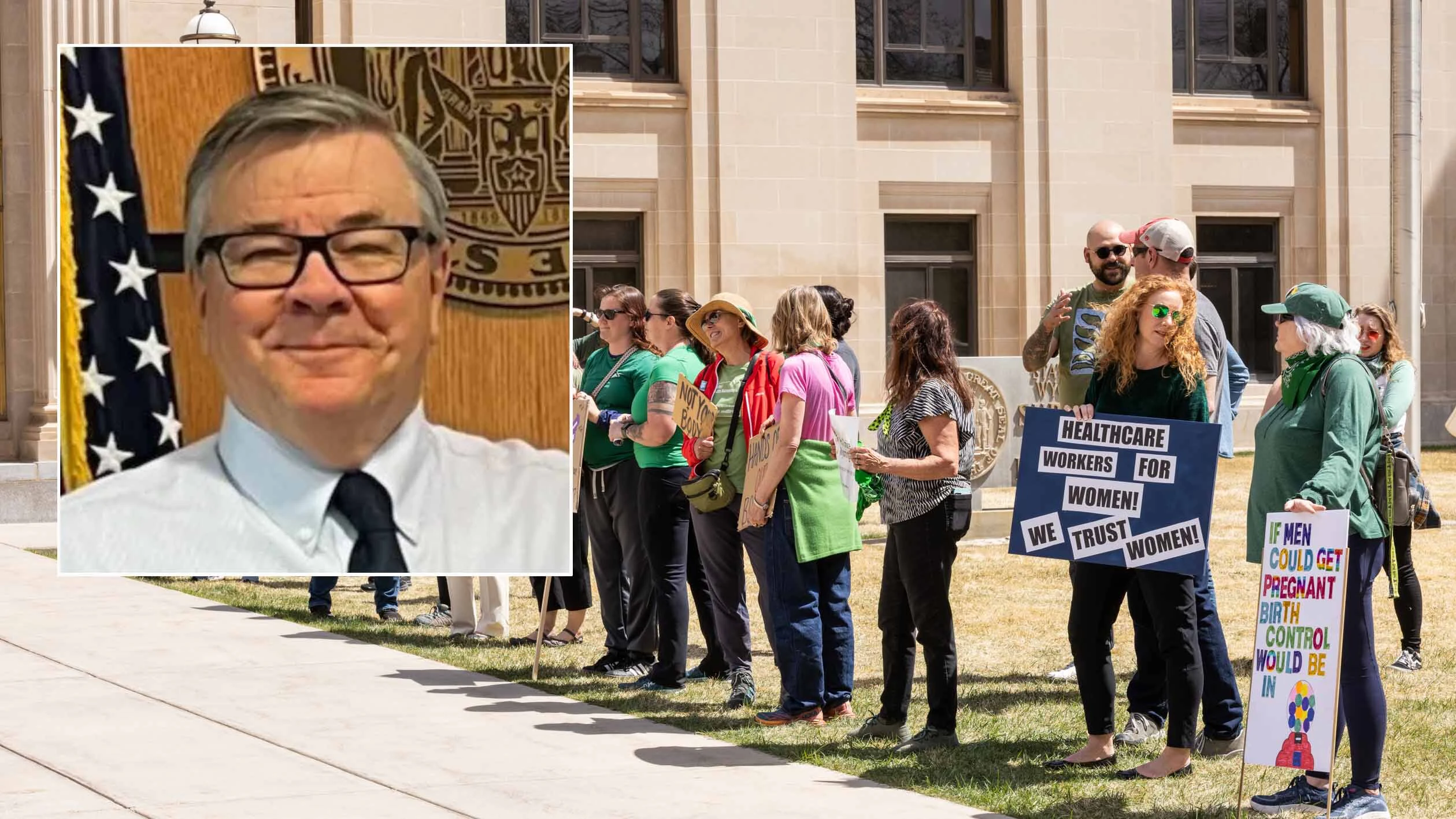

The Wyoming Attorney General’s office says that when the state’s highest court ruled that a woman’s right to have an abortion is so sacred the state’s bans couldn’t restrict it, it ignored the will of the people.
It also says the court changed its own legal rules without notice and completely ignored a possible right to life embedded in the Wyoming Constitution.
So asserts a Tuesday filing by Wyoming Special Assistant Attorney General Jay Jerde.
The filing is a petition for re-hearing, a Hail Mary toss in the nearly four-year litigation of Johnson v. State.
That’s a cluster of cases in which a pro-choice coalition has challenged Wyoming’s ban on nearly all abortions and its ban on chemical, or pill, abortions.
On Jan. 6, the Wyoming Supreme Court majority declared that women in Wyoming have a fundamental health care right to have an abortion — more fundamental than their right against unreasonable searches and seizures.
It also ruled that the legal strategy on which Jerde tried to defend the state’s two abortion bans should no longer apply.
And it ruled that because the Wyoming Constitution gave the Legislature the ability to restrict abortion as is “reasonable and necessary” to protect the people’s health and welfare (and mandated the legislature to protect the health right) it subjected the state's abortion bans to the most rigorous standard in constitutional law.
That was all wrong, Jerde’s filing claims.
He’s now asking the Wyoming Supreme Court to hear this final round of arguments “so that it may correct a number of legal errors.”
Wyoming Attorney General Keith Kautz, who is himself a retired Wyoming Supreme Court justice and who helped adjudicate some of the cases on which Jerde’s filing relies, told Cowboy State Daily in a Tuesday phone interview that, “We feel strongly about the positions taken in the petition for rehearing.”
The high court does not have to grant the rehearing.
If it does grant it, the pro-choice coalition that sparked these lawsuits will get a chance to rebut Jerde’s arguments.
Shifting Goal Posts
Firstly, Jerde’s filing says the high court shifted the legal goal posts on him without giving him notice or the chance to argue against that maneuver.
Jerde waged his defense of the state’s two bans on Wyoming’s existing case law around “facial challenges.” A facial challenge is when plaintiffs call a law altogether unconstitutional, as the pro-choice coalition did in this case.
An as-applied challenge, which the plaintiffs also invoked, means the plaintiffs only have to show that the laws are unconstitutional as applied in the state’s interaction with them.
Under Wyoming precedent, plaintiffs would have to show in a facial challenge that there’s “no set of circumstances” under which the laws they challenge would be constitutional.
The high court removed that definition and switched to a more plaintiff-friendly standard in its Jan. 6 ruling. It did so on its own whim, which in legal speak is “sua sponte.”
“Essentially, (the majority and concurring Justice John Fenn) changed the legal rules governing this case after the parties had presented briefing and argument under a different set of rules,” wrote Jerde. “By doing so, (they) deprived this Court of vigorous adversarial argument on the issue.”
Another part of the “issue,” Jerde notes, is that courts generally operate under a concept called “stare decisis,” which means deferring to earlier decisions by themselves or their predecessors on that same bench.
The Wyoming Supreme Court can abandon its own precedent when it’s poorly reasoned or no longer workable, or when it needs to do that to undo obvious defects and restore justice, Jerde noted, referencing a case the high court decided last year.
In 2018, the high court had upheld its facial challenge standard in Gordon v. State.
Nothing substantial in the legal realm has changed since then except the membership of the court, Jerde’s filing asserts. He added that keeping consistent precedent keeps courts “evenhanded, predictable, and consistent.”
One of the justices who heard that 2018 case, retired Wyoming Supreme Court Justice Kate Fox, was also recalled to finish the work she had started last year before her retirement on the abortion case.
Jerde references her, but not by name.
“It thus appears that this precedent was overruled because the one Justice who heard the Gordon appeal apparently changed her mind about the stare decisis ruling in that case, and three Justices who did not hear the Gordon appeal apparently disagreed with the stare decisis ruling in that case,” he wrote.
The other now-retired justice who heard the “Gordon” appeal is the Wyoming Attorney General for whose office Jerde is working, Kautz.
Speaking In Code
The Wyoming Constitution confers a health care autonomy right because in 2012, the voters passed a constitutional amendment giving each competent adult the right to make his or her own health care decisions, and to do so for their children.
That was an attempt to resist Obamacare.
That amendment also says the Legislature may “determine reasonable and necessary restrictions” on that right to protect the people’s health and general welfare, or to accomplish other purposes in the state Constitution.
It also says Wyoming “shall act to preserve these rights from undue governmental infringement.”
To the majority and concurring justice that struck down the state’s abortion bans, that wording is “easily harmonized” with the most rigorous standard of review in constitutional law, which most government actions don’t survive: strict scrutiny.
The terms of strict scrutiny require the state to show that its laws advance a compelling government interest, and are narrowly tailored to do so.
To Jerde, that’s a stretch and a mismatch.
“To justify the use of the strict scrutiny test, the majority would have the citizens of Wyoming believe that, when the Wyoming Legislature adopted (the amendment) and the people ratified it, they spoke in code,” he wrote, “(and) what they actually meant was the Legislature may restrict the rights granted under this section only if the Supreme Court finds the Legislature has a compelling interest to do so and the restrictions impose the least onerous burden on those rights.”
Jerde’s filing also says the majority and Fenn “myopically” focused on the term “undue” to require Wyoming to defend its abortion bans under a tougher standard, when Jerde’s reading of that section means that Wyoming should be taking affirmative (not defensive) steps to defend the people’s health care rights from others.
The high court in its Jan. 6 opinion had chided the Wyoming Attorney General’s Office for not providing enough evidence to carry its argument.
This, Jerde’s filing claims, is another departure from precedent for which the high court relied on two cases where courts had mandated evidence submissions to inform a secondary, not primary, legal question.
Here, wrote Jerde, the high court over-relied on the opinion of Mike Blonigen, a former district attorney and well-known prosecutor in Wyoming who wrote about how difficult the abortion bans would be to prosecute — when it should have sought instead “established truths, facts or pronouncements that do not change from case to case but apply universally.”
“The State’s ‘compelling interest,’ if required, is the life of an unborn human being,” wrote Jerde. “Whether that unborn human being is worthy of state protection is not a question for competing expert opinions, nor is it a question for determination by judges.”
‘Judicial Legislation’
Jerde’s filing says the high court majority ignored one of the state’s key arguments and a constitutional argument within the ban itself: that Article 1, Section 2 of the state Constitution protects unborn life.
That section reads:
“In their inherent right to life, liberty and the pursuit of happiness, all members of the human race are equal.”
Jerde argued that the “Life Act” — or ban on all abortions with exceptions for rape, incest, and life/injury-of-the-mother situations — sought to balance the unborn child’s right to life against the woman’s right to health care autonomy.
The majority in its ruling had listed the law’s rape and incest exceptions as a defect in the state’s right-to-life arguments.
The abortion bans, wrote the justices “are underinclusive because they do not protect unborn children.”
Jerde’s filing counters, saying the high court didn’t grapple properly with the question of whether an unborn baby is a member of the human race.
“The majority’s failure to do so is judicial legislation,” he wrote.
Clair McFarland can be reached at clair@cowboystatedaily.com.