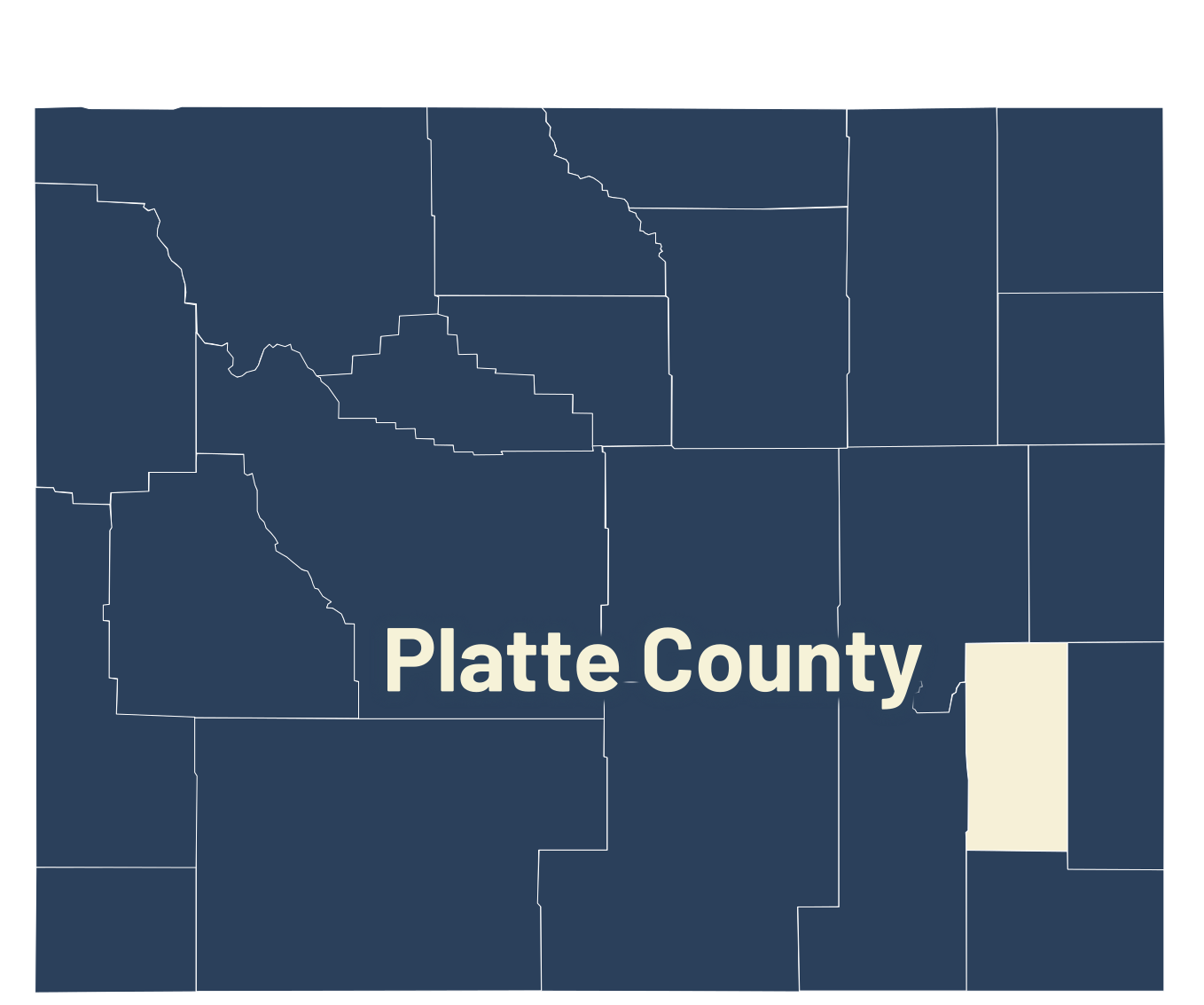
Platte County commissioners unanimously approved new wind and solar energy regulations Tuesday afternoon they said protect private property rights for landowners and neighbors.
The vote came despite requests from about a dozen citizens who wanted turbine setbacks increased to 1.25 miles from neighboring property lines. Commissioners maintained the existing, roughly quarter-mile setback from residences, saying broader restrictions would allow small landowners to effectively control development on thousands of acres of neighboring land.
Commissioner Ian Jolovich said the regulations represent the county's effort to balance competing property rights.
"I am very reticent to give too many rights to my neighbor," Jolovich said during deliberations. "I think that's a bad trade for Platte County and for property rights."
In an interview after the meeting, Jolovich explained the county's approach.
"The rules and regulations are a blunt tool, and the precise tool would be to look at the merits and the deficiencies of any one project that is being proposed and working with the developer and the neighboring landowners to find out what their issues are and see if we can come to an amicable solution on an individual case," Jolovich told Cowboy State Daily.
Jolovich said commissioners can still impose additional conditions on specific projects when permit applications come before them.
NextEra Energy, which is developing the Chugwater Energy Project in Platte County, came away pleased with the commission’s decisions Tuesday.
“The most important thing to think about is the shared value of doing the right thing,” Sara Cassidy, communications director for NextEra, told Cowboy State Daily. “And Platte County affirmed their wind and solar regulations. So these projects are done right. And again, that's a shared value we have — is doing the right thing.”
“We understand that not everybody likes the project,” said Cassidy. “We want to make sure we're working with folks. Because at the end of the day, again, it's about doing the right thing, it's about treating people with respect.”
State Precedent
The setback debate centered on a recent decision by the Wyoming Industrial Siting Council, which granted Kathryn Stevens a 1.25-mile setback from proposed turbines near her home.
Stevens told commissioners she presented a stack of peer-reviewed studies, acoustical reports and medical papers to the state council, which then approved her request.
"The Industrial Siting Division on behalf of the State Department made a huge decision to apply a one and a quarter mile setback for my family in regard to the turbines," Stevens said. "Consequently they granted my request for a conditional one and a quarter mile setback personally."
Stevens argued the county should extend the same protection to all residents.
"Why would only one family in Platte County have this protection?" she asked. "What the (Siting Council) made possible for me, you have the legal responsibility to make true for the rest of your constituents in rural Platte County."
Land Control
Opponents of the increased setback argued it would effectively give small landowners veto power over vast swaths of neighboring property.
Jim Lerwick, a landowner participating in the NextEra project, said the economics of such setbacks proved devastating in neighboring counties.
"A mile and a quarter setback would let a 40-acre piece control roughly 2,000 acres of other people's rights," Lerwick said. "So I would be careful in making any change to what you put in here."
Lerwick recounted how wind projects in other counties were eliminated due to two-mile setbacks around federal missile bases.
"That decision cost every man, woman, and child in those two counties an annual revenue of $4,000 plus," he said.
Economic Stakes
Josephine Young, executive director of Platte County Economic Development, told commissioners the 1.25-mile setback would effectively shut down development.
"One and a quarter mile changing it to everything would impact a huge amount of lands or remove them from any consideration," Young said. "It feels like if it were a true safety concern the (Siting Council) would have been consistent, not selective. A setback can be a safeguard or a shutdown."
Anthony Bianchini, senior project manager for NextEra Energy Resources, called the proposed regulations appropriate.
"These are good regulations and future projects done right," Bianchini said. "These are appropriate and safe. They're in line with the board, just as stringent as other counties."
Balancing Act
Rep. Jeremy Haroldson, R-Wheatland, acknowledged the difficulty commissioners faced in balancing competing property rights.
"I know where my quarter mile mark is, and I know where my half mile mark is, and I know where my three-quarter mile mark is, and I'll be completely honest with you, that quarter-mile mark's really close to my house," Haroldson said. "And so I sit there and just put myself into the shoes of these people and say, ‘You know, that's problematic.’"
But Haroldson noted the other side of the equation.
"At the same time, they have private property rights, the person wanting to put towers on their land," he said. "I think at the end of the day, you guys have to have that discussion to see if that's the right number."
Wyoming Secretary of State Chuck Gray attended the hearing and urged commissioners to back the 1.25-mile setback.
"My big ask would be to adopt the mile and a quarter setback that the Industrial Siting Commission approved for a family," Gray said. "I think if they said that it's good for that situation, it should be applied uniformly across the board and I think that is the standard that should be applied here in Platte County regulations."
The Platte County hearing stood in sharp contrast to a contentious meeting in Douglas on Jan. 8, where Gov. Mark Gordon and Secretary of State Gray clashed over wind energy policy, with Gordon at one point asking Gray if he wanted to "step outside."
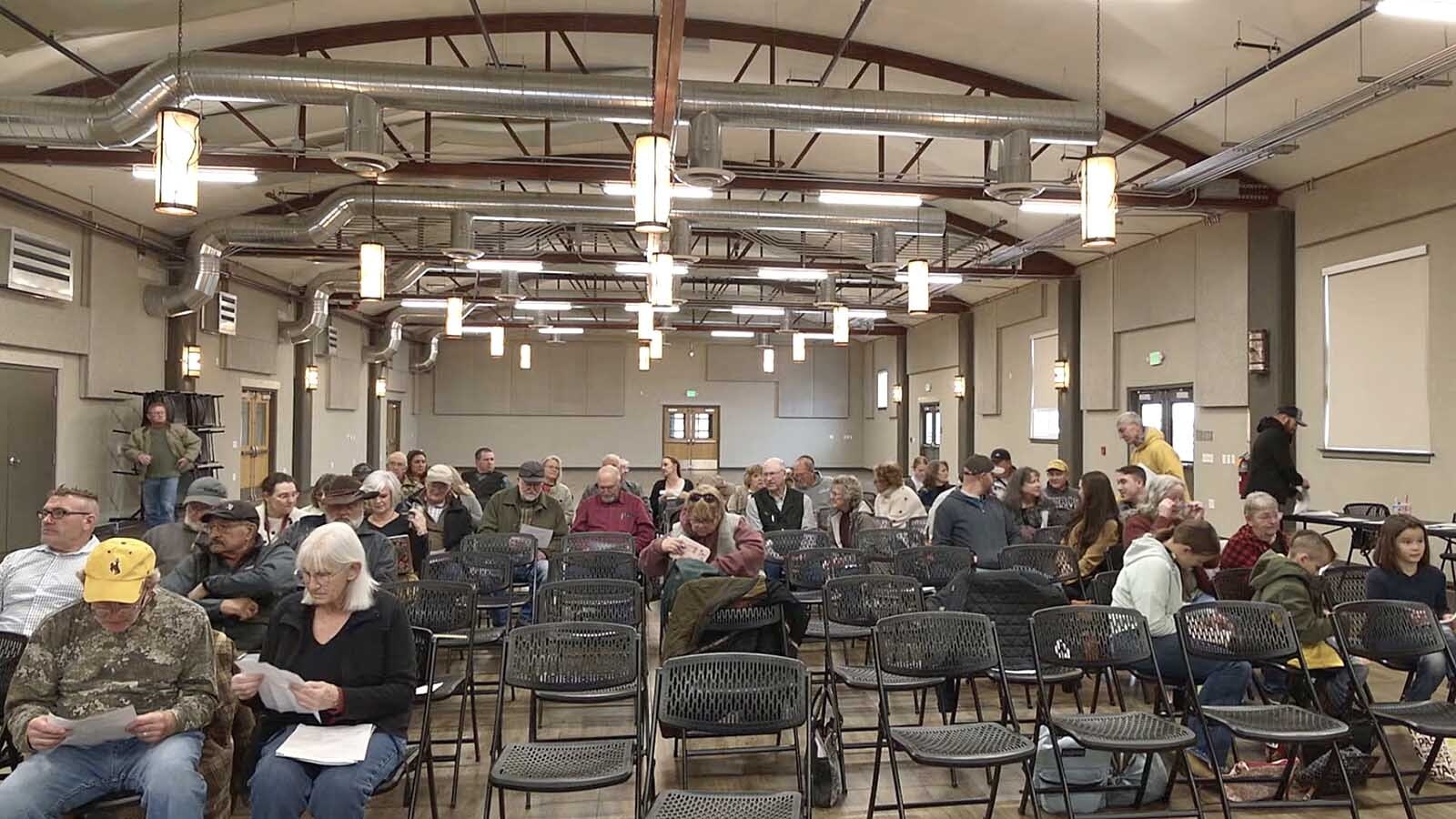
Tuesday's Wheatland meeting, held at the Platte County Fairgrounds, included private landowners asking commissioners to protect their right to work with wind and solar developers.
Commissioner Jeb Baker, serving his first term, said he worried about opening the door to expanded property rights claims.
"If a person cracks that door open on property rights, this is what scares me a little bit," Baker said. "If that door gets cracked open, whether it's wind or whether it's somebody kicking it, somebody out here on the flats could buy a piece of property downwind of a corn farmer and then take him to court because his corn stalks are blowing in his yard."
Baker said he felt compelled to give property owners latitude.
"I gotta give the property owner kind of a leniency in this deal," he said. "Because there's no putting that back in the box if it gets out."
David Madison can be reached at david@cowboystatedaily.com.