The sun is giving Wyoming its first chance of 2026 to see colorful auroras.
A coronal mass ejection (CME) has emanated from the surface of the sun and should collide with Earth’s atmosphere Monday night.
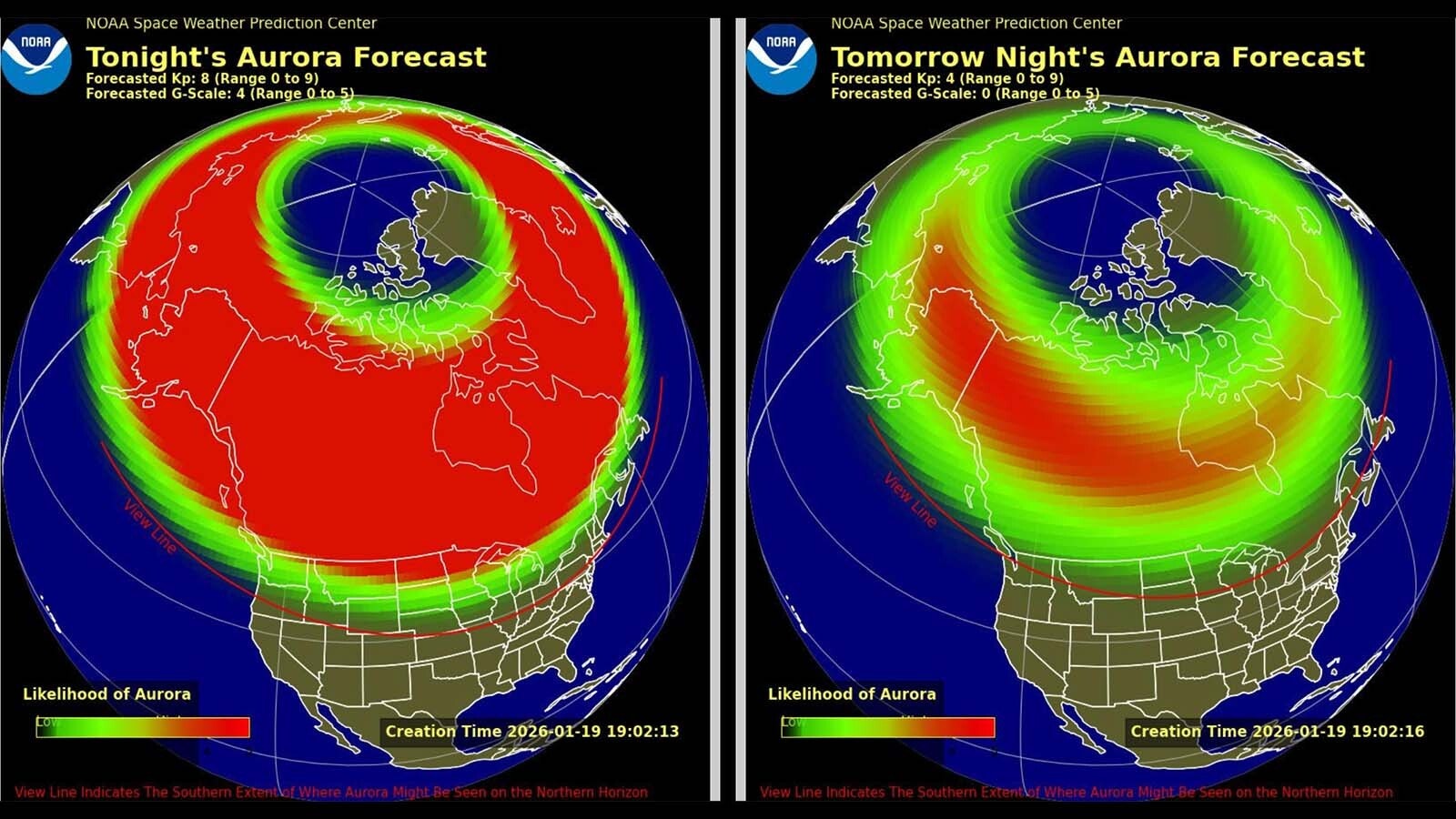
The National Oceanic and Atmospheric Administration’s Space Weather Prediction Center issued a G4 (Severe) Geomagnetic Storm Watch for Monday and Tuesday.
For reference on how intense that is, the scale peaks at G5, which means this is a particularly powerful CME.
It’s too early to say how intense any auroras will be once the solar energy arrives, but experts agree that something spectacular is going to happen.
Predictions are that auroras will be visible as far south as Texas and northern Mexico.
“I’m cautiously optimistic this will be a pretty impressive display,” said Jan Curtis, a retired meteorologist and former Wyoming state climatologist. “This is the best opportunity in several months, for sure.”
On Its Way
An X-Class solar flare was detected emanating from a sunspot around noon Sunday.
The surge of volatile solar energy is streaking across space towards Earth, where its energy will interact with the atmosphere, manifesting as an aurora.
“Although some of the energy has deviated away from Earth, there's a substantial amount that's expected to impact us sometime after dark,” Curtis said. “The intensity of the aurora depends on the polarity of the stream coming in.
"Physics will determine whether it's a good display, a bad one, or no display at all.”
There’s a lot we won’t know about this CME and the subsequent aurora until it gets closer.
The Space Weather Prediction Center says G4 (Severe) Geomagnetic Storm Watches are “very rare,” which is adding to the excitement and anxiety of aurora enthusiasts.
The last time a G4 Storm Watch was issued was in November, when Wyoming experienced one of the best auroras in recent years.
Curtis said this one could be similarly spectacular, but he’s not getting his hopes too high.
“I’ll be optimistic and say this will be no more than a G2 or G3 once it reaches us,” he said. “If it gets to G4, we'll get a pretty impressive display, but we’re not quite certain it's going to get that far.”
A G4 CME could be seen as far south as Texas, which means all of Wyoming would be within the window for optimal viewing. There’s also a chance of another aurora overnight Tuesday.
But what will we see once it gets here?
With Your Eyes And Phones
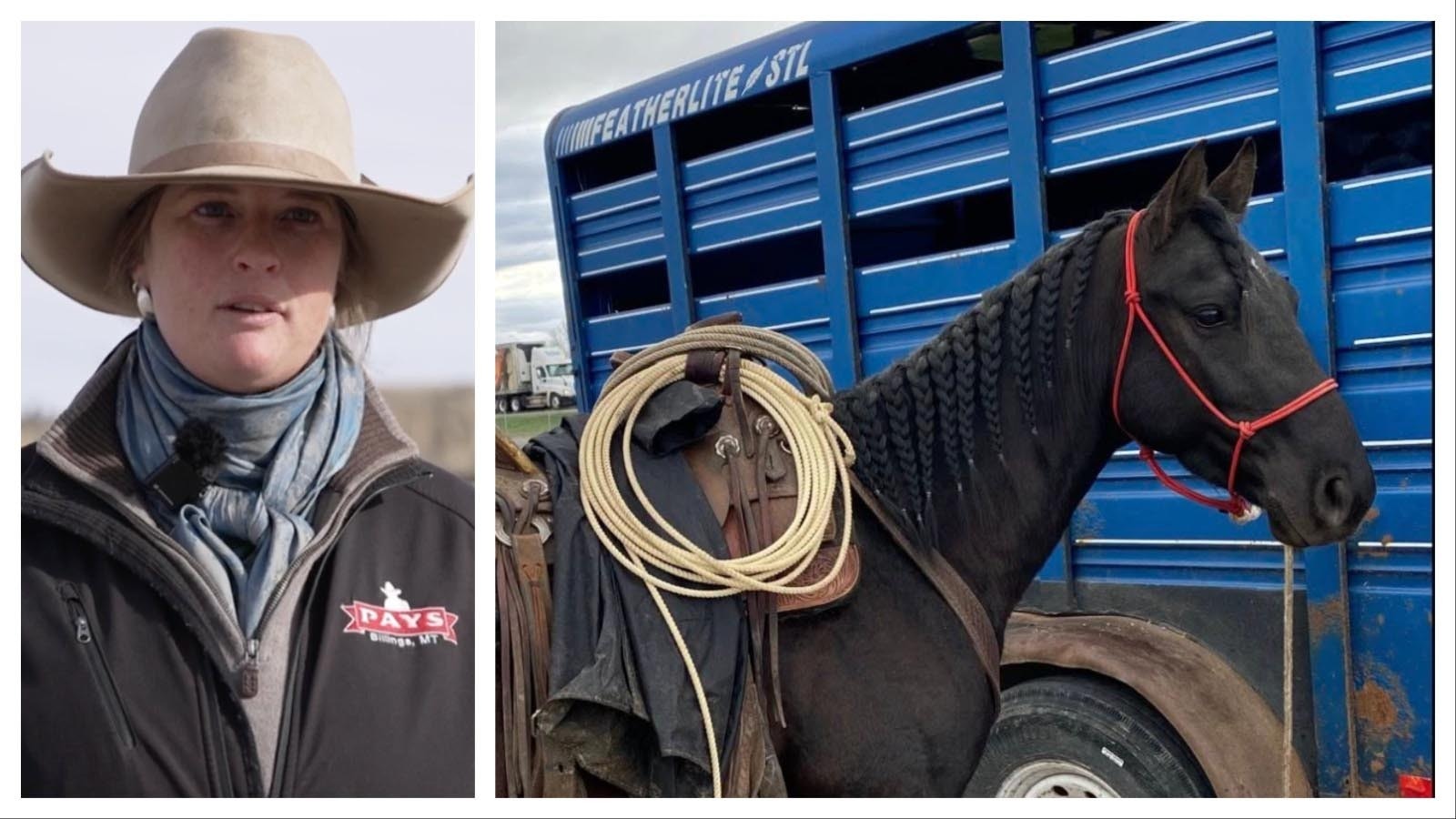
Bar Nunn photographer Laura Redmond uses several apps to monitor incoming CMEs. What’s making her optimistic about this one is its speed.
“When a CME launches from the sun, it usually takes two to three days to get here,” she said. “This CME went off yesterday morning, and it's supposed to hit sometime (Monday night). That means it's a big one.”
Depending on the intensity of a CME, Wyomingites might see an aurora directly overhead or just over the cusp of the horizon.
Redmond believes this CME could be visible overhead across Wyoming, and even to the naked eye.
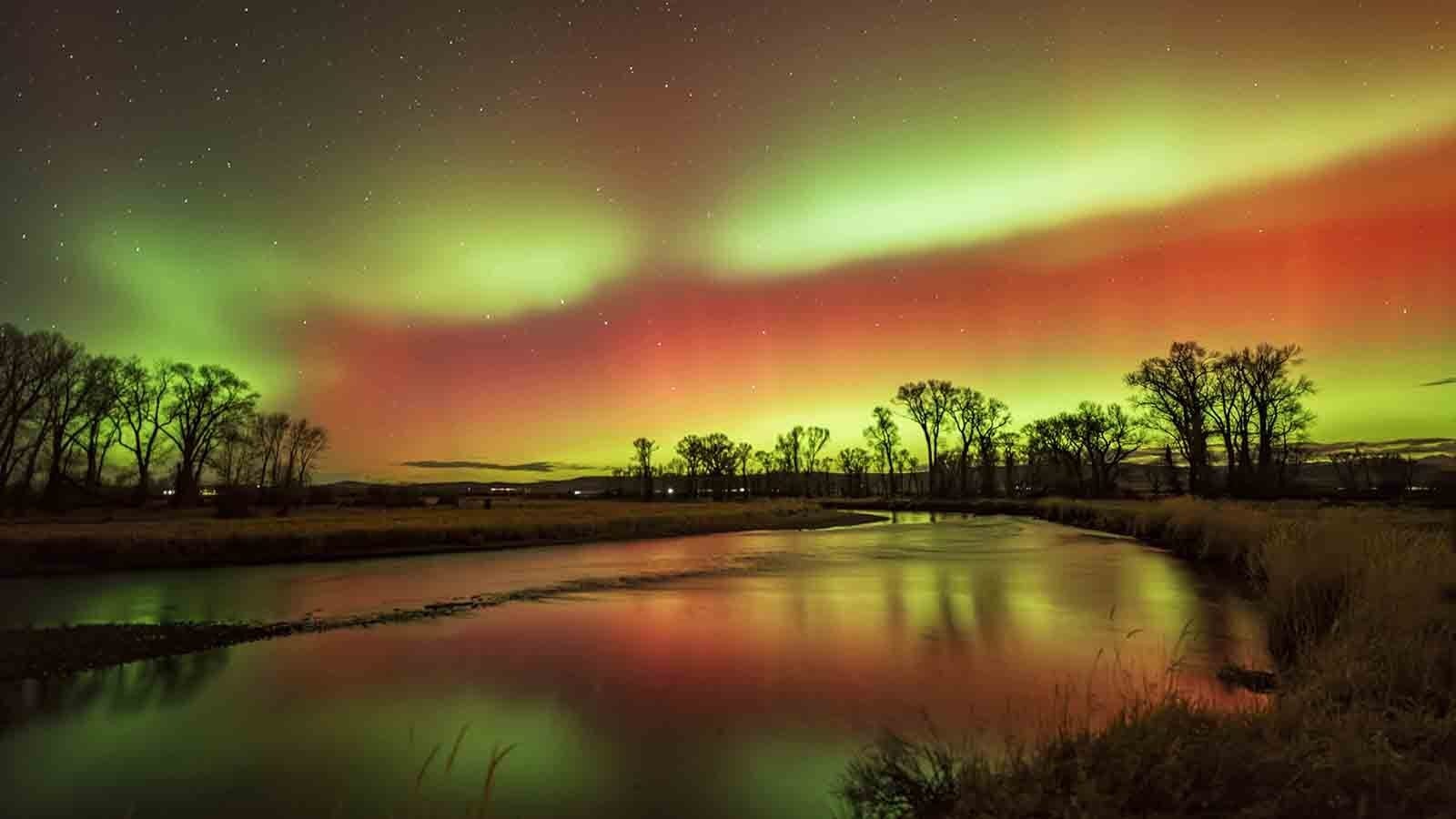
That doesn’t mean people will see spectacular ribbons of color, like those in photos taken by Redmond and others. There’s only so much that’s visible to the naked eye.
“When you're seeing them with your eyes, you're going to see a glow in what looks like light, misty clouds,” Redmond said. “Sometimes you can see green or red, but auroras are not as brilliant to your eyes as they are to the camera, because our eyes can't stay open that long.
"They blink. The camera doesn't have an eyelid, so it stays open as long as you tell it.”
That doesn’t mean a spectacular aurora shot isn’t unattainable for anyone who doesn’t have a high-end camera. Redmond is confident a smartphone would suffice.
“Put your phone in night mode, point it at the horizon to the north, and it will show you if they're there,” she said. “But you definitely need to be somewhere dark, so get away from streetlights.
"When you find a spot that’s dark enough, you’ll see it with your phone and your eyes."
Where And When
The G4 CME is still hurtling towards Earth. According to Redmond, it’s anticipated to first hit Earth’s atmosphere around 5 p.m.
Curtis said he’ll have his camera ready as soon as it gets dark, but that doesn’t mean there will be an immediate aurora.
Auroras take time to develop and intensify, and they change as the night progresses.
“I don't expect any activity until between 9 p.m. and 3 a.m. Tuesday,” he said. “Midnight will definitely be the central prediction time for the impact, and it should last through the dawn hours of tomorrow if it does come to pass.”
The moon will be at 1% illumination overnight, so the skies will definitely be dark enough for a great viewing.
However, Wyoming’s weather looks like it’s not going to cooperate for many eager aurora enthusiasts.
“There will be about 60% cloud cover, mostly over north and central Wyoming,” said Cowboy State Daily meteorologist Don Day. “It’ll be the mostly clear in the far west.”
That means the best seats for the show will be in Afton, Dubois, and Jackson, where overnight temperatures will be in the single digits.
Redmond chases auroras, so she’s not too keen to go that far in freezing temperatures, but said this aurora might be worth the trip.
“I would rather stay around Barr Nunn, but you've got a 50-50 chance of seeing auroras out here,” she said. “I’ll make a decision after looking at the cloud forecast around 8 p.m. We should be seeing lights by then.”
The sun is in the waning period of its solar maximum, a regular part of its solar cycle. During solar maximum, auroras are more frequent and intense.
As 2026 progresses, the likelihood of CMEs and auroras decreases to the point where there might only be one good event in several years.
For Curtis, that's a reason to make the most of every opportunity, and this is looking like a great opportunity across Wyoming.
“I would say that we have a six-month window before these types of events have a very low probability of occurring until the next maximum cycle,” Curtis said. “I was happy to see that this CME has become a very strong possibility for auroras.
"Once it starts, it’ll probably be visible for most of the night.”
Andrew Rossi can be reached at arossi@cowboystatedaily.com.