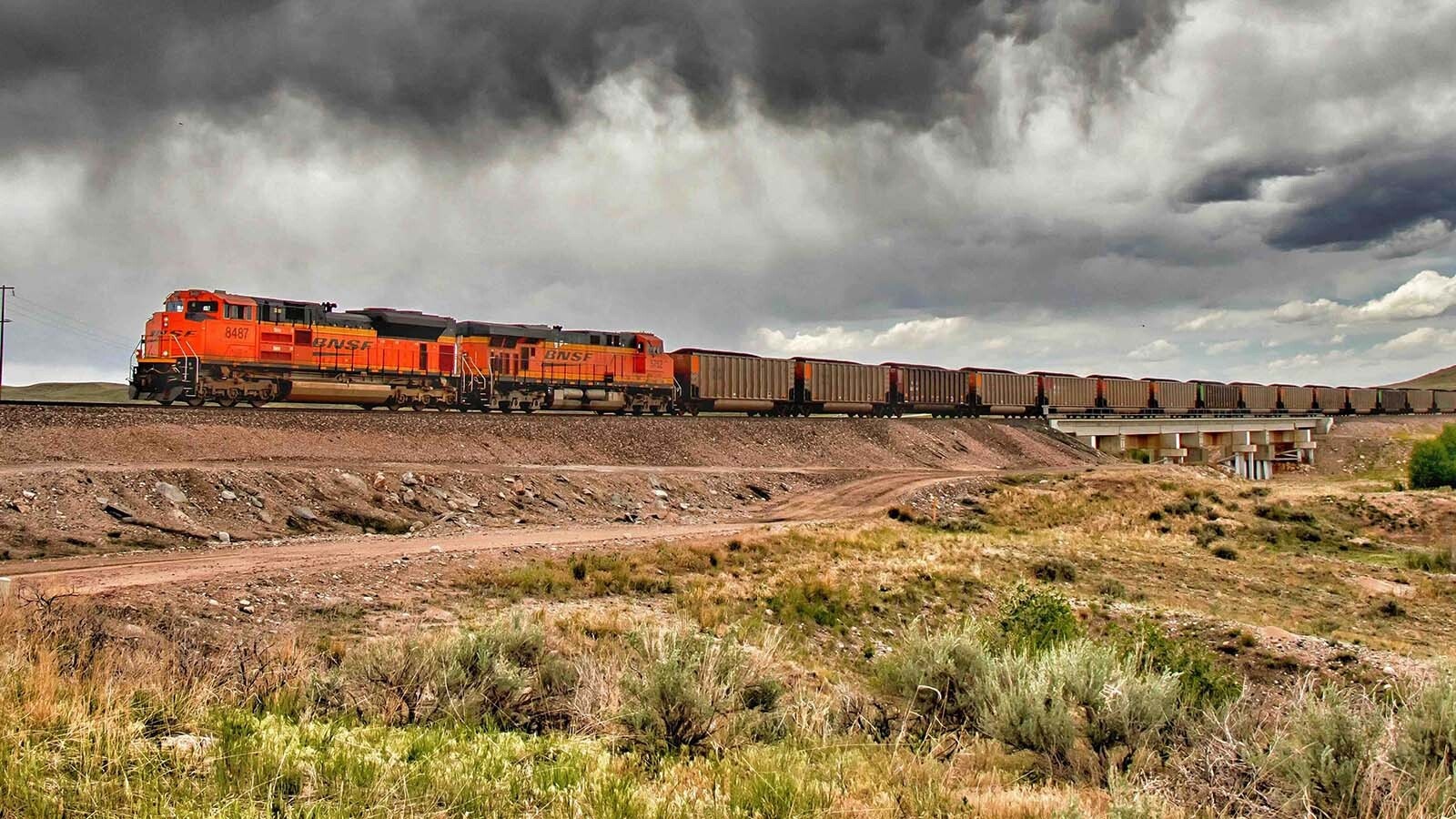
Every day, long trains loaded with Wyoming coal snake across the American heartland, eventually arriving at Plant Scherer north of Macon, Georgia — the most powerful coal-fired electricity generating plant in North America.
The massive facility, owned by Georgia Power, boasts four coal-fired units totaling roughly 3,500 to 3,720 megawatts, making it the largest operating coal plant in the U.S. for many years.
Right now, BNSF Railway hauls Powder River Basin coal across the West before handing off the shipments to Norfolk Southern, which pulls the coal cars down the final stretch to Georgia. If Union Pacific and Norfolk Southern have their way, that arrangement would change dramatically — and Wyoming coal producers would be left with fewer options and potentially higher shipping costs.
That’s according to critics of the proposed UP-NS rail merger.
On Thursday, the federal Surface Transportation Board delivered a unanimous decision that put the brakes on what appears to be the largest rail merger ever proposed. The federal agency rejected the merger application filed by Union Pacific and Norfolk Southern, finding it incomplete and ordering the railroads back to the drawing board.
Decision Details
The STB found that the nearly 7,000-page merger application failed to include required information, including projected market share data and the complete merger agreement between the two railroad giants.
According to the decision, the application “does not contain future market share projections showing the combined effects of merger-related growth, diversions, and merger-influenced and other changes to market conditions that Applicants anticipate.”
The Board also noted that Union Pacific and Norfolk Southern withheld a key schedule from their merger agreement — known as Schedule 5.8 — which describes conditions that would allow Union Pacific to walk away from the deal.
A spokesperson for Union Pacific told Cowboy State Daily, “Union Pacific will provide the additional information requested by the Surface Transportation Board.”
The railroads have until Feb. 17 to inform the Board whether they plan to refile, and until June 22 to submit a revised application.
Competition Concerns
Zak Andersen, BNSF chief of staff and vice president of communications, spoke with Cowboy State Daily from the railroad’s headquarters in Fort Worth, Texas, explaining why his company has opposed the merger from the beginning.
“We applaud the STB’s decision to reject the UP-NS merger application based on the application lacking core information critical to determining the proposed merger’s impact on competition,” Andersen said. “We also appreciate the STB’s willingness to consider the views of all stakeholders as part of the regulatory review process.”
Andersen spelled out BNSF’s fundamental opposition to the deal: “We view it as anti-competitive. It’s a threat to the resilience of the supply chain, simply because it results in the unprecedented consolidation of market power in our industry.”
He pointed to the already concentrated nature of the rail industry.
“There are really only four primary companies handling 90% of the freight today in the U.S.,” Andersen said. “And so we think for any given customer, you know, a shipper on rail, that you’re essentially, today you have four options.
"If this merger goes through, you got two. And anytime you go from four to two, that’s probably not a good thing for the competitive landscape.”
Wyoming Impact
The implications for Wyoming coal producers are stark, according to Andersen. Using Plant Scherer as a prime example, he explained the current competitive dynamic that benefits Wyoming energy companies.
“Today, the plant is captive to NS, right? NS is the only railroad that directly serves it,” Andersen said. “So either UP or BNSF can move that coal to a handoff and interchange point with Norfolk Southern. And we do.”
Currently, BNSF handles the shipments to Plant Scherer, and post-merger, that would likely change.
Andersen was blunt about where he believes this merger originated: “I’ve been convinced from day one. This merger did not begin by customers asking for it. It began by Wall Street asking for it.”
He predicted that when projected growth from the merger fails to materialize, Union Pacific will turn to captive customers to pay the bills.
“We think that UP goes back to what they’ve always done, which is to rely on charging captive customers, right? So we think rates go up. So therefore, prices for consumers go up. I don’t see that as a good thing for coal.”
Regulatory Hurdles
Andersen explained that this merger is being evaluated under stringent rules adopted by the STB — rules he said have never been tested because they raised the bar so high.
“A big piece of that is how you’re going to enhance competition,” he said. “Whereas in the past, you had to show where you’re going to preserve competition. So now they have to somehow show they’re going to improve it. And I don’t understand how a railroad with that much market power is going to prove that it enhanced competition.”
Andersen also raised concerns about service disruptions that have historically followed major rail mergers.
“After every major rail merger, there have been pretty serious service repercussions,” he said. “After the UP-Southern Pacific merger in the late ’90s, I mean, they had a full on meltdown, where the STB had to intervene.”
“With a network industry like ours, when one railroad starts to have trouble, it spreads pretty quickly to the others,” Andersen explained. “Because if all of a sudden we’re not getting the connections from one of the other ones, then we’re late.
"It just starts to metastasize. And so we worry about that quite a bit too.”
Economist’s View
Rob Godby, a natural resource economist at the University of Wyoming, has been watching the merger proceedings with interest. He told Cowboy State Daily that the STB’s decision reflects the complexity of evaluating such a massive transaction.
“As I understand it from reading reports from industry newsletters, the issue is as outlined, there was not a complete analysis of how this would affect regional rail-shipping market concentration in the future,” Godby said. “This is a complex merger, so it is likely to take quite a while to administrate and for a decision to be rendered.”
Godby noted that rival railroads and shippers have filed concerns about the merger’s potential effects.
“Other rail companies who fear a much larger and more consolidated competitor, and shipping rates or access to alternative shippers as well as effects to service,” he said.
The economist also flagged a potential domino effect.
“There is also a general concern in the industry that this could cause other rail companies to consolidate, having unintended effects on markets with respect to service and/or rates,” he said.
As for direct impacts on Wyoming mineral shipments, Godby offered a more measured assessment.
“I don’t expect any effects from the merger,” he said. “UP and BNSF operate jointly in a partnership to serve the PRB and as far as I can tell this would not affect the partnership between UP, or the newly consolidated entity if approved, and BNSF to operate access into the PRB.”
Godby suggested that any disruption to Wyoming operations could itself doom the merger.
“In fact, if it were to affect access, that would be another reason for the STB to potentially disapprove or request changes in the proposed merger, so I suspect the merger planners are working hard to avoid any disruption to Wyoming, especially coal shipments from the PRB, given the Trump administration’s elevated concern for maintaining coal production and use,” he said.
Merger Arguments
Union Pacific and Norfolk Southern have argued their merger would create America’s first transcontinental railroad, transforming the nation’s supply chain.
Union Pacific CEO Jim Vena said at a recent shippers meeting: “This is a transformational merger that will inject more competition into the railroad industry and force them to enhance their service, reduce their price, or do both.”
The companies contend that single-line transcontinental rail service will provide stronger competition with long-haul trucking.
According to a study cited by Union Pacific, interline merchandise traffic moving 1,000 to 1,500 miles costs on average 35% more than comparable single-line service.
The merger application included what Union Pacific described as a record-setting 2,000 letters of support from customers, public officials, industry associations and unions.
For now, Wyoming coal producers and the customers they serve — including that massive power plant in Georgia — will continue to have options when it comes to moving their product across the country.
Andersen, reflecting on what the merger battle means for the broader industry, returned to his central concern about consolidation.
“We’ve seen this before with both BNSF and UP, when we’ve struggled with service, what the impact is on the mines in Wyoming,” he said. “And so we worry about that quite a bit too.”
David Madison can be reached at david@cowboystatedaily.com.