Harrison Ford is legendary for his exploits on the silver screen, but one adventure of one of his most iconic characters still hits close to home in Wyoming.
In “The Young Indiana Jones Chronicles,” the original Indiana Jones was brought back to recall an exciting adventure from his youth in the wilds of Wyoming, and Ford donned his famous fedora to tell the tale.
“Young Indiana Jones and the Mystery of the Blues” is the only time Ford returned as the titular character in “The Young Indiana Jones Chronicles,” the series that ran on ABC from 1992 to 1993.
The bulk of the episode takes place in 1920s Chicago, but it’s a story of sacred relics told by Indiana Jones himself in a rustic cabin in the mountains of Wyoming.
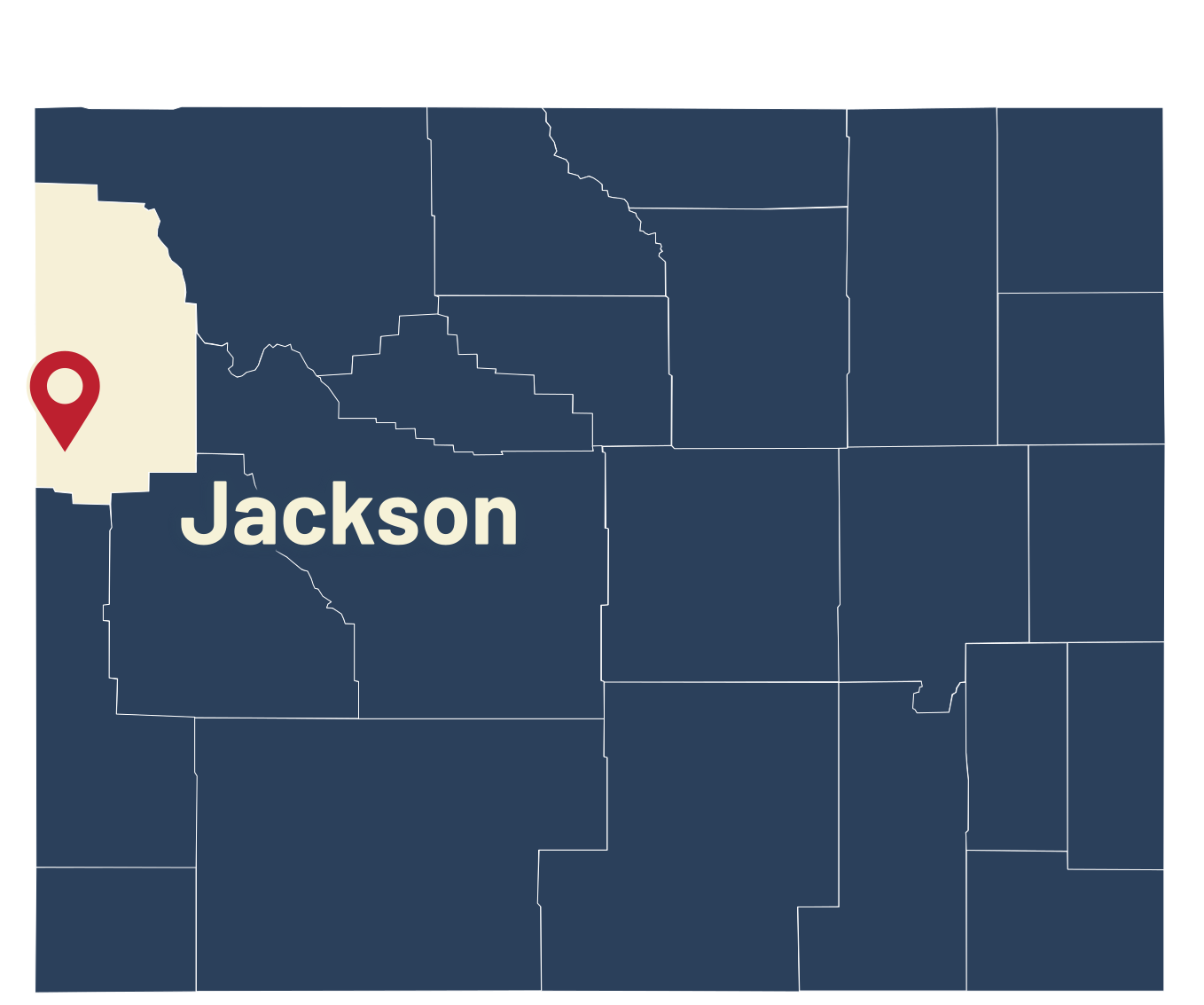
Those segments of the episode were set and filmed on Ford’s ranch in Jackson Hole.
A production crew from Lucasfilm, including the legendary George Lucas, flew to Jackson Hole so Ford could make a brief return to the role that made him an action star, and it inadvertently brought Indiana Jones back for future adventures on the big screen.
Mystery Of The Blues
“Indiana Jones and the Mystery of the Blues” aired as the fifth episode of Season Two of “The Young Indiana Jones Chronicles” on March 13, 1993.
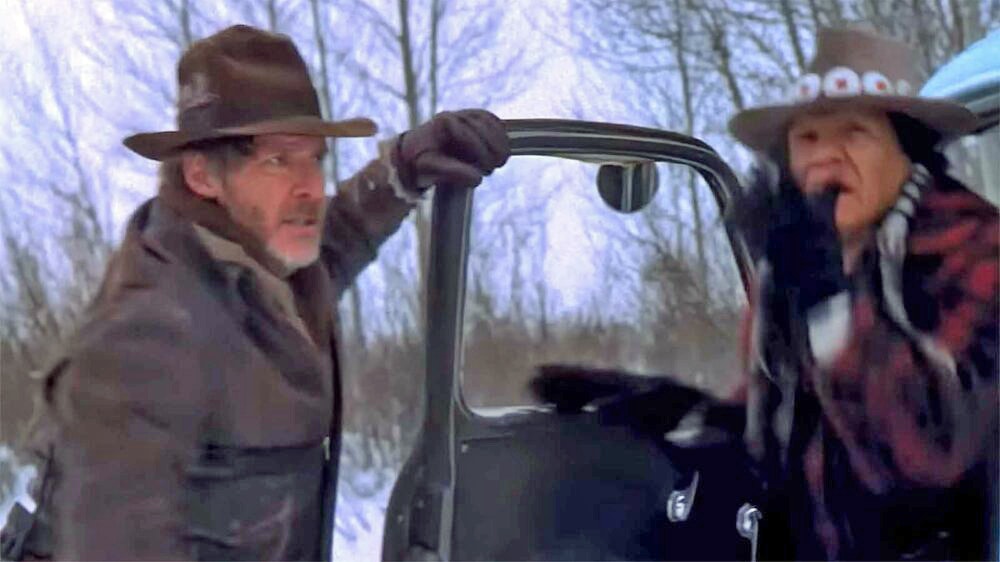
Ford’s scenes were filmed as the episode's bookends, separate from the main plot. The episode starts in 1950, with a high-speed car chase through the snow on the back roads of Wyoming.
Indy has recovered a sacred peace pipe from some heavily armed ne'er-do-wells, who are shooting at Indy’s truck. He reassures his friend, Greycloud, played by American Indian actor Saginaw Grant, that this is “not my first time” as he manages to elude their pursuers.
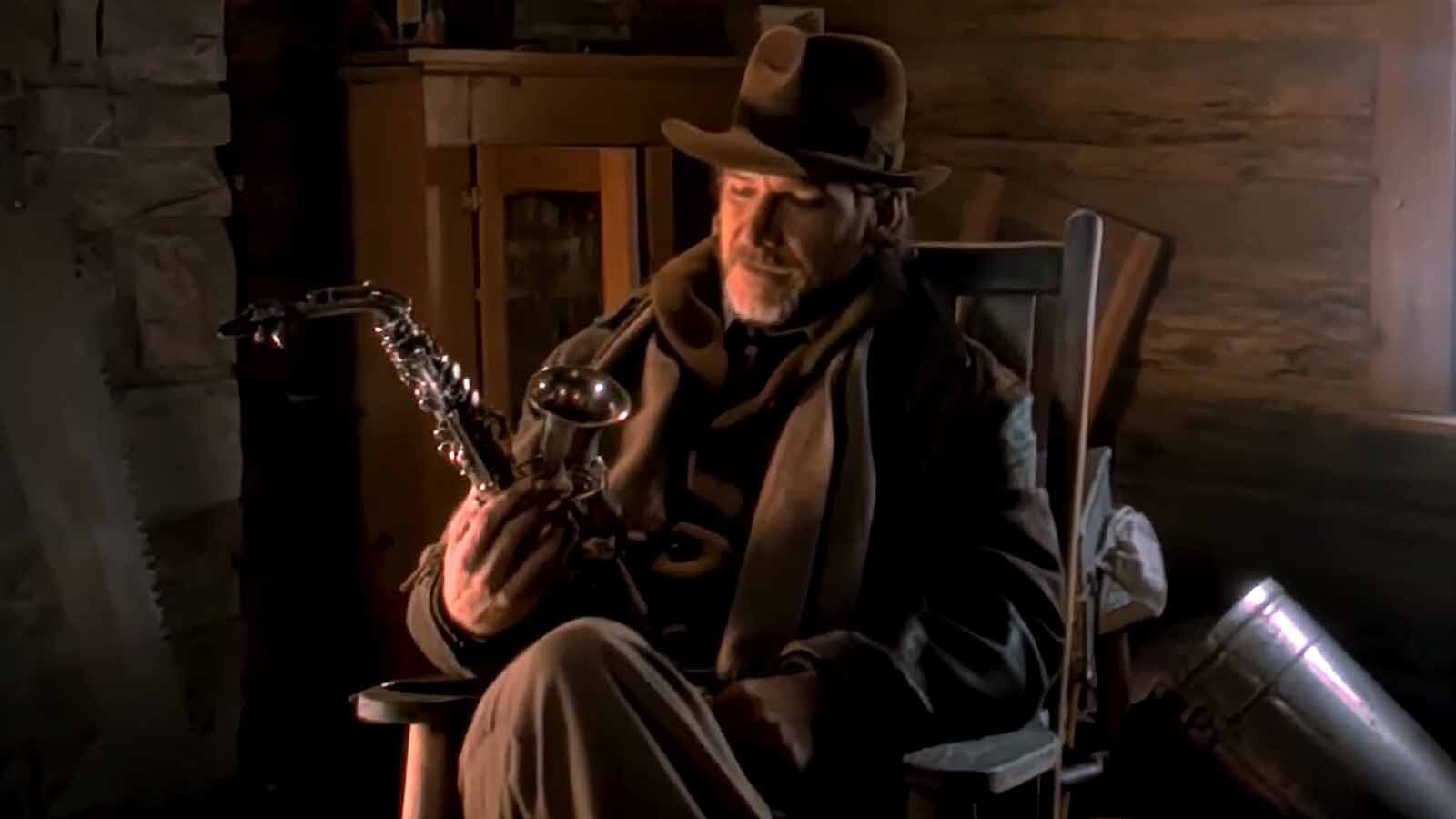
After getting caught in a snowstorm, Indy and Greycloud reach the safety of a backcountry cabin. Once inside, Indy pulls a soprano saxophone out of an old chest and reveals that he’s quite adept as a jazz musician.
“Here’s a sacred relic of my past,” he tells Greycloud, before regaling him with the flashback that makes up the bulk of the episode.
The bulk of the episode, narrated by Ford, takes place in Chicago, Illinois, in 1920. Henry “Indiana” Jones Jr., played by Sean Patrick Flanery, is paying his way through graduate school at the University of Chicago by working as a waiter at Colosimo’s Restaurant.
“Best food, best service, and best jazz in Chicago,” Indy says. “And I loved jazz.”
Even by Indiana Jones standards, the story is a little crazy. The partial list of historical figures Indy runs into in this episode alone includes Louis Armstrong, Ernest Hemingway, Eliot Ness, and Al Capone.
The short summary is that Indy finds himself in the middle of a bootlegging murder mystery. Capone and Johnny Torrio successfully execute “Big Jim” Colosimo, allowing them to take control of the Chicago mafia (which is historically accurate).
Indy, Ness, Hemingway, and Academy Award-winning writer Ben Hecht do some sleuthing to collect evidence and bring down the murderous mobsters (which isn’t historically accurate). Thwarted by the endemic corruption in Chicago, Indy and his compatriots “play the blues” as they go their separate ways, making this a formative experience on their paths towards the icons they’d become.
Why did any of this 1920s Chicago gangland story need to be told in a snow-covered Wyoming cabin? That’s where Harrison Ford happened to be, so it’s where Indiana Jones needed to be.
The Biggest Fan
Dan Madsen is the former president and publisher of the official Lucasfilm Fan Club and Star Wars Insider magazines. He wrote and published “The Young Indiana Jones Chronicles: On the Set and Behind the Scenes,” a book about the production of the television series, in 1992.
“I started a fan club for ‘Star Trek,’ which came to the attention of Paramount Studios and Gene Roddenberry,” he told Cowboy State Daily. “That became the official ‘Star Trek’ Fan Club. After running that for several years, I got a call from George Lucas and his team.”
Madsen traveled to Lucas’s Skywalker Ranch to accept the position of publishing the Lucasfilm Fan Club magazine, highlighting “all things under the sun” involving the production company’s creative properties, particularly “Indiana Jones” and “Star Wars.”
That magazine was rechristened “Star Wars Insider” in 1994. It will mark the end of almost 40 years of continuous publication with its final issue in April 2026.
“As a result of my time working on the Lucasfilm Fan Club magazine, I was asked to write the book on the making of ‘The Young Indiana Jones Chronicles,’ which I did,” he said.
Madsen said “Indiana Jones and the Mystery of the Blues” is an obvious standout of the series’s 28 episodes. An elderly Indiana Jones had appeared in the series, played by actor George Hall, but this was the first and only time Ford reprised his role.
“It was the only episode he was asked to do,” Madsen said. “George knew he wanted to get Harrison somewhere in the show as a cameo, and that particular episode happened to be the one that George felt would be the best.”
It was the first time Ford had returned as Indiana Jones since the release of “Indiana Jones and the Last Crusade” in 1989. However, getting Ford into the show was an adventure in and of itself.
Indiana Jones And The Shoot Between Shoots
Harrison Ford has been living in Jackson Hole since the 1980s. Because of Ford’s busy schedule, it was easier for Lucas, a small production unit, and all their actors and equipment to come to Wyoming than it was to get Ford to Los Angeles, California.
“It was the only way they could make it work,” Madsen said. “Ford was filming ‘The Fugitive’ at the time, so they had to find a spot close to him.”
The two-day shoot was a reunion of many key players in the Indiana Jones franchise.
The director credited for the episode is Carl Schultz, but Ford’s scenes were directed by Frank Marshall, a major producer involved in the Indiana Jones, Jurassic Park, and Back to the Future franchises, as well as many other projects by Lucas and Steven Spielberg.
Lucas, one of the writers of the episode’s story and a producer of “The Young Indiana Jones Chronicles,” came along, too.
According to Madsen, the shoot was done entirely on Ford’s 800-acre ranch in Jackson Hole, where he lives with his wife, Calista Flockhart, to this day. Everything was staged and shot on Dec. 19 and 20, 1992, during a gap in Ford’s filming schedule for the 1993 film, “The Fugitive.”
That explains Indy’s beard and mustache. The usually clean-shaven or stubble-covered archaeologist couldn’t shave because the beard of Dr. Richard Kimble, Ford’s character in “The Fugitive,” is a crucial plot point in the film.
Being the professionals they were, Ford, Lucas, and the production team easily got everything they needed, including a high-speed car chase with two vintage vehicles, during the two-day shoot. Lucas later said he appreciated Ford’s willingness to return to the role.
“Harrison did us a favor, and it was a little fun weekend,” he said.
Madsen said Ford’s reason for wanting to make time for a cameo in “The Young Indiana Jones Chronicles” was his enjoyment of the role and his personal relationship with Lucas. Ford got his big break as Han Solo in 1977’s “Star Wars,” and cemented himself as one of Hollywood’s biggest stars with 1981’s “Raiders of the Lost Ark,” his first foray as Indiana Jones.
“George pretty much helped make his career,” Madsen said. “Anytime that George would ask Harrison if he’d like to do something, Harrison would do it. He owed a lot to George, and George was a dear friend.”
I Dislike These Guys
The ending of “Indiana Jones and the Mystery of the Blues” is pretty tame by the standards of Indiana Jones.
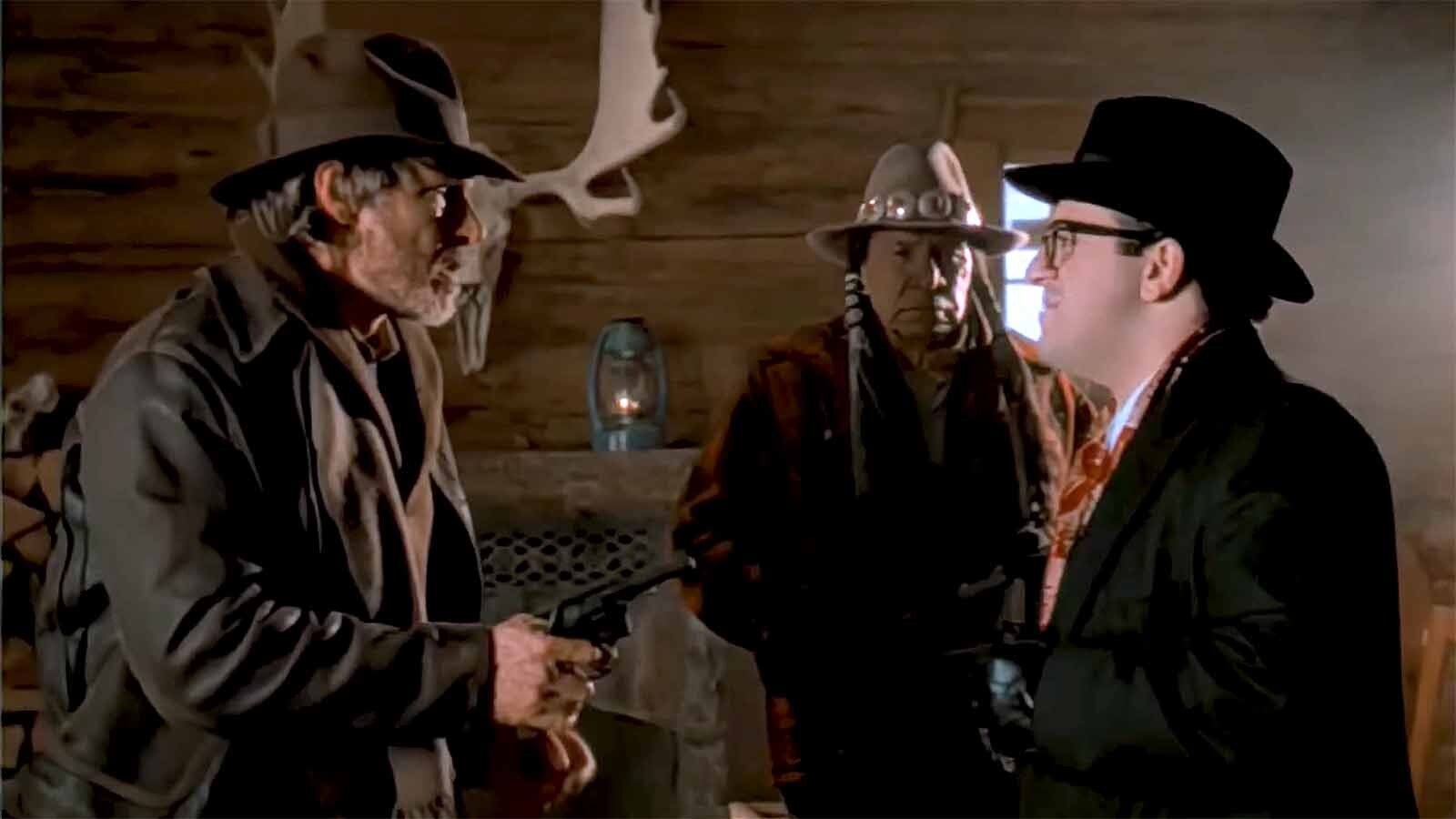
As the story and snowstorm come to a close, Indy and Greycloud are interrupted by the ne'er-do-wells they were running from at the beginning, who take the sacred peace pipe at gunpoint.
“The pipe, please, gentlemen, and you can go back to your weenie roast,” their leader says.
Indy lands a few punches and even disarms the cackling leader, attempting to shoot him with his own pistol. Unfortunately, the top thug “doesn’t like loaded weapons,” and all Indy gets for his heroic effort to shoot an unloaded gun is a backhanded slap.
Indy doesn’t need firearms or his iconic whip to stop the villains. Instead, he blows a low note on his soprano saxophone, triggering a small avalanche of snow that crushes the thugs.
With the peace pipe recovered, Indy and Greycloud leave the cabin to a few bars of "The Raiders March,” the iconic Indiana Jones theme composed by John Williams. Incidentally, this is also the only episode of the series to use any of Williams’s music.
“Things can’t always be the way you want them to be,” Indy says. “But sometimes, they are.”
Relic Of The Past
For a series with plots all over the globe, Wyoming is actually one of the adventures that hit closest to home for Indiana Jones.
The flashback that opens “Indiana Jones and the Last Crusade,” which briefly shows Indy’s childhood home, is set in Moab, Utah. The actual home featured in the film is in Antonito, Colorado, which is open to overnight guests as the Indiana Jones Bed and Breakfast.
The episode also fits into the expansive continuity of the Indiana Jones franchise.
Lucas was always mindful of maintaining a steady continuity for his creative projects. Ford’s bookending segments fall neatly into the character's timeline from the end of “Indiana Jones and the Last Crusade” to the elderly version depicted in the series and all subsequent appearances.
“We didn’t know what happened between the time we saw the young and old Indiana Jones in the series,” Madsen said. “This episode connected the movies with the series and gave fans some clarity on what happened to the character, and it still holds up.”
Foundation For The Future
In its own way, “Indiana Jones and the Mystery of the Blues” gave Indiana Jones a future on the silver screen. Madsen said the two-day Wyoming shoot gave Lucas and Ford a chance to catch up, reminding them how much they enjoyed the franchise and working together.
“I think there’s some truth to saying we wouldn’t have gotten the future Indiana Jones movies without this episode,” he said. “Harrison and George had some time to sit and talk about what they wanted to do during this shoot.”
Harrison Ford would return as Indiana Jones in 2008’s “Indiana Jones and the Kingdom of the Crystal Skull” and 2023’s “Indiana Jones and the Dial of Destiny.” Lucas got a story credit for the former but wasn’t involved with the latter, which was produced after he sold Lucasfilm to The Walt Disney Company.
As the ultimate authority on “The Young Indiana Jones Chronicles,” Madsen considers “Indiana Jones and the Mystery of the Blues” one of the best episodes of “The Young Indiana Jones Chronicles.” It has everything one would want from an Indiana Jones adventure, including the genuine article.
“If you were to pick the five best episodes, that one would certainly be added to the list,” he said. “It has a lot of action and adventure, and it’s a good episode outside of the Harrison Ford cameo. There’s no question. It’s one of the best.”
Andrew Rossi can be reached at arossi@cowboystatedaily.com.