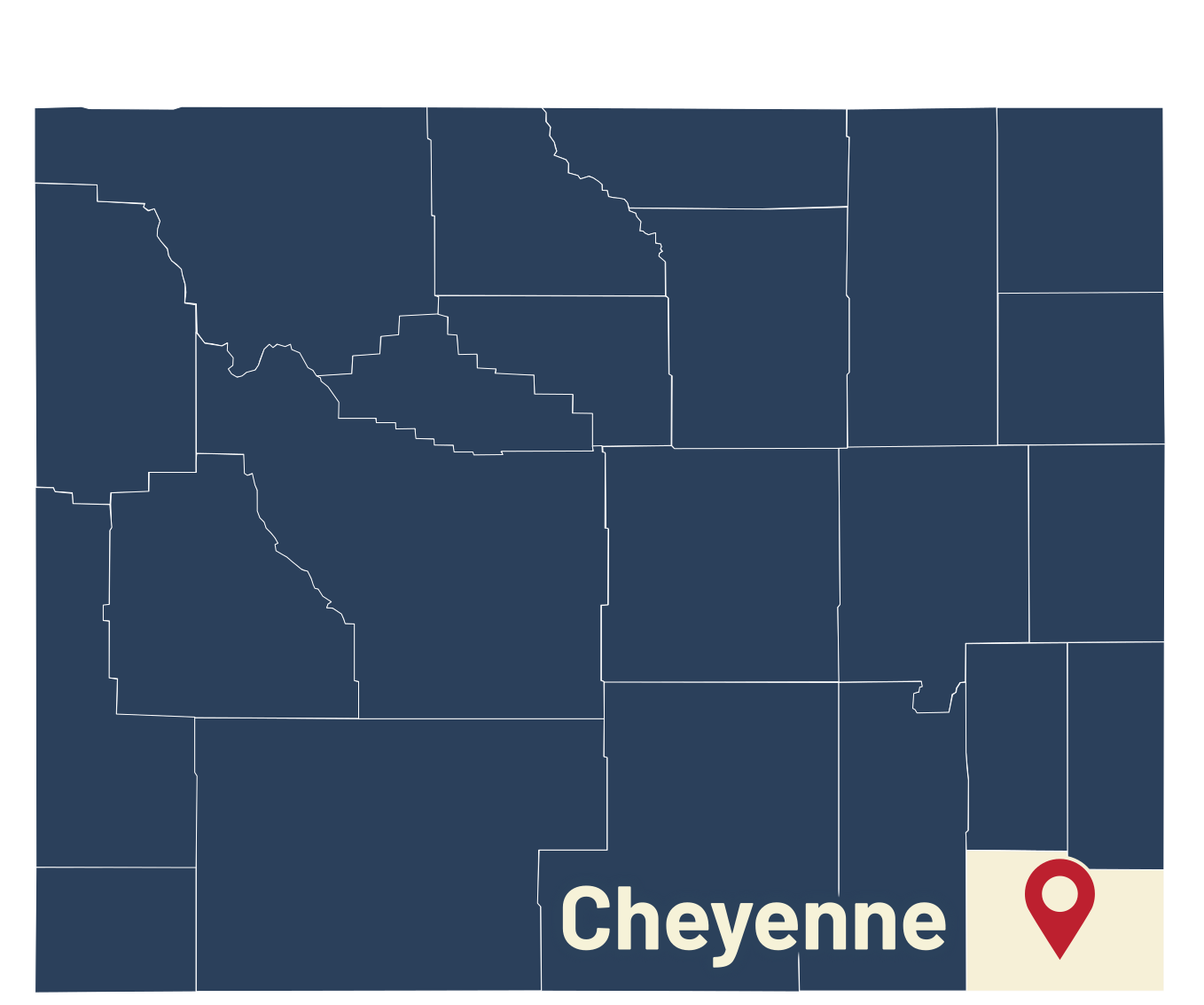

CHEYENNE — Members of the hard-right Wyoming Freedom Caucus exhibited their cohesiveness this week, and Gov. Mark Gordon’s budget reflects the cuts and potential damage.
None of this should be a surprise. The Freedom Caucus controls the Joint Appropriations Committee.
Its leader, Rep. John Bear, R-Gillette, had announced ahead of time their agenda and intent to restore state spending to the pre-COVID pandemic period.
Some of the bigger hits were to the University of Wyoming and the state’s public television operation, the Wyoming Department of Health and the Wyoming Business Council.
The latter took the killer vote.
The Appropriations Committee voted to de-fund all of the Council’s state money. They also were planning to introduce a bill to repeal the statute that set it up .
The Wyoming Business Council, however, has been de-funded before, but survived.
That action came early in its history in the late 1990s when it was revealed that its newly-hired director lived in Colorado.
So the council was shaky from the beginning.
The Council leaders hired another director who lived in Wyoming, but a wariness hovered over the hybrid private-public program.
Opponents questioned whether its operation was even constitutional, given that it provides businesses with taxpayer grant money.
They also claimed the agency displayed government favoritism in allocating grants.
Created in 1998 as the state's economic development agency, the Council’s role was to promote job creation, business expansion, and sustainable growth amid the state's resource-dependent economy.
Operating under a 13-member board of directors, the Council partners with private businesses, local governments, and state agencies to deliver grants, technical assistance, and strategic initiatives aimed at diversifying Wyoming's economy beyond traditional energy sectors like coal and oil, according to online sources.
At any rate, it is too early to mourn the fate of the Council and the other agencies that lost out.
The Appropriations Committee’s budget, as opposed to the governor’s budget, will be the one introduced in the House. (Unlike other bills, the the budget doesn’t need a two-thirds majority vote to be heard.)
Since the Freedom Caucus has majority leadership in the House, it is likely to pass most, if not all, of the committee’s version.
The likeliest scenario is that the big tussle to restore some of the cuts will come in the Senate.
The upper chamber, as it has been called, is a mixed bag. Democrats hold only two seats out of a total of 61, along with a number of traditional Republicans who are not MAGA or Freedom Caucus members.
Meanwhile, while the other programs were getting whacked, the small towns in Wyoming did pretty well.
The Appropriations Committee approved the governor’s bill for the Direct Distribution programs. This is a pot of state sales and use tax money that is distributed to cities and towns according to population.
Because of the Madden amendment, named after former state Sen. Mike Madden of Buffalo - a retired economics professor - the smaller communities get a bigger cut. This is because, proportionately, the small towns need the money more than the larger cities. So, their cut can represent 20 to 30 percent of their total revenues, to provide necessary services.
The locals wanted a bigger cut of the taxes - 8 percent instead of the 5.6 percent the governor recommended.
After the committee heard the mayors of Tensleep,
Shoshoni and Sheridan tell why they needed more money, Bear reminded the members of the their role and the agenda.
“We represent the taxpayers, not Sheridan,” he said.
The committee then voted down the proposed increase, and also rejected an attempt to remove the restriction that now prevents the locals from using it for employee benefits and salaries.
The plea of the small town mayors was for them to be able to use the direct distribution money to keep the small staffs they have. They cannot do that now under current law.
Contact Joan Barron at 307-632-2534 or jmbarron@bresnan.net