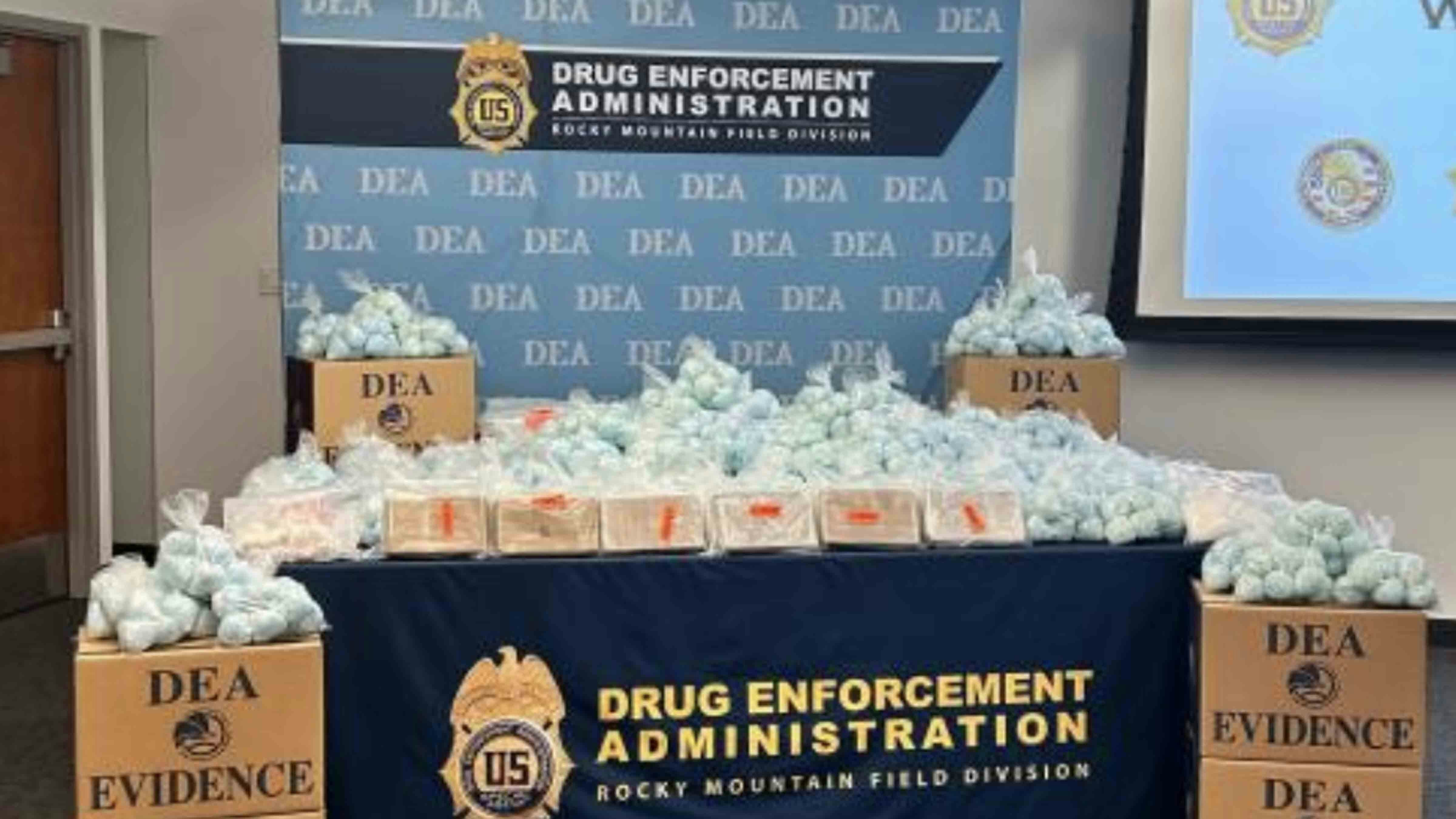
The Rocky Mountain West remains in the grip of fentanyl and methamphetamine addiction, with the U.S. Drug Enforcement Administration reporting record drug seizures throughout the region in 2025, Wyoming included.
Last year, the DEA seized 8,729,000 fentanyl pills and nearly 3,100 pounds of methamphetamine across the four-state mountain region that includes Colorado, Utah, Montana and Wyoming, with fentanyl seizures in Wyoming up by 264% in 2025, according to DEA figures.
Statewide law enforcement continues to grapple with drugs infiltrating Wyoming communities as traces of carfentanil, an extremely potent synthetic opioid used to tranquilize large animals, was discovered in small doses last year.
Though numbers between state and federal law enforcement fluctuate slightly, drug arrests in general continue to be on the rise, though overdoses fell slightly over the past calendar year.
With record fentanyl seizures in Colorado in particular, the DEA shattered its own records in 2025 as the drug epidemic shows no signs of slowing.
Distribution Channels
Cesar Avila, DEA assistant special agent in charge who oversees Wyoming and Montana, said the bulk of the drugs are coming across the southern border and being distributed to cartel networks in larger hub cities like Denver and Salt Lake City who then funnel it north into Wyoming’s small communities.
He started his roughly 24-year career with the agency in Phoenix and Houston with stints in Washington, D.C. and Dallas and currently lives in Billings, Montana.
Though his early years in the southern states involved much higher quantities of drugs and much more sophisticated criminal networks, Wyoming and Montana do see their share of drugs though the schemes aren’t as sophisticated because the states are “at the end of the rope.”
Here, it’s more about meeting demands of the end users and less about profit.
“When you’re dealing with the user population, they are more in it for effects and not for the profit margins,” he said. “They’re not necessarily doing it for the business side of things; they’re doing it more because they need that particular addiction.”
The drugs are being funneled north by two primary cartels functioning in Wyoming communities – the Sinaloa and Jalisco New Generation (CJNG) cartels – which Avila speculated have a presence in most if not all Wyoming communities.
The further north the drug gets, Avila said, the wider the profit margins that pretty much follows population centers along the state’s main interstate corridors.
“It goes back to where the people are, right?” Avila said, noting that the majority of DEA seizures occur in Cheyenne.
Drugs, too, vary depending on the sociological makeup of the community with more cocaine seizures found in affluent Jackson.
The mode of transport also changes as drugs head north into smaller communities. South of the border, big tractor trailers typically haul the drugs to the larger hubs with drugs either ferried by individual drivers or through the mail into Wyoming, Avila said.
The postal system becomes a more viable method for shipping drugs into Wyoming, Avila noted, particularly in the winter.
“It’s all about profit margins,” he said. “So driving from Arizona or California all the way up to states like Wyoming, is going to cut into their profit margins…it’s much cheaper to put it in the mail and risk losing the package then it is to drive a vehicle.”
As federal authorities work with the US Postal system and other entities to tamp down on these shipments, criminals find new schemes such as getting packages shipped to themselves at short-term Airbnb rentals.
“By the time we catch on to it, they’ve moved to the next one,” he said. “So, it’s a lot easier to be mobile and stay anonymous for sure as you’re doing stuff through the mail.”
Drug users are also increasingly turning to the internet to buy drugs from overseas websites that appear like professional companies which are actually peddling illicit drugs.
Numbers vary slightly
Numbers wise, federal seizures of fentanyl are up considerably while meth is slightly down over the past year in Wyoming.
In 2025, the DEA seized 5,000 fentanyl pills last year compared to 1,375 in 2024. Methamphetamine was down slightly last year from 53 pounds in 2024 to 40 pounds in 2025.
State seizures, however, fluctuate with DEA figures though overall drug arrests in general went up slightly, according to figures from the Wyoming Division of Criminal Investigation, which has its own drug enforcement agents.
In 2025, DCI reported 357 drug arrests compared to 343 in 2024.
Of those, the agency saw an increase in meth arrests from 170 in 2024 to 217 last year. Unlike DEA figures, however, DCI’s fentanyl-related busts fell significantly from 114 down to 62 last year.
Overall, these are the two drugs significantly impacting Wyoming communities, according to Ryan Cox, DCI commander of Wyoming Information Analysis and Cold Case teams.
“Methamphetamine and fentanyl still remain our highest concerns to public safety,” Cox told Cowboy State Daily in a Thursday email.
Avila agreed that meth in particular remains the drug of choice in Wyoming.
“Methamphetamines have always been a big problem for states, certainly in Wyoming,” he said.
Other drugs making a comeback
And along with these two drugs, heroin also made a comeback over the past year accounting for 38 items in 2024 up to 55 last year.
Like heroin, cocaine is also becoming more available in the state and is accounting for more seizures and overdoses than heroin.
More serious drugs, likewise, are also trickling in over state lines.
And though it’s not yet been seen in large numbers, Avila said that the DEA is seeing more carfentanil turn up in supply chains, particularly in Denver and Salt Lake City.
“If we’re seeing the increases there, chances are it’s coming into our destinations like our towns in Wyoming,” he said.
Last year, only two samples seized by DCI tested positive for carfentanil, according to Cox.
Though that may seemingly be good news, other dangerous drugs are showing up in Wyoming communities, like other illicit, very potent opiods, said Casey Patterson, drug intelligence officer with the Wyoming DCI Rocky Mountain HIDTA.
These include synthetic opioids like nitazenes and xylazine, an animal tranquilizer. Another potent synthetic sedative and pain pill used to treat dogs and cats, medetomidine, has been found in Wyoming and is 200 times more potent than xylazine, Patterson said.
Overdoses Down
Despite the lethality of many of these drugs entering the market, overdoses in Wyoming are on the decline, though opioids, including fentanyl, accounted for 61% of overdose deaths between 2020 and 2024, according to the Wyoming Department of Health’s website.
The WDH did not respond to requests for 2025 figures.
Still, overdose numbers are declining. In 2024, 112 people died from drug overdoses, which was down from 133 deaths in 2023.
Likewise, emergency medical service calls involving overdoses fell by 20% in 2025 from the prior year.
Overdose figures from the Center for Disease Control and Prevention (CDC) likewise support this decline, documenting a 30% decrease in fatal drug overdose deaths among Wyoming residents between August 2024 and 2025.
Temporary Lull
The decline in overdose deaths might be stemming from supply chain issues that led to a reduced lethality in fentanyl pills pouring over the border.
Though fentanyl continues to enter the state in record numbers, Avila said the fentanyl pills tested by the DEA appear to be becoming less potent.
Where in the past, seven out of 10 pills tested positive for lethal doses of fentanyl, which is on average 2 milligrams of fentanyl powder or the size of the lead in a pencil, now it's more like five out of 10 that test lethal, Avila said.
He attributes this to the Trump Administration putting increased pressure on China to stop providing the chemicals as well as pressure on Mexico.
Patterson cautions that this might be a temporary lull stemming from supply chain shortages as these precursors become more restricted and less readily available.
But perhaps this is just a temporary lull, he said.
He noted that illicit drug manufacturing is big business for cartels hellbent on turning a profit, and he worries about the next evolution and what potentially new deadly substances might be introduced in leiu of standard precursors.
“That can mean further adulterating already dangerous illicit drugs or by diluting them by mixing in chemicals such as BTMPS (Tinuvin 770), which is a UV light stabilizer used in plastics manufacturing,” he said.
The dangers are clear when it comes to taking pills that don't come from a pharmacy, he said, noting the many instances in which Wyomingites have taken a pill from a friend only to find it a counterfeit opioid laced with fentanyl.
Apart From The Numbers
But do the numbers tell the actual story about the reality of drugs in Wyoming communities.
Allen Thompson cautions over putting too much stock in arrest figures for several reasons. For starters, both state and federal cases might take years to build and not accurately reflect that year’s numbers and arrests could also be reflective of short-staffed agencies that are hamstrung by a lack of manpower.
Thompson is executive director of the Wyoming Association of Sheriffs and Chiefs of Police (WASCOP), which among other duties collects and analyzes substance abuse data from police and sheriff's office across the state which is released in two separate annual reports.
And though the numbers fluctuate yearly, methamphetamine-related arrests continue to increase every year. This number has grown substantially over the past decade with 420 documented meth-involved arrests in 2011 compared to 1,100 in 2024.
The four counties with the highest number of arrests involving meth in 2024 include Natrona at 366, followed by Laramie at 158, Campbell at 126 and Fremont with 99.
The report does not specifically delineate fentanyl arrests but rather groups it in under drug-involved offenses, which over the past five years has been double those of meth. In 2024, state law enforcement agencies documented 2,394 drug involved arrests compared to 1,100 crimes involving meth.
Alcohol Real Threat
Apart from illicit narcotics, the real threat to public safety in the Cowboy State is alcohol when it comes to arrest numbers which historically have been much higher.
In their most recent 2024 report released in May 2025, alcohol by far accounts for the largest number of crimes at just under 53%. Though this number has decreased significantly over the past two decades, according to the report, alcohol is still a major contributor of arrests.
In 2024, there were 5,511 arrests involving alcohol that accounted for 53% of the state’s annual crimes with the bulk involving driving under the influence arrests. This is compared to 10.5% meth and just under 23% drug-involved arrests in the same year.
Of those 53% arrests in which alcohol played a factor, 80% occurred in Teton County.
Despite the relatively high number of alcohol-fueled arrests, the number has actually decreased over the past decade from a high of 64% in 2014, which bottomed out at 41% in 2018 before once again steadily rising.
Drug-impaired driving, however, continues to rise over the past six years from 12% in 2019 compared to just over 19% in 2024.
Many residents throughout the state consider driving under the influence a considerable problem with 85% of Wyomingites saying that drinking and driving a serious or somewhat serious problem in their communities, according to the report.
Targeting Youth
As long as there is demand, illicit substances will continue trickling into Wyoming communities which Avila said should be addressed early on with youth.
He pointed both parents, educators and other community leaders to the DEA’s “Fentanyl Free America” program for free resources aimed at raising awareness and educating young people on the dangers of drugs.
Patterson agreed that a big part of the solution rests with parents and caregivers being aware of where and how teens can access drugs.
“Parents should be aware that drugs are being bought and sold on social media platforms such as Snapchat, and emojis are being used almost like hieroglyphics,” he said.
Along with the “Fentanyl Free America” program, he also pointed parents to the DEA’s “One Pill Can Kill” initiative as well as WASCOP’s comprehensive website, WYwetalk.org, for more information and resources.
Jen Kocher can be reached at jen@cowboystatedaily.com.