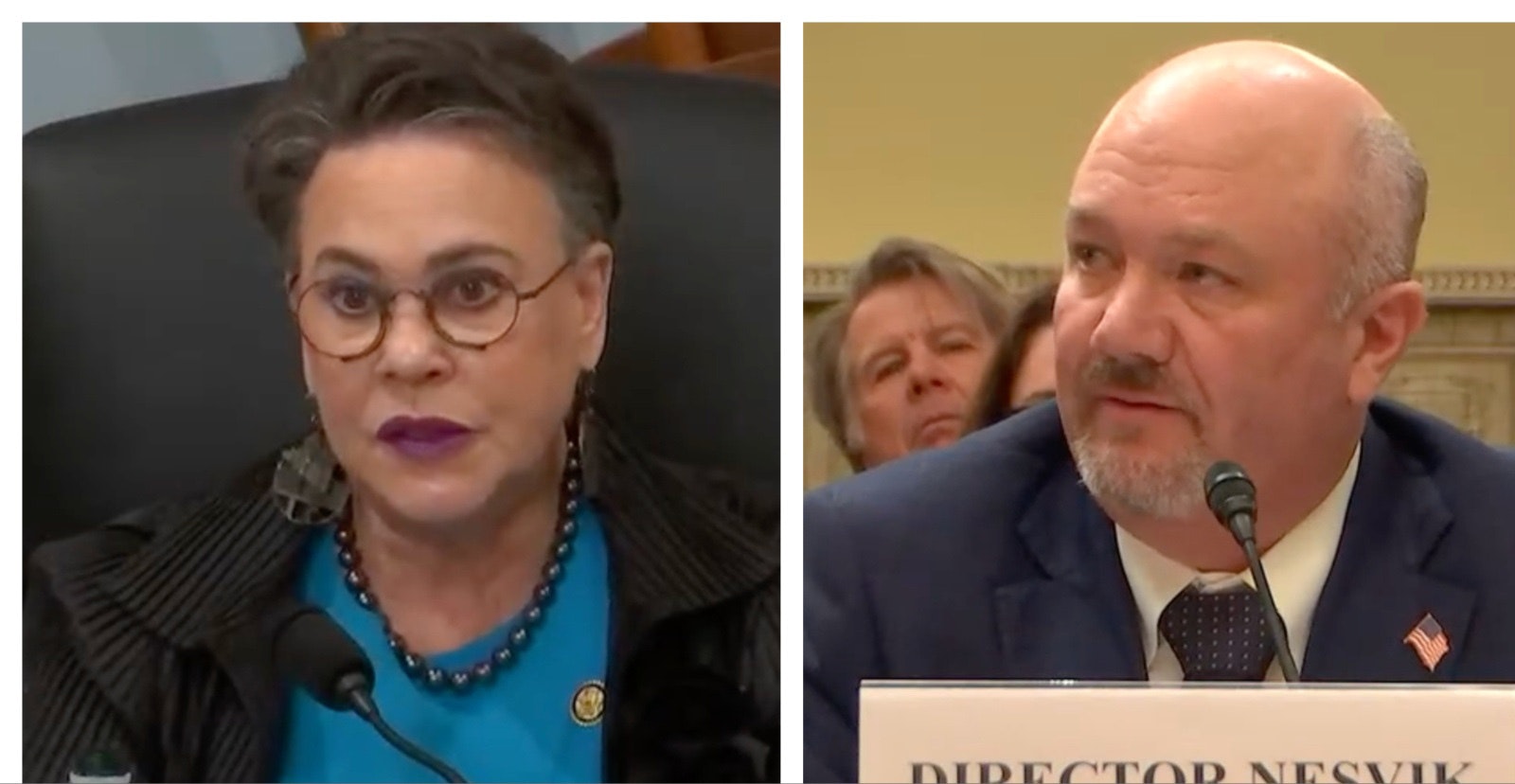
As U.S. Fish and Wildlife Director Brian Nesvik moves to open more federal land to hunting and fishing, grizzlies should be delisted, because they keep mauling hunters, Wyoming Congresswoman Harriet Hageman said.
“Well, you and I both have read too many articles of individuals who have been injured by grizzly bears in Wyoming and surrounding states,” Hageman told Nesvik during a hearing Wednesday before the U.S. House Subcommittee on Water, Wildlife and Fisheries, which Hageman chairs.
Nesvik appeared before the subcommittee to speak about his goal over the next two years to open new hunting and fishing access on 16 federal wildlife refuges, in areas totaling roughly 87,000 acres.
He didn’t specify which, if any, of those locations are in Wyoming.
Hunting and angling are already allowed on some U.S. Fish and Wildlife Service (FWS) lands in Wyoming.
Long-Time Advocates Of Delisting
Nesvik is the former director of the Wyoming Game and Fish Department. During his tenure in that position, he openly advocated for delisting grizzly bears from federal protection in Wyoming and putting them under the direct management of Game and Fish.
His successor, Game and Fish Director Angi Bruce has also spoken openly in favor of delisting grizzlies.
Speaking recently to Cowboy State Daily in his role as FWS director, Nesvik said he hopes a final decision on grizzly delisting can be reached within two years.
He gave no indication during the hearing that the timeline has changed.
Hageman likewise has been vocal about her support for delisting grizzlies, a message she repeated during Wednesday’s hearing.
“This is something that I have been raising since the moment that I arrived in Congress over three years ago,” she said.
Nesvik responded to Hageman by saying he thinks that, after roughly 50 years of federal endangered species protection in the Lower 48, the grizzly population is recovered.
“And so I do believe recovery is clear. And now it's my job, in this role, to consider how we use the best available science to move forward with future policy around the grizzly bear, not only in the Greater Yellowstone Ecosystem, but also in the Lower 48,” he said.
Hunters Worried About Being Mauled
Some Wyoming hunters recently told Cowboy State Daily that the possibility of grizzly attacks is a serious concern for them.
Celia Easton of Thermopolis said she suffered symptoms of posttraumatic stress disorder (PTSD), after a grizzly charged her and pulled her boot off her foot on Oct. 15, while she was elk hunting alone in the Beartooth Mountains.
During the hearing, Hageman said grizzlies have fully occupied prime wildland territory in the core of the Yellowstone ecosystem, and are pushing out into areas where more conflict with humans is inevitable.
“So at one time, the Fish and Wildlife Service described the Greater Yellowstone Ecosystem area as being saturated with grizzly bears, and there simply wasn't room for additional bears,” she said.
Wandering Bears Cause Conflicts?
Nesvik agreed that grizzlies have been dispersing beyond suitable habitat.
“When grizzly bears find themselves in habitats – I've experienced this personally – where they're in and amongst cornfields, or in developed areas where there are a lot of people (neither) grizzly bears, nor people do very well. It's not good for the grizzly bear and it's not good for people,” he said.
Hageman said that’s led to more hunters getting mauled, and Nesvik, again, agreed.
“Well, in an overabundance of grizzly bears in those areas that are not suitable habitat, it actually places our hunters, our fishermen and women and our recreators at risk of great bodily injury and even death, doesn't it?” Hageman asked Nesvik.
“Yes, madam chairwoman, unfortunately, there have been many cases of all of the above,” Nesvik said.
Grizzlies were placed under federal protection in 1975, after they had disappeared from nearly all of their historical range in the Lower 48.
Wyoming grizzlies are part of the Greater Yellowstone Ecosystem population, which includes parts of Idaho and Montana, and is estimated at roughly 1,000 bears.
There is also the Northern Continental Divide Ecosystem grizzly population, about 1,000 bears, centered in Glacier National Park in Montana.
If and when grizzlies are delisted, Game and Fish will likely open a hunting season for them.
Grizzly advocates have argued that the bears shouldn’t be considered fully recovered until there is contiguous occupied habitat and significant intermingling and breeding between those two populations.
Mark Heinz can be reached at mark@cowboystatedaily.com.