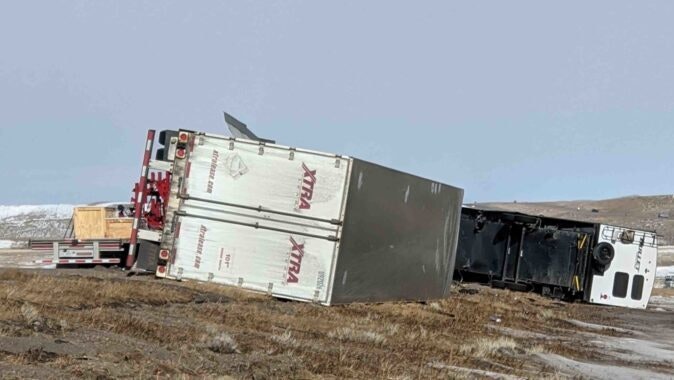
The winds are going to blow Eastern Wyoming down on Friday. A massive Canadian cold front, bringing gusts up to 75 mph and single-digit wind chills, is going to clip the eastern half of the state as it moves more severe winter weather to the east.
Black Hills Energy declared an Emergency Public Safety Power Shutoff Watch for the Harriman and Curt Gowdy areas, west of Cheyenne, from 9 a.m. Thursday through Friday because of “high fire-risk conditions in Friday’s forecast.”
“It’s very analogous to what they're doing in California,” said Cowboy State Daily meteorologist Don Day. “When 60 to 70 mph winds come, there’s a risk of power lines getting knocked down. And since there’s no extensive snow cover, that could start wildfires.”
The subsequent cold front will be like “another slap in the face of winter,” according to Day, but the strong winds and cold temperatures won’t be carrying much, if any, snow. It’ll be all the fun of Wyoming’s winter winds without any of the much-needed moisture.
“There might be a little precipitation in places, but the overall takeaway from the forecast is the cold and the wind,” he said. “It’s going to be miserable.”
Batten Down The Hatches
The cold front will reach eastern Wyoming by Thursday evening. Shelby Fuller, a meteorologist with the National Weather Service (NWS) office in Cheyenne, said hurricane-force winds are expected to blow across Wyoming, Nebraska, and South Dakota.
“We’re expecting pretty strong winds, with gusts from anywhere of like 60 to 75 mph, from the northwest,” she said. “That’s pretty strong, especially from that direction, but it’s a pretty strong cold front.”
Fuller said the driving forces behind the windstorm are the strong Canadian cold front and a strong jet stream aloft. While the winds are blowing, daytime high temperatures will drop over nearly 30 degrees between Thursday and Friday and go even lower overnight.
“We're looking at temperatures to fall below average for this time of year,” she said. “We're looking at temperatures in the upper 20s and low 30s for highs on Friday, with wind chills anywhere from the teens to single digits. That’ll make a difference in how cold it feels.”
Unlike western Wyoming, where some are windier than others, eastern Wyoming is wide and flat enough that there aren’t many especially wind-prone areas. That means 70-mph gusts are possible across the expanse.
One would think an influx of Arctic air would bring an influx of much-needed snow. Unfortunately, this storm won’t be the salvation many are seeking for the parched landscape.
“The Arctic air is pushing in with a ton of wind and very little precipitation,” Day said. “There'll be some snow in the Black Hills, but that’s about it. It’s just a gross winter weather pattern.”
Wall Across The West
While eastern Wyoming gets blown over, western Wyoming will be relatively warm and placid. Day said a high-pressure system has settled over the western half of the state, shielding it from Friday’s Arctic air blast.
“It’s going to get colder and a bit windy, and there might be some snow showers, but essentially, the western side of the state doesn't have anything significant through next week, while the eastern side gets this glancing blow,” he said.
That’s been the pattern of what Day called “a remarkable winter” up to this point. Wyoming has simultaneously experienced record-breaking high temperatures and excellent snowpack in the western mountains during an unusually warm November and December.
Meanwhile, the rest of the Northern Hemisphere has been smothered with snow and subzero temperatures. The winter that Wyoming meteorologists anticipated has frozen the front line of Russia’s invasion of Ukraine.
“There's going to be another massive cold outbreak in Russia, Ukraine, and a lot of Europe for the next two or three weeks,” Day said. “You’re going to hear about the ‘Arctic Express’ in the nation's midsection again at the same time. There's not a lack of winter in the world, except here.”
The snowpack in western Wyoming is still solid, between 95% and 133% of seasonal averages, but eastern Wyoming is struggling severely. The northeast corner of the Cowboy State has only 5% of its seasonal snow water equivalent.
Meanwhile, Colorado is experiencing its lowest snowpack to date, on record. The highest snowpack in the Centennial State is only at 77%, and there’s no relief coming in the near future.
“The upper North Platte Basin in southern Wyoming and northern Colorado was around 85% a week ago, but now it's down into the 70s,” Day said. “That particular drainage is just as important as the Green River, Wind River, Shoshone, Yellowstone, and Snake River basins. That’s the biggest concern I have right now, and a lot of people are paying attention to that one.”
Plenty Of Time For “Winter’s Last Chance”
The “good news” for Wyoming residents and meteorologists is that there’s plenty of winter left. Cold, dry windstorms aren’t unusual for January, and despite the subpar snow amounts, nobody’s losing sweat yet.
“December and January are the two driest months of the year on the plains,” Day said. “February, March, April, May are what I call the money months. If you don't get that precipitation during the money months, you're screwed for the summer. Once we get into February, indications are that's the last hurrah, so to speak. Winter's last chance."
After reviewing historical data, Day found that the 2010-2011 winter season is analogous to what Wyoming has experienced up to this point. During that season, above-average temperatures and below-average precipitation in December gave way to a harsh winter by February.
“When you look at what the long-range modeling is showing for February, it should get cold,” he said. “But in the back of your mind, you are very suspicious because of the way this winter has gone. Full disclosure, those models were way off in December. They missed it. They just were wrong.”
Fuller didn’t seem overly concerned about the current state of affairs for Wyoming’s winter. Friday will be a temperate typhoon with no moisture, but the verdict’s still out for what’s left of the winter season.
“On average, January is a drier month for eastern Wyoming,” she said. “We see an increase in winds, which usually leads to a decrease in precipitation, so this isn't unusual. Precipitation usually picks up later in the wintertime, like February, March, and April, and it looks like it’s going to. There's still plenty of winter left.”
Andrew Rossi can be reached at arossi@cowboystatedaily.com.