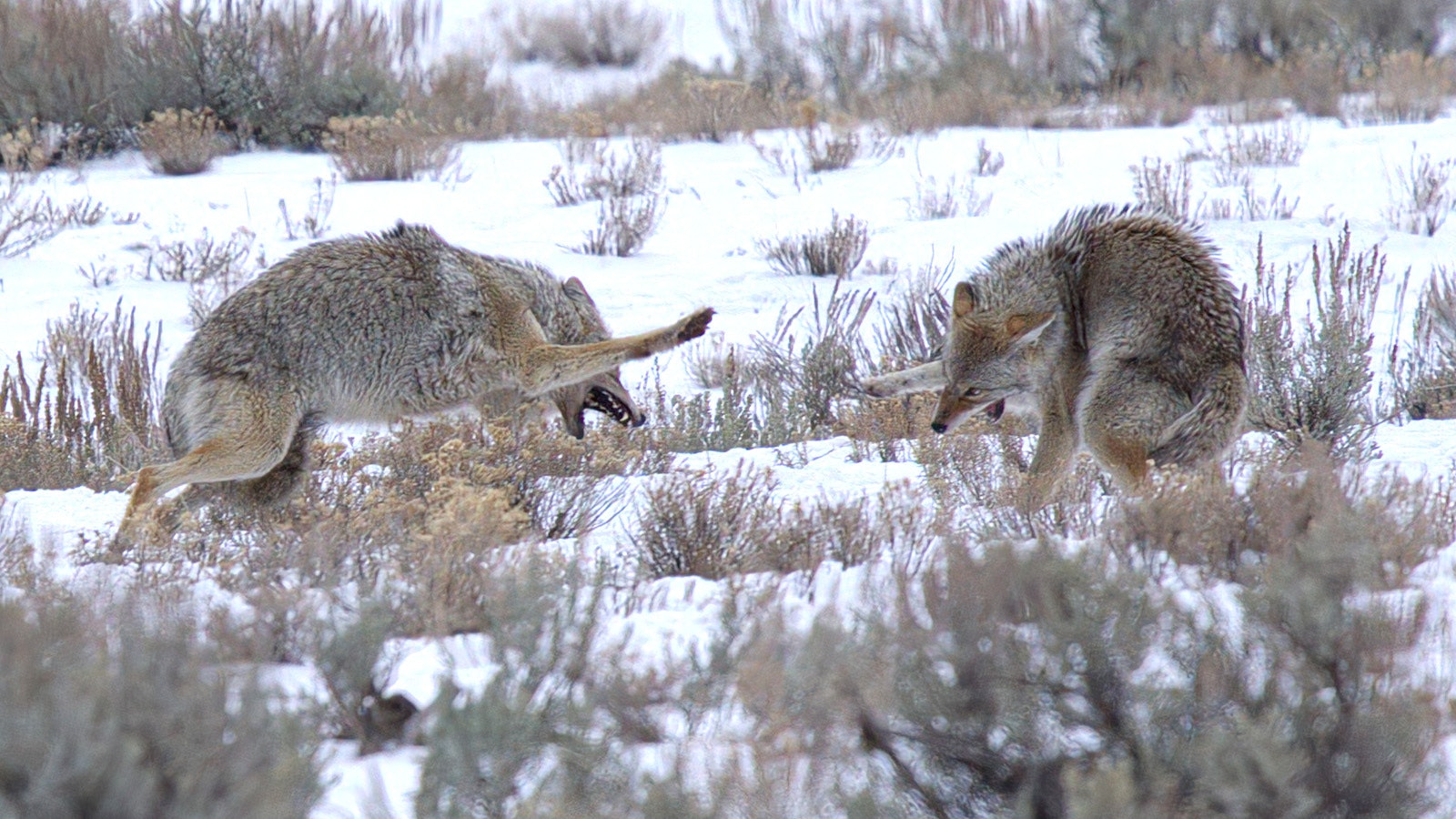
Two coyotes in standoff over a bison carcass in Yellowstone National Park arched their backs, raised their paws and bared their teeth so aggressively it might be easy to assume they were ready to rip each other apart.
It was all for show, biologists told Cowboy State Daily.
Coyotes might tussle with each other, but they don’t get into vicious, winner-take-all fights like wolves sometimes do.
Robert Crabtree, the founder, chief scientist and president of the Yellowstone Ecological Research Center, has studied coyotes extensively and has immense respect for them.
Coyotes are a “highly evolved” and “complex species,” and many of their behaviors remain a mystery, he said.
Who Gets First Dibs?
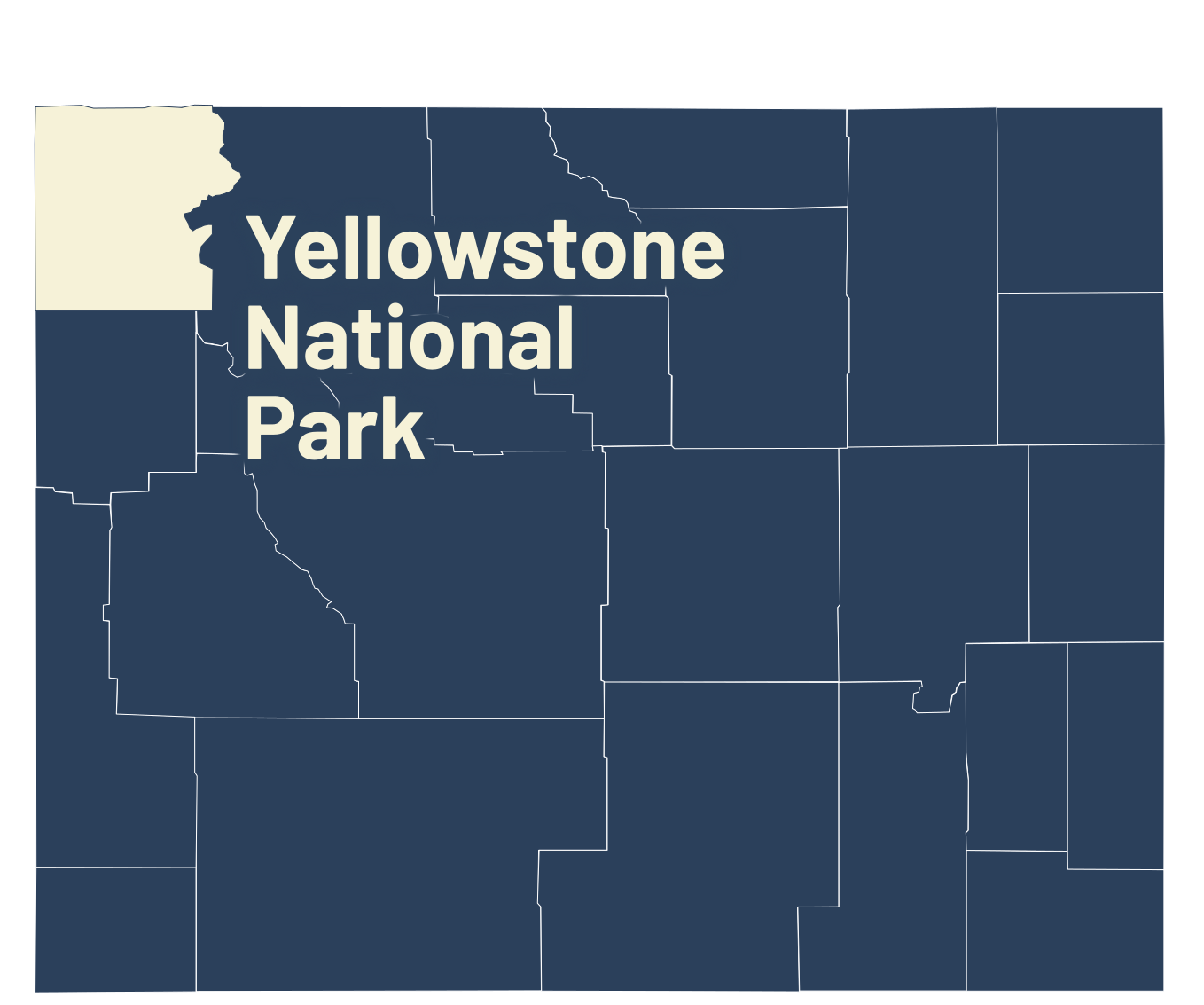
John Winnie Jr., an associate teaching professor in the Department of Ecology at Montana State University, was in Yellowstone the first weekend in January when he watched the coyote standoff unfold.
At one point, he got a photo of the coyotes facing each other and posturing with intimidating stances.
The coyote on the left in the photo was feasting on a bison carcass when the other coyote approached, apparently hoping to take its turn at the buffet, he said.
“The one on the right in the photo approached and started the display. The one that was on the carcass jumped off and started doing the same thing,” Winnie said.
Later, “it looked like they scuffled a little bit, but didn’t really get into it,” he said.
In the end, the coyote pictured on the left apparently re-established first dibs and went back to eating. The second coyote retreated, then returned to eat after the first one was finished.
Arched Backs, Grimacing
Winnie specializes in wolf and elk research, but said he’s also been fascinated by Yellowstone’s coyotes.
The incident with the bison carcass wasn’t the first time he’s seen them display such seemingly weird behavior.
“I see coyotes in Yellowstone do a lot of that arched-back behavior, with their tails tucked, and grimacing,” he said.
“I’ve always speculated that to be some sort of antagonistic response,” he said, adding that “sometimes, it also seems to be a bizarre form of greeting,” Winnie added.
If grimacing and showing teeth is a form of greeting with coyotes, that might be what gets them in trouble with wolves, he said.
“Showing your teeth to a dominant wolf, that’s exactly what you don’t want to say to a wolf,” he said.
Coyotes Fight Nicer Than Wolves
After seeing the photograph, Crabtree said the coyote on the left was probably the top dog.
“My guess is, that's an alpha male on the left — deep chest, and larger,” he said.
Coyotes display a range of interesting and sometimes baffling behavior, Crabtree said.
“There's a whole repertoire of different behaviors at and around carcasses,” he said. "I did a study on that with a grad student and it was so complicated and context-dependent.
"We just really couldn't figure out any regular patterns."
When wolves fight, they frequently maim and even kill each other.
Yellowstone’s most famous wolf, 907F, died on Christmas Day 2024 from wounds she suffered in a brawl with wolves from a rival pack a few days prior.
Coyotes have their disagreements, but typically aren’t out to seriously hurt or kill each other, Crabtree said.
“Coyotes fight all the time,” he said. "But it's all ritualistic to avoid fatal fighting. Coyotes don't kill each other like wolves do."
Mark Heinz can be reached at mark@cowboystatedaily.com.