
The man who wrote in short sentences came to love wide open West of Wyoming, a land with tall mountains teeming with wildlife.
The trout and cool breezes in the elevations lured him. Elk and bear walking its ridges stirred him. And during his Prohibition visits, the challenge of obtaining alcohol illegally never deterred him.
Once tasted and seen, he desired it.
This author of growing national reputation kept coming back to Wyoming. Then, he found Idaho and another wife.
For Ernest Hemingway, his life and the novels he authored often were two sides of the same coin. The West became a fascination and refuge, and for more than a decade Wyoming played an important role as a getaway and inspiration.
Retired West Virginia Bethany College professor and now Colorado resident Larry Grimes, an expert on the famous author who describes himself as “living with Hemingway for 60 years,” characterizes Wyoming and Hemingway’s experiences in the state and Montana as influential in his writing and important for his rest.
“He was living in Key West when he found Wyoming and Montana,” Grimes said. “I’m saying both states, because Hemingway, like the elk, the bear, and the mule deer he hunted, didn’t know anything about state lines.
What the journalist, short-story author, and novelist did know was that Florida got hot in the summer. So, when a friend he met as an ambulance driver in Italy during World War I invited him to go to Wyoming in the summer of 1928, the outdoor enthusiast took him up on it.
Grimes said Hemingway and buddy, Bill Horne, pointed their car toward Sheridan. The writer was trying to wrap up his novel, “A Farewell to Arms.”
Left behind was his second wife, Pauline, who had just had a difficult childbirth with her first child, and his second. She had the baby in Kansas City and then took the child to Arkansas with her family.
The 1928 visit involved three places, two where Hemingway tried to write but found it difficult.
Horne took Hemingway to the Upper Folly Ranch in the Bighorn Mountains where Chicago millionaires sent their daughters to spend the summer. Horne found his future wife there, Hemingway found too many distractions to finish his book, Grimes said.
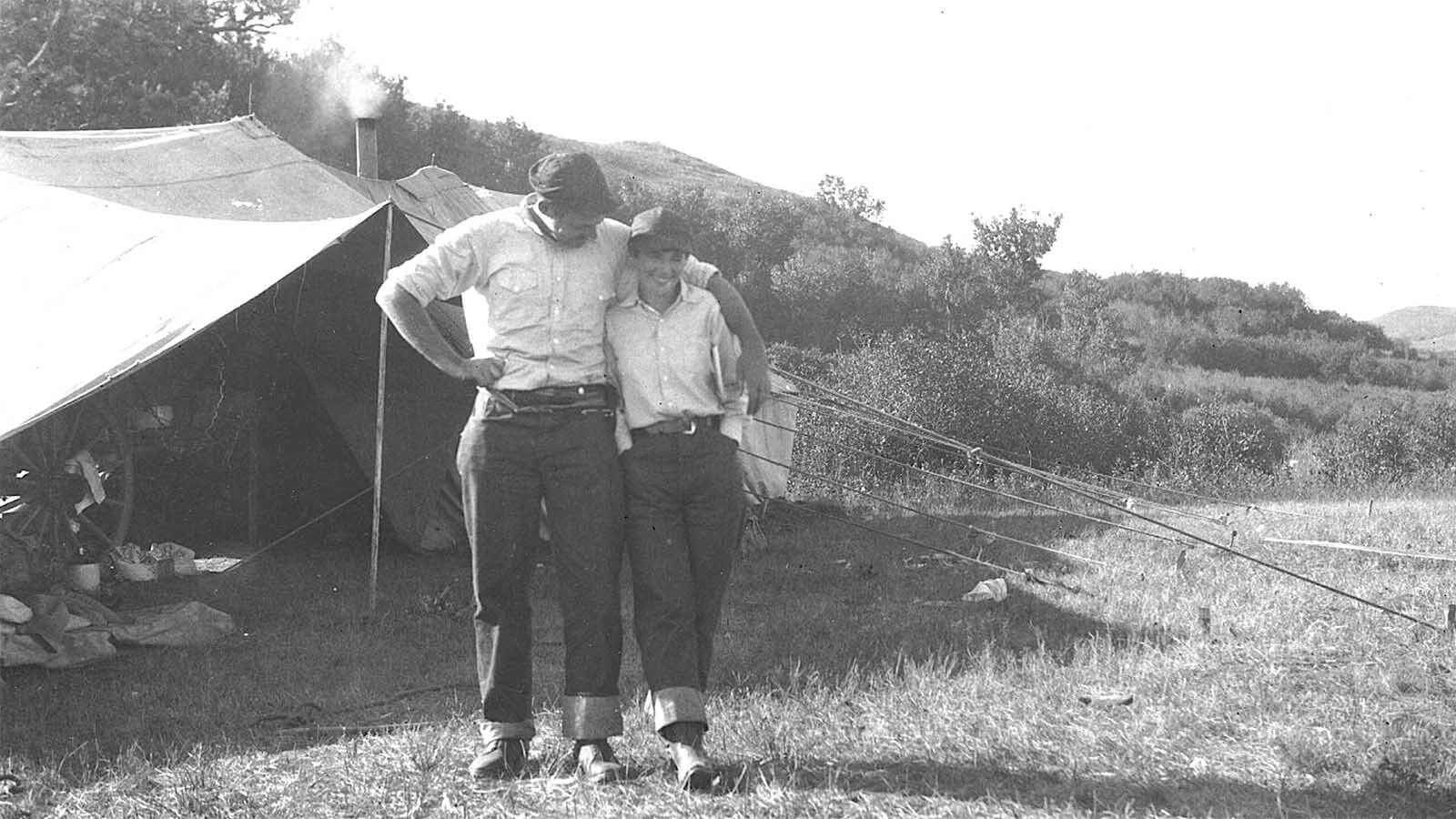
Ernest Hemingway and his wife, Pauline, camping during their 1928 trip in the West. (Courtesy Wyoming State Archives) 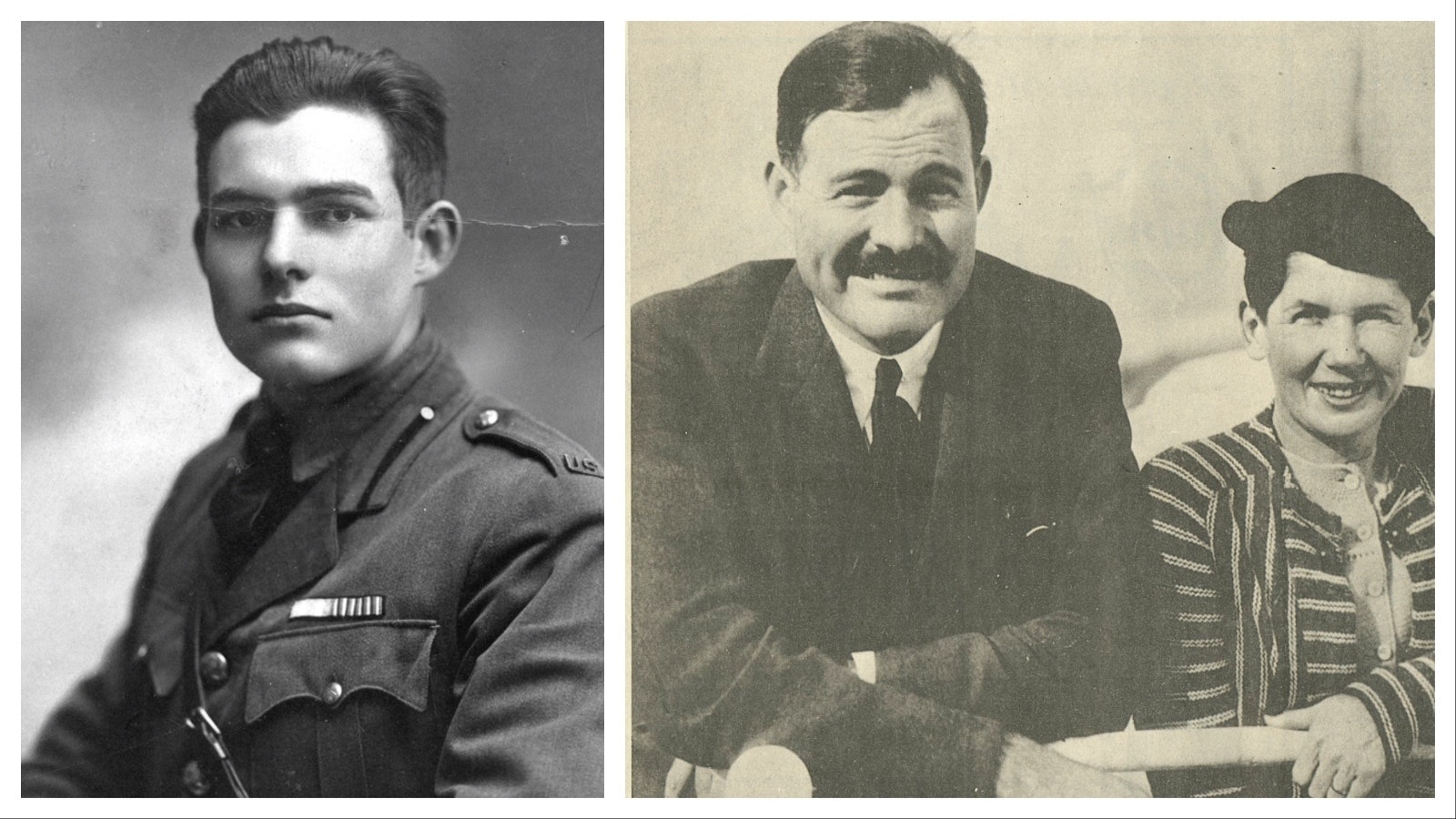
A young Ernest Hemingway, left, serving as an ambulance driver during World War I. Right, a newspaper clipping of Ernest Hemingway and Pauline. (Courtesy John F. Kennedy Presidential Library and Museum;) 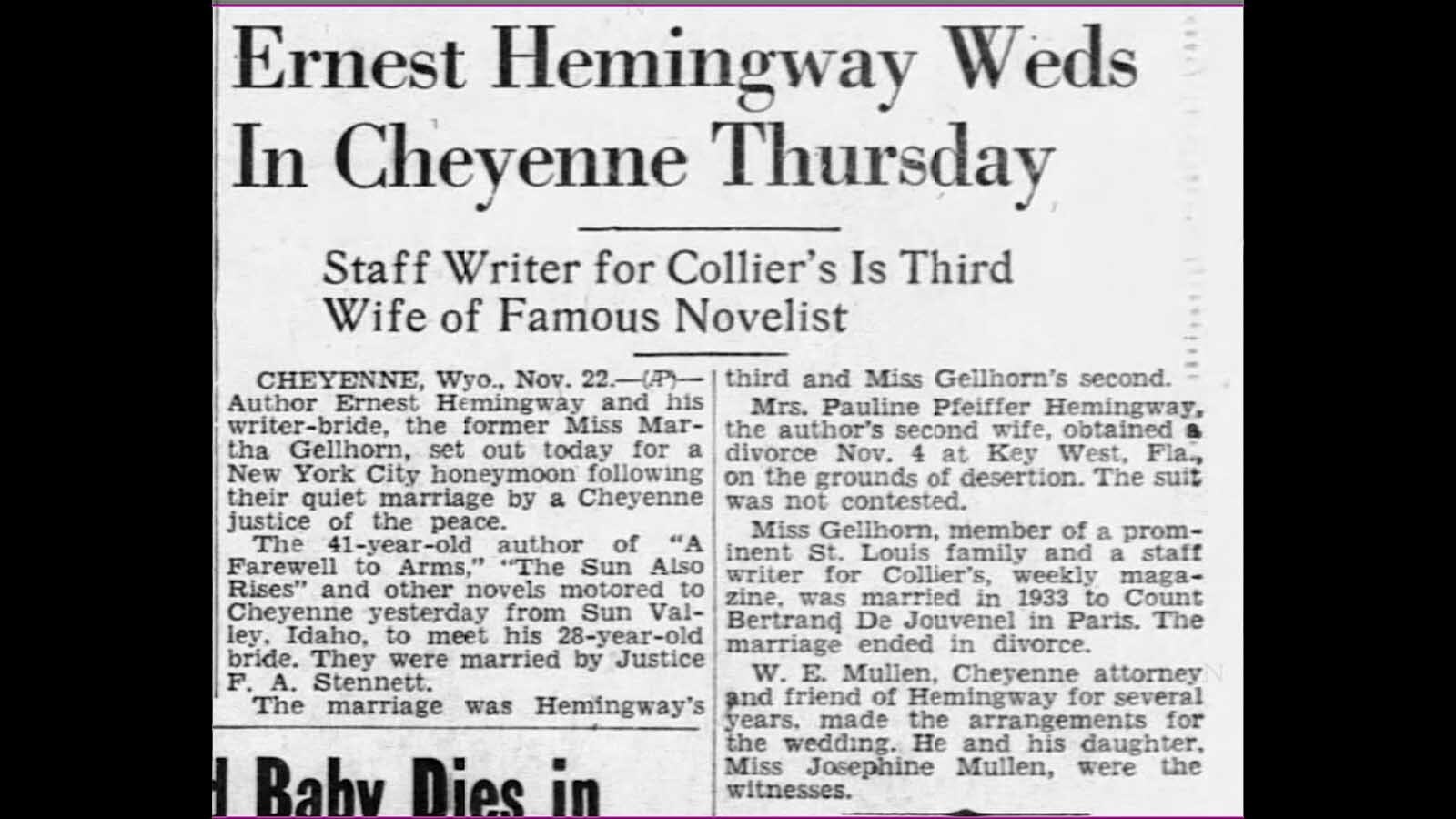
The Nov. 22, 1940, Casper Tribune-Herald carried a front-page story on Ernest Hemingway’s marriage to Martha Gellhorn in the Cheyenne Depot. (Courtesy Newspapers.com) 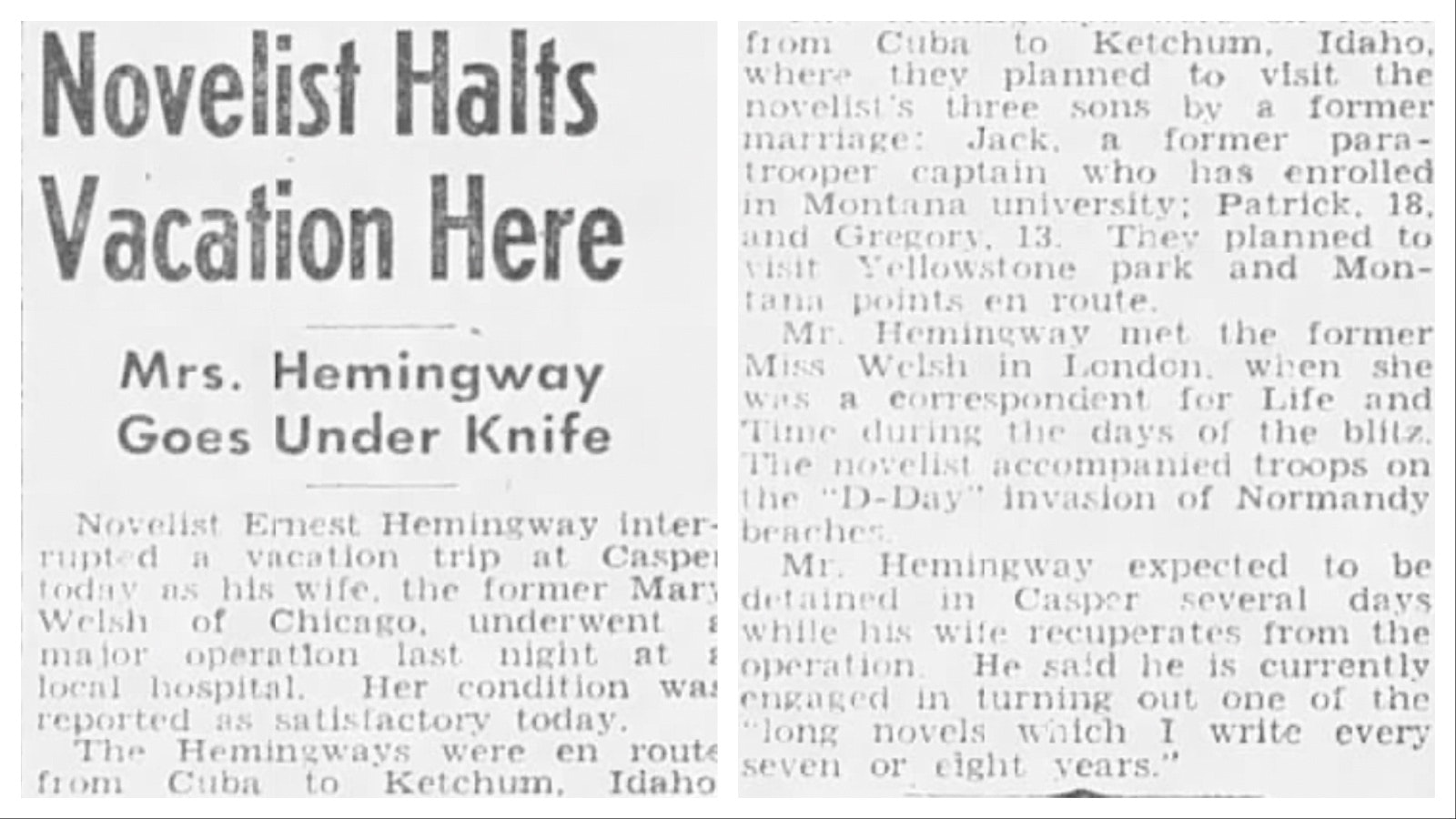
The Casper Tribune-Herald reported on Aug. 20, 1946, about the Hemingway’s emergency stop in Casper for Mary Hemingway to have surgery. (Courtesy Newspapers.com)
Sheridan Inn
He said Hemingway then drove into Sheridan and found the third floor of the Sheridan Inn too hot and the Mint Bar too close as a temptation. But Hemingway did develop a friendship with a French couple who dabbled in making bootleg alcohol products that he purchased. They also inspired his 1930 short story “Wine of Wyoming.”
Leaving the heat, Hemingway moved to the Lower Folly Ranch for 10 days and then to the Spear-O-Wigwam cabins in the Bighorns where Pauline would join him.
Retired Sheridan librarian and author Judy Slack researched and compiled a book of articles, photos, and diary entries on Hemingway’s first visit titled, “Ernest Hemingway: His 1928 Stay in the Bighorn Mountains.”
Slack said her research shows that Hemingway wrote much of “A Farewell to Arms” while at the Lower Folly ranch.
“Valerie Hemingway, his daughter-in-law told me that he would type about 20-to-30 pages a day when he was in the process of writing,” she said. “The only place that was quiet and where he was alone was at the Lower Folly.”
When his wife arrived at Spear-O-Wigwam with him, his typewriter was only heard for short sessions in the morning before he and Pauline went fishing or hunting, she said.
Grimes, though, believes that it was at Spear-O-Wigwam where, Hemingway concluded the book about an American serving in the ambulance corps of the Italian Army and who fell in love with an English nurse. The novel mirrored Hemingway’s experiences in World War I.
“Hemingway stayed in a cabin there and that’s where he finished writing ‘Farewell,’” he said. “He finally got the ending right, and, in that sense, we can say that Wyoming was a powerful inspiration, he found what he needed.”
The author also found the fishing in the Big Horns to be “fantastic,” Grimes said.
In her research, Slack found an order from Hemingway made at the Big Horn Post Office for a fishing rod from a Sheridan hardware store for $2.64 and a 7-cent fee, possibly for shipping.
Bighorn Influence?
Grimes said a letter that Hemingway wrote of his time there stated the Bighorn Mountains reminded him of the Guadarrama Mountains in Spain. The letter revealed something of the importance of Wyoming for Hemingway and his imagination.
As a writer, Hemingway needed experiences and place for creating his story. Grimes believes that the Bighorns likely were the author’s inspiration for him when he sat down to write the novel about the Spanish Civil War.
“I think that 1928 experience in the Bighorns at Spear-O-Wigwam … not only allowed him to finish ‘A Farewell to Arms,’ it gave him the place he needed, the setting he needed to draft ‘For Whom the Bell Tolls,’” he said. “So, I’d say that’s pretty important.”
Grimes said Hemingway returned to the state in 1930 and stayed at the L Bar T Ranch on the border between Wyoming and Montana. He came back to the ranch in 1932, 1936, 1938, and 1939, he said. Part of his experiences in northwest Wyoming and across the border into Montana during those years involved his learning to hunt big game.
Hemingway’s early years in Michigan and later fishing in the ocean off Key West never allowed him the challenges of hunting grizzly bears, elk, bighorn sheep, and mule deer.
“The ranchers at the L Bar T were good teachers,” Grimes said. “They take him out on hunts while he’s there, and through all of this is a lot of backpacking into lakes, a lot of long stays, several days of fishing, tenting.”
The author enjoyed the ranch because he was out of the limelight and did not get treated as a celebrity, Grimes said. As in other places he lived, the regular people were his friends. In Key West he hung out with boat captains and bar owners. In Wyoming, he enjoyed the company of ranch hands.
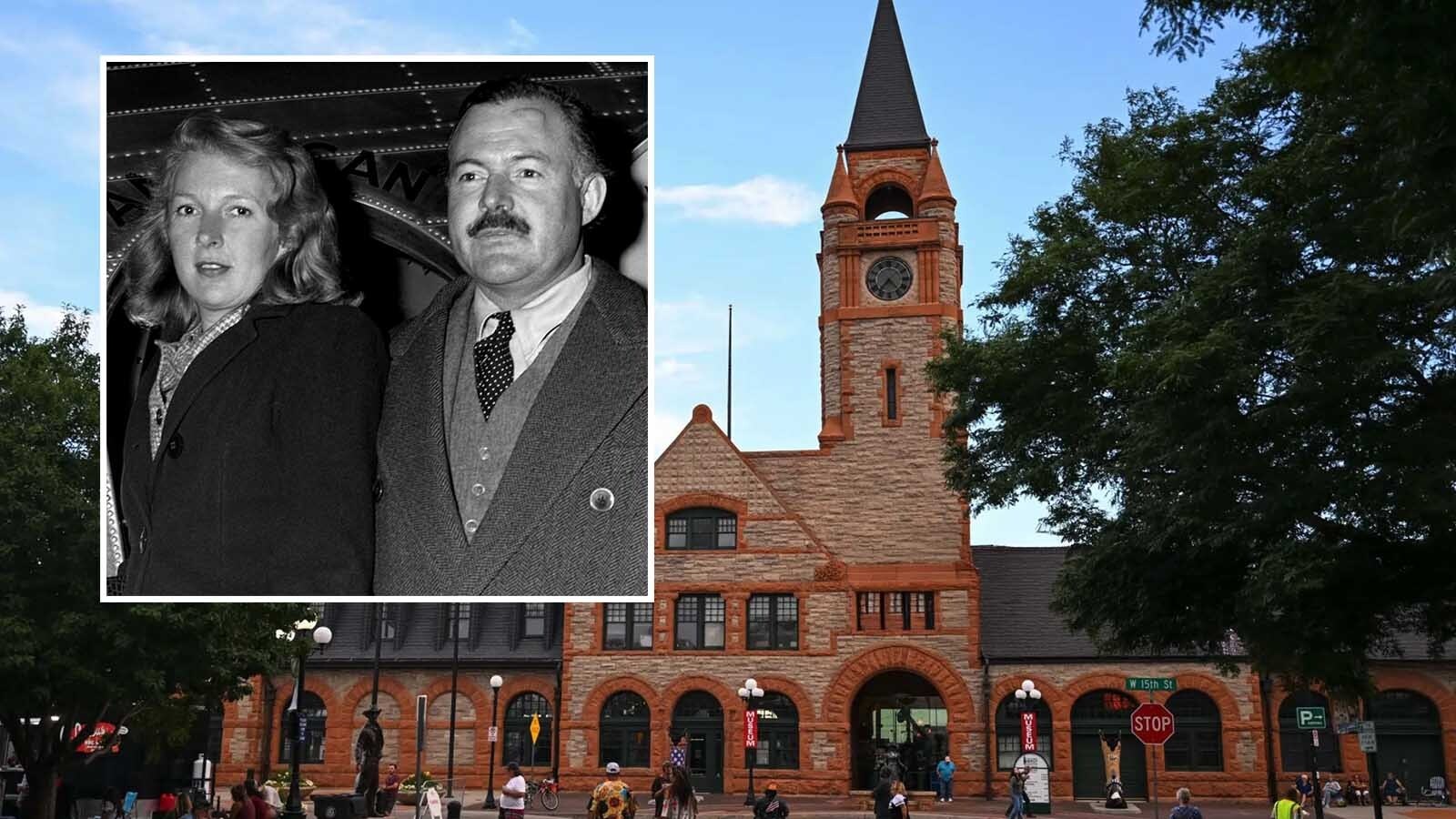
Ernest Hemingway and Martha Gellhorn were married in 1940 at the Cheyenne Depot. (Getty Images) 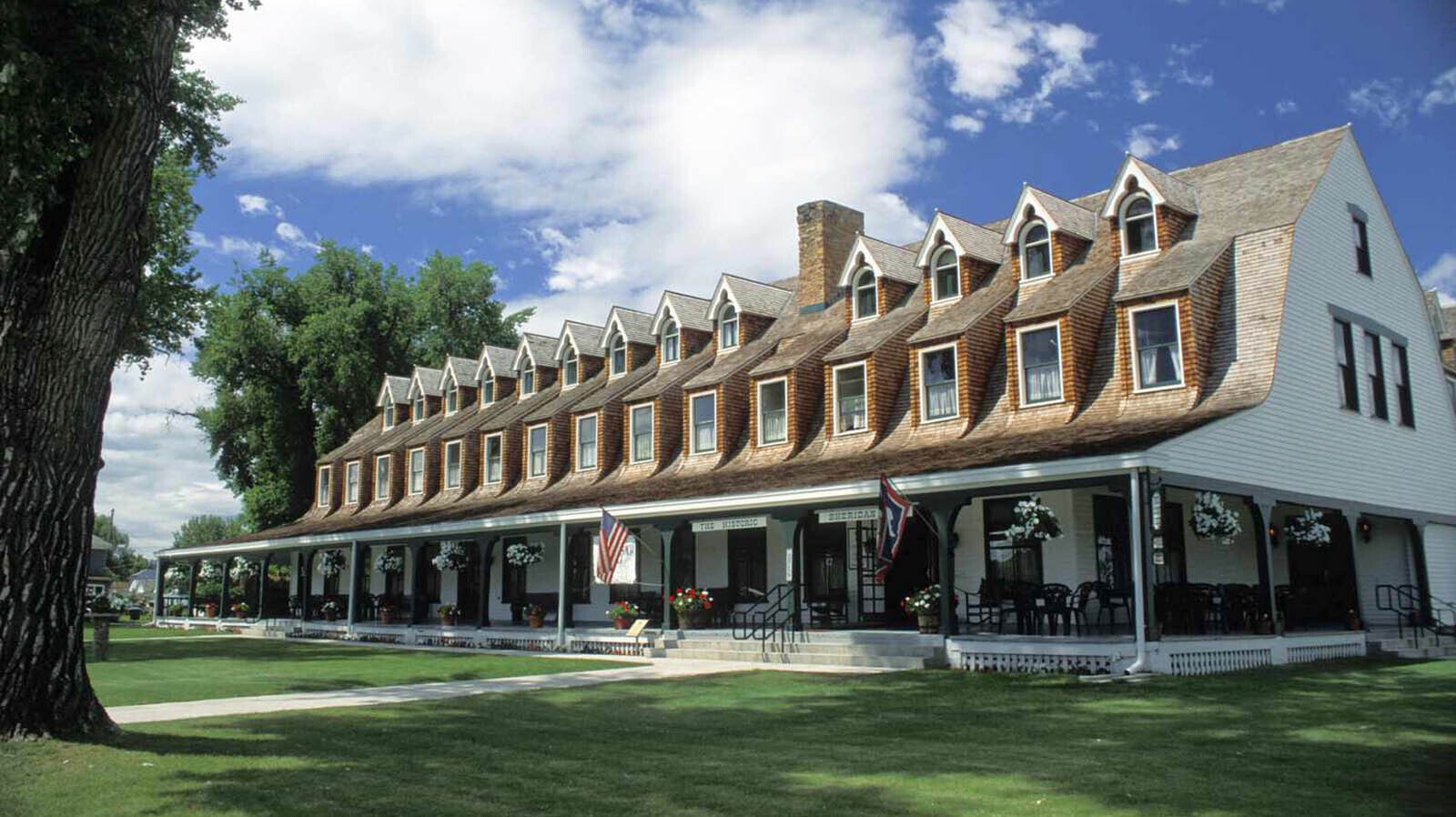
Ernest Hemingway during a short stay in August 1928 found the Sheridan Inn too hot on the third floor. (Getty Images) 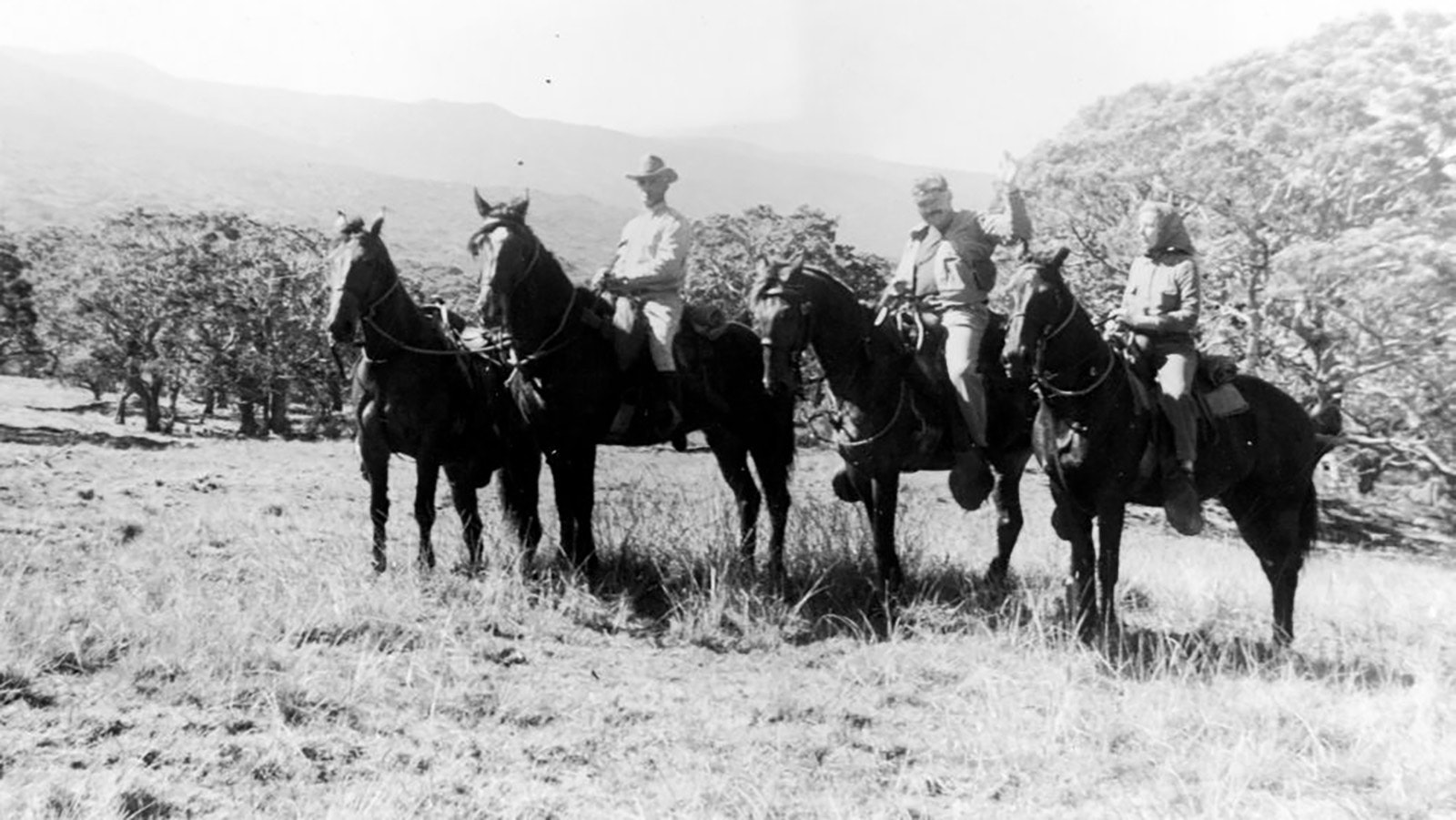
Ernest Hemingway, center, and Martha Gellhorn, right on horseback in Idaho in 1940. (Courtesy John F. Kennedy Presidential Library and Museum) Ernest Hemingway during a short stay in August 1928 found the Sheridan Inn too hot on the third floor. (Getty Images)
Productive Times
His times at the L Bar T also proved productive for his writing. Grimes said at the ranch he finished his book “Death in the Afternoon” and mailed it from the general store in Cooke City.
“He finished ‘To Have and Have Not,’ and worked on ‘For Whom the Bell Tolls,’” said Grimes, at the ranch.
The visits in 1932 and 1936 were also good family time for him, his wife, Pauline, and his boys, Grimes said. His oldest son, “Jack” Hemingway born to him and first wife, Hadley Richardson, became a conservationist and author of books on fly fishing. Patrick, who he had with Pauline, became a wildlife manager and writer. His third son, Gregory, also of his marriage to Pauline, would become a physician, lead a troubled life, and later be known as Gloria.
His last stay at the ranch was in 1939 as his second marriage disintegrated. He had met journalist and novelist Martha Gellhorn in 1936 and traveled with her to report on the Spanish Civil War in 1937.
Grimes said at the end of his family’s 1939 visit to the ranch, he had a friend drive Pauline and his boys back East, while he drove to Billings to meet Gellhorn and they went to Idaho.
An article in the Billings Gazette on Sept. 27, 1939, reported that Hemingway would be “the only resident” of the 200-room Sun Valley lodge during the fall until it was opened for the winter ski season, according to lodge officials.
“Gary Cooper, screen actor and friend of Hemingway, may join him,” the newspaper reported. “They plan to hunt and fish together.”
Third Marriage
In 1940, Wyoming played a supporting role as the place where his five-year marriage to Gellhorn launched. Pauline’s divorce was publicized on Nov. 5, 1940, in Florida’s Key West Citizen and the cause was listed as “desertion.”
A front-page story in the Nov. 22, 1940, Casper Tribune-Herald announced the writer’s third marriage and his new wife’s second. The ceremony took place at the Cheyenne Depot.
“W. E. Mullen, Cheyenne attorney, and friend of Hemingway for several years, made the arrangements for the wedding. He and his daughter, Miss Josephine Mullen, were the witnesses,” the paper reported.
Grimes said the marriage took place during a stopover and dinner at the train station.
Other “stop-over” places for the author during his years traveling to Sheridan or the L Bar T during visits to the state included the Occidental Hotel in Buffalo and the Chamberlain Inn in Cody, he said.
It was also in Cody that the author was brought after an incident while fishing on Crandall Creek north of the city. Actions by a horse named “Goofy” required stitches in Hemingway’s forehead and leg.
“He (Goofy) was spooked by a bear and dragged Hemingway through the brush,” Grimes said. “Hemingway had a huge gash in the leg and a gash on his forehead.”
According to the story, Hemingway said he wanted to buy Goofy. Grimes said someone responded that he was a “horrible horse.”
Grimes said Hemingway’s reply was: “I don’t want to ride him, I want to shoot him.”
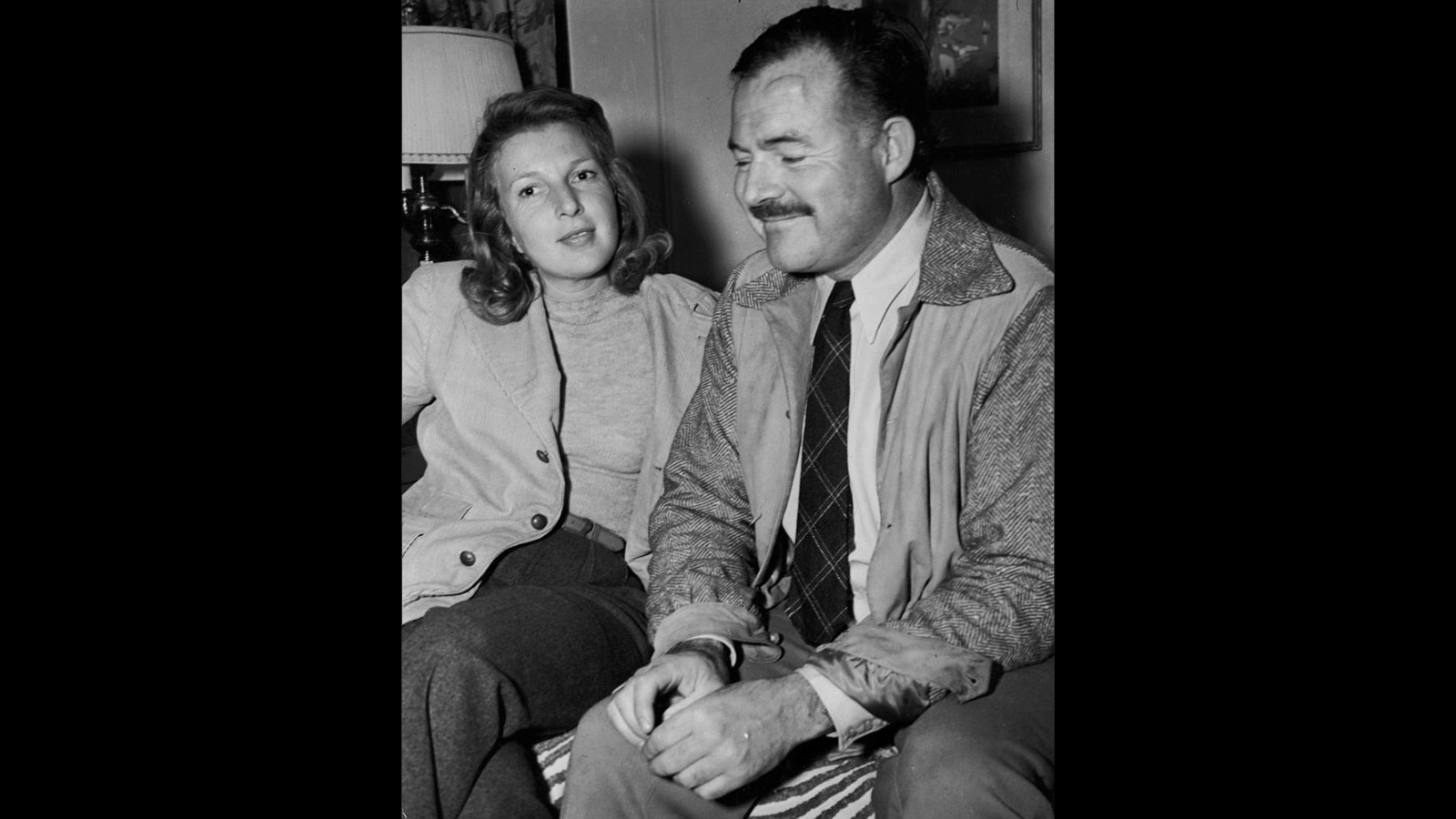
Ernest Hemingway and Martha Gellhorn in Sun Valley, Idaho, in 1940. (Courtesy John F. Kennedy Presidential Library and Museum) 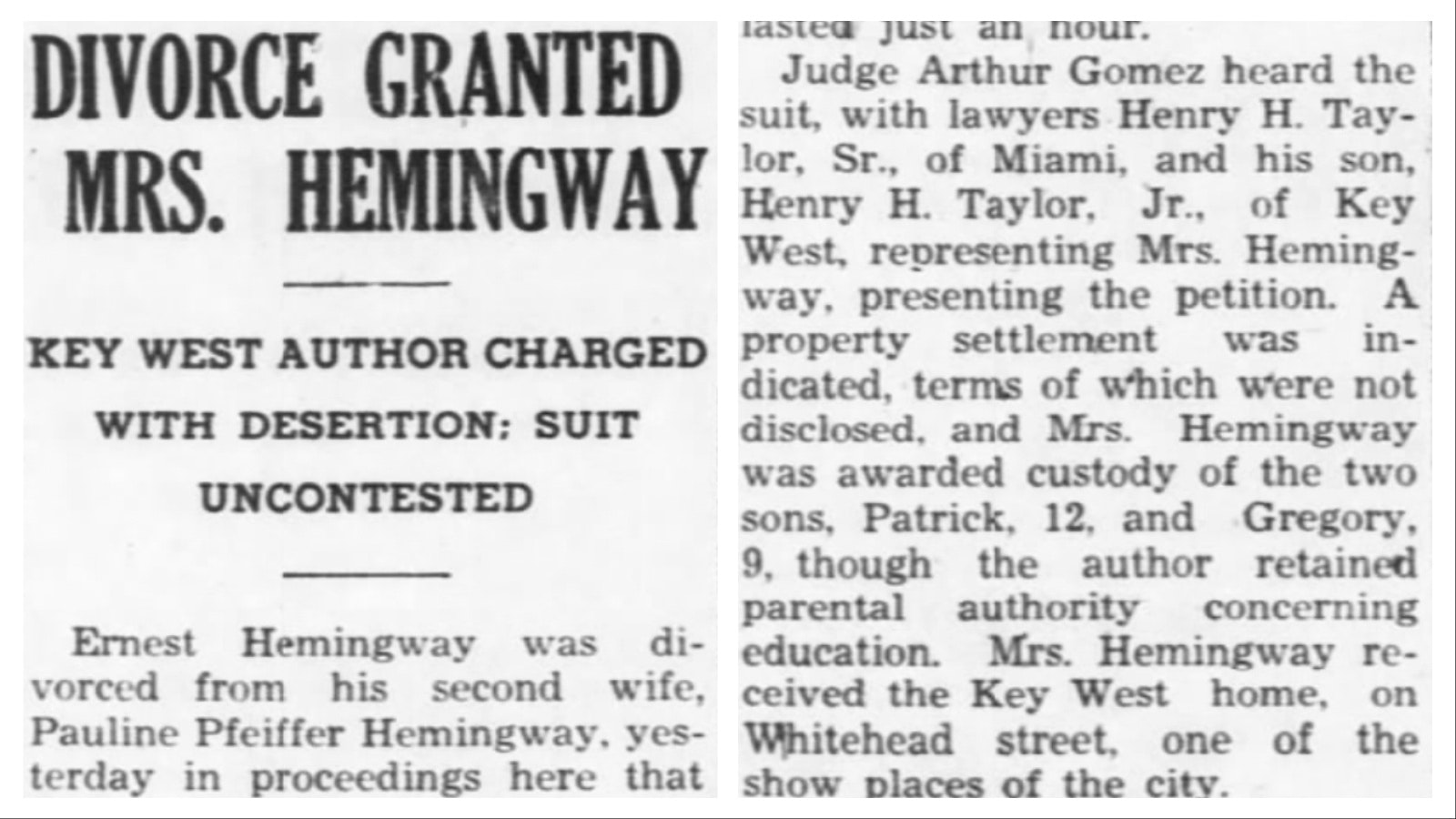
The Key West Citizen on Nov. 5, 1940, reported on Ernest Hemingway’s divorce from this second wife, Pauline. (Courtesy Newspapers.com)
Emergency Visit
In 1946, after Hemingway divorced Gellhorn and married his fourth wife, Mary Welsh, the couple were traveling to Idaho when Mary needed emergency surgery. It occurred in Casper.
“The Hemingways were enroute from Cuba to Ketchum, Idaho,” the Casper Tribune-Herald reported on Aug. 20, 1946. “Mr. Hemingway expected to be detained in Casper several days while his wife recuperates from the operation.”
While Wyoming stopped being a planned destination for the writer after 1939, the relationships he made in the state were not forgotten and its influence ongoing.
A cowboy at the L Bar T was named a godfather to Hemingway’s son, Patrick, and ranch owners Lawrence and Olive Nordquist became lifelong friends.
It was also in Wyoming during his 1928 visit that author Darla Worden, who wrote the book, “Cockeyed Happy,” about Hemingway’s summers in the state with Pauline, reported that Hemingway and Pauline stopped to see “The Virginian” author Owen Wister who was staying at Trapper Creek Lodge near Shell.
Hemingway in a letter cited by Worden called Wister a “sweet old guy.”
Grimes said he believes that “For Whom The Bell Tolls,” published in 1940, despite being a Spanish Civil War novel, was a nod toward Wister and his famous novel inspired by Wyoming.
“In some ways it is an American western and the hero is Robert Jordan,” Grimes said. “And Robert Jordan is from Red Lodge, Montana.”
Hemingway went on to work as a correspondent in World War II. He wrote more books, including “The Old Man and the Sea,” which gained him a Pulitzer Prize in 1953, and he receive a bigger prize in 1954 when he was awarded the Nobel Prize in Literature.
Hemingway, in failing health, famously took his own life with a shotgun blast to his head on July 2, 1961, in Idaho.
The Casper Tribune-Herald honored him with an editorial on July 3, 1961, recalling his stop in the city years earlier as he acted to save his wife.
“Big, brawny Ernie Hemingway, who somehow late in his career become ‘Papa’ Hemingway is remembered by a number of Casper residents for few days stopover here a decade ago when his wife became seriously ill, and was placed in the hospital,” the editor wrote. “Mrs. Hemingway wrote that her husband ‘saved my life in Casper, Wyoming.’”
Dale Killingbeck can be reached at dale@cowboystatedaily.com.


