
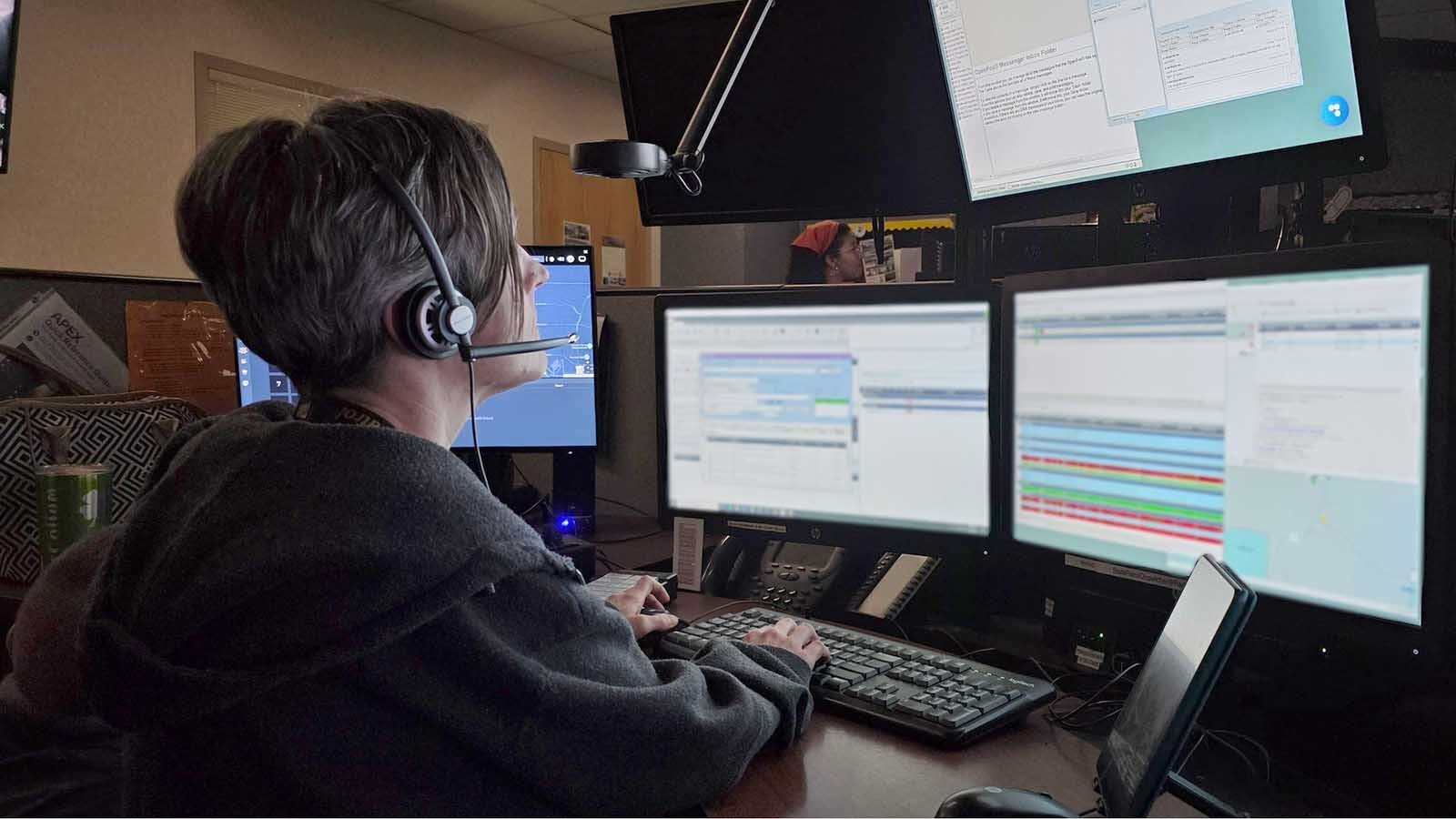
Problems with Wyoming’s 911 system have been brewing for quite some time and didn’t just start to appear when a cable was cut in Cody, leaving the city without adequate 911 services for 75 hours.
Problems have been occurring in other communities as well.
In February 2024, for example, a grandmother in Torrington fell down in her home and was unable to get up.
It may sound just like a commercial, but it was a real incident, and it was a life-threatening situation for the 93-year-old woman who had fallen.
She called 911 several times, and her family members all called 911 several times as well, but no one was able to get a call through. There was simply nothing there.
Eventually, someone was able to connect to emergency help via an office line at the Park County Sheriff’s Office.
But 911, the number people normally call in an emergency, remained a black hole.
Torrington Police Chief Matt Johnson didn’t learn he had a major 911 problem on his hands until the next day when the woman’s grandson called him to talk about it.
“She survived, but in my mind, that’s a pretty big deal,” Johnson said. “Those are the folks we do everything we can to protect.
"Having them unable to reach the lifeline of help when they need it is a pretty scary situation.”
Johnson is well aware that if that woman had been having a heart attack, this story could have had a very different, much more tragic ending.
“The reason we didn’t know about all these instances is we were still receiving intermittent 911 calls,” he said. “Sometimes it would work, sometimes it wouldn’t.
"So, we didn’t know that we had failures in the system, and we hadn’t been notified that there was a service issue.”
Fixes Are Late Coming
Since then, many strides have been made to rectify the immediate problems that were causing the situation in Torrington.
Further investigation of that incident by Torrington and state officials revealed that the town's services had been intermittently down 15 different times for a total of 12,456 minutes, Johnson said.
In total, that’s eight days’ worth of silent outages for a center that Johnson said normally takes an average of seven calls per day.
That suggests as many as 56 calls may have found nowhere to land over that time period.
“Of those 15 incidents, three lasted for more than 48 hours,” Johnson said. “And I want to reiterate, not all of those were total system failures.
"But in every single instance, there were members of our public who weren’t able to reach 911.”
As the causes of these failures came to light, it threw up a red flag for the entire state of Wyoming, Wyoming Department of Transportation Chief Technology Officer and State 911 Coordinator Nate Smolinski told Cowboy State Daily.
It underscored just how out-of-date Wyoming’s 911 system had really become.
Moving to Next Generation 911 was no longer something that would be nice to do someday. It was something that needed to have happened yesterday.
“When we started figuring that out and kind of peeling it back a little bit, that’s when we really said, ‘You know, we’ve got to do something a little bit better here,’” Smolinski said. “That’s what started a lot of our discussion.”
Real-Time Video Of Emergency Could Become Commonplace
A fiber optic cable is just a bundle of very thin strands of what looks like luminous spun glass hair to the naked eye.
But the pulses of light carried by those tiny filaments are packed with an entire universe of data. Data that can travel those glass fibers at up to two-thirds the speed of light.
That kind of speed for such large volumes of data would give new wings to Wyoming’s 911 system and bring about fantastic new capabilities — the stuff of what was once science fiction in a George Jetson cartoon or a Star Trek episode.
Things like pinpointing the exact location of an emergency, down to a specific room in a specific building.
Or receiving a real-time video of what’s happening at the scene of an emergency.
With that kind of eye on the scene, dispatchers could talk those already there through the life-saving steps they need to immediately take while professional help is on the way.
The dispatchers would also be able to watch what the people are doing as they carry out those steps, and offer corrections or encouragement as needed.
A Nationwide Effort
Replacing aging, analog 911 systems with Next Generation 911 systems is something that’s happening on a nationwide basis at Public Safety Answering Points across the country.
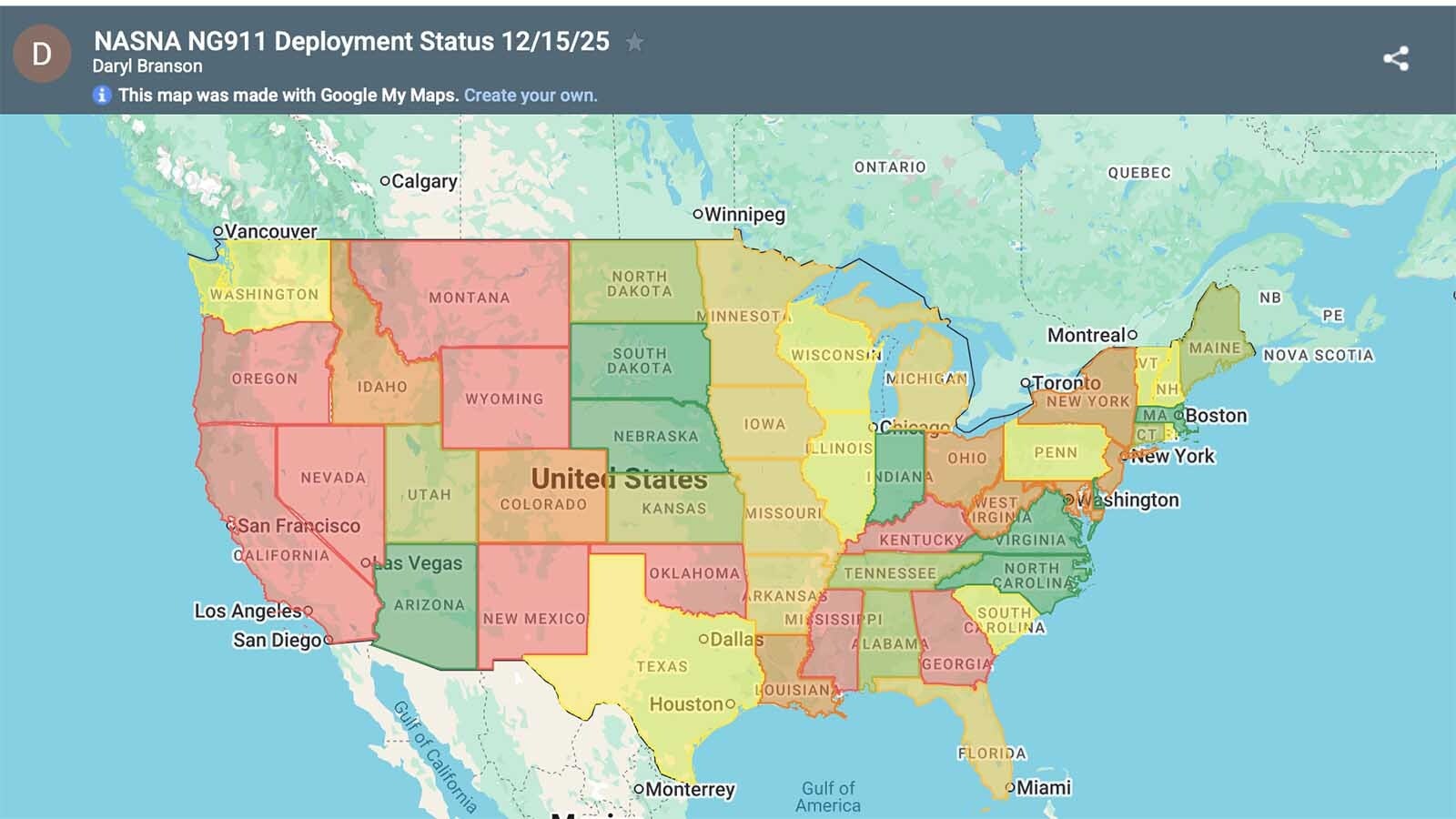
According to a map created by National Association of State 911 Administrators, South Dakota and Nebraska, on Wyoming’s eastern border, have already switched over to Next Generation 911.
Idaho, on Wyoming’s Western border, is planning to switch over by the end of January; and Colorado, to the south, has also begun the process and should soon switch over as well.
Wyoming hasn’t yet begun the process, and costs for its changeover have not yet been determined.
It would likely fall somewhere between $5 million and $15 million for the statewide system, Park County Sheriff’s 911 Manager and Communications Director Monte McClain told Cowboy State Daily.
The actual cost would be the subject of a proposed study that will be considered in the upcoming. legislative session.
Cities, meanwhile, have already upgraded equipment individually to handle Next Generation 911, McClain said.
Without the statewide system in place, however, that’s a little like having a Smart Phone or Smart TV that has no actual service.
Funding Is A Sticking Point
Wyoming’s legacy 911 system was state of the art when it was first installed, but that was in 1969.
A lot has changed since the days of copper wiring, McClain said. He’s been helping to lead the charge on bringing Wyoming’s 911 services into the current century.
The primary benefit, as he sees it, are redundancies that would mean 911 services are never compromised for 75 hours at a stretch, as they were in Park County when someone cut a fiber cable late Monday night.
McClain had to resort to posting a cellphone number to the Park County Sheriff’s Department’s Facebook page so that people could reach someone in case of emergency.
For three hours, that was the only way anyone could report an emergency because even the office phone lines at the Sheriff’s Department were down.
That couldn’t happen with Next Generation 911 because it’s a self-healing system, much like the Internet, McClain said.
“If one path or one cable is cut, the internet can self-heal and reroute traffic through different cables to get to your destination,” he said. “There are outages that happen all the time, and yet your Internet stays up, so that would be one of the big benefits.”
Next Generation 911 also has the capability to cost-effectively incorporate texts to 911, something Cody doesn’t have right now because that’s too expensive.
“We’re operating with pay phone and dial-up technology and have been for years,” McClain said. “And we’ve been trying for years to get that improved and we just have yet to get it done and it’s because of funding.”
911 System Is $3 Million In The Red
Wyoming’s antiquated 911 system is costing more and more to operate.
At this point, it’s $3 million in the red annually across the state, Smolinski said.
Part of the problem is an outdated fee structure set up in 1986, which set charges of 75 cents per device. That may have been adequate for 1986, but the world has changed a lot since then.
“Technology costs, device costs, that doesn’t go down,” Smolinski said. “That continues to rise, and the fee has stayed very stagnant over the years. The fee has not increased over the years to make up the gap.”
In Goshen County, for example, which has a population around 13,000, the cost of maintaining a 24-7 center for 911 calls was $670,000 in 2024.
Revenue, meanwhile, was $123,000, Johnson said — nowhere near the service’s cost.
“We’re spending, what that comes out to is probably $4.50 for every dollar in revenue we get,” he said. “That’s a significant burden for a small group of taxpayers to bear.”
The difference is typically made up for from the general funds of local governments. Those are funded by property tax revenues, which took a significant hit last year.
Per Mile Charges From Cheyenne Are Adding Up
One of the things that makes the old system expensive is that charges are figured on a per-mile basis from Cheyenne for each 911 call.
That’s where the nerve center is that sorts 911 calls and sends them to their respective communities along antiquated copper lines.
“Lumen (Technologies) charges me mileage from Cheyenne to Cody,” McClain said. “So, I pay almost $80,000 a year to have eight phone lines.”
With a Next Generation 911 system, those per mile charges for copper lines would be a thing of the past.
The fee structure would be different, though not necessarily less expensive, when considering upfront costs for migrating to a fiber optic system.
Long-term, McClain believes Next Generation 911 is going to be less expensive to maintain.
Figuring out how best to migrate to Next Generation 911 and how best to fund it is the subject of a draft bill that’s been teed up for the next legislative session.
“The main priority on this one is to go ahead and seek funding for a third-party consultant to examine the current state of where we are with 911 in Wyoming, and then start to develop a roadmap of what it would look like to migrate to Next Generation 911,” Smolinski said.
“And part of what that study would entail is, we’re looking for some guidance, because there are a lot of different models out there,” he added.
The study would also take a deep dive into better efficiencies to figure out what resources individual PSAPs might share.
“We want to take a very good look at what that looks like, to make sure we’re not overbuilding a system,” Smolinski said. “And then probably the really large one is the cost.
"What’s this going to cost, and what kind of funding options are available, what kind of models are out there.”
That will allow a discussion about next generation that fit Wyoming, Smolinski said.
“The idea is we’d like to have a roadmap in our hand with multiple solutions,” he said. “Multiple options that can be discussed and find the best possible fit for Wyoming.”
Renée Jean can be reached at renee@cowboystatedaily.com.


