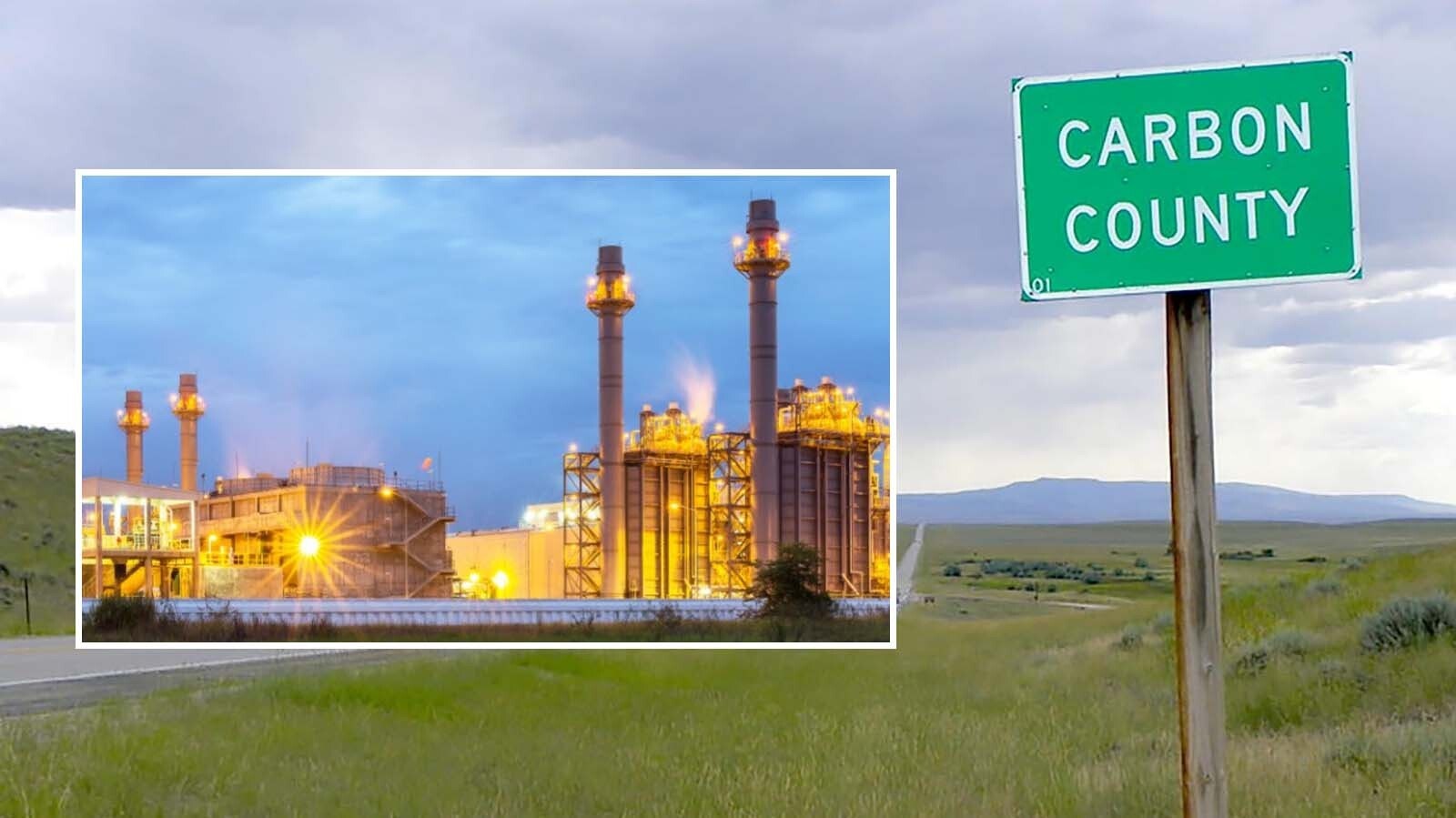
A proposed large natural gas plant south of Rawlins and Sinclair will use a combination of air and water for cooling, reducing the water consumption by up to 95%, company officials said this week.
Yet water usage remains a concern for the Carbon County Board of Commissioners.
Also of concern — the project’s name.
Representatives from The Power Company of Wyoming provided a preliminary overview of their proposed Seminoe Generating Station to the commissioners on Tuesday.
Right away, CEO Roxane Perruso clarified the project is not related to the Seminoe Hydro Pump Storage project proposed by Utah company rHydro.
“Is it possible to change your [project] name?” Commission Vice Chairman Sue Jones asked. “People are confused.”
Two Different Seminoe Projects
The Seminoe Generating Station natural gas project will be a simple- and combined-cycle natural gas generation station located on less than 70 privately owned acres and is expected to generate power capacity of 2,000 megawatts, or 2 gigawatts.
The proposed Seminoe Hydro Pump Storage project would depend on Seminoe Reservoir in part to capture and store energy to improve the efficiency of renewable energy.
Touted as one of the most widely used and reliable forms of large-scale renewable energy storage, pumped hydro relies on gravity and water rather than chemicals.
The Seminoe Generating Station project began development in 2017. It was put aside, Perruso said, because the market wasn’t ready.
Now, she told the commissioners, the market is ready.
“Now with recent surge in power demand and the fact that our generation and transmission projects are well advanced, we think that it is the right time now to move this project forward,” Perruso said at Tuesday’s commission meeting.
The natural gas project would be largely carried out by the same team that is developing the Transwest Express Transmission Project and the Chokecherry and Sierra Madre Wind Energy Project.
The Transwest Express Transmission Project is a 732-mile high-voltage transmission line intended to connect Wyoming’s renewable wind energy to demand centers in California, Arizona, and Nevada.
The Chokecherry and Sierra Madre Wind Energy Project will feed the transmission line and will include 600 wind turbines when completed.
“The idea is that they have a sustainable source of power in the field to supplement what the wind does,” Carbon County Commission Chairman Travis Moore told Cowboy State Daily.
The Seminoe Generating Station will be located on the Overland Trail Ranch on what Ryan Jacobson, Power Company of Wyoming’s executive vice president of Engineering and Construction, called “a relatively compact development site.”
Kelly Cummins, the company’s executive vice president of land, environment and operations, said the project will create a low-cost and reliable energy supply by combining natural gas and wind power.
“Combining wind power and natural gas is a unique opportunity for a lower cost supply with lower emissions,” she said.
Technical Design Manager Amy Groseclose said a form of emissions control called selective catalytic reduction (SCR) would decrease nitrous oxide emissions by about 90%.
She also said the project will use a dry cooling technology, relying on air rather than water as the heat transfer cooling mechanism. The technology is expected to decrease the facility’s water consumption by up to 95%.
That was enticing to commissioners.
“We were just kind of awestruck when they were talking about water usage for cooling,” Moore told Cowboy State Daily.
Water Rights Concerns
But Commissioner John Johnson still pressed the company on its necessary water usage for the project.
“Where is the water going to come from?” Johnson asked.
Cummins responded that water would come from the Platte River and that Wyoming Power Company intended to change the Overland Ranch’s water rights. There would also be potential to use excess potable water, if communities were open to it.
The project would require 320 acre-feet of total consumption annually.
“That’s a lot of territorial water rights,” said Johnson. “Water rights are near and dear to my heart.”
But Johnson was appreciative of the company’s efforts to reduce water dependency.
“I applaud you for using the dry cooling system to save 90% of the water,” he said.
Kara Choquette, the company’s vice president of Government and Public Relations, touted the economic benefits of the proposed natural gas project, saying it will result in an anticipated peak of 350 construction jobs and 30 operations jobs.
These would be in addition to jobs already being carried out for the Transwest and Chokecherry projects, she said.
According to Perruso, the natural gas plant is scheduled to come online with the Transwest Express Transmission line in 2029 or 2030. Wind turbines that are part of the Chokecherry and Sierra Madre Wind Energy Project will start to go up in one or two years.
Kate Meadows can be reached at kate@cowboystatedaily.com.