
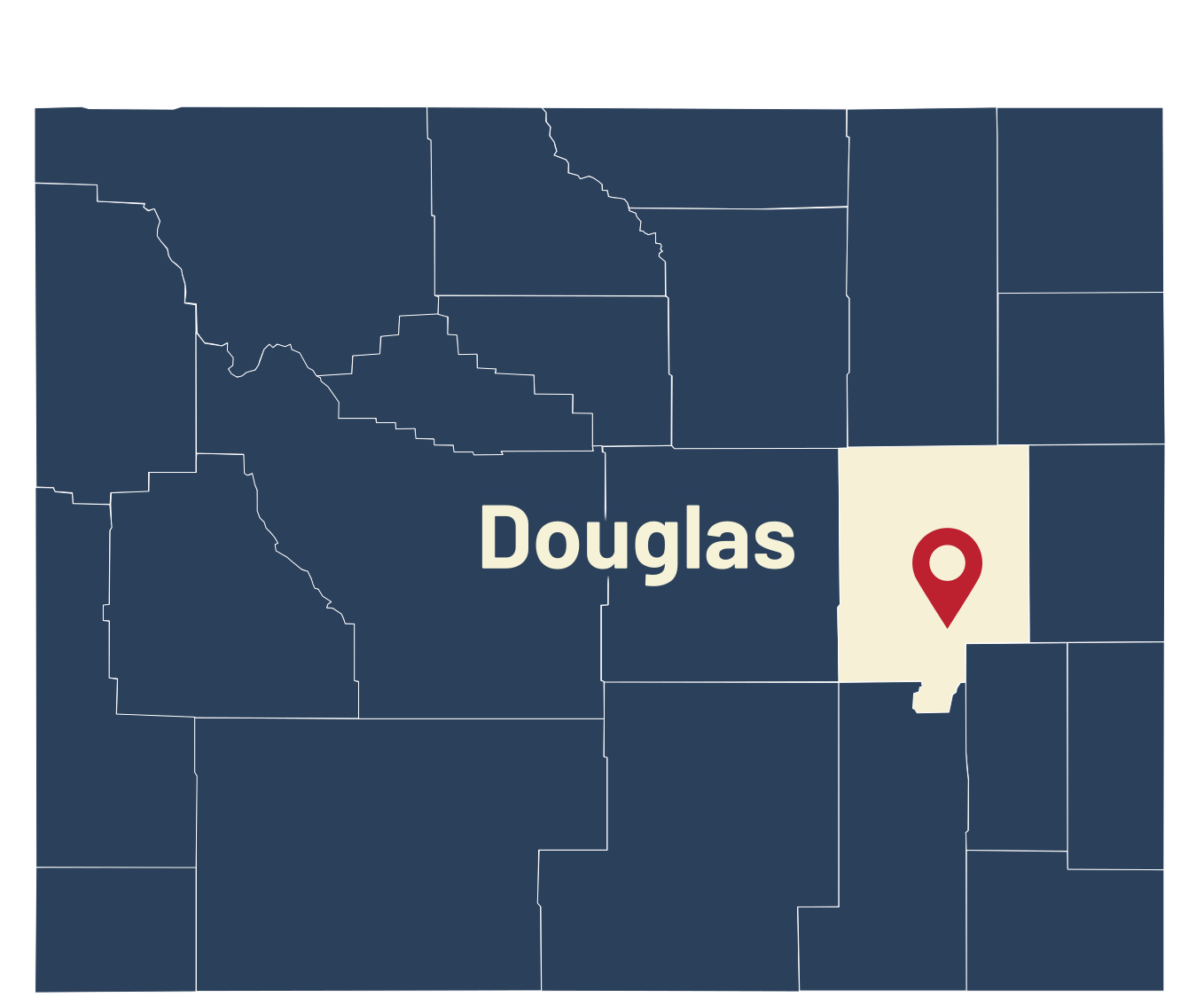
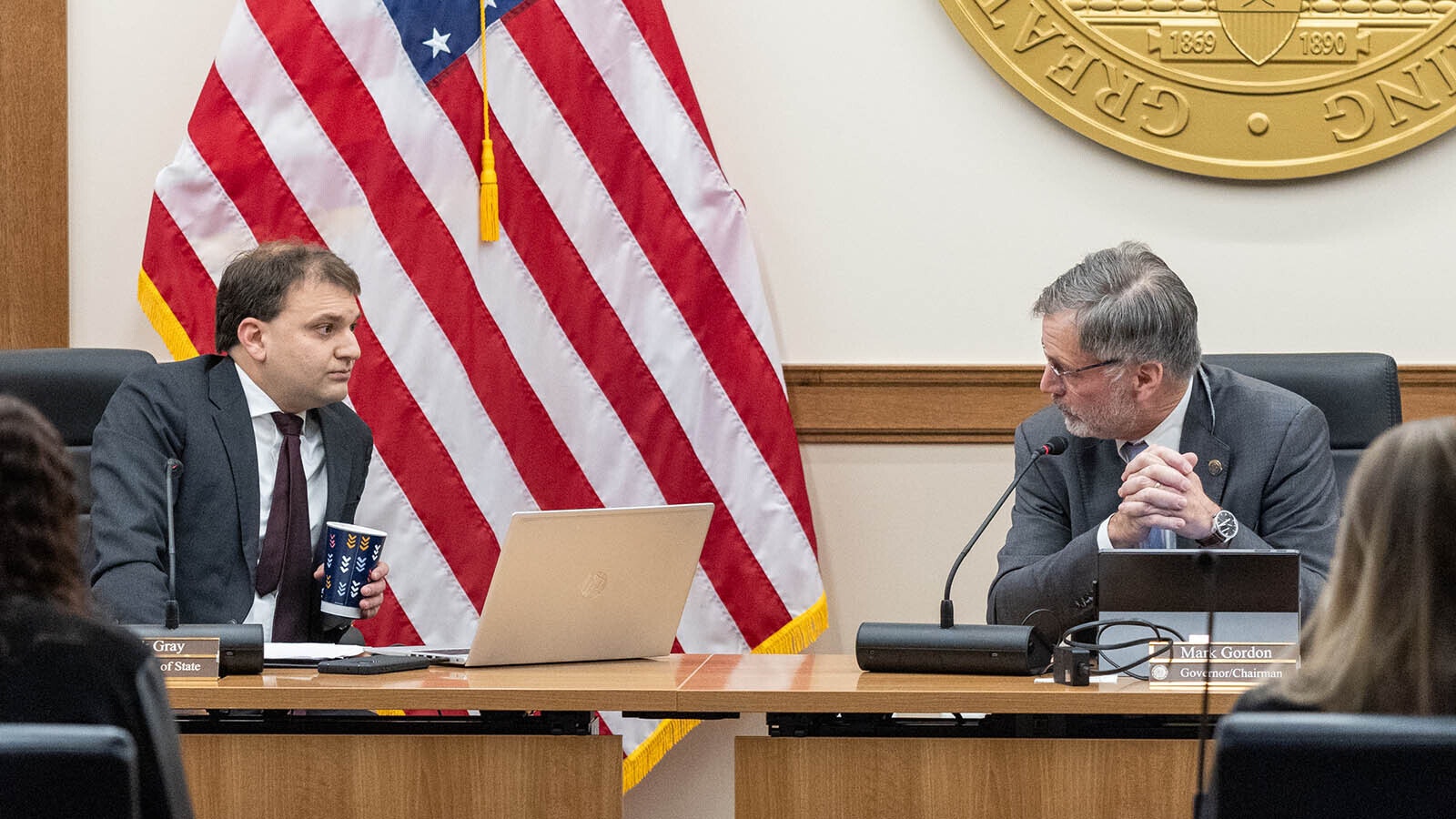
The feud between Gov. Mark Gordon and Secretary of State Chuck Gray boiled over Thursday when Gordon asked Gray, “Do you want to step outside” near the end of a marathon Wyoming Board of Land Commissioners meeting in Douglas.
That capped a more than five-and-a-half-hour special meeting about the state’s handling of a controversial wind energy lease.
The moment came after hours of testimony from ranchers, residents and elected officials opposed to the Pronghorn H2 wind project, as Gray pressed Gordon to ensure the state attorney general would not "undercut the will of the board" before its next regular meeting.
Gordon spoke up in defense of Attorney General Keith Kautz, igniting a terse back-and-forth between them.
Gordon admonished Gray to not “cast aspersions” on Kautz.
To which Gray replied, “Mr. Chairman … I take deep umbrage at you saying I cast aspersions."
“I take deep umbrage at you,” Gordon says as they start talking over each other.
"Step outside, you want to step outside?” Gordon said, raising his voice a little and looking at Gray, who was seated to his right.
"Are you threatening me?" Gray asked.
"No, I'm asking if you want to step outside," Gordon replied.
"Are you threatening me?" Gray repeated.
Superintendent of Public Instruction Megan Degenfelder tried to interject, but Gray admonished her to “please stop interrupting."
About The Meeting
The exchange capped an otherwise pleasant meeting that drew dozens of opponents to the Douglas Library, where residents delivered pointed testimony against the proposed wind project on both private and state trust lands in the shadow of the northern Laramie Range.
Gray had attempted to bring a motion to rescind the wind leases, but the motion was ruled out of order because the special meeting had only been noticed for public comment, not action.
Putting the governor’s “step outside" question to Gray in context, Gordon spokesperson Amy Edmonds told Cowboy State Daily after the meeting that, “It’s clear the secretary was making sweeping statements that many were struggling to understand.
"One thing was clear — the motion made by the secretary of state was out of order and could have thrown the entire work of the board on behalf of the people in jeopardy.”
Edmonds then clarified that Gordon didn’t want to physically fight Gray.
“The governor wished only to step outside and have a conversation with the secretary to try and understand his points,” Edmonds said.
For his part, Gray told Cowboy State Daily after the meeting that, “Rather than discuss the issues, the governor keeps resorting to gaslighting and threatening others.”
Gray also said, “I’m planning on bringing that motion again to end the wind lease at the next meeting of the State Board of Land Commissioners.”
Locals Speak
Turns out, the governor wasn’t the only one to evoke the spirit of the outdoors.
Kelsey Stephens stood before the land commissioners and painted an idyllic picture of her life on Deer Creek Road outside Glenrock.
"It's a beautiful summer evening. The crickets and frogs are singing their evening tune. The air smells of freshly cut grass. A long hot summer's day is finally behind you, and you're sitting on your front porch watching the sun sink low on the horizon. The gleaming red hills glow in the fading light. Honestly, it's a view that'll take your breath away," Stevens told the board.
"I'm incredibly blessed to call this view my home. And this is where they want to place a wind farm and no, we won't just get used to it,” she added in her emotionally charged testimony at the Converse County Library before a capacity crowd.
Stephens is the daughter-in-law of Mike Stephens, the Converse County rancher whose lawsuit resulted in Converse County District Court Judge Scott Peasley's Dec. 5 ruling that vacated the Pronghorn H2 wind lease on state trust lands.
Kautz has since appealed that ruling to the Wyoming Supreme Court.
Stephens told the board she and her husband built their home 13 years ago "with our own two hands alongside our family and friends.”
"We built our dream home there intentionally because of the land, the view and the life that it allows us to live," she said. "Thirteen years ago, if someone had told me that when I stepped on my front porch I'd be looking at wind towers on the face of the mountain, I would have laughed."
Stephens, who runs a photography business using the family ranch as a backdrop, said she has "lost trust" in the process.
"It feels as though had the people of Converse County not stood up and questioned this project, it would have moved forward without meaningful local scrutiny," she said. "The fact that legal review revealed concerns about compliance with our own governing laws has created uncertainty for many of us who are expected to trust this process."
Glenrock Speaks
The special meeting at the Douglas Library drew dozens of residents opposed to the Pronghorn project, which would place up to 267 wind turbines across the landscape outside Glenrock, including 15,500 acres of state trust lands in the northern Laramie Range.
Joe Benedetta, a Converse County resident who lives in the proposed project footprint, told the board that a petition against the project has gathered about 2,500 signatures.
"Virtually all those signatures are out of Wyoming — 98% of them; 75% of those are out of Converse County," Benedetta said.
He said when comparing petition signatures to voters in precincts near Glenrock, "We've got about an 87% ratio signatures versus voters. My point in that is the community is interested. The community wants their voices heard."
Benedetta criticized the lack of meaningful public engagement before the board approved the lease in April.
"We learned about this project back in March when Pronghorn came to our county commissioners to make their proposal," he said. "We were told there'd be no public comment. Three weeks later, literally three weeks later, we were in front of you folks down in Cheyenne. We had little time to react to it."
"We felt like at that point it's a done deal. We didn't have any say. Y'all voted for the wind leases and we're all looking around like, what happened?"
'Wyoming Wind Wall'
Wendy Volk, a 30-year real estate professional connected to the six-generation Dereemer Ranch in Horse Creek, testified electronically about what she called a "Wyoming wind wall."
"Wyoming is undergoing one of the most dramatic land use changes in its history, from Cheyenne up to Douglas and Glenrock, and from Cheyenne to Rawlins, there's more than 200 miles of proposed wind turbines, tall roads, substations, transmission lines and associated infrastructure that are forming across ranch lands and wildlife habitat," Volk said.
"I've seen maps showing that there could be potentially 4,000 wind turbines in Wyoming, and that will destroy what we have so sacred here in Wyoming," she said.
Volk urged the board to conduct corridor-scale reviews rather than evaluating projects individually.
"Once agricultural land is converted to industrial use, it is effectively lost forever. I know this as a 30-year real estate professional. Once you change it, we're not getting it back," she said.
'I Apologize'
During testimony, State Auditor Kristi Racines essentially asked for a do-over when it comes to how the the Land Board has handled the Pronghorn and Sidewinder projects spearheaded by Focus Clean Energy.
"One of the complaints I've heard about this decision is that we aren't willing to admit we made a mistake," she said. "And so, me personally, I am here today to tell you that I apologize. I apologize for the mess that this has become. I apologize for the meeting last month."
She acknowledged she was "learning in public, and it stinks, but I'm willing to do it, so I am here to listen. I'm here for you to yell at me and tell me what I got wrong."
State Treasurer Curt Meier also explained the board's constitutional constraints.
"As the Land Board is a constitutional office and we're bound to represent the school children and the institutions of the state of Wyoming," he said. "My oath says that I protect, support, defend and obey the Constitution of Wyoming and the Constitution of the United States."
A Dangerous Precedent
State Rep. Kevin Campbell, R-Glenrock, told the board he first came to them as a freshman lawmaker to oppose wind development.
"I know that I came back in January as a freshman lawmaker in the Capitol. I came down and talked to all of you guys individually about a wind project that I hated," Campbell said.
"I come before you today, Mr. Chairman, to address the dangerous precedent being set under the guise of fiduciary duty," he said. "The Pronghorn H2 project is being sold as a win for our schools. That's what our fiduciary responsibility is. But as a lawmaker and a steward of the state, I question this."
Campbell argued the project violates state law.
"Wyoming law defines wind leasing as a power for the grid. Pronghorn H2 is a private, off-grid industrial plant," he said.
The representative warned the board about what he called "asset degradation."
"We're talking about industrializing a pristine segment of our nation's history. Once abused, it's gone forever," Campbell said.
He also raised concerns about opportunity costs.
"By locking up 15,000 acres for half a century, you are physically blocking access to critical minerals that could generate generational wealth for our students — wealth that could dwarf these wind leases by billions," Campbell said.
'Rare and Exceedingly Uncommon'
Gordon responded to Campbell by recalling his efforts to revive a dormant provision of state law.
"Back in the 1970s when we passed the Environmental Quality Act, there was a provision in it that was called 'rare and exceedingly uncommon.' It allowed for a nomination to be done that could set aside portions of state land," Gordon said.
Gordon explained that the Legislature later restricted the provision so that such lands "can only be taken off the list" rather than added.
"I have been trying for at least four years to repurpose that provision so that citizens like these could say, 'This is a very special part of Wyoming. This needs to be protected,' which would then give this board more of an opportunity to say, 'Here's the reason why we shouldn't be talking about fiduciary,'" Gordon said.
The governor then asked Campbell directly for his support.
"Is there a chance that you could help support that? If we can get that in this session?" Gordon asked.
"I would be more than willing to work with you on that, governor," Campbell replied.
"Fantastic. Thank you," Gordon said.
'Not Nothing'
Not all testimony opposed the project outright. Marguerite Herman of Cheyenne challenged the board to explain how it would fulfill its constitutional duty to fund schools if it rejects wind leases.
"You've got to figure out about the trust duty," Herman told the board. "I mean, you still have to pay teachers and keep the lights on."
Herman argued that opponents were conflating the board's leasing decisions with regulatory oversight that comes later in the process.
"People are bringing hydrology issues to you because they ... want you to make those decisions," she said. "They're bringing dust, noise, traffic to you, and you don't have a hydrology department.
"So you're trusting the regulators of our executive branch to listen to the concerns, weigh them and make a decision."
She posed a direct challenge: "If not wind farms, then what? I just put that out to you. ... You got to do something to fulfill your duty."
Secretary Gray pushed back.
"This is the analysis that we've seen from at times members of this board, which is that money comes in, thumbs up," he said. "That means that's consistent with the fiduciary duty. That's basically the only form of analysis: money in, thumbs up.
"And there are so many problems with analyzing the fiduciary duty in that way."
Gray raised concerns about foreign ownership and financial accountability.
“We have no idea whether they could assign the rights of the lease to a subsidiary that goes broke, that has no assets, and we have no ability to claw back and get funding for bonding,” he said.
Herman acknowledged the limits of a revenue-only analysis.
"Revenue is not the only thing, but it's not nothing either," she replied. "You can't just lay waste to land and sort of extract every penny from it."
She suggested the board explore alternatives such as conservation leases and monetizing recreation, which she called "a non-consumptive use of land."
What's Next?
The Pronghorn wind lease remains vacated following Judge Peasley's December ruling. Attorney General Kautz has appealed the decision to the Wyoming Supreme Court.
Gordon, who voted with the board majority to approve the lease in April, has supported the appeal, arguing the ruling's interpretation of state law has implications beyond wind energy.
Gray, the lone board member to originally vote against the lease, has called for reversal of what he terms "the woke wind lease."
Now Gray appears to be joined in his opposition by the rest of the land commissioners. Auditor Racines told the room in Douglas, “I did get this one wrong.”
Focus Clean Energy, the Colorado-based developer behind the project, has said it remains "committed to advancing this project lawfully and responsibly."
The state land portion represents about 30% of the total Pronghorn project footprint.
David Madison can be reached at david@cowboystatedaily.com.


